Best Storage Compartments in Modern Golf Stand Bags

The best storage compartments in modern golf stand bags combine a dedicated putter well, full-length top dividers, six to nine well-sorted pockets that you can reach while walking, a soft-lined valuables pocket with a secure closure, a rangefinder slot, an optional removable cooler, and water-repellent materials that protect the contents. Compartment design is what turns a bag from a carrier into a genuinely useful walking tool, because a stand bag is not strapped to a cart — its storage is on your shoulder, accessed between shots and while standing. Get the pockets, dividers and closures right and a round flows; get them wrong and every short game is a hunt for a lost sleeve of balls. This guide, written from the production floor of QUANZHOU JUNYUAN BAGS (founded 2014, serving 200+ brands across 100+ countries), explains exactly which compartments matter, how they are engineered, and how to specify them for your own brand or first bag.
Why Compartment Design Defines a Stand Bag
A stand bag is carried, which changes everything about storage. On a cart bag, organization is constrained by how the bag sits on the cart rails; on a stand bag, the pocket layout must work while the bag is on your shoulder, being set down and picked up as you walk shot by shot. That means access speed matters more than pocket count. The best compartment layouts put the stuff you reach for constantly — tees, balls, rangefinder, phone — at the sides and top of the bag, where your hand naturally lands, and reserve the lower and rear zones for quieter gear such as clothing, rainwear and a spare layer. Getting this zone logic right is what separates a bag you barely notice from one you resent carrying by the back nine.
There is also a weight and balance story. Every pocket you add is fabric, zipper, and structure, all of which add grams. Because a stand bag must stay reasonably light to be carried, compartment design is a constant trade-off between storage and weight. Engineers solve this by sizing each pocket to a real use case rather than adding storage for its own sake, and by placing heavier pocket contents closer to the body's center of gravity so the loaded bag does not torque on one shoulder. A bag whose compartments are wrongly distributed feels heavier than its spec sheet suggests, because the load fights your posture at every step. For a deep look at how bag type and purpose shape the overall design, our golf bag types guide positions stand bags against cart, staff and sunday bags, and our weight and balance analysis explains how compartment placement moves the loaded center of gravity.
The Top: Dividers, Putter Well and Grip Protection
The opening, or top, is the most-used compartment of all — it holds the clubs. The single most valuable modern feature is full-length dividers, which run the entire depth of the bag so shafts stay separated and grips do not tangle when you lift the bag on and off your shoulder. Without full-length separation, a conventional 4-way or 14-way top protects only the very top inch; the shafts can still rub and clatter below. Full-length dividers prevent exactly that, protecting both your grips and your clubs' finishes from the endless micro-bumping that a walking round produces.
The best layouts give woods, irons and wedges their own homes, and reserve a dedicated putter well for the most-used club. Putter wells protect the putter from the shuffle of other grips and let you grab it quickly on the green without digging. For walkers carrying a full set, a 5-way full-length layout is the sweet spot: woods, long irons, mid irons, wedges and a putter slot, each with a full-depth channel. A 14-way top is heavier and overkill unless you carry a completely filled tournament set; for most amateurs it adds weight without a corresponding benefit. The number of ways should match the size of the set and the frequency of club swaps, not fashion. Our divider systems guide compares the top layouts in detail, and the organization guide shows how an orderly divider order turns a round into a routine instead of a hunt for the right shaft.
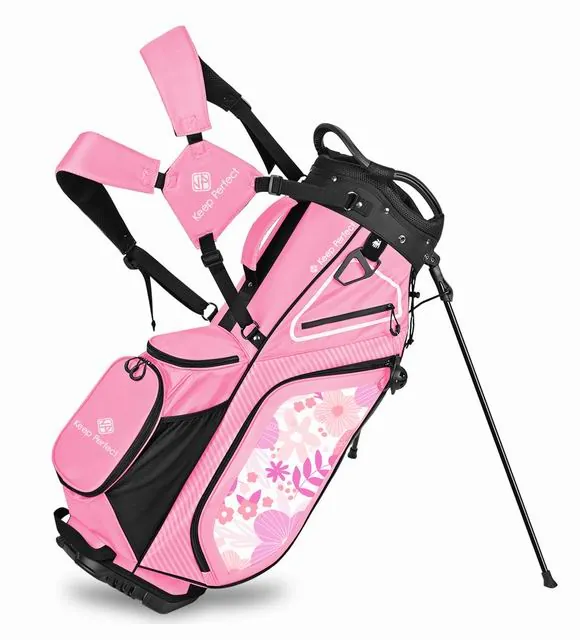
The Perfect Pocket Line-Up for Walkers
Below the top, compartment quality is decided by the pocket set. A realistic, walker-friendly line-up for a modern stand bag looks like this:
- Ball and tee pocket — usually two, kept shallow and at the side so a sleeve is easy to grab while standing.
- Valuables pocket — a soft-lined, fleece or PU-lined pocket near the base with a secure closure (zip or magnetic) for phone, keys and wallet.
- Rangefinder pocket — often at the top front or side, sized to a rangefinder and reachable while walking.
- Apparel pocket — a larger pocket for a rain jacket or a layer, positioned so its bulk does not unbalance the bag.
- Cooler / bottle pocket — an insulated section or a removable cooler for drinks.
- Ornament pocket — a small point for tees, glove or markers.
- Pen / scorecard slot — a handy narrow pocket on the top or side for a scorecard and pencil.
Six to nine pockets cover this range comfortably. The check is not how many there are, but whether each is reachable, sized to what you actually carry, and does not drag the empty weight up. We size pockets to real gear dimensions and test access with the bag being carried, because a pocket that only opens easily on a bench fails its only test on the course. For the full picture of pocket types and layouts across bag categories, our premium pocket feature guide and pocket organization guide complement this read.
Valuables, Magnetic Closures and Quick Access
The valuables pocket is the compartment players judge immediately. A good valuables pocket is soft-lined so a phone screen does not scratch, positioned near the base so the bag does not need to be set down to reach it, and fitted with a closure that closes itself — a magnetic or a dimension-taped opening that keeps valuables in even if you forget to zip it. Magnetic closures have become standard on quality stand bags precisely because they combine one-handed speed with security. A fleece or PU lining inside this pocket also guards a watch strap or wedding ring from abrasion over a full round of digging.
Quick-access engineering matters across the whole bag. Features worth prioritizing are an angled or offset opening that orients to your reach, closures that operate with one hand, and pockets that stay open while you dig rather than flopping closed. For a walker, every second spent fiddling with a stubborn zipper or a flopping flap is time taken away from the game and rhythm. The sweet spots are where the pocket mouth is positioned relative to the strap and to the natural height of your hand. We design and test these openings with the bag being carried, which is the only way to validate a genuinely walker-friendly pocket system — a bag that forces you to stop and set it down to reach a phone has failed its most basic walker test.
Coolers, Hydration and Insulated Sections
Hydration is a practical concern on any round, so many walkers want an insulated cooler or an insulated bottle pocket. The trade-off is that insulation adds bulk and weight — an insulated cooler can add material and padding that a walker feels over 10,000 steps. The best solution for most walkers is a removable cooler pocket: a detachable insulated section you can leave at the car for a light round or mount when you plan to carry drinks. An integrated cooler keeps drinks cool too, but you carry its empty weight every round, even the ones where you forgot to pack water. That is why the removable design has grown so popular among serious walkers: it is the only layout that makes the storage decision per-round rather than permanently.
If drinks matter to you, size the cooler to what you actually take: a single water or two bottles generally, versus a larger cooler for practice or casual loops. The decision belongs to the golfer and the climate. In hot seasons the cooler earns its keep; through a cool winter it is often empty dead weight. Insulation quality matters too — a thin liner barely keeps a bottle cold, while a proper insulated wall holds temperature through a back nine. For a dedicated look at cooler capacity and insulation trade-offs across bag types, our cooler size guide and the all-day cooler guide give the sizing logic.
Standard Compartment Tiers Compared
| Tier | Top Layout | Pocket Count | Best For | Signature Features |
|---|---|---|---|---|
| Entry value stand bag | 4-way partial/full | 5-6 pockets | Casual walkers | Ball/tee + apparel + one valuables |
| Mid-tier all-round stand bag | 5-way full-length | 7-8 pockets | Most walking amateurs | Putter well, magnetic valuables, rangefinder slot |
| Premium crossover stand bag | 14-way full-length | 8-9 pockets | Dedicated walkers, hybrid users | Removable cooler, full organization, premium materials |
Representative compartment configurations for modern stand bags.
Materials: Making Storage Durable and Weather-Ready
Compartment quality depends as much on material as on layout. The workhorse shell for walker-friendly stand bags is 600D-840D polyester, with a heavier base panel to shrug off grass and ground contact. Each pocket's closure must be rust-resistant and the zippers top-tier, because a jammed zipper ruins a round faster than almost anything. A water-repellent PU coating keeps light rain and dewy-morning grass off the contents; for wet-climate regulars, a waterproof laminated membrane with sealed seams does the job at the cost of some weight and price. Choosing the wrong fabric for a heavily used pocket zone shows up quickly as wear and failed zippers.
The valuables pocket especially should be weather-secure, since that is where the phone lives. When you weigh materials for a custom stand bag, the question is not just "what fabric," but "what fabric for each zone": shell, base, pocket backs, lining and closures each carry different demands. A pocket back needs stiffness to hold its shape while flexible enough to shrug off a full load; a lining needs softness where it meets electronics. Hardware — zippers, sliders, magnets, buckles — should be chosen for cycle life, since the hundreds of openings a season incur are unavoidable wear. For the complete fabric and hardware decision tree, our material science guide and the waterproof bag guide explain the differences between water-repellent and fully waterproof builds.
Customizing Compartments for a Brand
For brands and retailers, compartments are a differentiator you can shape. Pocket count, divider over height, closure type, pocket placement, liner color — all are configurable within an OEM/ODM program. Working with a factory means you select a pocket layout, then decide materials and decoration. The standard route is a 200-piece MOQ per design and colorway with 100-piece test orders for a new pocket spec, sampling in 10-20 days and bulk production in 45-60 days. A distinctive pocket system — a signature valuables pocket, a unique divider scheme, a brand-matched liner — is one of the fastest ways to make a generic stand bag read as premium on a shelf.
Because compartment configuration directly drives weight, cost and tooling, we always recommend prototyping the pocket set before a large run — a test order verifies that every pocket opens, closes and carries as intended, and lets you refine pocket depths and angles before committing to the full quantity. A new divider shape may need pattern work and a new pocket layout may change the panel cutting plan, so prototyping early avoids rework at scale. For the end-to-end workflow, our custom solutions and OEM/ODM services pages cover moving from a pocket idea to a production-ready bag, and how to customize a stand bag ties decoration into the same compartment design.
Quality Control That Protects Every Pocket
Compartments fail in predictable places, and factory QA targets those spots. At QUANZHOU JUNYUAN BAGS we check zipper-cycle durability, closure and magnetic strength, pocket-lining attachment, divider alignment along the full length, and seam integrity under load on every stand bag lot. These sit inside a three-stage inspection covering incoming fabric, in-process assembly and finished goods. Because a stand bag's storage is opened and closed more than any other part, the zipper and magnet test is not a one-off sample check but an in-line gate on production. Our affiliated factory passed an independent SGS and Alibaba verification in March 2026 — the kind of independent, third-party confirmation buyers of storage-heavy stand bags should always seek in a supplier before committing a program.
For a brand selling stand bags at retail, the durability story of the pockets and dividers is among the strongest selling points and the most common warranty source. We validate these hot spots so that the pocket system outlasts the season and the honest marketing. The detailed checklist we recommend verifying with any supplier is in our quality standards guide and manufacturer selection guide.
Caring for Stand Bag Compartments
Pockets and dividers last longest with simple care. Keep zips and magnetic closures clean; sand and grit in a zipper are the fastest way to jam it, so a regular wipe-down of the pocket list after a sandy round pays off. Pull the bag upright between rounds so the dividers and base hold their shape rather than crushing flat in a car boot. Refresh any DWR water-repellency once a season, and air the bag out after a wet round before storing so moisture does not sit in the linings and breed mold. Check pocket-lining attachment and the dividers' stitching for early wear before a loose seam becomes a tear.
Special attention should go to the two most-punished zones: the base panel that meets moist grass and the valuables pocket that takes constant opening. A few months of regular attention there often doubles a bag's serviceable life. A little care multiplies the seasons of a well-built pocket set. For a full cleaning and storage protocol, our maintenance guide and stand bag care guide cover hardware, textiles and storage in depth.
Six Rules for Choosing Stand Bag Compartments
- Put full-length dividers first: grip protection beats pocket count.
- Add a putter well: protect and reach your most-used club.
- Match pockets to your walks: 6-9 well-sorted beats more, smaller, unused ones.
- Demand a soft-lined valuables pocket with a secure, self-closing closure.
- Make the cooler removable unless you always carry drinks.
- Prototype a new pocket spec with a 100-piece test order before a large run.
Frequently Asked Questions
- How many pockets should a golf stand bag have?
- A modern stand bag suits most players with 6-9 pockets: a putter well, 2-3 ball/tee pockets, an apparel pocket, a valuables pocket, a rangefinder pocket and often a cooler. Exactly how many depends on how much you carry and how you walk.
- What is the best divider layout for a stand bag?
- Full-length dividers are essential to stop grips tangling. A 4-way or 5-way full-length layout suits most walkers; 14-way is heavier and overkill unless you carry a completely filled tournament set.
- Should a stand bag have a cooler pocket?
- Only if you routinely carry drinks and want them cool. A removable insulated cooler pocket or an integrated insulated section adds weight; many walkers prefer a detachable cooler so it can be left at the car.
- How are stand bag pockets organized to be walker-friendly?
- Can be dedicated at the base for valuables, a reachable rangefinder slot at the top or side, and side ball/tee pockets so the gear you grab most is within reach while standing.
- What materials are used for stand bag pockets?
- Durable 600D-840D polyester shells, water-repellent PU coating, rust-resistant zippers and magnetic or dimension-taped closures are standard. Waterproof builds add a laminated membrane, held back only by weight and cost.
- Can I customize stand bag compartments for a brand?
- Yes. Factories design pockets, dividers and closure systems to your spec at a 200-piece MOQ per colorway with 100-piece test orders, sampling in 10-20 days and bulk production in 45-60 days.
- Do more pockets make a stand bag better?
- Not necessarily. Extra pockets add weight and bulk. A pocket layout matched to how you actually carry beats a bag with more, smaller pockets that stay empty every round.
Factory Verdict on Stand Bag Storage
From the production floor, the best storage compartments in a modern stand bag are a function of engineering, not decoration: full-length dividers that protect grips, a putter well, six to nine pockets matched to real walks, a soft-lined valuables pocket, and water-repellent materials that protect the contents. Every feature must justify its grams, and every pocket must earn its place in the layout. A bag that organizes the way you actually play is the one you will carry without frustration season after season — and the one a retailer can sell on a story of genuine usefulness rather than a pocket count nobody uses.
QUANZHOU JUNYUAN BAGS has designed and built stand bag compartment systems since founding in 2014, backed by a 200,000-piece monthly capacity and 7 production lines. Whether you are launching a stand bag line or refining an existing one, our engineers will spec the pocket set to your golfers. Reach us at contact, service@junyuanbags.com, or WhatsApp +86 17750020688.
Looking for a Reliable Manufacturing Partner?
From stand bag compartment design to cart bags and travel covers, our team builds quality factory-direct. Test orders from 100 pieces, sampling 10-20 days, bulk in 45-60 days.
Request a Bulk Quote →