Golf Bag Color Psychology: How Color Shapes Perception, Confidence and Performance
Golf bag color psychology examines how hue, saturation and finish influence mood, confidence and focus — and why color choice affects more than aesthetics.
Golf Bag Color Psychology
Golf bag color psychology is the study of how the hue, saturation, and finish of your golf bag influence your mood, confidence, focus, and even measurable shot performance on the course. Research in sports psychology consistently shows that color perception alters physiological arousal, attentional control, and self-efficacy — and because a golf bag accompanies every single round, it is one of the most persistent visual inputs a player receives. Data from peer-reviewed studies on red versus blue equipment indicates that warm, high-arousal colors can sharpen power output while cooler tones improve precision and putting focus. This guide explains the science, walks you through every major color family, and shows global buyers how to turn color into a real competitive advantage — from weekend social play to branded OEM programmes.
Beyond the athlete side, color psychology drives the entire golf bag market. Industry data suggests that more than half of recreational bag purchases are influenced by visual appeal and colourway first, ahead of pocket count or weight. For brands sourcing through an OEM or ODM partner, the colourway you lock in at development stage becomes your shelf identity for two to three years, because MOQ and production tooling make mid-season recolours expensive. Understanding the colour levers below helps you brief your factory correctly, select dyes that hold under UV, and avoid aesthetic choices that silently undercut your perceived quality.
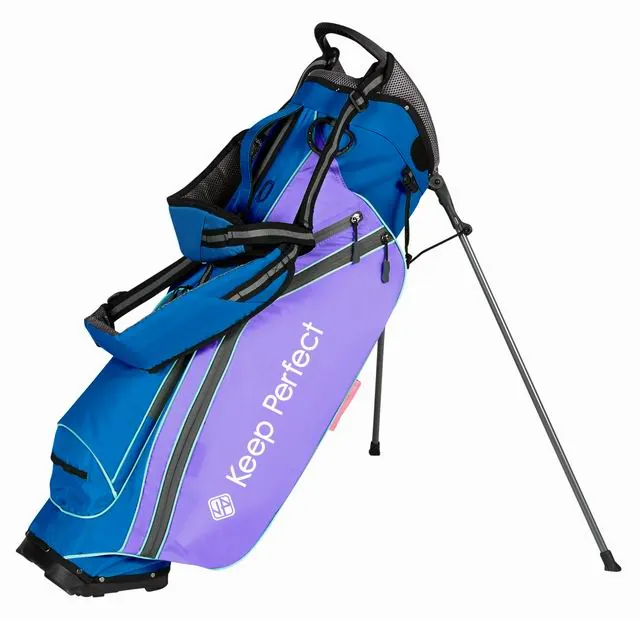
After exploring golf bag color psychology, see how different colourways affect the visual read and identity of a bag
What Is Golf Bag Color Psychology?
Golf bag color psychology combines colour theory from consumer behaviour with sports-science evidence about how visual stimuli modulate performance. At its core it asks a practical question: does the shade of your bag change how you feel and play? The short answer is yes, and the mechanism is well documented. Colours carry three distinct signals: a physiological signal (arousal and heart rate), a cognitive signal (attention and processing fluency), and a social signal (how others perceive your brand or personality).
When you see a red bag, your autonomic nervous system responds differently than when you see a blue bag. This is not merely anecdote — controlled experiments measuring reaction time, grip strength, and subjective energy show measurable differences between warm and cool colour presentations. In a golf context these effects compound: pre-shot routines, pressure putting, and negotiation of course strategy all depend on stable arousal. A bag that overstimulates a naturally anxious player, or understimulates an already flat player, can tip the balance.
Importantly, the industry correlation between colourway and purchasing has been tracked for over a decade. Bags in white, black, and navy blue traditionally lead global wholesale sales, while performance-driven players increasingly choose brighter accents. Understanding the psychological map of each colour lets buyers move beyond "what looks nice" and select a hue that actively supports the player type and the brand story they are telling.
Why Colour Choice Matters in Competitive Golf
Competitive golf is a precision sport played under sustained psychological load. Handicap improvement, tournament pressure, and slow rounds all tax attention. The bag sits in the player's peripheral vision for four to five hours every round, which makes it one of the highest-repetition colour exposures in sport. Colour psychology matters in golf specifically because of this exposure frequency and because arousal regulation is a trainable performance variable.
There is also a practical, non-psychological reason colour matters: visibility and bag identification. On crowded starter-sheet fields or busy practice ranges, a distinctive colourway helps you and your partners spot the bag instantly, reducing time lost to misidentification. Bright bags also photograph better for content creators, and they read more clearly in television coverage when players carry branded colours that align with sponsorship.
Finally, colour affects how a product is valued. In winery and automotive retail, darker or more saturated finishes are consistently associated with higher perceived quality. The same bias transfers to golf bags: a deep matte navy or black with clean contrast stitching is judged more premium than a washed-out pastel, before a single stitch of construction quality is examined. For OEM buyers this perception premium matters directly at the point of sale.
Color Psychology Fundamentals in Golf
Colour psychology in golf reduces to a few transferable principles, all grounded in the arousal–performance relationship described by the inverted-U theory: some stimulation helps, too much or too little hurts. Different hues sit at different points on that curve, and each affects concentration, energy and mood distinctly.
Warm Colours — Energy & Arrogance
Reds, oranges and yellows raise heart rate and perceived energy. They are linked to confidence, dominance and aggression, and are associated with better performance in short, explosive, power-oriented tasks. In golf they suit players who must manufacture energy for long courses or who benefit from a mental "switch-on" before the first tee.
Cool Colours — Calm & Focus
Blues, greens and purples lower arousal and promote calm, concentration and methodical problem solving. They are associated with reliability and are ideal for players whose weakness is rushing, anxiety, or losing focus on approach shots and putting where precision is everything.
The practical takeaway is not that one colour is universally better; it is that the right colour depends on the player's natural arousal level and the shot types that cost them strokes. A naturally calm, over-deliberate golfer gains from warm accents; a quick-tempered or anxious golfer gains from cool, grounding tones. This is the core logic golf bag colour psychology applies at selection time.
Golf Bag Color Psychology at a Glance
| Colour | Psychological Signal | Best For | Watch Out For |
|---|---|---|---|
| Red | High arousal, energy, dominance | Power players needing an energy lift | Can overstimulate an already quick temper |
| Blue | Calm, focus, trust | Putting and approach precision | May feel too passive for flat-energy days |
| Green | Balance, harmony, recovery | Consistency across a full round | Low visibility on grass for identification |
| Black | Focus, authority, premium perception | Branded and professional use, prestige | Tends to absorb heat; can look dull if flat |
| Yellow / Orange | Optimism, creativity, warning | Boosting mood and high visibility | High arousal can break focus under pressure |
| White | Clean, fresh, premium, classic | Heritage styling, photos, light weight look | Shows dirt, stains and wear quickly |
Use this table as your selection start point. In practice the most effective golf bags combine a dominant neutral base with one or two psychological accents, giving the player the anchoring calm of a cool or classic tone plus a targeted burst of energy or brand colour exactly where they need it.
The Science Behind Red, Blue and Green Bags
The strongest controlled evidence in sports colour psychology centres on red and blue, and golf offers a perfect natural laboratory because the bag, shirt and grips can be varied independently. Red is consistently linked with perceived dominance and is chosen more often by competitors in head-to-head settings; it is also shown to increase risk-taking and physical output. In golf this translates to a bag that quietly encourages aggressive line choices and longer, firmer swings.
Blue is the mirror image: it lowers arousal, slows perceived time, and supports the slow, methodical processing required for alignment and short-game execution. Players who struggle with quick tempo or who lose strokes on the greens frequently respond to blue accents by reporting calmer, more consistent routines. The effect is modest but reliable across repeated studies, which is why professional psychologists treat colour as a real, if secondary, performance variable rather than purely superstition.
Green sits in the middle. It is associated with restoration, balance and the relaxation response — useful on long, high-stress rounds where fatigue accumulation is the real opponent. On a visual level, green introduces a visibility problem on grass, so brands pair green bases with high-contrast shoulder straps, piping or zipper pulls. Black and grey operate outside the warm–cool axis entirely, functioning as neutral authority anchors that make accent colours and logos "pop", which is why they dominate workplace and premium OEM ranges.
How Colors Affect Your Performance and Confidence
Confidence is the psychological currency of golf, and colour feeds it through a self-perception loop. A player who believes their kit "looks faster" or "feels like a tour player's bag" enters the round with elevated self-efficacy, which measurably improves commitment to shots and outcome expectations. This placebo-quality effect is real: perceived superiority of equipment has been shown to improve actual performance even when the equipment is functionally identical.
The mechanism runs in both directions. A bag in a colour the player dislikes, or one that clashes with their shirt and style, creates a subtle background dissonance that nags at focus. Conversely, a bag that matches the player's self-image reinforces a coherent pre-shot identity. Golf professionals routinely exploit this by colour-coding their full kit — bag, headwear and grips — so that alignment with the personal brand becomes automatic rather than deliberate.
For amateur players the confidence effect is often larger than the arousal effect, because their limiting factors are commitment and timing, not raw physical output. Practical guidance from sports psychologists is simple: select a colourway you genuinely enjoy seeing out of the corner of your eye all day. Branding matters, but personal resonance is the dominant variable for recreational rounds.
Choosing the Right Color by Player Type
Beginner and High-Handicap Players
Prioritise visibility and confidence. Bright, high-contrast colourways help with bag identification and make practice sessions feel more enjoyable. Warm accents support the energy needed to persist through a learning curve. Avoid washed pastels that fade into the background.
Low-Handicap and Tournament Players
Emphasise calm and brand consistency. Cool blue, navy, black or green bases reduce arousal variance across long competition days. Strong outlines and accent piping retain visibility without sacrificing the authoritative, focused image that sponsors and clubs prefer.
Between these extremes, social and club players can simply express personality — the bag is the most visible piece of kit on a resort or membership day and a natural canvas for identity. The rule of thumb remains the same: anchor with a functional neural tone, add a psychological accent that counteracts your known weakness, and keep a logo or brand colour in a position of high visibility.

A premium golf bag colourway that combines an authoritative base with a calm green accent
Color, Mood and Mental State on the Course
Golf is four to five hours of sustained emotional regulation, and colour is one of the quietest tools a player has to steer their mood. Warming tones before the round generate the activation needed for a confident start; cooling tones during the closing holes prevent the fatigue-driven decision errors that ruin good scores. Players who carry a bag they dislike, whether for its colour or its worn finish, report measurable drops in enjoyment even when scores hold steady.
There is also a seasonal and meteorological dimension. On bright, hot summer days, dark colours absorb heat and can cause the bag to feel hotter to the touch and to fade faster under strong UV. Light neutrals reflect heat, keep contents cooler, and photograph cleaner. In the winter, richer, warmer colourways add a psychological lift against grey skies. Seasonal rotation — a lighter colourway in summer, a deeper one in winter — is a legitimate performance choice, not just fashion.
Practical mood management with colour is low-cost and immediate: reserve an "angry" colour you love for days when you need motivation, and a "calm" colour for pressure events. Many amateur players unknowingly do the reverse, choosing a visually aggressive colour before an anxiety-prone match and then wondering why they feel tight. Being deliberate about when you use which bag is a free edge.
2025 Color Trends and Global Market Preferences
Across the global golf bag market, colourway preference is consolidating around two poles: timeless neutral/authority tones for commercial and corporate programmes, and bright statement colourways for consumer and resort retail. Deep navy, black, charcoal and white remain the volume leaders in wholesale because they carry logos cleanly and register as premium. On the consumer side, refreshed mint greens, dusty blues, warm whites and accent pulses of coral and electric blue are gaining share with the growing cohort of women and younger golfers.
Market data also confirms that colour visibility on e-commerce thumbnails strongly predicts click-through. Bags photographed in saturated, high-contrast colourways outperform flat, low-saturation images on retail platforms, independent of function. For brands this means the colourway you develop is not only your player-side identity but your digital shelf strategy — a reason to invest in a distinctive signature colour that survives compression in product grids.
Regional differences matter too. North American buyers favour clean, logo-forward designs with strong brand colours; European buyers lean toward understated, heritage-derived tones; quickly-growing Asia-Pacific markets gravitate toward brighter, more expressive accents. A multi-region brand should therefore not assume one colourway fits every market — it is often worth running two variants off the same pattern block to serve the psychologies of different buying groups.
Color and Material: Dye, Finish and UV Durability
A colourway is only as good as the material that carries it. Nylon, polyester, canvas and technical fabrics each accept dye differently, and the same hue can shift dramatically across substrates. Reactively-dyed, solution-dyed polyester holds colourfar longer than surface-printed designs, which are prone to fading, cracking and rub-off. When specing a bag that will live in the sun, solution-dyed or high-fastness pigments are the durable choice.
Finish also changes perception. A matte, slightly textured finish reads as technical, robust and premium; a glossy finish reads as sporty but can look cheaper and scratches visibly. Contrast piping, welded zipper tapes and tone-matched hardware either harmonise or fight the base colour. The most professional OEM programmes treat colour as a system — base, trim, hardware and logo applied on an approved colour-matching standard so panels match within tolerance across production runs.
Because colour inconsistency between batches is the single most common quality complaint in private-label sourcing, serious manufacturers maintain a documented colour-matching and inspection process. For a buyer this translates into a simple due-diligence question: can the factory show you a colour-matching standard and a batch-to-batch tolerance record? Factories that can are dramatically more reliable for brand consistency than those that rely on verbal assurance.
How Golf Bag Color Psychology Connects to Branding
For corporate buyers, academies and private-label brands, golf bag colour is brand equity. A signature colourway — used consistently across bags, staff bags, travel covers and cart bags — builds immediate recognition that a revolving random colour scheme cannot match. Colour psychology therefore scales from individual performance to organisational identity.
The psychology transfers to staff bags and corporate gifts too. A golf academy or club that outfits members in a unified, well-chosen colourway creates a team coherence effect that raises perceived professionalism and member pride. Tournament sponsors use brand-coloured bags as moving billboards whose visibility compounds with every round. Because the bag is the largest reliably visible branded surface on the course, colour placement here outperforms most other sponsorship inventory.
The key is restraint: a powerful brand identity is one colour anchored by supporting tones, not a rainbow. Professional guidance is to fix one dominant brand colour, pair it with a neutral base (black, navy, grey, white), and use a single contrasting accent. This triad keeps the psychological signal clear while leaving room for logos, monograms and co-branding to do their work.
Building a Custom Color Programme with Your Factory
Turning colour psychology into manufactured reality requires a capable OEM or ODM partner with disciplined colour management. QUANZHOU JUNYUAN BAGS (service@junyuanbags.com, +86 17750020688) is an experienced golf-bag manufacturer whose founder entered the industry in 2004 and whose company was established in 2014, giving it the long operational track record that stable colour reproduction depends on. It operates through an affiliated factory of approximately 4,950 m², staffed by a production team of around 137 people across seven production lines and 126 sewing stations, with a monthly output capacity of roughly 200,000 pieces serving more than 200 brands in over 100 countries.
For custom colour development, a realistic engagement model is: standard MOQ of 200 pieces per design (test orders from 100 pieces), sampling taking roughly 10–20 days, and bulk production typically 45–60 days depending on material and finishing complexity. This cadence lets a brand lock its colourway, approve physical samples against the colour-matching standard, and then run repeatable production with batch consistency — all of which directly protects the colour-equity strategy described above.
When briefing colour, share your psychological intent, not just a hex code or Pantone reference. Tell the factory whether you need a calm, focus-driven tone for tournament play, an authoritative corporate tone for staff bags, or a bright consumer statement for resort retail. A partner that understands the goal can steer substrate, finish and accent decisions that no colour code can capture, and can flag durability trade-offs before they become expensive mistakes.
Color Maintenance: Keeping Your Bag Looking Its Best
A well-chosen colour still needs care to keep delivering its psychological and branding impact. Light bases and bright accents show dirt faster, so establish a simple routine: empty the bag, use a soft brush or damp cloth to remove loose grime, and spot-clean with a mild detergent suited to the fabric type. Avoid harsh solvents that strip dye and seam treatments. For waterproof-coated fabrics, re-apply the recommended DWR treatment so the coating — and its colour sheen — lasts longer.
Sun exposure is the main enemy of colour vibrancy. Store bags out of direct sunlight and away from prolonged heat, and never leave a bag in a car boot for days in summer if you want the colourway to survive. For branded bags, keeping straps and piping clean preserves the contrast accents that carry the psychological signal. Detailed guidance lives in our golf bag maintenance and care guide.
Watching the finish of your bag also tells you when a colour refresh is needed. Faded, chalky panels or cracked surface prints signal that the substrate's dye system has reached its end of life; for brands this is the trigger to plan the next colourway so the refreshed identity launches seamlessly in the existing seasonal calendar.
Frequently Asked Questions
- What is the best colour for a golf bag psychologically?
- There is no single best colour; it depends on the player's natural arousal level and weakness. Red energy suits players who need a lift on power shots, blue and green promote calm focus for putting and approach, while black and navy read as authoritative and premium. Anchor with a functional base tone and add one targeted accent.
- Does the colour of a golf bag actually affect performance?
- Peer-reviewed sports psychology research shows colour can influence arousal, risk-taking, confidence and, through perceived equipment quality, actual outcomes. The effects are modest and mediated by the player, but reliable across studies — a reason to treat colour as a real performance variable rather than superstition.
- Should players use warm or cool colours?
- Warm colours (red, orange, yellow) raise arousal and confidence and suit naturally flat or over-deliberate players. Cool colours (blue, green, purple) reduce arousal and support precision, suiting anxious or quick-tempered players. Choose according to the mental state that costs you strokes.
- What is the most popular golf bag colour in wholesale?
- Black, deep navy, charcoal and white dominate global wholesale volumes because they register as premium, clean up well on logos and meet the colour psychology of authority and trust. Bright accents are added as secondary colours for consumer and resort retail.
- How do I keep a light-coloured bag looking clean?
- Brush or wipe off loose grime after each round, spot-clean with a mild fabric-appropriate detergent, avoid harsh solvents, store out of direct sunlight, and re-apply waterproof coating treatments as recommended. This preserves both colour vibrancy and the logo contrast that carries your branding.
- Can I develop a custom colourway for my brand?
- Yes. Custom colourways are developed through an OEM or ODM programme with colour-matching standards, typically at a 200-piece MOQ with 100-piece test orders, 10–20 day sampling and 45–60 day bulk production. QUANZHOU JUNYUAN BAGS can develop standard, customised and full private-label colourways for golf bags, staff bags, travel covers and cart bags.
Conclusion
Golf bag colour psychology turns the most visible part of your kit into a working performance and branding asset. Warm colours energise, cool colours focus, and neutral anchors project authority — but the right choice is always the one matched to the player's mental state, the shot types that cost strokes, and the identity a brand wants to carry. As 2025 colour trends converge on durable neutrals plus expressive accents, the market is increasingly rewarding the brands and players who choose colour with intent rather than habit.
Whether you are an individual refining your own bag or a buyer building a private-label, team or corporate programme, the same principles apply: anchor the tone, target one psychological accent, protect the colourway with sound material selection, and partner with a manufacturer disciplined enough to reproduce it consistently. Combined with the CONFIDENCE and arousal levers described here, colour becomes one of the lowest-cost, highest-repetition performance edges in the game.
Author & Manufacturing Note
QUANZHOU JUNYUAN BAGS — OEM/ODM golf bag manufacturer. Established process experience since 2004; company founded 2014; affiliated factory approx. 4,950 m²; seven production lines, 126 sewing stations, ~137 staff, monthly output ~200,000 pieces; serving 200+ brands across 100+ countries; SGS-reviewed in March 2026. Standard OEM MOQ 200 pieces (test orders from 100), sampling 10–20 days, bulk production 45–60 days.
Contact: service@junyuanbags.com · WhatsApp/Phone +86 17750020688