The Complete Guide to Golf Bag Customization and Personalization
Golf bag customization lets brands control fabric, color, logo, pocket layout and hardware — from private-label OEM to full bespoke personalization at factory level.
The Complete Guide to Golf Bag Customization and Personalization
Custom golf bag personalisation is the practice of turning a stock bag into a personally or commercially meaningful object — through monograms, embroidery, full custom colourways, badge systems and co-designed private-label ranges — executed through OEM and ODM workflows that protect brand consistency, colour accuracy and production reliability at scale. This guide is a complete playbook: it explains every personalisation method, the psychology and commercial logic behind choosing each one, the material and colour considerations that decide how long your personalisation lasts, and the exact factory workflow that moves an idea from logo brief to shipping container.
The golf bag is the largest, most durable, most visible and most repeatedly photographed object a golfer carries. That single fact makes it the ideal canvas for personalisation. Every round, every event photo and every shared post broadcasts the owner's identity or a brand's message. In 2025 that opportunity is fully mature: personalisation has moved beyond cheap logos into a designed discipline with real psychology, real economics and real production standards. This guide is written for both individual players designing one deeply personal bag and commercial buyers building a team, academy or private-label programme.

Custom golf bag design process showing personalisation options and colourways
What Does Golf Bag Personalisation Mean in 2025?
Personalisation today is categorically more than a printed logo. It spans several distinct techniques and strategies, each suited to a different buyer and identity goal. The full menu includes monograms and personal initials, tonal and contrast embroidery, full custom colourways, interchangeable badge and patch systems, smart and storage-focused personalisation, and complete co-designed private-label product lines. Choosing the right layer depends on whether you are personalising for emotional ownership, professional branding, team cohesion or retail differentiation.
The broad trend is a move from decoration to identity. Buyers increasingly want the whole bag — base colour, trim, hardware, pocket architecture and branding — considered as one system. That is what separates a personalised bag from a rebranded stock bag, and it is exactly the difference a genuine OEM or ODM partner helps a buyer achieve with production discipline.
Underpinning all of it is a simple psychological truth: people value, care for and retain objects designed for them. A bag carrying your initials, your club or your brand tells a story every time it is seen, and that narrative is the durable asset personalisation creates.
Personalisation Methods and Their Best Use
| Method | How It Looks | Durability | Best Buyer |
|---|---|---|---|
| Monogram / Initials | Embroidered initials or name | Very high | Individuals, gifts |
| Tonal Embroidery | Same-colour textured logo | Very high, low fade | Premium brands, clubs |
| Contrast Embroidery | Distinct-colour stitched logo | High | Teams, consumer brands |
| Full Custom Colourway | Entire colour system specified | Material-dependent | Private label, corporate |
| Badge / Patch System | Interchangeable identity badges | High | Clubs, events, sponsors |
| Co-designed Private Label | Managed OEM/ODM range | Production-managed | Retailers, distributors |
Each method trades off visibility, durability, cost and emotional weight. Tonal embroidery and monograms skew toward premium emotion and longevity; full colourways and private labels skew toward commercial differentiation. The right choice is the one that matches the identity goal and the budget envelope you can defend at retail.
Monograms and Personal Initials
The monogram is the oldest and most emotionally reliable personalisation. Embroidery of a player's initials, name or family crest onto a pocket or panel creates instant ownership and makes the bag unmistakably theirs. It works beautifully on a premium neutral base and pairs naturally with either tonal or contrast stitching, letting the personal mark read as either an understated whisper or a clean statement.
Placement is the design decision that makes or breaks a monogram. Too small and it reads as an afterthought; too large and it undermines the premium tone. Good practice is to size the monogram against the pocket proportion and to align it with the brand logo so the two coexist without competing. A knowledgeable factory advises on this, using the bag's actual dimensions rather than a generic template.
For gifts — corporate, tournament or personal — the monogram is the most reliable way to turn a thoughtful purchase into a keepsake. A monogrammed team or club bag becomes a badge of belonging, deepening the emotional connection that keeps golf communities cohesive and loyal.
Tonal vs Contrast Embroidery
Embroidery is the backbone of premium golf bag personalisation, and the 2025 choice is between tonal and contrast. Tonal embroidery stitches in a shade barely distinct from the fabric, producing a texture-defined logo that reads as deeply luxurious and resists the fading and cracking that printed marks suffer. Contrast embroidery uses a distinct colour for a bold, sporty, high-visibility identity. The choice is psychological: tonal for authority and premium, contrast for energy and consumer visibility.
Embroidery also outlasts most printed personalisation because the thread is woven into, not laid on, the fabric. It holds under UV, survives laundering-style cleaning and keeps its definition far longer. Detail guidance on embroidery, placement and thread choice is provided in our custom logo and embroidery guide.
Because embroidery is tight-tolerance and repeatable, it is also the production-safest personalisation: it is difficult to mismatch and rarely rejected at QC. For a brand scaling a range, that reliability is worth a great deal, because it keeps more of the personalisation budget in sellable product.
The Full Custom Colourway
In 2025, the most commercially significant personalisation is the full custom colourway — specifying base, trim, hardware, piping and logo as one designed system rather than placing a logo on a stock bag. This is what creates a genuine private label that is impossible to comparison-shop and gives a retail range a distinct shelf identity that photographs well and holds value.
Colour choice here is where psychology does its work. Apply the direction from our golf bag colour psychology guide: calm greens for sustainability-led consumer lines, navy and black for corporate authority, expressive accents for e-commerce visibility, and heritage tones for prestige clubs. Each direction maps to a documented colour-matching standard.
Production discipline decides whether a custom colourway is an asset or a liability. The factory must match a physical colour reference, verify tolerance across batches, and keep that standard through repeat orders. This is the single most important thing to verify in a potential partner, because colour mismatch is the most common reason bespoke bags earn returns and complaints.
Badge and Patch Systems
Interchangeable badge and patch systems solve the perennial "how do we refresh the branding" problem elegantly. Clubs, academies and event organisers attach member, sponsor or tournament badges to a standardised bag base, allowing the identity to be refreshed quickly and cheaply while the bag structure stays common. This is ideal for membership programmes, annual tournaments and multi-sponsor events.
The craft is in the attachment. Badges must be secure enough not to flap or loosen during play, yet positioned and engineered so replacement is straightforward. Reinforced panels, tonal frames and carefully chosen attachment hardware keep badges both stable and elegant, integrating them into the bag rather than onto it.
The business case is unusually strong: a club can stock one base-SKU bag and personalise at point of allocation, cutting dead-stock risk while still delivering personalised kit. Sponsors get a reusable asset refreshed each season by swapping a badge — predictable cost, persistent value.
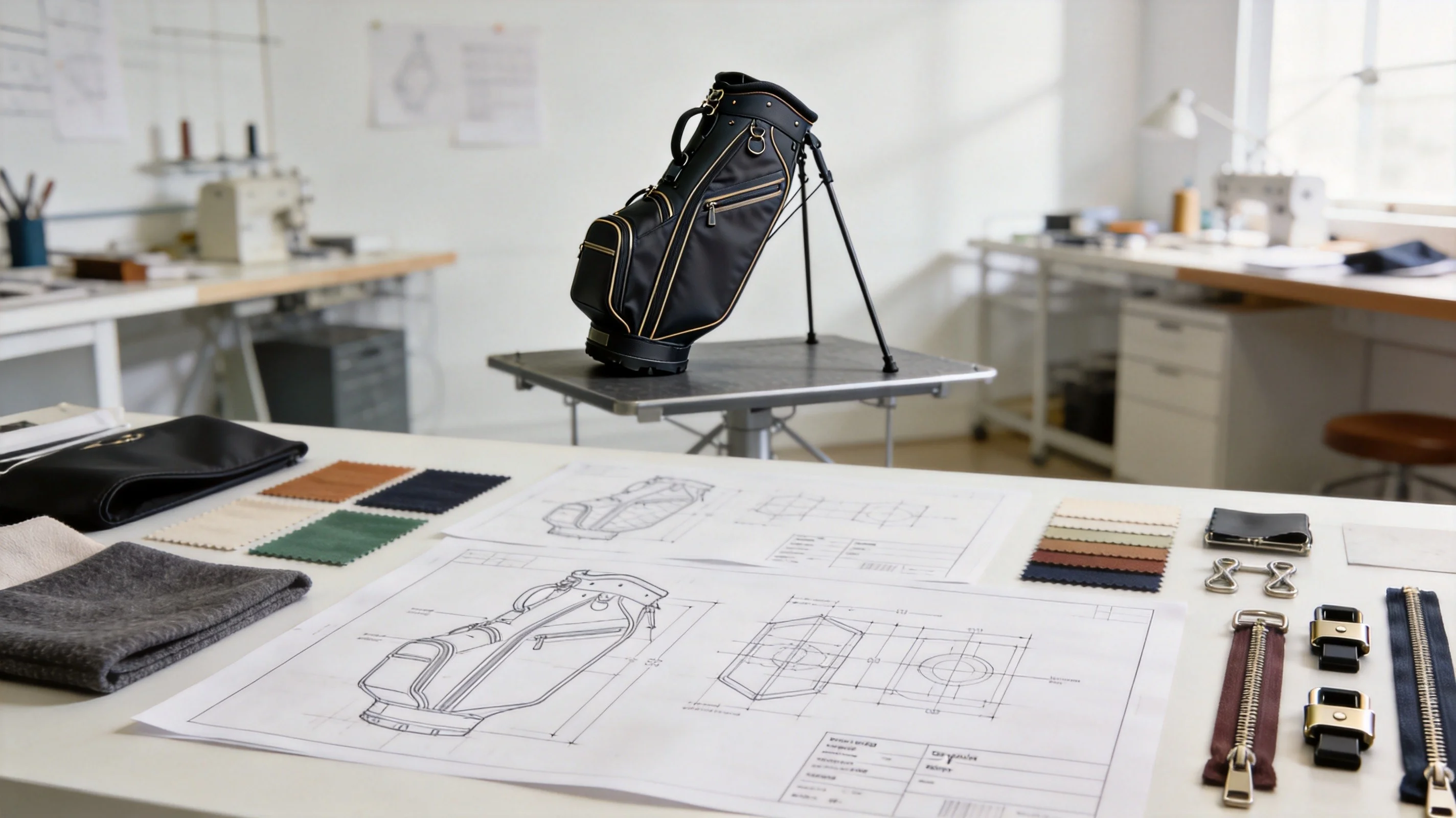
Custom golf bag sampling stage where designs are prototyped for approval
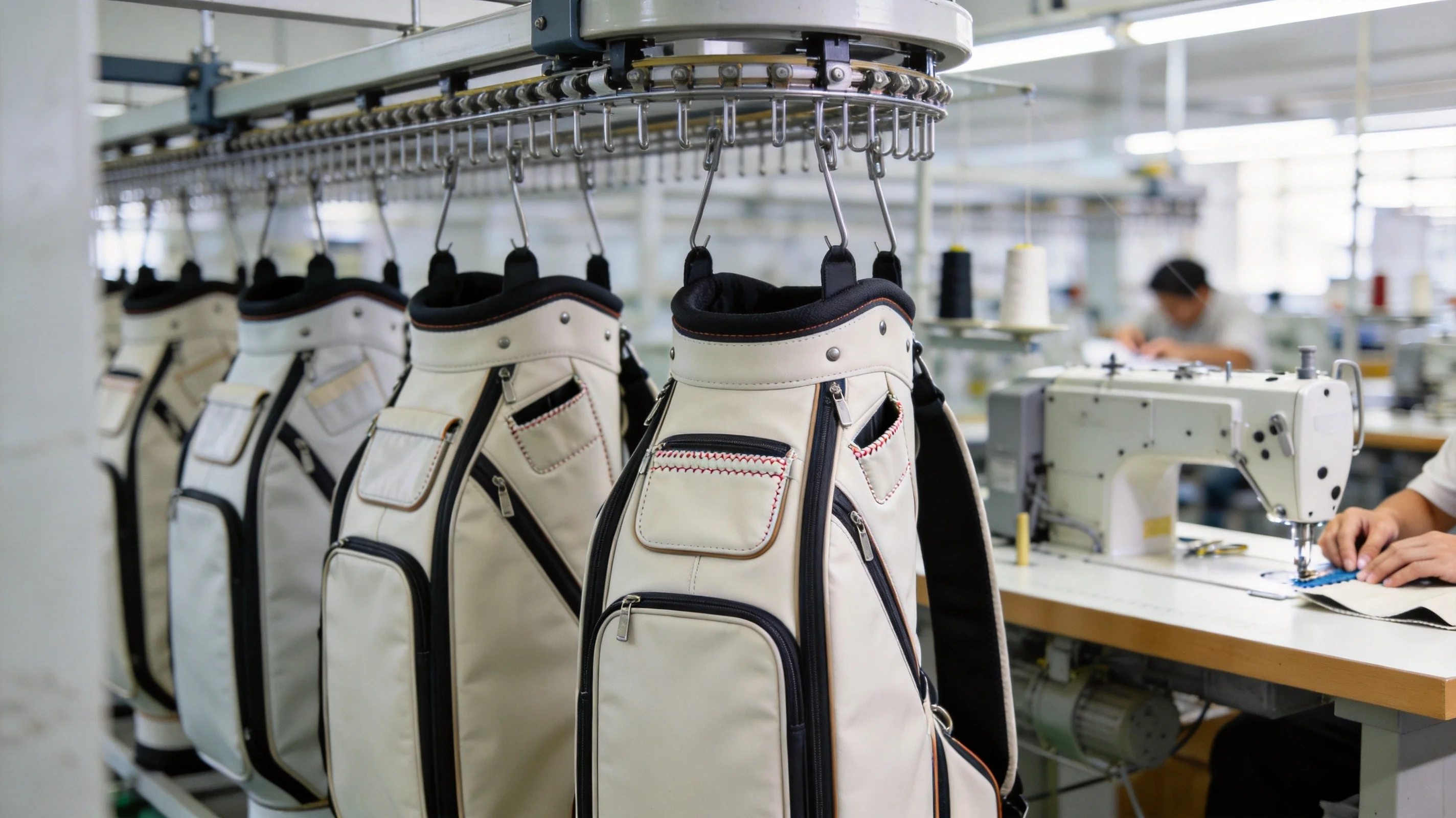
OEM production line manufacturing custom golf bags with disciplined construction
Smart and Storage-Focused Personalisation
Personalisation increasingly extends beyond the logo into structure: configuring pockets, dividers and storage for the owner's actual gear. Dedicated, labelled pockets for rangefinders, devices and power banks, plus RFID or NFC-capable elements, make a bag feel designed for one person. This "structural personalisation" is as meaningful as a monogram and equally differentiating for brands.
The planning principle is to fix pocket sets and dividers at the development and pattern stage, because retrofitting storage after tooling is expensive. A brand that co-designs its storage architecture early gets a bag that is genuinely bespoke, not just decorated, and the resulting product photographs and sells on function as much as identity. Organisation principles are covered in our storage and organisation guide.
Structurally personalised bags also future-proof themselves: as the owner's gear evolves, labelled capacity designed at the start accommodates new devices without a replacement purchase, which is precisely the durability and readiness modern buyers value.
Co-Designed Private-Label Ranges
The most commercially important personalisation trend is the move from one-off custom orders to recurring, co-designed private-label ranges. Rather than ordering "a custom bag", retailers, distributors and golf brands commission a managed range in which the manufacturer handles pattern engineering, sample iteration, seasonal colour refresh and QC, while the brand owns the identity. This converts personalisation from a cost into a repeatable revenue engine.
Co-design improves unit economics because the same pattern block serves a multi-colour range across segments: the brand refreshes colourways seasonally rather than re-tooling, and repeat MOQ keeps per-unit cost competitive. The result is a bespoke identity at stock-like efficiency. The full private-label pathway is described in our private-label golf bag guide.
For a distributor looking to differentiate its catalogue, a co-designed range is the single most durable way to do it. It builds a product DNA competitors cannot copy, creates recurring order patterns and gives the brand pricing power that commodity stock never offers.
Material, Colour and Durability of Personalisation
The longevity of your personalisation depends on the substrate that carries it. Solution-dyed polyester and high-fastness pigments retain colour far longer than surface-printed designs, which fade, crack and rub away. Embroidery, because it is woven thread, outlasts all printed techniques. A personalisation programme should therefore match the method to the expected life of the bag and to the finish that preserves the colourway.
Maintenance is part of the equation. Light bases and bright accents show dirt faster, so warn buyers to brush off grime, spot-clean gently and store bags out of direct sunlight. For coated fabrics, re-applying the recommended treatment preserves both water-resistance and colour sheen. These routines keep a personalised logo and colourway crisp for years, compounding the value of the original investment.
A brand planning seasonal colour refresh should also plan substrate consistency so the heritage colourway stays recognisable even as accents rotate. This consistency is exactly what a manufacturing partner protects with a locked colour-matching standard, which is why partner selection is the pivotal decision for any durable personalisation programme.
Working With Your Factory: The Personalisation Workflow
A reliable personalisation programme follows four disciplined stages. In the brief, define the psychological tone, colourway, logo technique, placement and material. In sampling, the factory matches a colour-matching standard and produces physical samples — the step that prevents colour and embroidery surprises. In locking, the approved reference is frozen against documented tolerance. In repeat, the standard supplies seasonal refreshes with consistency.
QUANZHOU JUNYUAN BAGS (service@junyuanbags.com, +86 17750020688) executes this workflow across golf bags and related categories. With industry experience since 2004 and the company founded in 2014, it operates through an affiliated factory of approximately 4,950 m² staffed by roughly 137 people across seven production lines and 126 sewing stations, with monthly output near 200,000 pieces serving over 200 brands in more than 100 countries. Standard programmes run at a 200-piece MOQ (test orders from 100), sampling in 10–20 days and bulk production in 45–60 days.
The full sequence from inquiry through sampling, production and delivery is documented in our customization and production process guide. Following it keeps a personalisation programme profitable by preventing the two most common failures — colour mismatch and embroidery defects — before they reach the customer.
Choosing Between OEM and ODM for Personalisation
The most important partnership decision in a custom golf bag project is OEM versus ODM. In OEM, the buyer supplies a complete design and the factory manufactures it to that drawing. In ODM, the factory co-designs and develops the product with the buyer, applying its pattern, sampling and engineering expertise to make the concept manufacturable. For deep personalisation — full colourways, private labels, structural pocket changes — ODM tends to deliver a more durable, more cost-effective result because the factory flags fragile or costly design choices before money is spent on tooling.
The choice shapes every stage that follows. An OEM buyer owns the design and simply commissions production. An ODM buyer gains a development partner that recommends materials, refines the pattern and locks the colour and construction standard through its own sampling discipline. This is why the co-design relationship, rather than the pure commission, is where the personalisation guide's promise of a manufacturable bespoke product is actually earned.
QUANZHOU JUNYUAN BAGS operates in both modes. With industry experience since 2004 and founded in 2014, it develops and manufactures custom golf bags through an affiliated factory of about 4,950 m² with seven production lines, 126 sewing stations and roughly 137 staff, at a monthly output near 200,000 pieces serving over 200 brands in more than 100 countries, SGS-reviewed in March 2026. Standard MOQ is 200 pieces (test orders from 100), sampling in 10–20 days and bulk production in 45–60 days, at service@junyuanbags.com and +86 17750020688. The co-design depth, engineering expertise and honest MOQ are precisely what make either OEM or ODM personalisation deliverable and repeatable.
Quality, Testing and the Personalised Standard
A personalised golf bag is a promise about colour, logo and construction, so quality control is central to the guide. The three standards to lock are the colour-matching standard (against which every panel is compared), the logo or embroidery proof (digitised, stitch-density-tuned and approved) and the construction reference captured in the approved physical sample. Holding all three through bulk production is what keeps a personalised run consistent across hundreds of units.
Testing should stress the personalisation specifically: UV-fade resistance of the colourway, wear of the embroidery and patch attachment, hardware function and the seam integrity around custom pockets. A factory that documents these tests against a tolerance record is protecting the bespoke identity, and a buyer who asks for these records before committing avoids the colour drift and logo failures that plague poorly-managed custom projects.
Documentation is as valuable as the inspection itself. The colour-matching standard, the approved sample, the logo proof and the QC tolerance record together form the contract that governs bulk and every future reorder. A factory that keeps and shares this documentation enables a second and third season at lower cost and higher consistency, because the reference is already locked. This is why the personalisation guide always pairs quality control with record-keeping: the durable value of customisation lives in the standard it creates.
A clearly-written approval process also prevents disputes. When the sample, colour and logo are formally approved against dated records, there is no ambiguity about what the factory was told to deliver, protecting both buyer and manufacturer through the long bulk window. This formality, rather than an informal verbal okay, is what turns a bespoke project into a repeatable programme.
Frequently Asked Questions
- What is the main difference between OEM and ODM for personalisation?
- OEM means you supply the design and the factory manufactures it; ODM means the factory co-designs and develops the product with you, using its engineering and pattern expertise. For deep personalisation like full custom colourways and private labels, ODM tends to deliver a more manufacturable result.
- What personalisation options last longest?
- Embroidery — both tonal and contrast — outlasts printed techniques because it is woven thread rather than surface application. Combined with solution-dyed polyester or high-fastness pigments and proper care, embroidered and colourway personalisation can remain crisp for years.
- Can I personalise a bag for just myself, not a bulk order?
- Yes. Individual monograms and names are common, though they may follow a smaller-order route than a bulk programme. For the usual bulk model of personalisation, a standard 200-piece MOQ applies with test orders from 100 pieces.
- What is the minimum order for a custom-colour-range?
- A typical OEM/ODM custom-colour programme runs at a 200-piece MOQ per design, with test orders from 100 pieces. Sampling takes roughly 10–20 days and bulk production 45–60 days, giving you a repeatable seasonal schedule.
- How do I keep the logo colour consistent on repeat orders?
- Lock an approved physical sample and colour/embroidery standard, and ensure the factory maintains that reference with documented batch tolerance through inspection. This is how repeat orders stay visually identical.
- Can my brand get a full private-label range developed?
- Yes. QUANZHOU JUNYUAN BAGS co-designs and manufactures private-label ranges, from pattern engineering and sampling to seasonal colourway refresh and QC, at a 200-piece MOQ with 100-piece test orders, across golf bags and related categories.
Conclusion
Golf bag personalisation has matured from printed logos into a designed discipline with real psychology, real economics and real production standards. Monograms, tonal and contrast embroidery, full custom colourways, badge systems, smart storage and co-designed private labels each serve a different identity goal, and each rewards the buyer who pairs the right method with disciplined colour and embroidery execution.
The universal lesson is that personalisation is only as good as its production. Colour consistency, embroidery durability and batch tolerance are what turn a bespoke identity into a long-lived asset, and they are decided by the factory you work with. Choose a partner that locks colour standards, verifies tolerance and prints your personalisation reliably, and your golf bag becomes the durable, proud, story-carrying object it is meant to be. To brief your programme, contact QUANZHOU JUNYUAN BAGS at service@junyuanbags.com or +86 17750020688.
Author & Manufacturing Note
QUANZHOU JUNYUAN BAGS — OEM/ODM golf bag manufacturer. Industry experience since 2004; company founded 2014; affiliated factory approx. 4,950 m²; seven production lines, 126 sewing stations, ~137 staff, monthly output ~200,000 pieces; serving 200+ brands across 100+ countries; SGS-reviewed March 2026. Standard OEM MOQ 200 pieces (test orders from 100), sampling 10–20 days, bulk production 45–60 days.
Contact: service@junyuanbags.com · WhatsApp/Phone +86 17750020688