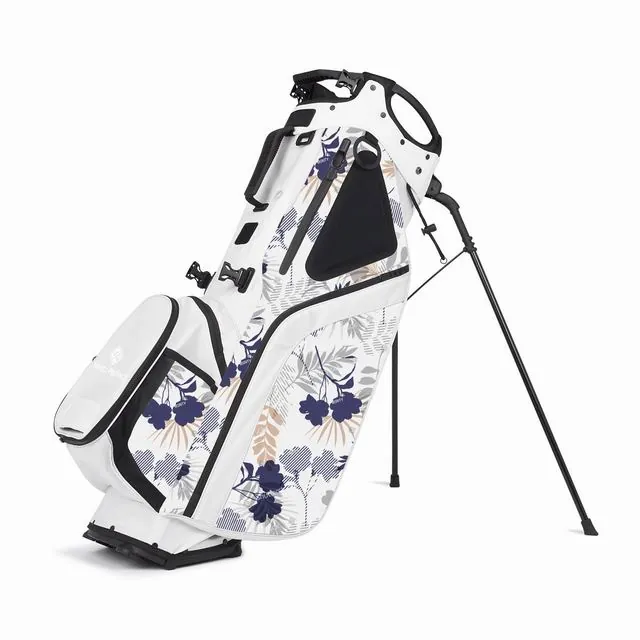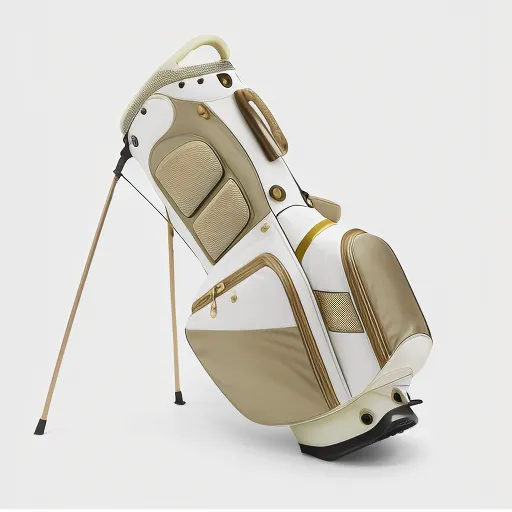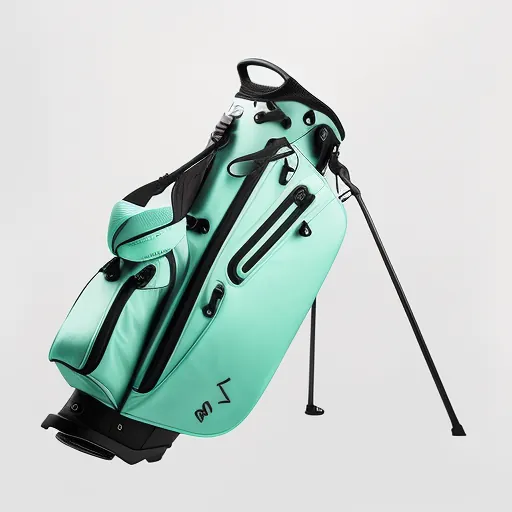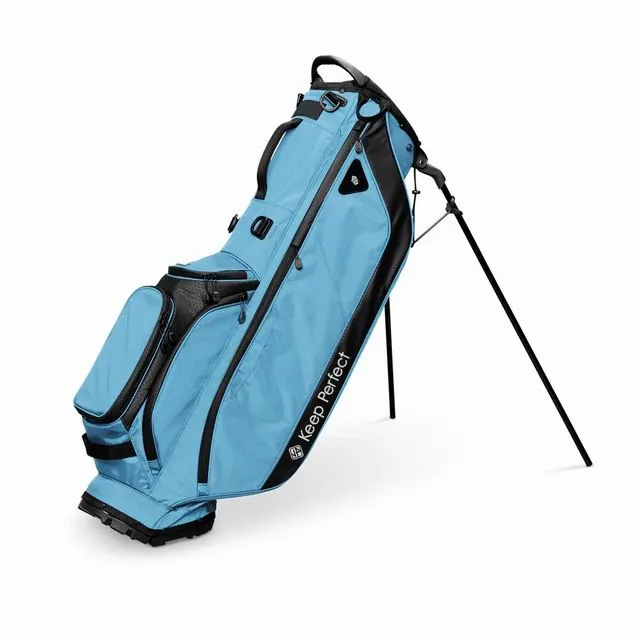
Exporting golf bags at scale is a strategy, not an order form: a China-based manufacturer with ~200,000 units of monthly capacity can put a working test order in your hands at MOQ 100, a full custom run at MOQ 200, hold samples to 10–20 days, ship production in 45–60 days, and land duty-clearable goods in the US (HTSUS 4202) and EU (CN 4202) with the right incoterms, forwarder and documentation. This guide is for importers, distributors and brand teams who want to export golf bags and staff/cart/stand bags internationally without bleeding margin to freight, duty or poor paperwork. We write from the operating vantage of our affiliated manufacturing network in Quanzhou, Fujian — main plant 4,950 m², founded 2014, founder in the trade since 2004 — and every tariff and classification reference here is verifiable against the public authorities listed in Sources.
The Golf Bag Export Opportunity in 2025
International demand for golf hard goods remains concentrated in the United States and the European Union, with growing pockets across Japan, Australia, the Gulf region and parts of Southeast Asia. For a manufacturer, that geography is a strength: a single mix of products — stand bags, cart bags, staff bags, travel covers — can serve dozens of markets from one production base, provided the export documentation and compliance are handled correctly for each destination. For a buyer, the opportunity is equally clear: sourcing from a concentrated manufacturing hub keeps freight consolidation and material pricing efficient, but it puts a premium on export expertise that turns a container into a profitable inbound P&L.
The realistic first-mover target is not the whole market but a defensible slice. A distributor that enters with two or three validated SKUs, a frozen spec, a committed supplier and a clear duty and freight model can establish a repeatable lane far faster than a brand that tries to serve ten countries with ten different packaging designs in its first season.
Choosing the Right Product and Market Mix
Export strategy begins with product-market fit, not with a price list. Staff and cart bags dominate the professional and resort channels; stand bags lead the walking-golfer segment; travel covers and sundry accessories round out the range. Match the bag type to the buying season and channel of each target market — pro shops and resort retail follow different calendars and price expectations than online DTC. A product that fits the channel ships; one that does not sits in a warehouse waiting for a discount.
A useful way to stress-test a product-market fit is to ask three questions before you commit capital. First, does the target channel actually buy this category in the volumes you plan? Pro shops, resort retail, online DTC and tournament channels each have different sell-through curves and mark-up expectations. Second, can the unit economics survive the full freight and duty stack? A bag that sells for forty dollars at retail needs a landed cost far below half of that to leave margin for distribution and retail. Third, can the format scale — can a twenty-piece test tell you anything about a two-thousand-piece reorder, or does packaging and QC change entirely at volume? The answers usually reveal which two SKUs deserve the first container and which five should wait.
Equally important is the seasonal calendar. The northern-hemisphere buying window for spring and summer golf peaks in the preceding autumn for retail commitment and in the winter for import arrival. If you are importing into the US or EU, your order must clear the factory, the ocean and customs in time for the spring launch. That means the sourcing decision — not the delivery — is the autumn event. Exporters who plan backwards from the sellable date consistently outperform those who plan forwards from the order date.
Also decide early whether you sell own-brand, private-label or OEM on behalf of a retailer. Each changes the documentation, the packaging and the margins. Private-label golf bags — where you take the product, brand it, and own the import — give the best profit potential and the most compliance responsibility; OEM work for a retailer shifts that responsibility but narrows your control.
Working MOQ and Sampling as an Export Gate
For cross-border buyers, the MOQ and sampling terms define the entry ticket. Our working model: a test order is accepted from 100 pieces so a first-time importer can validate product, packaging, freight and customs before committing; a standard custom run sets MOQ at 200 pieces; a sample needs 10–20 days; and full production runs 45–60 days from material confirmation. Treat those numbers as your planning skeleton. A test order that validates the whole chain is worth far more than a big first order that reveals its flaws after it lands.
Sampling deserves its own budget and calendar line. An approved sample is the frozen master against which bulk, packaging and inspection are measured. For export, the sample should be shipped with the exact packing you intend to use, because carton size and dimensional weight decide your freight quote and, in some lanes, your duty valuation approach.

Pricing for Export: FOB, CIF and Landed Cost
Export pricing is a stack, not a point. The FOB price covers the goods ready at the named port; CIF adds freight and insurance to the destination; DDP adds everything through to delivery. For a buyer the number that matters is landed cost — FOB, freight, insurance, duty, brokerage, port handling and last mile — because that is the number that must support your resale margin. Pricing on FOB alone is how importers discover mid-season that their real margin was negative.
Golf bags are bulky and volume-heavy, so freight often costs more than a first-time buyer expects. Model the chargeable volume — the greater of gross weight and dimensional weight — because padded bags with rigid leg sets claim a lot of CBM. Packing that lowers dimensional weight is a pricing lever in its own right, often worth 10–20% on the per-unit freight line.
Incoterms and Where Risk and Cost Transfer
Incoterms decide who owns risk and cost at each handover, and choosing the right one for your corridor is export fundamentals. EXW puts everything on the buyer. FOB transfers the goods at the named port. CFR and CIF put freight (and insurance, for CIF) on the seller up to destination, while the buyer handles the rest. DDP makes the seller responsible all the way to the buyer’s door — including customs and duty — which is attractive for price certainty but concentrates a lot of compliance on the seller.
As a practical rule for first-time importers, FOB with your own forwarder gives the most control over freight and the clearest view of costs; DDP gives the most price certainty for a direct channel. Price both with your forwarder before choosing, because the real difference is rarely what the headline delta suggests once you account for who owns the risk of delay.
Choosing a Forwarder and Freight Mode
The forwarder is the keystone of cross-border logistics. A good forwarder holds your lanes, knows your ports, consolidates cargo, and keeps the documentation moving. When you pick one, confirm they handle the specific corridor you need — US West or East Coast, EU via a named gateway — and that they can quote both sea and air without steering you. Ask how they handle consolidation, how they flag schedule changes, and who is accountable when a container slips.
On mode, sea FCL is the value champion for runs of hundreds or thousands of pieces; LCL suits smaller first orders; air rescues samples, reorders and season-critical stock; and rail lanes from China to Europe offer a middle path on speed versus cost. Match the mode to the margin and the urgency of the SKU, and never book a crisis air lane without first re-testing the two obvious alternatives — ship the sea lane two weeks earlier, or split the order.
Customs Classification and Duty for Golf Bags
Getting the classification right is the foundation of a clean import. Golf bags enter the United States under HTSUS heading 4202 — luggage and similar containers — with the current rate published by the US International Trade Commission. Into the European Union they fall under Combined Nomenclature code 4202, with the autonomous duty and any formalities documented in the EU’s Access2Markets tool. Both rates are revised and occasionally restructured, so verify the number at booking time against the authority source rather than relying on memory or a broker’s hearsay.
Classification also drives valuation and origin requirements. Capture country of origin, material composition and value accurately at the factory packing stage, because these feed the customs declaration your broker files. An origin or value misdeclaration is not a minor paperwork slip; it can trigger penalties, holds and delayed release that wreck a seasonal timeline.
Export Documentation: The Paper Trail That Nets the Deal
Export documentation is where good deals close and bad ones stall. The core set is: commercial invoice, packing list, bill of lading or airway bill, and the relevant certificates (origin, and, where a market demands it, inspection). Each document must agree with the others — the invoice quantities with the packing list, the weights and carton marks with the bill of lading. One mismatch is enough to hold a container at a foreign port and generate storage charges that dwarf the error that caused them.
A best practice for exporters and buyers alike is to digitize the packing data at the moment the goods are packed: carton marks, piece counts, weights and the HTS/CN code on every master carton. When the receiving warehouse can reconcile a container against a machine-readable packing list in minutes rather than days, both clearance and downstream stock accuracy improve measurably.
Two documentation habits deserve special emphasis because they cause the most delay. The first is consistency: the commercial invoice, the packing list, the bill of lading and any certificate of origin must all tell the same story about quantities, weights, values and carton marks. Cross-check these documents before they leave the factory, because a discrepancy discovered at a foreign port is dozens of times more expensive than one caught on the dock. The second habit is to issue documents that support, and never contradict, the customs declaration — the declared value, classification and origin must line up with the paperwork the buyer’s broker files, or the shipment invites a query or a hold that no freight discount can offset.
It also pays to keep the documentation digital and shareable in real time. When the buyer’s customs broker, the receiving warehouse and the seller can all see the same packing list at the same moment, clearance speeds up and disputes shrink. The cleanest exporters treat the packing list as a live data object from the moment the first carton is sealed, not as a document drafted after the container has sailed.
Marine Insurance: Coverage You Hope to Never Use
Marine cargo insurance is cheap relative to the exposure it covers, and it is routinely the first line budget buyers cut. For a bulk golf bag shipment, the aggregate value of a container is not trivial, and the perils — rough seas, container mishandling, humidity damage to textiles and hardware — are real. Insure to at least the CIF value plus a small percentage of profit expectation. A claim on a container of brand-new private-label stock is far more expensive than the year’s premium.
Ask your forwarder or insurer about the coverage terms that suit soft goods: all-risks versus named perils, the deductible, and whether freshwater and humidity damage — the classic textile risk — is covered. Textiles absorb moisture and fog in hold environments, so the humidity angle is not an abstract concern.
Quality and Pre-Shipment Inspection for Export
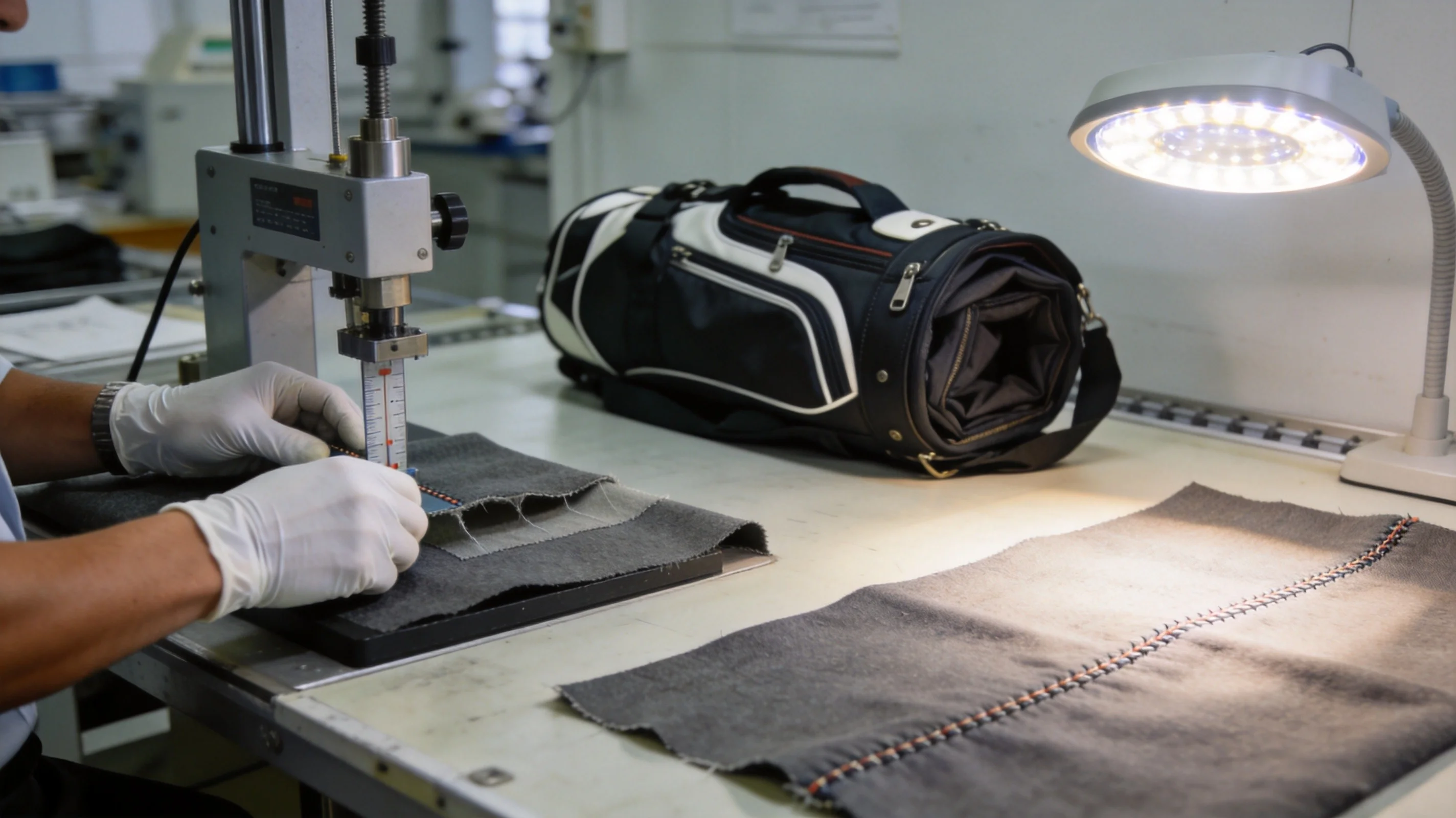
Quality for export is managed before the container is sealed, not after it arrives. The highest-value control is a pre-shipment inspection (PSI) at the factory — a statistical AQL draw on the packed goods — ideally with the packing included in the check, because a wrong carton mark or a mis-packed colourway travels as a defect even when the bags themselves are perfect. Our Quanzhou plant runs its own 100% department checks and has passed an SGS on-site audit (March 2026), which is the kind of third-party evidence importers increasingly present to their own retail customers.
Set the AQL standard in your contract — which defects are critical, major and minor, and the sample size and acceptance number — so the buyer and factory are measuring the same thing on every shipment. An ambiguous inspection standard is a standing invitation for disagreement on a non-conforming container.
Trade Compliance and Forbidden Content
Beyond tariff, exporters must respect trade compliance basics: accurate origin marking where required, no prohibited content in materials, correct labelling and, in several markets, packaging and recycling rules. The EU, for example, applies packaging expectations that a diligent exporter designs for from the start, and responsible-sourcing evidence is increasingly requested by US retailers. Getting these right at the design and packing stage is cheaper than fixing them in a market where compliance is enforced.
Sustainability is now a trade attribute, not a nice-to-have. Recycled or bluesign-tracked fabrics, reduced package weight, and cartons sized to eliminate dimensional-weight waste are export features that help you clear due-diligence and land better freight. A collapsed, well-packed carton is simultaneously a freight saving and a compliance story.
Post-Arrival: Receiving, Distribution and Reorder
The export operation does not end at the port gate. On arrival, run a receiving inspection — count the cartons, verify marks, spot-check for transit damage and humidity — before stock reaches the racks. Reconcile the physical goods against the digital packing list so your inventory system starts accurate. Then use your reorder trigger early: place the reorder the day stock enters the warehouse, not the day it nearly sells out, because the 45–60 day factory window and the freight transit sit between today’s stock and next season’s shelf.
Distribution strategy follows margin: high-margin hero SKUs justify faster freight and deeper stock; low-margin volume SKUs ride the slow lane. Match the mode to the margin and the season, and keep the calendar dated from the landed, cleared date so every party is measured against the moment stock is actually sellable.
Do not underestimate the value of a tested landing corridor for repeat business. Once a buyer has run a container on a given lane, the forwarder, the customs broker, the banking documents and the receiving warehouse all have a working template for the next one. Repeat lanes are cheaper to run, faster to clear and easier to forecast than one-off adventures on new routes. That is why the most successful importers deliberately repeat a validated corridor — same product family, same packing, same gateway port — rather than chasing the lowest quote on a new lane every season. Predictability compounds into margin the way volume alone rarely does.
Building a Repeatable Export Lane
| Stage | Typical Duration | Key Decision |
|---|---|---|
| Product & market selection | Planning | Fit product to channel & season |
| Sampling & approval | 10–20 days | Freeze the master sample |
| Test order | From MOQ 100 | Validate the whole chain |
| Production | 45–60 days | Hold the calendar checkpoints |
| Inspection & packing | 2–4 days | PSI before sealing the carton |
| Freight & customs | Varies by lane | Correct HTS/CN and documentation |
Frequently Asked Questions
- Can I test the market with a small order?
- Yes — a test order is accepted from 100 pieces so you can validate product, packing, freight and customs before committing to a full run; the standard custom MOQ is 200 pieces.
- How quickly can I get an export sample?
- A custom sample normally takes 10–20 days including pattern, cutting, sewing and finishing, with revision rounds on top.
- How long does full production take?
- Full production runs 45–60 days from material confirmation, before you add the freight and customs transit time.
- Which duty applies when importing golf bags?
- Golf bags sit under HTSUS heading 4202 for the US and CN code 4202 for the EU; verify current rates on the official USITC HTSUS portal or EU Access2Markets.
- Should I buy FOB or DDP?
- FOB with your own forwarder gives the most control and cost visibility; DDP gives the most price certainty to the door. Price both and compare the real difference for your lane.
- What is the biggest export mistake to avoid?
- Pricing on FOB alone, guessing the duty rate, and shipping an ambiguous inspection standard — all three quietly convert a good deal into a negative-margin season.
Taken as a whole, a repeatable export lane is the sum of decisions a buyer makes before the first container ever sails: the right product for the right channel, a frozen sample, an honest pricing stack, a forwarder who holds the lane, a correct classification, documents that agree with one another, and an insurance policy that covers the real exposure. None of these is heroic, and all of them compound. Brands that assemble this stack once and then refine it each season find that exporting golf bags stops being a gamble and becomes a dependable, forecastable line of business.
A dependable export lane, once built, becomes one of the most predictable profit engines a golf hard-goods company can own — as long as the plan is written before the container sails.
Research the current schedule, hold your lane, and let the evidence in the Sources above — the tariff portals, the customs authorities — validate every assumption before you commit a single unit.
Sources
Tariff, classification and trade references in this guide can be verified against these official sources:
- US Harmonized Tariff Schedule — USITC — heading 4202 rates and structure.
- US Customs and Border Protection — import entry, valuation and classification guidance.
- European Commission Taxation & Customs Union — EU customs duty and combined nomenclature.
- EU Access2Markets — current CN duties and import formalities.
- World Customs Organization — HS classification framework underlying 4202.
Start your export programme with our wholesale team, check wholesale pricing and factory-direct sourcing, or build a custom range through OEM/ODM services and custom solutions. Contact service@junyuanbags.com or +86 17750020688.