Golf Bag Manufacturing Quality Control: The Complete Guide
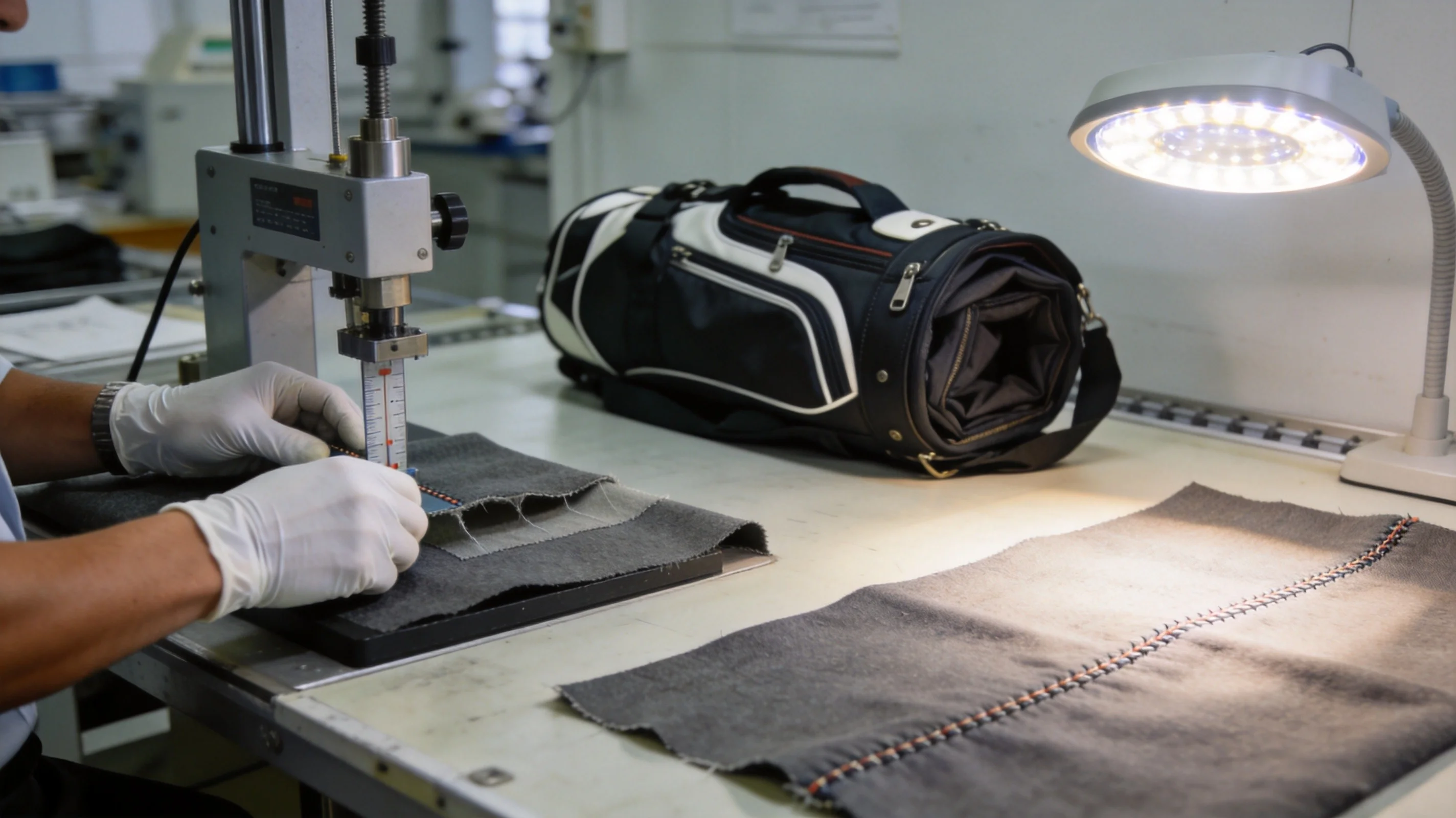
Quality control in golf bag manufacturing is a sequence of documented inspection gates — incoming material verification, in-process checks at cutting and sewing, finished-goods validation against the approved sample, and an AQL-based pre-shipment random sampling — that together turn a single good sample into a dependable bulk run; our own facility is ISO 9001:2015 certified and passed SGS and Alibaba verification in March 2026. This guide explains those gates and how to hold any factory to them.
Why Quality Control Is the Real Product
A golf bag is judged on the course, under weight, weather and years of use. A seam that splits, a buckle that snaps or a base that sags will reach the end user long before they ever read a spec sheet. Quality control is the discipline that prevents these failures from ever shipping. It is not a luxury added at the end; it is the system that decides, unit by unit, whether the product you designed is the product the customer receives.
For a buyer, understanding QC is strategic leverage. It lets you distinguish a factory that merely claims quality from one that can prove it — through procedures, records and a willingness to be inspected. This is exactly the territory covered in our quality standards guide, which turns abstract promises into measurable, verifiable criteria.
The Foundation: ISO 9001 and Documented Procedures
International quality management starts with a recognised framework, most commonly ISO 9001. Certification means the factory maintains documented procedures for everything that affects quality — from supplier management and production control to inspection and corrective action. It is not a guarantee that every bag is perfect, but it is strong evidence that the factory has disciplined, repeatable processes audited by an independent body.
Social and ethical compliance is addressed by frameworks such as BSCI (amfori Business Social Compliance Initiative), which audits working conditions. A factory holding both ISO 9001 for quality and BSCI for labour standards addresses the two independent concerns most global buyers raise first. Our facility holds both certifications and welcomes third-party audits; the verification we passed from SGS and Alibaba in March 2026 underlines that the claims are tested, not just stated.
Gate 1: Incoming Material Inspection
Quality control begins before any cutting, at the raw material stage. The factory verifies that arriving fabric, hardware, zippers, padding and trims meet the specification agreed with the buyer. Fabric is checked for weight (denier or ounces per square yard), colour fastness and visual flaws, while hardware is confirmed to be the correct grade and finish.
This gate matters because defects in materials propagate into every finished bag made from them. Catching an off-spec dye lot or a weak zipper at intake costs a fraction of what it costs to discover inside sewn bags. Serious factories sample incoming lots and quarantine anything that fails, refusing to accept the temptation to use cheaper stock to hit a margin.
Gate 2: In-Process Inspection at Cutting and Sewing
In-process inspection catches errors while they are still inexpensive to fix. On the cutting floor, products are checked for dimensional accuracy and panel completeness. On the sewing lines, supervisors and inspectors sample work at defined intervals, verifying seam quality, stitch density and assembly against a build standard.
The logic is straightforward economics. Correcting a mis-folded pocket at the sewing station takes seconds; dismantling a finished and decorated bag to fix it takes minutes and wastes decoration on a panel you must replace. By inspecting early and often, the factory prevents defects from compounding, keeping rework rates and costs low while protecting the schedule.
Gate 3: Finished-Goods Inspection Against the Sample
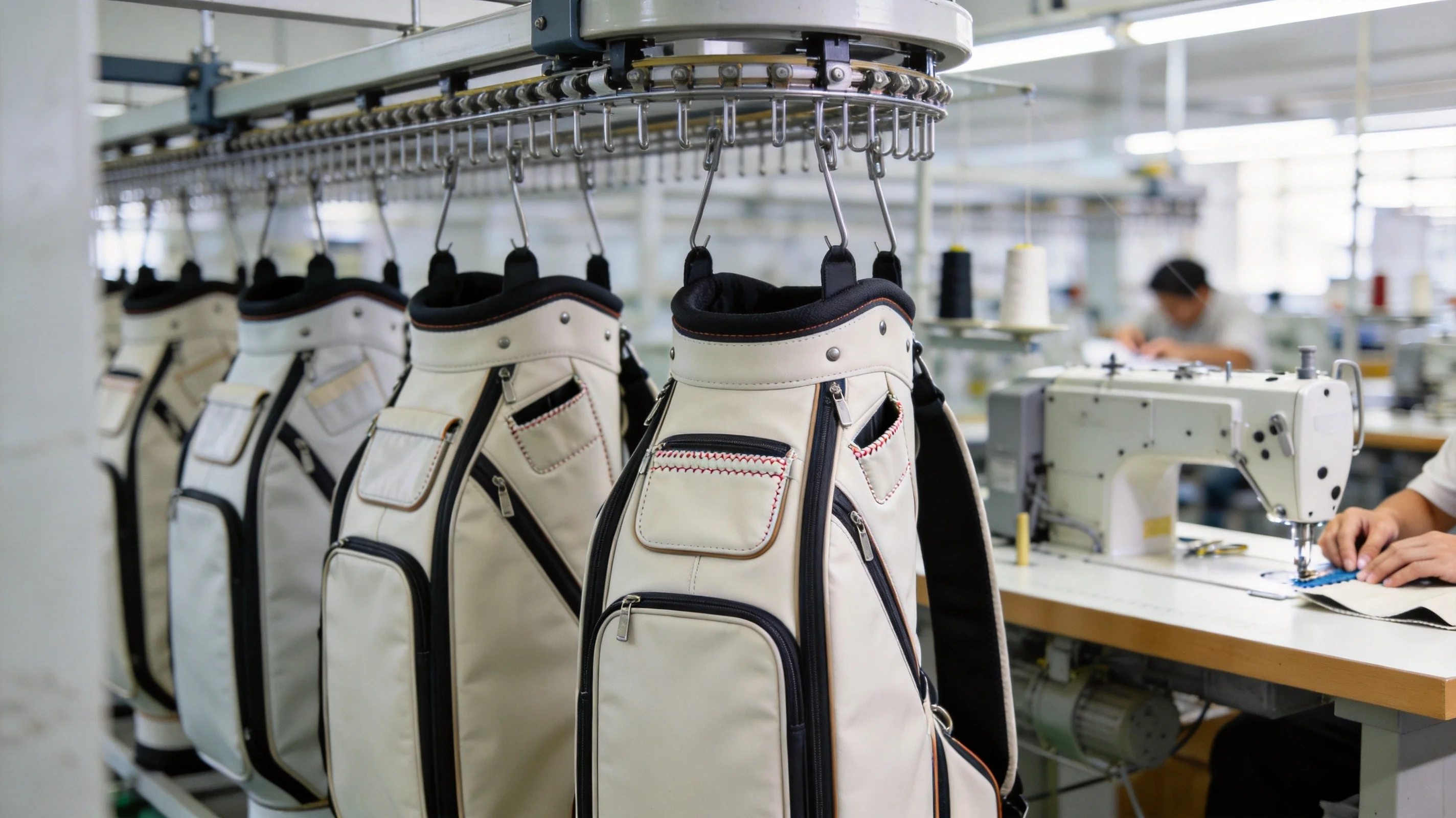
Once a bag is assembled, trimmed and decorated, it is checked against the approved sample — the ultimate reference. Dimensional checks confirm the bag matches specified height, width and depth. Seams are examined for tension, puckering and reinforcement at load points. Hardware and zippers are function-tested. Decoration is matched to the approved artwork for placement, colour and stitch quality.
The approved sample is the contract for appearance and build. Every finished bag should visibly and functionally match it within defined tolerances. This is why a rigorous sample-approval step is so consequential: whatever you approve becomes the standard every production unit is held to, so inspect the sample ruthlessly. Our sampling guidance explains what to check point by point so your benchmark is solid.
Function Testing: Beyond Visual Checks
Visual inspection does not catch every weakness, which is why function testing matters. A zipper must complete thousands of open-close cycles; a strap anchor must hold against repeated loaded pulls; a stand mechanism must extend and lock reliably; a base must support a full bag without distorting. Each is verified with practical tests, not just a glance.
Depending on the product and market, additional performance tests apply. Waterproof bags are tested for water resistance; heavyweight bags are loaded and lifted by their handles to validate strap and handle anchoring; divider systems are checked for grip protection and club clearance. Defining which tests matter for your product up front makes the QC agreement concrete rather than vague.
Need a Factory You Can Audit?
ISO 9001 and BSCI certified, SGS and Alibaba verified in March 2026, with open third-party inspection on every order. Contact us to see our QC procedures and recordings.
Discuss Your QC Requirements →Pre-Shipment Inspection and AQL Sampling
The final gate before packing is pre-shipment inspection, usually conducted under an AQL (Acceptable Quality Limit) plan. AQL is a statistically derived sampling method: from each lot, a number of units are drawn and inspected according to a defined sampling table, and the lot is either accepted or rejected based on how many defects of each severity the sample reveals.
Defects are typically classified as critical, major and minor. A common contract is AQL 2.5 for major defects and 4.0 for minor, critical defects always being grounds for rejection. Because the method is objective and statistical, both buyer and factory can agree on the same rule before production and hold to it afterwards.
Third-party firms such as SGS execute the inspection on-site before container loading, independently verifying sample selection, measuring against your criteria and issuing a report. For first orders and large shipments this independent check is one of the cheapest risk-reduction measures available. Our quality standards guide walks you through configuring your own AQL criteria.
The Quality Control Workflow at a Glance
For planning purposes, the QC sequence maps cleanly onto the production schedule. Treating each gate as non-negotiable de-risks the entire order.
| QC Gate | What Is Checked | When |
|---|---|---|
| Incoming material | Fabric weight, colour, hardware grade | Before cutting |
| Cutting | Panel accuracy, flaws, dye-lot control | During cutting |
| In-process sewing | Seam quality, stitch density, assembly | At each station |
| Finished goods | Dimensions, hardware, decoration vs sample | After finishing |
| Pre-shipment | AQL random sample of the lot | Before loading |
How Capacity and QC Interact
Quality control is demanding of staff time and management attention, which is why under-resourced factories cut corners. A factory that runs 7 production lines with 126 sewing machines and 137 employees, sustaining 200,000 bags a month, can dedicate trained inspectors to each gate without choking output. Headcount and organisation are, in effect, quality infrastructure.
The practical implication for a buyer: when evaluating capacity, ask how inspection is staffed, not just how many machines exist. A supplier with real inspectors per line and a documented plan will produce more consistently than one running at maximum output with no supervision slack. Capacity and quality are connected disciplines, not competing ones.
Verifying a Factory's QC Honestly
Because QC claims are easy to assert but harder to verify, approach any supplier with structured questions. Ask to see their ISO 9001 certificate and audit reports. Request the inspection checklists actually used on the floor. Ask about defect rates and corrective-action records for recent orders, and whether third-party pre-shipment inspection is permitted without surcharge pushback.
Reference brands are the strongest evidence. A factory that has served 200+ brands across 100+ countries has a track record that factories selling only on price cannot match. Combine references with a willingness to run a small test order, and you can validate quality commitments before committing to volume. Our manufacturer selection guide turns these questions into a structured audit a buyer can run.
Conclusion
Quality control is the disciplined sequence of inspection gates that guarantees a golf bag arrives as designed: without seam splits, failing hardware or mismatched branding. From incoming materials to an AQL pre-shipment sample, each gate catches a class of defect at the cheapest point to fix it. A buyer who understands these gates — and chooses an ISO 9001 and BSCI certified, audited factory that openly supports third-party inspection — is far less likely to open a container to find a returns problem instead of a saleable product.
The Economic Logic of Early Inspection
Quality control in golf bag manufacturing is ultimately an economic discipline as much as a technical one. The cost of correcting a defect rises steeply as production advances: fixing a mis-folded pocket at the sewing station takes seconds; correcting the same defect on a finished, decorated bag requires dismantling and wastes the decoration applied to a panel that must be replaced; and discovering a systemic flaw only at pre-shipment puts an entire container at risk.
This is why the inspection gates are sequenced the way they are. Each gate catches a class of defect at the point where it is cheapest to address, so the cumulative cost of quality is kept low while the level of protection stays high. A factory that understands this economics does not merely inspect more; it inspects at the right stages and spends its QC budget where it buys the most protection. This disciplined prioritisation is the difference between a quality system that works and one that merely exists on paper.
For a buyer, appreciating this logic changes how you evaluate a factory's QC. The question is not simply whether inspections happen, but whether they happen at the economically correct points and whether the factory can articulate why. A partner who understands early-inspection economics and applies it is protecting your order's quality and cost simultaneously.
QC Documentation and Traceability
Genuine quality control is documented, because undocumented inspections are untestable claims. A reliable factory keeps records of every check it performs — which materials passed intake, which panels were cleared at cutting, which stations reported clean in-process results, which finished bags were validated and what the pre-shipment AQL sample found. These records make quality traceable to a specific order and to specific actions.
Documentation also powers continuous improvement. By aggregating inspection results across orders, a factory can identify defect patterns, trace them to root causes — a machine calibration, a material lot, a training gap — and take corrective action that measurably reduces future defects. This turns QC from a static checkpoint into a dynamic system that gets better with every order.
Our facility maintains documented QC records per order under its ISO 9001 system, and the rigour is a large part of why we passed SGS and Alibaba verification in March 2026. For a buyer, requiring documented records and reviewing a sample of them is one of the most effective ways to verify that a factory's QC is real before you commit volume.
Partnering on Quality From the Start
The most reliable quality is achieved when buyer and factory agree the standard at the outset, not when a dispute surfaces at inspection. Agree the critical-to-quality criteria for your product — construction, materials, decoration, function — and an AQL plan, and write both into the order specification. Your approved sample anchors the visual standard; your written criteria anchor the measurable one.
Because our facility serves 200+ brands across 100+ countries, we are experienced at aligning quality expectations with buyers of varying sophistication. Establishing this alignment early, through a complete quality standards agreement and documented QC, is the strongest safeguard your product has after the container leaves the factory. Quality that is agreed in advance is quality that can actually be enforced.
The outcome of disciplined QC is a product your customers trust and reorder. Consistent, defect-free golf bags build the reliable experience that sustains a brand through seasons of use, and it is the factory's investment in early inspection, documentation and partnership that makes that consistency possible.
Building Quality Into Capacity and Process
Quality control is wholeheartedly a capacity question. Inspecting at every gate requires trained people and management attention, which smaller or overbooked workshops cannot always afford. A factory that runs 7 production lines, 126 sewing machines and 137 employees — sustaining 200,000 bags a month — can staff real inspectors at each gate without sacrificing output. Organisation and headcount are, in effect, quality infrastructure.
This is why capacity and quality should never be evaluated separately. When a buyer asks how a factory can both hit volume and hold quality, the honest answer is that the two are not in opposition: a properly staffed, well-organised facility does both, because inspecting is part of the process, not a competing demand on it. When a facility is under-staffed for its volume, inspection is the first thing to be skipped, and quality is the first casualty.
For a buyer, the practical screen is simple. Ask how inspection is staffed, how many inspectors work per line, and whether every gate is covered during full-volume production. The answers reveal whether the factory treats QC as an integrated commitment or as a margin that can be trimmed when orders pile up. An honest answer aligns with the documented process, and it is a strong predictor of whether a batch will arrive consistent or compromised.
Quality Control and Your Brand Reputation
Quality control is ultimately protecting something intangible: your brand reputation. Every golf bag that reaches a customer is a member of that brand's extended sales force. A defect-free bag that performs season after season quietly builds trust and repeat business; a failing bag provokes complaints, returns and negative word of mouth that can outlast the product itself. QC is the firewall between intended quality and received experience.
For brands serving 200-plus wholesale accounts and end customers across many markets, the stakes of any single bad batch are high. This is one reason we hold our QC standards so firmly and document them per order; protecting client reputations is inseparable from protecting our own. The controlling question for a buyer is not whether a factory can produce one fine bag, but whether it can consistently produce thousands of fine bags — and that is precisely what disciplined QC delivers.
By agreeing a thorough quality standard, verifying it through inspection and working with a factory that treats QC as a capacity commitment rather than an afterthought, you protect the reputation your bags carry. Our quality standards guide helps you establish that standard, and our commitment to documented, audited QC is how yours arrives as designed.
Social Compliance and Quality Culture
Quality in golf bag manufacturing is inseparable from a responsible production environment. An audited facility operating under recognised social-compliance standards tends to produce more consistently, because disciplined, safe working conditions and proper training translate directly into lower defect rates and steadier workmanship. We hold this philosophy as a structural part of our quality system.
Our facility has completed SGS factory audits and works in line with BSCI principles, and we document our processes under the ISO 9001 framework. Independent audits confirm that our working conditions, environment and management processes support the quality we claim. For importers, an audited factory is both a compliance and a quality signal, reducing the risk associated with a partner.
A quality culture is ultimately carried by people. Our 137 employees benefit from structured training and clear standards, which is why a 126-sewing-machine plant can sustain consistent craftsmanship across growing volume. When evaluating a factory, look beyond equipment to the audit and training record; the discipline it reveals is the strongest predictor of the quality your order will receive.
Getting Started With a Qualified Partner
The most practical way to turn this groundwork into a reliable product is to engage a factory with verifiable credentials, proven output and transparent process. A qualified facility founded in 2014, staffed by a team whose founder entered the industry in 2004, brings more than twenty years of hands-on knowledge to every programme. That experience shows in faster sampling, fewer defects and sound advice at each decision point.
At our facility in China, seven production lines and 126 sewing machines support a 137-person team producing about 200,000 golf bags a month for 200+ brands sold to 100+ countries. Backed by SGS factory audits and BSCI-aligned practices, we combine real capacity with documented quality control, so you can validate us before committing. Whether you begin with a 100-piece test order or move straight to a full production run, the milestones you have read here are the milestones we apply to your order.
To start, bring a detailed specification and an honest sense of your volume and deadline, and we will map the stages, timings and costs for your exact programme. With direct contact to our export team, service@junyuanbags.com or +86 17750020688, you can begin a conversation that moves quickly into a structured plan. The process and standards described above are not theory; they are the operating reality you are welcome to verify before your first container ships.
Our Factory Profile and How It Shapes This Standard
The standards and timings described here reflect how we actually operate. QUANZHOU JUNYUAN BAGS runs a 4,950 sqm
factory as an affiliated production partner, a facility founded in 2014 by a founder who entered the golf bag industry in 2004 — more than twenty years of hands-on manufacturing experience. It operates seven production lines with 126 sewing machines and a team of 137 employees, producing on the order of 200,000 golf bags per month for more than 200 brands in over 100 countries.
For custom and OEM/ODM work, our standard MOQ is 200 pieces, with a lower 100-piece test order available to validate a design before scaling. Prototype sampling runs 10-20 days, and bulk production runs 45-60 days, giving you a realistic, verifiable window rather than an optimistic promise. Our quality and compliance record is independently confirmed: the factory has completed SGS factory audits and its management system is documented under the ISO 9001 framework.
Questions on how these numbers apply to your product are welcome. Our export team is reachable at service@junyuanbags.com or +86 17750020688, and you can explore the services we offer through our OEM/ODM services and process guide pages. Wherever an order begins, these are the concrete operating figures behind every bag we build.
Sources
Frequently Asked Questions
- What is quality control in golf bag manufacturing?
- A system of inspection gates - incoming materials, in-process sewing, finished-goods checks and pre-shipment sampling - that turns a good sample into a consistent bulk run.
- What QC checks are performed on a golf bag?
- Dimensions, seam construction, zipper function, divider layout, strap anchoring, base rigidity, hardware and logo quality, plus material weight and colour at intake.
- What is AQL inspection for golf bags?
- A statistically based sampling plan where a sample is inspected and the lot accepted or rejected by defect count. Common levels are AQL 2.5 major and 4.0 minor.
- Should I use a third-party inspector for golf bags?
- Yes, for first orders and large shipments. Firms such as SGS inspect on-site against an AQL plan before loading, giving independent verification.
- How do I choose a golf bag factory with good QC?
- Look for ISO 9001:2015 and BSCI, audited facilities, documented procedures, open third-party inspection, and reference brands attesting consistent output.