Golf Bag Travel Protection & Airline Transport Guide 2025

Golf bag travel protection in 2025 comes down to one idea: keep fragile points decoupled from impact. A properly packed hard or hybrid case — heads inverted, spine bar across the top, all-club zips secured, dead space padded — is what survives aircraft holds and carousels, while the airline's liability cap covers only a fraction of a premium set's value, so protection plus insurance is the realistic minimum. The damage profile is concentrated at two moments: the drop onto the carousel and the crush under other bags in the hold, and both are manageable with the right case and packing order. This guide sets out the threats, the protection systems, the airline rules at the IATA baseline, and the factory checks that turn a case into genuine cover.
Most travellers overthink the case and underthink everything else. A high-end hard case that is loosely packed still breaks clubs, and a modest soft case packed intelligently often survives the trip. Protection is a system of five layers — case, bag cover, head sleeve, spine bar and pocket padding — deployed in the right order. This guide walks those layers in detail, matches them to the specific threats a real journey presents, then connects them to the airline rules and the insurance reality that sit around the whole plan.
What 'Travel Protection' Actually Means
Travel protection is not a single product; it is the combined effect of the container, the internal packing and the way the case is handled. The container — hard shell, soft-spined cover or hybrid — provides the first line of defence against impact and crush. The internal packing manages the second, keeping each club separate so force on the case is not transferred to a shaft or tip. The handling is the third, and it is the one you control least but influence most through a robust case, clear labelling and quick action at the carousel.
When a factory tests a travel product it tests the same three lines: a drop test for the shell, a crush or stacking test for the interior, and an impact-transfer check to confirm the club heads stay decoupled. That is the standard we round up in the impact-resistance standards guide, and it is the checklist a buyer should hold any supplier to.
The Real Threats: Drop, Crush, Water and Theft
Name the threats and the design follows. A drop onto the tarmac or carousel landing is the classic generator of cracked tips, snapped ferrules and dented heads — the case should have a hard base plate and reinforced corners that take the impact. Crush or stacking happens when heavier bags settle on top in the hold, so the case needs an arch or spine that stops its roof from pressing the club crowns. Water arrives as rain on the apron and condensation in the baggage hold, demanding a seam-sealed, water-resistant liner around the clubs. And theft or loss is mitigated by a TSA lock, an inner tag, a tracker and insurance — none of which prevents it, but all of which either deter it or recover the value.
Weight the threats for your own flying profile: a golfer on well-handled direct domestic routes faces mostly crush, while an international traveller through busy hubs faces drops, water and longer theft windows simultaneously. Matching the case to your dominant threats is the difference between buying a label and buying protection. The durability guidance for frequent travel weights these threats against flight frequency.
Hard, Soft and Hybrid: The Protection Ladder
Protection scales with shell rigidity, but so does weight and price, so the honest comparison is a ladder rather than a winner. A soft-spined cover offers the least drop protection but the easiest handling and storage. A hard case offers the most crush and drop defence for long-haul and frequent travel. A hybrid — hard base and top plates with a soft middle, or a full-length rigid spine over a fabric body — splits the difference and is the fastest-growing segment because it protects the vulnerable bottom and mouth while staying packable.
| Case type | Drop defence | Crush defence | Weight & storage | Best for |
|---|---|---|---|---|
| Soft-spined cover | Medium | Low-Medium | Light, folds flat | Light flying |
| Hybrid case | High at base | Medium | Moderate | Mixed frequency |
| Hard shell case | Highest | Highest | Heavier, bulky | Long-haul, frequent |
The full comparison of hard versus soft golf travel cases runs the trade-offs in more depth, including the wheel, hinge and closure details that matter even more than the shell itself over years of use.
Airline Rules and the IATA Baseline
The airline leg is governed by a small set of rules that are remarkably consistent thanks to the IATA recommended practice on sporting equipment. Golf clubs longer than about 3 ft (91 cm) are generally exempt from the 62-in (157 cm) linear-size limit, which is why a golf bag files as an ordinary checked item. The constraints that actually bind are the weight cap (about 50 lb / 23 kg on full-service economy, 20-23 kg on low-cost and some international routes) and the fee structure, which ranges from a first-bag fee to a dedicated sports-item charge. A few carriers further restrict loose lithium batteries in accessories, and smart trolleys may need to be carried or declared per battery rules.
Always verify the specific carrier's policy at booking and again 72 hours before departure, because 2025 saw several fee and weight changes, and the penalty for an overweight club bag at the desk is disproportionate to the few minutes a scale would have saved. The region-by-region table in the size requirements guide is worth keeping with you.
Packing the Case: Order and Padding
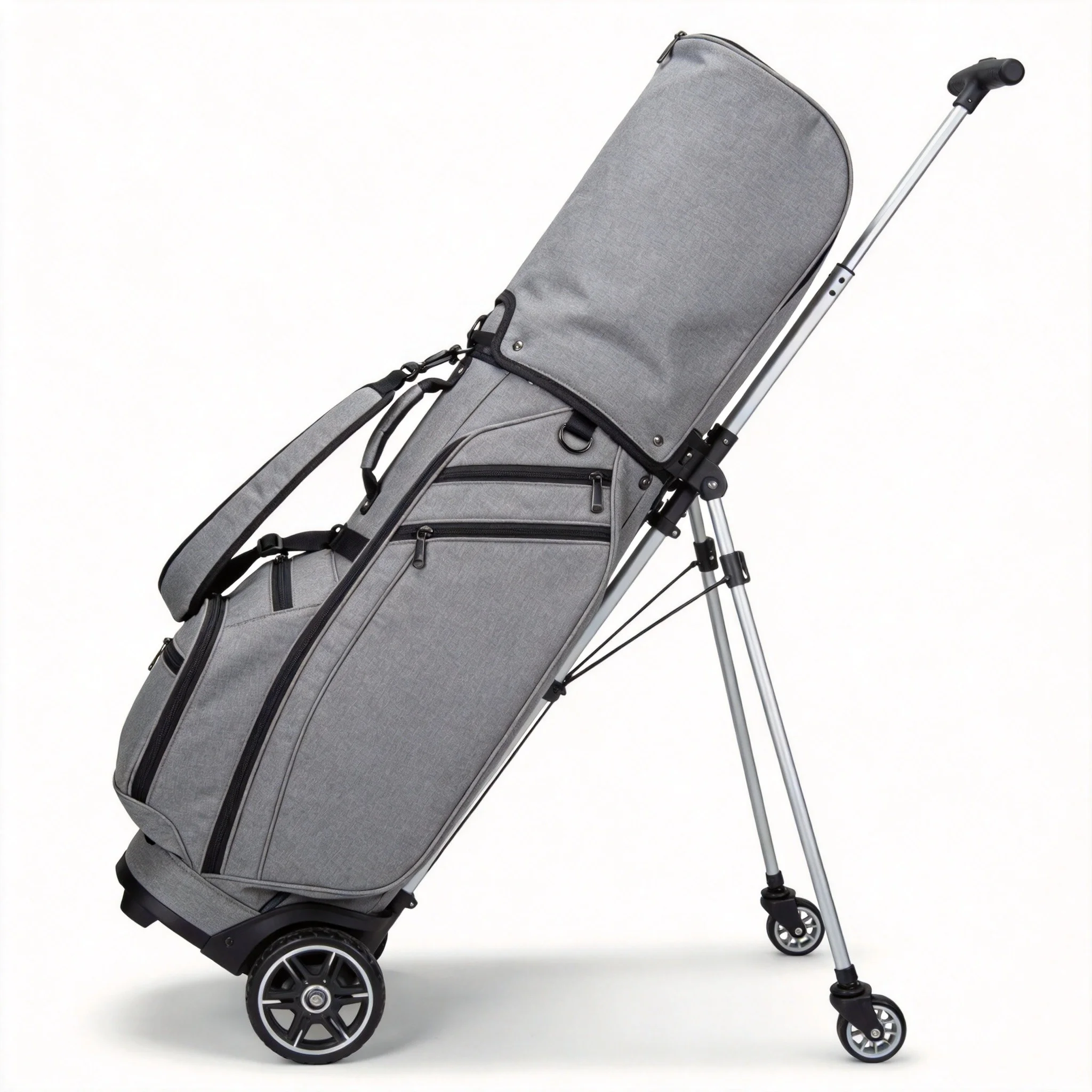
Protection is decided in the ten minutes you pack, not in the shop. The reliable order: remove adjustable driver and fairway heads, or face all fixed heads downward; fit a stretchable sleeve around the head bundle; lay a spine protection bar down the full length over the shafts; secure the club-bag zips so nothing spills; tuck shoes and soft items as crush padding in the dead space; close and zip the case firmly; then lock it with a TSA-approved lock and attach inner and outer destination tags.
The two mistakes that ruin otherwise good cases are leaving the head bundle upright and leaving gaping empty space. Upright heads put the most fragile part at the top where stacking pressure acts; empty space lets the set rattle so a drop becomes a multiple-play impact. Both are fixed below cost with a sleeve and a folded layer of clothing. The full twelve-point routine is documented in the step-by-step packing guide, which is worth printing once and pinning to the bag store.
The Spine Bar and Head-Protection System
The spine bar is the single most underrated protection device in golf travel. A rigid bar that locks down the length of the bag, resting over the shafts at the mouth, converts a case that could bend in the middle into one that resists compression from above. Placed correctly, it carries the load that would otherwise press the club crowns into the case roof. Pair it with a padded mouth collar and the fragile top of the set is fully cushioned.
Head protection completes the system: a silicone or stretchable sleeve over the driver and wood heads keeps them from knocking each other and from chipping when the case tips. Some cases integrate pegs or foam cradles for the heads; others rely on sleeves. Either approach is fine as long as the heads are removed or inverted and separated from each other and from the metal bases. This is the precise logic a factory validates in its impact-transfer test when it certifies a travel line, detailed in the clubs-during-air-travel guide.
Water and Weather Defence
Rain on the apron, spray in the trolley and condensation in the hold all put moisture inside a case over a long trip. A genuinely protection-grade case uses a seam-taped, water-resistant liner inside the main compartment and water-safe coated yarn on the exterior, so a wet tarmac transfer does not reach the grips. Rust on wedge faces and damp mould inside the bag are the classic signs a case leaked at the zip or the seam rather than being genuinely sealed.
For destinations that are warm and humid, pair the case with a moisture-absorbing pack in the club bag and let the bag air fully before the return flight. The notes on waterproof golf travel bags separate a real hydrostatic rating from a rain-cover claim, and the same test applies to the travel case as to any waterproof product in the range.
Locks, TSA and Anti-Theft Basics
Use a TSA-approved combination lock on the travel case. It lets screeners open and re-lock the case without breaking it, while a non-approved lock risks a cable cut or a cracked shell at inspection. Beyond the lock, an inner destination tag with a phone number, a dull exterior colour scheme that is less tempting than a branded case, and packing valuables in your carry-on are the practical anti-theft steps. A Bluetooth tracker adds a recovery channel not available on the airline's own system.
No lock prevents a determined thief, and no tracker recovers a case, but together they shift the odds sharply, and the few minutes they cost are trivial against the value of a full set. The security section of the transport guide expands the lock-and-claim procedure.
Insurance and the Liability Gap
This is the gap that costs people real money. Airline checked-baggage liability is capped at a modest per-kilogram figure — in practice far below the replacement value of a premium set — and the cap applies to the suitcase and, on many policies, excludes or under-values the individual golf clubs. The robust answer is a dedicated sports-equipment rider on a home contents policy or a stand-alone golf-insurance product that covers the set to replacement value on a named basis, ideally alongside cover for the rental car and personal effects on the trip.
Before flying, photograph the set and store the receipts; on damage, report at the reclaim office before leaving the area and keep the boarding stub. When shipping clubs ahead by courier, confirm the declared-value cover at booking, because parcel liability is often below the set's value too. Protection and insurance are complementary: the case stops the physical damage, and the policy covers the residual risk no case can remove.
Choosing by Route and Frequency
Match the protection spend to the route and how often you fly. A golfer making two direct domestic flights a year on reliable carriers can protect a modest set adequately with a soft-spined cover packed well. A nominal international traveller flying through busy hubs needs a hard or hybrid case built for drops, water and longer theft exposure, and likely a ship-ahead option for the long legs. The rule of thumb is that overall protection cost should sit at a sensible fraction — often between a tenth and a fifth — of the value of the set it protects, and it should scale with trip length and handling risk.
For retailers, that judgement becomes a tiering decision: offer a lightweight cover for casual players, a hybrid for mixed frequency, and a hard case plus an insurance referral for the serious frequent flyer, all at a factory-supported MOQ. The retailer custom travel bag guide shows how to build and price exactly that ladder.
How a Factory Validates Protection
Real protection is provable, and a responsible factory proves it. Look for documented drop tests at realistic heights, a crush or stacking load test on the case roof, a wheel load-and-roll test under 40-45 lb, hinge torque to thousands of cycles, seam-sealing checks against water, and an impact-transfer test confirming the club heads stay decoupled. Our affiliated 4,950 m² factory — producing golf equipment since 2004 and established as a company in 2014 — runs seven production lines with 126 sewing machines and 137 staff, manufacturing 200,000 bags a month for 200+ brands reaching 100+ countries, and passed an SGS audit in March 2026. Sampling runs 10-20 days and bulk production 45-60 days, at a 200-piece MOQ (100 for test orders).
Buyers should ask a supplier for its impact and wheel test records, the shell's cold-crack behaviour, the zipper cycle rating and the insurer's declared value, and should review the batch sample against those records before production. The OEM golf travel bag sourcing guide and the impact-resistance standards reference provide the concrete acceptance checklist to run with any maker.
Timing, Labelling and the Human Factor
A great case cannot out-engineer a chaotic harrow rush, so protect the moments you control. Check in early, on a less frantic weekday or off-peak flight, so the case is tagged and sorted when handlers are not already overwhelmed. Attach a bright, durable tag so the case is easy to spot and to lift correctly — handlers heave by the handle, not by the lock, when they can see where the grip is. Print the full itinerary on the inner tag, not just the destination hotel, so a misroute can be corrected instead of abandoned.
Treat the case as if it will be dropped, because on a busy day it will be: do not rely on exactness of handling; rely on the simplicity of the protection. A case that is easy for a handler to grasp, obviously fragile-labelled at the mouth, and packed so that nothing depends on a handler's care is the case that survives the human factor a transit hub cannot control. This same realism is why the factory pack-and-label guidance on travel-bag longevity emphasises a durable, legible label and a case that looks handled rather than brand-new.
Protection Beyond the Case: Rental Equipment and Events
The benefit of a properly protected, properly insured set is that you will not need a rental on the one trip where arriving matters. Rental clubs are a fine backup for casual holidays, but for a tournament, a fitting session or a course you otherwise love, only your own set performs identically. Walking the protection plan in advance — case, packing, track, insurance, ship-ahead decision — means the equipment shows up in the same configuration you practiced with, rather than a course's generic loaner positioned on a different lie and loft.
For events, shift the recommendation to a ship-ahead parcel booked a week out, or a designated luggage-forwarding partner the clubhouse provides, and arrange collection before the practice round. When you travel light and rent instead, protect your budget but not your expectations: confirm set model, shaft flex and across-time inventory before you pay, keep the rental receipt, and adjust your handicap expectations on an unfamiliar set and course. Rental remains an honest, cost-effective choice for a casual holiday, while your own protected set is the better answer for tournaments, fittings and courses you already trust to play your normal game.
Conclusion
Golf bag travel protection in 2025 is a system, not a product: choose a case scaled to your worst threat, pack the fragile points with the spine bar and head sleeves in place, keep the case genuinely sealed against water, lock it TSA-approved with an inner tag and tracker, and back it with insurance because airline liability caps fall far short of a premium set's value. Match the spend to route and frequency, and hold any factory you use to real drop, crush, wheel and seam evidence. Do all of that and the difference between a protected set and a damaged one becomes a matter of a few minutes and a little planning — not luck.
Sources
Frequently Asked Questions
- What is the single most important pack for golf travel protection?
- Invert or remove the club heads and place a spine protection bar across the top of the shafts, then pad the dead space. The driver head is the most fragile point, and inverting it lets the case's base plate absorb the impact instead of the tip.
- Hard or soft case: which protects clubs better?
- A hard shell offers the highest drop and crush defence because the rigid body spreads force away from the clubs. A soft-spined cover protects adequately for light flying but leaves more risk under stacking and drops, so pick by route and frequency.
- What does the airline liability actually cover for a golf bag?
- Checked-baggage liability is capped at a modest per-kilogram figure, almost always below the replacement value of a premium set, and many policies under-value clubs. Use a sports-equipment rider for full cover and photograph the set first.
- Is a TSA-approved lock necessary on a travel case?
- Yes. It lets screeners open and re-lock the case without breaking or cutting it. A non-approved lock risks damage at inspection, and a cut cable or cracked shell is exactly the kind of avoidable fitness failure it stops.
- Can I pack clothes and shoes in my golf travel case?
- Yes, and soft items double as crush padding in the dead space. Just keep the packed weight under the airline cap (about 50 lb / 23 kg on most economy fares) and weigh the case before you fly.
- How do I match a travel case to my trips?
- Scale protection to route, frequency and set value. Occasional direct domestic flights can use a well-packed soft cover; long-haul or frequent travel through hubs deserves a hard or hybrid case plus, for the longest legs, a ship-ahead or insurance option.
- What factory tests prove a case protects?
- Ask for a drop test at realistic height, a crush or stacking test, a loaded wheel roll, hinge torque to thousands of cycles, seam-sealing checks, and an impact-transfer test confirming the heads stay decoupled.