Golf Cart Bag Size and Dimensions: Complete Guide

Most standard golf cart bags measure about 85-96 cm (33-38 in) tall, roughly 25-30 cm (10-12 in) across the top opening, 33-37 cm (13-15 in) at the widest body diameter, and carry a full 14-club set at an empty weight of about 1.7-2.5 kg — and those numbers exist because they are the dimensions that fit standard cart trays while keeping clubs standing vertically. This complete guide turns dimensional decisions into a precise, usable spec, drawing on pattern and production data from QUANZHOU JUNYUAN BAGS (founded 2014, founder in the trade since 2004), which builds cart bags of many sizes for more than 200 brand partners in over 100 countries. Whether you are buying one bag or tooling a new private-label cart bag, knowing the actual numbers is what protects you from a bag that is too tall to fit a cart or too shallow to protect long clubs.
Size is the most under-appreciated specification in the whole bag category. Buyers who would never tolerate a mis-sized fit in apparel freely buy golf bags without checking the dimensional fit against their cart and their clubs — and then discover, at the first tee or the first container load, that the bag is wrong. This guide gives you the complete dimensional picture: height, top opening, body diameter, depth, divider footprint, club capacity, cart compatibility, weight and the tolerances you should hold to. Where a real standard exists, we name it; where marketing exaggerates, we correct it with the production numbers we actually cut to.
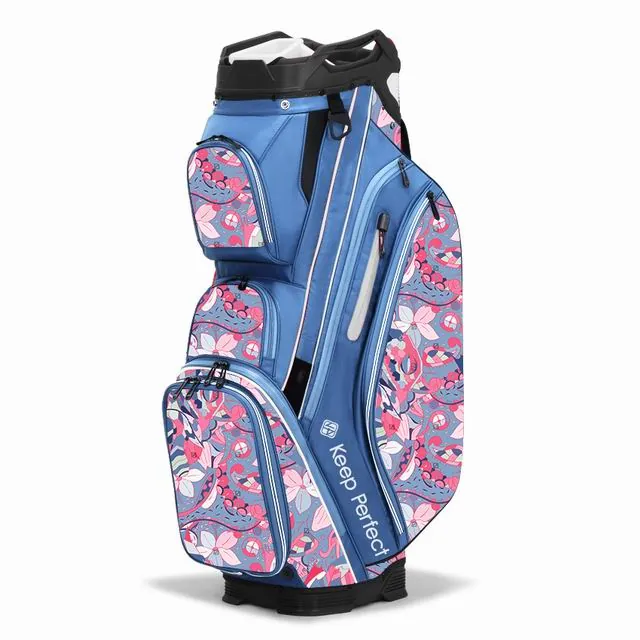
Why Dimensions Matter Before You Buy
Three fit failures cover nearly all size-related complaints. A bag too tall for a cart tray tips the clubs forward or rubs the steering column; a bag too wide for the strap violates the tray footprint and pinches straps; and a bag too shallow in internal depth leaves long irons unsupported so heads bang inside. Each failure is preventable with three numbers: overall height, widest diameter or footprint, and internal divider depth. Get these right and the bag disappears into its job; get them wrong and you notice it on every round and every cart mount.
For OEM buyers the stakes multiply because a dimensional error is baked into hundreds of units. This is precisely why factories hold dimensional tolerances in production and why pattern engineering is a real discipline. When we tool a new cart bag, we lock the cut dimensions and test them against a reference fixture — the kind of discipline that keeps one customer's cart bag from silently becoming 2 cm taller than the approved sample. The numbers below are the standards we and much of the industry build to.
Height: The Most Contested Number
Overall height is measured from the lowest point of the base to the top of the opening. The useful range for a standard cart bag is roughly 85-96 cm (33-38 in), and the most forgiving common size sits around 88-92 cm. Height matters primarily because it sets how deeply and how vertically clubs stand in the bag, which in turn affects whether the longest drivers and woods rest their heads against the padded top ring or lean and rattle. A bag on the taller side of the range supports longer clubs more vertically, which protects shafts and keeps grips from tangling.
But taller is not automatically better. Very tall bags can tip on carts with low trays, and they can be awkward in some car trunks. The right height is the one that keeps your clubs standing nearly vertically while seating securely in the cart tray. When comparing two bags, measure both actual overall height and internal divider depth — the usable depth that actually supports the club shafts — because a thick top ring or a reinforced collar can inflate the external height without adding real club support.
Height also interacts with how the bag carries its weight once loaded, which is why dimensional decisions should never be made in isolation from balance. A bag that is dimensionally correct but tips the centre of gravity high will still rock on the tray, and a bag that is stable but slightly too tall will rub the steering column. The most useful habit is to treat height, base footprint and loaded balance as one system, and to cross-check them together rather than approving a measurement on paper. Our cart bag weight and balance guide explains how the loaded centre of gravity should sit low and close to the tray for a truly stable ride, and pairing it with this dimensioning guide gives you the full picture before you commit to a specification.
Top Opening and Divider Footprint
The top ring opening typically measures 25-30 cm (10-12 in) across, and the way that opening is divided sets both capacity and how the clubs pack. A full-length 14-way divider divides the opening into 14 individual slots so every club has its own channel from the ring to the base, eliminating chatter and grip tangling. An 8-way layout is a popular compromise that still isolates most clubs while keeping an unusually large putter well. The 14-way is the best club protector but can make it slightly slower to return a club to its slot compared with an 8-way, which is why both remain common.
For OEM work the divider topology is a core design decision because it changes the top ring tooling and the internal structure cost. Most of our cart bag production uses a full-length 14-way divider as the default for tournament and rental buyers who want maximum club protection, while 8-way suits the recreational rider who values an organized, easy-access opening. Your choice should match how the user actually returns clubs between shots, not just how the opening looks on a shelf.
Body Diameter and Cart Tray Fit
The widest body diameter of a standard cart bag is about 33-37 cm (13-15 in), and this is the number to check against your cart tray. Motorised cart trays and two-wheel trolleys publish width limits, and a bag that overhangs its tray will interfere with the steering column, pinch the straps or rock in motion. Most standard cart bags fit most standard trays, but the wide side of the range can be tight in compact electric trolleys, and the narrow side can look lost in a wide resort cart.
The base footprint — the flat bottom area that actually contacts the tray — is what matters for stability, and it should be close to the widest diameter so the bag sits flat rather than tapering to a narrow bottom that wobbles. A rigid, molded base that matches the body diameter at the tray line is the single best guarantee of a stable mount. When measuring a sample, set it on your actual cart tray and confirm there is no overhang and no excessive play. For a full treatment of how a bag's base and footprint affect a stable ride, see our quality standards guide.
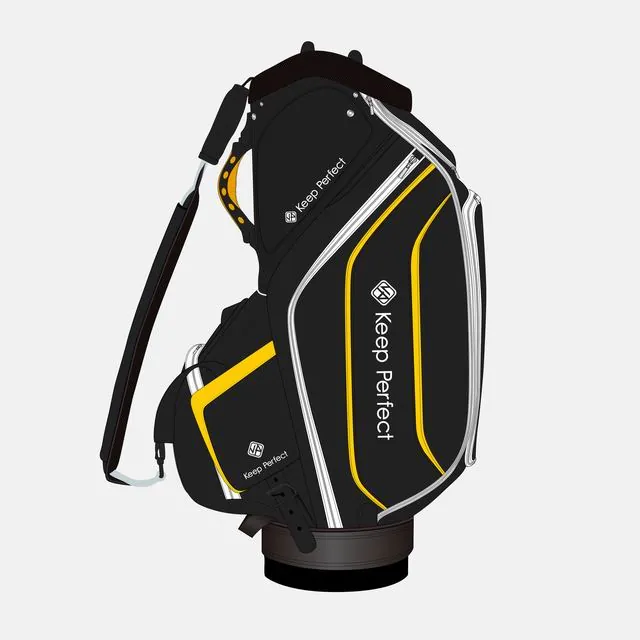
Depth: The Number Buyers Ignore
Internal depth — the distance from the top ring down to the base inside the bag — determines how much club shaft is supported below the grip. A shallow divider leaves the heads free to knock together near the top and lets long clubs lean; a deep one holds them firmly upright. Standard cart bags provide roughly 40-49 cm of usable internal depth, and for taller players carrying a long driver it is usually the deeper side that feels right. Depth, like height, should be verified with a club slid all the way down, not assumed from the external shell.
Depth interacts with height: a manufacturer can achieve a tall external silhouette with a shallow interior by adding thick walls and trim, which is why the internal measurement is the honest one. When you evaluate a bag, slide a driver to the base and check how much of the grip is exposed relative to the top ring. If a long club's head sits well above the padded collar, or the shaft bends near the base, the depth is wrong for your longest club regardless of what the tall silhouette suggests.
Club Capacity and 14-Club Compliance
The Rules of Golf limit a golfer to carrying 14 clubs, and a proper cart bag supports that full set whether laid out in a 14-way, 8-way or 5-way divider. Capacity is a function of the divider topology and the top ring diameter more than the bag height, so a compact bag can still be fully compliant. The practical difference between divider layouts is not whether 14 clubs fit — they all fit — but how cleanly they sit, how protected they are and how easy they are to retrieve and replace. If you play irons and wedges with thick grips, check slot width: some premium oversized grips can be tight in narrow divider channels.
Buyers should also consider the putter well. Many players prefer a dedicated, full-length putter well so the putter stores separately without pressing its head against other grips, which is a feature increasingly expected at the mid-market and above. When choosing for a specific player, match the divider layout to how that player organizes their set — the bag that feels fastest in the hand is the one you will actually use well.
Weight: Empty Weight and Balanced Load
Empty weight for a standard cart bag is roughly 1.7-2.5 kg (3.7-5.5 lb). Since a cart bag is not carried, there is no strong incentive to strip it thin, and buyers in the very light range should ask what reinforcement was removed. Conversely, a bag well above 2.5 kg is carrying unnecessary dead weight on the cart and is often over-built in unhelpful ways. The better metric is balance with a full set loaded, not empty weight alone: a bag that stays upright on the cart, does not list, and seats its weight low and close to the tray is the one that rides well.
Load-weight distribution is the forgotten half of the equation. When 14 clubs plus balls, tees, a rangefinder and a few accessories are added, a bag can carry 8-10 kg or more, and where that load sits matters on a slightly tilted cart. A bag with a low center of gravity remains stable when the cart brakes or turns, while a top-heavy arrangement lists and can pull a corner strap loose. In production we tune the base weight and the distribution of the internal structure to keep the loaded center of gravity low; buyers tuning by feel should push a fully loaded bag on a slight tilt and watch whether it stays planted. The most realistic evaluation is always the loaded one.
Note that while lightness can be a legitimate product feature for some models, our manufacturing identity is balance and durability rather than chasing small weight numbers at the cost of structure. A durable, well-balanced cart bag at the mid-range of that weight band will outlast a featherweight bag with a weak base on real cart duty. When comparing, lift both empty and loaded, and watch how each behaves on a tilted cart tray.
Cart Compatibility: Motorized, Push and Electric
Cart bags are designed to ride, and compatibility spans three platforms: motorized riding carts, two-wheel push trolleys and electric trolleys. The deciding specs are the base footprint and overall height against the cart's tray dimensions and strap layout. A bag that fits your shopping-cart-sized resort cart may not fit a compact electric trolley, so verify against the specific model. Standard cart bags in the 33-37 cm diameter range cover the large majority of cart trays, and the safest purchase is one that sits within the tray with no overhang.
Push trolleys add a subtlety: the bag's strap guides or pass-throughs should align with the trolley's mounting points, and its center of gravity should sit near the trolley axle for easy pushing. A bag whose weight rides too high is noticeably harder to push on slopes. If you use a push or electric trolley, load the bag, mount it and push a few paces before buying. For a deeper comparison of how bag geometry interacts with trolleys, our golf bag types guide covers cart, stand and push-cart bag differences.
Tolerances, Measuring Conventions and Compliance
Dimensions are only as useful as the convention they are measured by, and the industry is inconsistent about where a measurement starts and ends. Overall height, for example, can be quoted with or without the top-handle loop, and body diameter can be measured at the widest pocket bulge or at the shell. This ambiguity is why buying on a number alone is risky: the same metric can describe different physical objects from different suppliers. Insist that a factory state its measuring convention — where the tape starts and ends — and ask for a measurement on a physical sample so you can reproduce it yourself.
Holding tolerances matters for anything that must fit another object. A cart bag's base must sit within a cart tray, so a production tolerance of plus or minus a centimetre on body diameter is the difference between a same-fit bag and a bag that overhangs. Ask your factory its dimensional tolerance and how it verifies on the line. Our QC checks follow a locked measuring convention and confirm the approved sample's numbers on production units, so the bag that arrives matches the bag you approved. This kind of discipline is standard in the garment OEM world and is exactly what you should expect from a serious golf bag partner.
Standard Custom Cart Bag Dimensions Reference
When specifying a custom cart bag, the following reference range covers the large majority of retail and course programs we produce across 200+ brand partners. Treat these as design anchors, then tune to your market and your cart models.
| Dimension | Standard Range | Buying Note |
|---|---|---|
| Overall height | 85-96 cm (33-38 in) | 88-92 cm is the most forgiving |
| Top opening | 25-30 cm (10-12 in) | Drives divider layout |
| Body diameter | 33-37 cm (13-15 in) | Check against cart tray width |
| Internal divider depth | 40-49 cm | Verify with a long club |
| Club capacity | 14 (14-/8-/5-way) | Match to player organization |
| Empty weight | 1.7-2.5 kg | Balance matters over raw weight |
How a Manufacturer Tools a Custom Size
For OEM production, dimensions are locked at the pattern stage with a cut-and-sew envelope that accounts for seam allowance, so the finished bag matches the spec within a tight tolerance. We cut the shell to a dimension that yields the approved external height and diameter after assembly, then verify the finished product against the dimensional standard before it ships. Dimensional control is one of the quiet attributes buyers trust a factory for: the approved 88 cm sample should arrive as an 88 cm carton-loaded unit, not drift across a run.
Choosing a bag size is ultimately an exercise in fit, and manufacturers and buyers converge on a small set of standard configurations precisely because they fit the widest range of golfers and carts. If most of your playing group rides a standard resort cart and carries a conventional set of 14 clubs, the 88-92 cm height, 33-37 cm diameter and 14-way divider package is overwhelmingly likely to serve well. If your users include juniors, many of whom use shorter clubs, or taller players who prefer a deeper bag for a long driver, tune the height and depth accordingly. These are the decisions that convert a generic bag purchase into an intentional one.
That reliability comes from holding production lines to the pattern rather than eyeballing. Our 7 production lines and 126 sewing machines run against locked cut files, and our QC checks dimensional tolerance at inspection. When you custom-order, ask your factory which tolerance it holds and how it verifies; a factory that can state a number is a factory you can plan around. For the wider quality-control framework, the quality standards guide details how dimensional and construction checks fit into QC from cut to carton.
The Three-Measurement Test Before You Commit
Regardless of brand claims, run three quick measurements on any candidate bag. Measure the overall height and the internal divider depth with a tape against the inside. Measure the widest body diameter and set the bag on your exact cart tray to confirm fit. And weigh the empty bag, then load 14 clubs and confirm it stands upright on a slight tilt. These three checks — height/depth, tray fit and loaded balance — catch the overwhelming majority of size-related mistakes in under five minutes at the shop or at your desk with a sample.
If you are specifying a run, add a fourth step: have the factory cut one sample to your exact dimensions, test it on the real carts your users will ride, and only then approve bulk. With sampling in 10-20 days and bulk production in 45-60 days at QUANZHOU JUNYUAN BAGS, and an MOQ of 200 pcs (test order 100 pcs), there is time to lock dimensions properly before a single container is committed. For help turning your target dimensions into a working cart bag, contact our engineering team — service@junyuanbags.com or +86 17750020688.
Getting a Size, Weight or Dimension Study Wrong Is Expensive — this guide exists to prevent that. Every number above is grounded in production reality rather than shelf marketing: the same dimensions we cut against when building cart bags for 200+ brand partners.Frequently Asked Questions
- How tall is a standard golf cart bag?
- Roughly 85-96 cm (33-38 in) overall, with the most forgiving conventional height around 88-92 cm.
- How wide is a golf cart bag?
- The top opening is about 25-30 cm (10-12 in); the widest body diameter is usually 33-37 cm (13-15 in), fitting standard cart trays.
- How many clubs does a cart bag hold?
- 14 clubs, the legal limit under the Rules of Golf, typically in a full-length 14-way or 8-way divider.
- How much does a cart bag weigh?
- About 1.7-2.5 kg (3.7-5.5 lb) empty. Lighter bags often cut base and handle reinforcement.
- Will a cart bag fit on push trolleys and electric carts?
- Most standard bags fit both if their 33-37 cm base footprint and height sit within the cart's tray specs; always verify the specific model.
- What are standard custom cart bag dimensions for OEM production?
- About 88-92 cm tall, 25-30 cm top, 33-37 cm body, 40-49 cm depth. MOQ 200 (test 100), sampling 10-20 days, bulk 45-60 days.
Sources
- USGA – The Rules of Golf (14-club limit)
- Golf Digest – Golf Bag Fit and Equipment Guidance
- Golf Monthly – Golf Cart Bag Dimensions and Reviews
- MyGolfSpy – Independent Golf Equipment Testing
Content director: QUANZHOU JUNYUAN BAGS. For custom cart bag dimensioning, email service@junyuanbags.com or call +86 17750020688.