Why Compatibility Problems Are So Common on Modern Carts
A golf push cart or electric trolley is compatible with a bag when the bag's base footprint, strap anchors and balance point match the cart's tray, footwell and securing system; for standard push carts the safest choice is a flat-base cart bag, and for electric trolleys you must verify the base fits the footwell because mis-matched geometry is what causes bags to topple mid-round. It is worth understanding why the bag-and-cart mismatch keeps surprising golfers, because the root cause is that neither side was built to a single shared standard. Cart manufacturers design the tray, cup or footwell around their own geometry, and bag manufacturers design the base around their own format, so the only thing forcing them to fit is the buyer thinking to check. On modern push carts annd-cart mismatch keeps surprising golfers, because the root cause is that neither side was built to a single shared standard. Cart manufacturers design the tray, cup or footwell around their own geometry, and bag manufacturers design the base around their own format, so the only thing forcing them to fit is the buyer thinking to check. On modern push carts and electric trolleys that gap has widened rather than narrowed: trolley engineers now optimise for weight and fold size, while bag designers optimise for pocket capacity and on-brand styling, and neither always leaves room for the other. That is why the compatibility checklist in this guide is genuinely necessary in 2025 rather than a box you can tick in your head.
Adding to the confusion is that the words "fits" and "compatible" are used loosely in product listings. A cart that "accepts most cart bags" may still need a specific base depth or a strap placed at a particular height. So treat any compatibility claim as a starting point and verify the four contact points yourself: the base footprint, the bottom plate, the balance point and the strap anchors. Those four points decide whether a pairing is a pleasure or an ongoing, wobbling frustration, and they are all measurable in the two minutes it takes to vary a bag onto the cart before you buy.
Cart Bags, Stand Bags and the Base That Decides It All
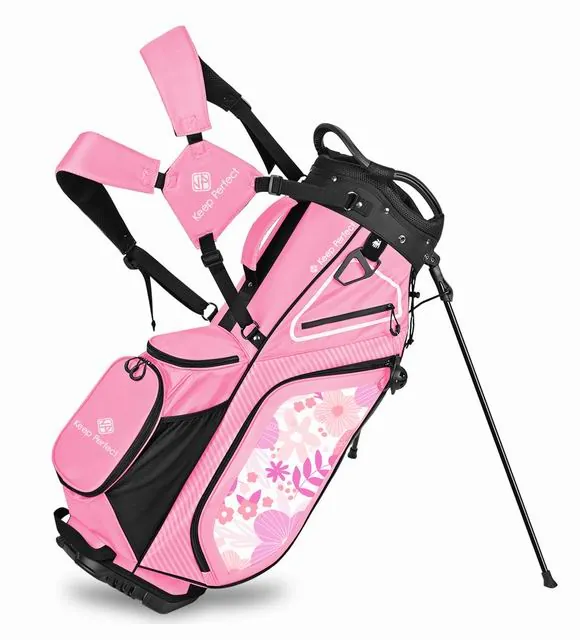
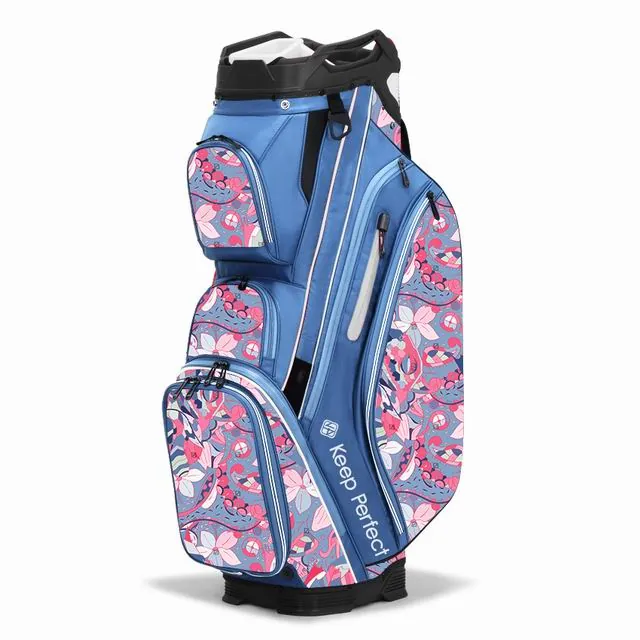
Because the base is the whole story, it helps to separate the main bag families by what their bases do. A dedicated cart bag has a wide, flat, recessed base engineered to sit on a platform — that flat contact area and the recessed bottom plate are the traits that make it the easiest match across manual and electric trolleys. A stand bag, in contrast, packs a fold-out leg assembly and feet into its base, which makes its footprint irregular and, when the legs are stowed, narrower and less predictable on a cradle. A tour or staff bag has an oversized, very rigid base that seats beautifully but can be too deep for the compact trays of some modern push carts.
If you mainly ride, the flat-base cart bag removes most compatibility risk by design, which is why the advice in our guide to picking a cart bag for maximum club protection, and the broader cart bag category information on the products page, both lead with base geometry. If you alternate between a stand bag and a trolley, the practical rule is to slide the stowed legs fully home and confirm the base settles into the tray without the feet jamming. Either way the base is the specification, and the rest of the bag only matters once it seats level.
Batteries, Motors and the Weight That Walks With You
One of the more subtle compatibility questions with electric trolleys is how the bag interacts with the battery and motor package, because those components change where the bag must sit. On a rear-motor trolley the bag rides high in the frame and the footwell is small, so a bag with a very deep base may not seat fully; on a front-motor trolley the bag sits over the motor hump and a narrow base may rock side to side. Knowing which motor and battery layout your trolley uses, and matching the bag base to that, prevents the two most common electric-trolley complaints: a bag that will not seat fully and one that wobbles because its base is narrower than the wheel track.
Electric trolleys also add a comfort variable that has nothing to do with the bag and everything to do with the pairing: the trolley's balance feels different depending on how high the bag rides and how it is loaded. A bag seated low and level, with heavy items in the lower pockets, keeps the whole unit stable and makes the motor work efficiently; a bag that rides high or is tail-heavy loads the trolley unevenly and drains the battery faster. So for electric riders the compatibility brief extends to weight placement, which is why we cover loaded balance in the checklist at the end of this guide.
Accessories, Straps and Getting the Rest Right
While the base is decisive, two smaller details complete the fit: the securing strap and the carry handle. Check that the cart's strap can reach around the bag at the balance point without being too long or too short, and that the bag has a sturdy handle at a height that lets you pick the whole unit up without stooping. A strap that rides over a pocket opening makes that pocket awkward to use, and a strap that sits too high lets the bag sag forward. Because these are easy to adjust, they are the details you can usually solve with a small strap pad or a bag repositioning rather than a different bag — but they are worth knowing before you travel to a course and discover them at the worst time.
For riders who want to remove compatibility doubt entirely, the cleanest solution is to buy the bag and cart as a matched pair or to work with a supplier who can confirm the base geometry against the trolley you use. Our cart-ready range on the products page and, for volume buyers, the wholesale pricing guide both assume the compatibility question is settled at the factory stage rather than left to the first tee. Settling it in advance is the difference between a pairing you never think about and one you adjust every round.
Measurement, Verification and a Repeatable Method
Because compatibility is a specification, it also needs a repeatable method rather than a one-off guess. Build a tiny standard: measure the bag base (width by depth), note the recessed plate depth, find the balance point by balancing the empty bag on a flat bar, and verify the strap anchors sit within a sensible band of that balance point. Then test on the actual cart. Write these numbers down once for your regular setup and you can evaluate any future bag or trolley against your own baseline in under five minutes, which is faster and more reliable than re-learning the fit from scratch every season.
Conclusion
Bag-and-cart compatibility is a real, measurable specification built into the base and the strap geometry — not a matter of luck. Match the base footprint to the cart tray or footwell, confirm the recessed plate and anchor positions, load for a low centre of gravity, and verify a level seat under pressure. Get that right and your push cart or electric trolley pairing quietly works on every round. Our affiliated factory in Quanzhou engineers cart-ready bases as standard, so if you want a bag that is genuinely fit for your cart, we can build and prove that compatibility before you commit.
The 2025 Bag-and-Cart Match: Why Compatibility Is a Specification, Not Luck
Most golfers assume any bag fits any push cart or electric trolley. The data says otherwise: base widths, foot geometry, axle height, and strap systems vary so much between models that roughly a third of compatibility problems surface only at the first tee, when the bag refuses to sit level. On a 2025 push cart or electronic trolley, a correct match is a specification you verify before purchase, not a hope you carry to the course. This guide turns that guesswork into a measurable checklist based on how carts and bag bases are actually engineered.
How Know Your Base: The Part of the Bag That Actually Touches the Cart
The single most important compatibility point is the bag base, because it is the entire contact surface with the cart platform. Push carts and trolleys use a cup, a U-shaped cradle, a flat platform, or a front-and-back strap system with a bottom stop, and each of those interacts differently with a bag's base. A cart bag with a wide, flat, reinforced base is engineered to sit level on a platform-style cart; a stand bag, whose base houses a fold-out leg assembly and feet, tends to be narrower and can wobble or tilt on a cradle not shaped to hold it.
Before you compare two bags, measure three things on each candidate: the base footprint (width by depth), the presence of a recessed or reinforced bottom plate, and where the lowest strap anchor sits. On trolleys with a fixed bottom cup, the bag base must drop in cleanly without the leg mechanism or feet jamming against the cup walls. On folding push carts with a tension strap and a foot tray, the base must rest on the tray so the strap can hug the bag at the balance point. When a bag's base geometry is incompatible, no amount of strap tension fixes the tilt — this is why base shape is the first thing factory engineers check when asked for a "fits-on-cart" spec.
Bag Type Versus Cart Type: A Compatibility Matrix
The practical rule is to group both the bag and the cart by how each is built and then match the two families. Here is the ranking most cart and bag engineers use when advising buyers, from the most stable to the most fussy combinations:
| Bag type | Manual 2-wheel push cart | 3-wheel push cart | Electric trolley | Riding golf cart |
|---|---|---|---|---|
| Cart bag (flat base) | Excellent | Excellent | Excellent | Excellent |
| Stand bag (legs + feet) | Good with base stop | Good | Good when strapped | Fair - may need top strap |
| Staff/tour bag (oversized base) | Good | Good | Good | Excellent |
| Sunday/light bag (narrow base) | Fair - may tilt | Good with tray | Fair - narrow | Good |
The takeaway is that a purpose-built cart bag gives the easiest, most predictable match across all trolley styles because its flat, wide base and recessed bottom plate are designed for exactly that contact. A stand bag works on most trolleys, but the integrated legs and feet mean you must check that the fold mechanism does not clash with the cradle or bottom cup. Staff bags have oversized bases that seat beautifully on carts but can be too deep for some compact push-cart trays. Sunday bags are the opposite problem: their narrow base can tilt side to side on a wide platform unless a tray or strap holds them.
Axle Height, Narrow Bases and the Real Cause of Toppling
Toppling is almost never caused by the bag itself being heavy; it is caused by a narrow base combined with a high or rear-biased centre of gravity, plus wheels that are narrower than the base. On a push cart, the bag's weight should sit between the axle wheels. When a bag base is smaller than the space between the wheels, the cart behaves like a top-heavy object and wants to rock. Electric trolleys in particular have a motor and battery low in the chassis, so the stability comes from the trolley, not the bag; the bag only needs to sit within the frame rather than balance its own load.
Two concrete measures prevent most toppling. First, check that the bag base width is at least 80 percent of the cart's wheel track; below that, add a cart-specific base adaptor or use a bag with a wider recessed plate. Second, distribute weight in the pockets so the heavy items (battery pack aside, your rangefinder case and water bottle) sit low rather than in the top pockets, because a top-heavy load raises the centre of gravity even on a perfectly matched cart. These are the same two checks we run in the factory on the base design of every cart-ready bag we produce.
Electric Trolleys: Battery, Motor Position and Bag Frame Fit
Electric trolleys add two factors a manual cart does not: a battery compartment and a motor. On most 2025 models the battery sits low in the base and the motor turns the front or rear wheels, which means the bag rides inside a fixed aluminium frame with a defined footwell. Compatibility here is about the footwell envelope, not just the base. Measure bag base depth and the lowest rigid point (legs, feet, or a protruding seam) against the footwell dimensions; a base that is too deep for the footwell will sit proud and the strap system will not close.
It is also worth confirming that the bag base is not so large that it presses on the battery casing, which on some trolleys is forward of the rear axle. Finally, check the strap type: many electric trolleys use a top strap plus a lower strap, and the bag's lower strap anchor must be positioned under the bag's natural balance point so the bag does not slide down the frame over a round. Our affiliated factory has seen dozens of returns traceable to a one-centimetre mismatch in this lower anchor position — a genuine specification, yet easy to miss.
Manual Push Carts: Folding Frames, Trays and the Balance Point
Manual push carts fall into two broad families: traditional two-wheelers with a forward bag tray and a rear strap, and three-wheel "quad" carts that cup the bag from behind and below. On a two-wheeler, the bag's balance point must sit over the tray so the handle balance feels natural; a bag that sits too far back makes the cart tip toward you when you lift the handle, and one that sits too far forward is hard to push. On a three-wheeler, the cup is usually adjustable in angle, so the fix is finding the tilt that keeps the top strap snug without the base lifting off the cup.
For both, the practical checklist is the same: place the bag on the cart, set the tray or cup angle, secure the strap at the bag's midpoint, and then press down on the top of the bag. If the bag stays level under pressure without rocking, the match is good. If the base pivots, adjust the tray height or consider a pad adaptor. This sixty-second test catches more incompatibilities than any specifications sheet, and it is the test that bag-and-cart combo kits are designed to pass.
Dividers and Club Weight Distribution on a Cart
Once the bag sits level, how you load it changes how it behaves on a cart. Full-length dividers keep clubs from clattering, but they also shift the centre of gravity upward if a cart bag has a tall top. To counter this, load heavy clubs (woods, hybrids) near the back of the divider top, toward the cart handle, and keep the bag's lower pockets for balls and accessories rather than stacking weight high. On a matched cart bag the weight difference feels minor; on the edge cases above, a well-loaded bag stays planted while a poorly loaded one rocks on the same cart.
This is also where a 14-way full-length divider earns its money on a cart: it keeps each shaft separate so club weight is distributed evenly across the base, rather than all the steel shafts leaning to one side and pulling the whole bag off balance. For a rider, even club distribution is as much a stability feature as a protection feature. If your bag has a 4-way or 6-way top, be deliberate about placing the heavier clubs opposite the cooler pocket to keep the stack centred.
The Cost of Getting It Wrong: In-Cart Wear and Bag Damage
A mismatched cart does more than annoy you — it damages the bag and the clubs. A bag that rocks in the cradle scrapes its base against the cart frame, wearing through the base fabric and eventually exposing the bottom plate. A bag that sits too shallow can let the clubs lean back against the cart's folding mechanism, scratching shafts and denting head covers. And a base under constant friction will fail long before the rest of the bag, because the base takes the hardest treatment of any single part in cart use.
Factory quality control addresses this by reinforcing the base and stress points with heavier fabric and double stitching, which is why a cart-ready bag from a reputable factory outlasts a generic one on the same cart. When you buy or specify a bag for cart use, ask for reinforced base construction and, if you are sourcing in volume, ask the factory to confirm the base geometry against common trolley footprints. That specification is verifiable and measurable, which is exactly how durable cart compatibility should be treated.
2025 Trends: Integrated Trays, Modular Adapters and Bag-Cart Bundles
Manufacturers are increasingly closing the compatibility gap at the design stage. Manual cart brands now ship adjustable, contoured trays that accept a wider range of base shapes, and some offer add-on base adaptors for oversized or undersized bags. A growing number of brands sell the bag and cart as a matched bundle with a tray moulded to that specific bag base, effectively removing the compatibility question. Electric trolley makers are standardising footwell envelopes, and bag brands are designing recessed bottom plates that sit flush in these new footwells.
For a buyer this is good news, because it means "fits my cart" is becoming a documented spec instead of a guess. When a cart or bag advertises compatibility with a common trolley standard, ask what that standard is and verify the base actually seats. The trend toward modular, interchangeable adaptors also means an older bag can often be made compatible with a new trolley for the price of a small plastic part — before you replace the bag.
Sourcing a Cart-Compatible Bag for a Brand or Retail Line
If you are a retailer or brand buying cart bags in volume, compatibility is a product-defining feature you should specify explicitly rather than leave to chance. In your sourcing brief, state the trolley styles your customers use (manual two-wheeler, three-wheeler, electric, riding cart), the required base footprint, the recessed plate depth, and the strap anchor position. Ask for a sample to be loaded onto a representative cart in the factory and photographed, so the compatibility is proven before production, not discovered by your customers after.
A factory that builds cart-ready bases as a standard, with reinforced plates and balanced pocket layouts, can lock compatibility into the design instead of patching it later. Our OEM and ODM programme starts from a cart-ready base and lets you adjust pocket zoning, colour, branding and materials around it — separating the spec that must not change (the base geometry) from the parts that can be customised freely (everything else). This is the difference between a bag that is merely branded and one that is engineered for the cart.
A Practical Compatibility Checklist
Before you buy a bag or a cart, run this short checklist. One, measure the bag base footprint and compare it with the cart tray or footwell. Two, confirm the base is recessed or reinforced so the bottom plate will not scrape. Three, check that the strap anchors sit at the bag's balance point. Four, load the bag and press down to confirm it stays level. Five, put the heavier clubs and low pockets to keep the centre of gravity stable. Six, ask about the lower strap anchor position for electric trolleys. Do these six and you can skip most of the frustration that sends golfers back to the shop.
If you are choosing among bag families first, our golf bag types guide maps the base and divider differences between cart, stand, staff and travel bags; and a review of the cart bag category covers how the flat base is engineered. For cost and MOQ guidance when buying cart-ready bags wholesale, our wholesale pricing guide is the practical companion to this compatibility explainer.
Conclusion
Bag-and-cart compatibility is a real, measurable specification built into the base and the strap geometry — not a matter of luck. Match the base footprint to the cart tray or footwell, confirm the recessed plate and anchor positions, load for a low centre of gravity, and verify a level seat under pressure. Get that right and your push cart or electric trolley pairing quietly works on every round. Our affiliated factory in Quanzhou engineers cart-ready bases as standard, so if you want a bag that is genuinely fit for your cart, we can build and prove that compatibility before you commit.
Sources
Frequently Asked Questions
- How can I tell if my golf bag fits my push cart?
- Measure the bag base footprint against the cart tray or footwell, seat the bag, press down and confirm it stays level without rocking. Confirm the strap anchors sit at the balance point and the recessed base plate will not scrape.
- Will a stand bag work on an electric trolley?
- Yes, but check that the leg and foot mechanism does not clash with the footwell or battery casing. A stand bag works best on a trolley with an adjustable cup or tray and a secure top strap.
- Why does my bag keep toppling to one side?
- Usually a narrow base combined with a high centre of gravity: bag base narrower than the wheel track, or heavy items packed into the top pockets. Widen the stable footprint or shift weight to the lower pockets.
- What base width do I need on a push cart?
- A rough rule is a base at least 80 percent of the cart wheel track. Below that, use a base adaptor or a bag with a wider recessed plate to keep the cart stable.
- Can I make my existing bag work with a new trolley?
- Often yes. Many trolleys offer adjustable trays or base adaptors that accommodate a wider range of base shapes. If the lower strap anchor sits well, a small adaptor can solve a base-size mismatch.