Golf Stand Bag vs Cart Bag: Which Is Better for Regular Use?

For regular play, a golf stand bag is the better default for most amateurs because its integrated legs and dual straps let you walk or ride with one bag, while a cart bag is better specifically for dedicated cart users who prioritize maximum storage, a larger club opening and horse-shaped fit over portability. The deciding factor is not brand loyalty but how you actually play each week: walk a course and you want a stand bag; ride or use a trolley and a cart bag's extra pockets earn their weight. This guide from QUANZHOU JUNYUAN BAGS (founded 2014, serving 200+ brands across 100+ countries) compares the two across the factors that matter for regular use and helps you match the right bag to your routine.
Quick Verdict: Which Bag Should You Choose?
- Choose a stand bag if you walk some or most of your rounds, value the ability to set the bag on its own legs on the fairway, and want one bag for both walking and riding.
- Choose a cart bag if you mostly ride or push a trolley, want the largest storage and a top-down club layout, and rarely or never carry the bag on your back.
- Choose both if you are a frequent golfer with distinct routines — a light stand bag for walking, a roomy cart bag for strictly cart days.
Most amateur players are better served by a stand bag because it is the more versatile tool, and versatility matters when there is no predictor for whether any given round will be a walk or a ride. For the sources of why versatility wins for the majority of players, industry bodies like the National Golf Foundation track how and where amateurs play, and Golf Datatech reports how the two categories sit in the market.
What Is a Golf Stand Bag?
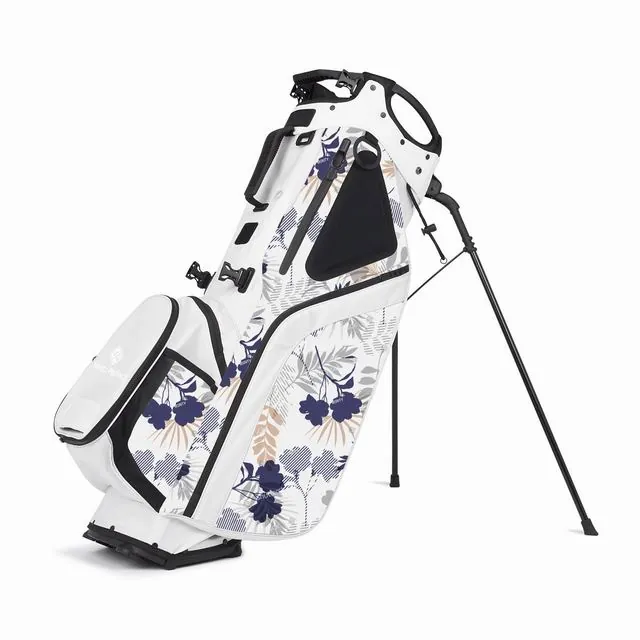
A stand bag is a lightweight carry bag fitted with its own two (or sometimes four) legs that deploy when the bag is set down, plus integrated carry straps. Its defining trait is portability: it is built light enough and balanced well enough to carry several kilometers comfortably, and the legs let it stand upright on the grass without leaning on anything. Stand bags typically hold 5-14 clubs in a full-length divider layout and include a handful of useful pockets without the bulk of a cart bag.
The design intent of a stand bag is to make walking the course genuinely comfortable. Where a cart bag is organized for a flat position on a trolley, the stand bag is organized for a vertical position on a golfer's back: the weight sits low and centred, the straps are balanced, and the back panel is cushioned and breathable. Everything about the category's geometry — the leg pivot, the strap attachment, the pocket placement — is tuned for a carrying golfer rather than for a cart, which is why walkers should never be tempted to make do with a cart bag.
The stand bag is the natural choice for walking golfers of every level, from amateurs who walk a few rounds a month to professionals who walk tournament fairways. Because it can also be strapped to a cart using a pass-through channel, it covers both carry and ride in a single bag. That dual capability is what makes it the most common "regular use" bag. Our broader golf bag types guide and stand bag range lay out the category in full.
What Is a Golf Cart Bag?
A cart bag is larger, heavier and designed to ride on a trolley or golf cart, not to be worn on your back. It offers more and bigger pockets, a wider club opening that makes full-length clubs easy to draw and replace, often 14-way dividers, and a build optimized for a dense, organized load. Cart bags trade portability and legs for storage and top-down convenience, which is exactly the right trade for someone who never needs to lift the bag far.
Cart bags shine where organization and capacity matter: room for layers, dozens of balls, multiple rangefinders, rain gear and a cooler, plus a layout that keeps everything reachable when the bag is strapped to a cart. For riders and trolley users, the extra size is not a compromise. For more on how the cart-focused build is engineered, our cart bag range and types guide are worth reading.
Stand Bag vs Cart Bag: Head-to-Head Comparison
| Aspect | Golf Stand Bag | Golf Cart Bag |
|---|---|---|
| Best for | Walking, carry, versatile | Riding, trolley users |
| Weight | Light, app. 1.8-2.6 kg | Heavier, 2.5-3.5 kg+ |
| Legs | Integrated external legs | None (rides on cart) |
| Carry straps | Integrated dual straps | Rarely, small haul handle |
| Storage | Fewer, compact pockets | More, larger pockets + cooler |
| Club opening | Standard, 4-14 way | Wide, often 14-way |
| On cart | Yes (strap pass-through) | Designed for it |
| Versatility | High (walk or ride) | Lower (cart-focused) |
Representative comparison drawn from factory specifications.
Walking vs Riding: The Biggest Deciding Factor
The single biggest factor in the choice is whether you walk. A stand bag is built for metres on your back: it is lighter, balanced, carries comfortably and stands on its own legs so you never have to lay it in the grass. A cart bag is built for a ride: heavier, roomier and organized for a flat trolley position, but awkward to carry for more than a short distance. If you walk, an uncomfortable cart bag turns every round into a chore; if you ride, a smaller stand bag wastes the space and comfort you paid for.
It is worth being honest about the real mix on any given course. Even many "cart players" hop out to a shot and stand the bag on the ground while they chip or putt, and a walk from far side of the car park, over a pathway or down a long fairway quickly becomes a main for a heavy cart bag. The stand bag's legs mean you can park it anywhere, hands-free, in the exact spot that keeps your next club closest. On a busy weekend this small convenience compounds into a genuinely more relaxed round.
Many golfers vary between walking and riding depending on weather, course, company or fitness. For them, the stand bag's ability to do both well is decisive: strap it on for a walk or strap it to a cart for a ride, with no second bag required. This is why for "regular use" the stand bag frequently wins — regular use almost always includes some walking, and a stand bag never makes a ride worse, while a cart bag makes every walk worse. For more on the walking side of the question, see choosing a stand bag for walking golfers and stand bag vs Sunday bag.
Storage and Organization Needs
Storage is where the cart bag argues back. If your round requires a full change of layers, a cooler, a rangefinder with case, several balls and rain gear, a cart bag's larger pocket architecture holds it all in a tidy place. Stand bags, by design, keep storage compact to save weight, which is the correct trade if you prioritize a light carry but the wrong one if your pockets are always overflowing. If you are a "pockets-full golfer," a cart bag removes the anxiety of where to put things.
Consider how the two organize the essentials differently. A stand bag usually budgets its limited pockets for the daily five: balls, tees/markers, valuables, a water bottle, and a small outer pouch for gloves and rangefinder. Everything you can count on reaching in-cart, like a jacket or a flask, a stand bag can still hold, but it will not keep them tidy in a dedicated bellows or cooler pocket the way a cart bag can. If your normal kit equals more than those daily five categories, the cart bag's organisation earns your serious consideration.
Club organization is also a real difference. Cart bags frequently offer 14-way full-length dividers that keep each club in its own slot, stop shaft/rattle and make clubs easy to lift out on a cart. Stand bags offer 4-, 5- or 14-way dividers depending on model, trading some lafopenness for weight. For golfers fussy about club protection, a 14-way cart bag on a ride is the most organized setup; for weight-conscious walkers a stand bag divider is still fully serviceable. Our 14-way vs full divider guide covers the trade in detail.
Comfort, Fit and Weight
Comfort and fit are dominated by the carry strap. A stand bag's integrated dual straps distribute weight across both shoulders for a comfortable carry, making it the right fit for anyone who will hoist it. A cart bag, with no carry straps to speak of, trades that comfort for a rigid, roomy frame that sits on a trolley. If comfort on the body matters, the stand bag is the clear winner; if comfort of organization matters, the cart bag takes it.
Fit extends beyond straps. A stand bag is built to nestle against the back within a compact frame, which suits smaller-framed golfers and anyone who finds a big bag awkward. A cart bag's larger horse-shaped silhouette is designed to fill a trolley footprint, and is physically too large and heavy for comfortable carrying. If your body finds hauling a wide, heavy object impossible or uncomfortable, the stand bag is effectively the only comfortable option, and that alone can settle the decision regardless of storage preference.
Weight touches everything: a lighter stand bag is easier to lift, load and even take on a cart, whereas a cart bag's extra heft is only worth it if you rarely lift it. For golfers with back or joint limitations, a stand bag is usually the kinder choice because it is lighter and balanced for the body. Our weight and portability analysis and carry weight guide explain the weight/load interplay more fully.
On-Course Practicality
On the course, the two bags behave very differently at the moment you stop. With a stand bag, you swing it off your back, tip it, and it stands on its own legs beside you — ideal for walking holes and quick access to clubs. With a cart bag, you reach over the cart or trolley, drawing and replacing clubs from a wide top. If you play from a cart all day, the cart bag's stable cart seat and wide opening are more practical; if you play walking fairway golf, the self-standing stand bag is unbeatable.
The wider opening and full-length dividers of a cart bag also reduce club drag and clatter during a busy round, a quiet advantage for the organized rider. Meanwhile the stand bag's legs let a walker keep the bag's top angled toward them on the tee, so pulling a club is one smooth motion instead of a stoop to a bag lying flat in the grass. Neither is wrong; they are simply optimized for different rhythms of stopping and restarting across eighteen holes.
The weather is another practical angle. A cart bag keeps everything under a rain hood and shields gear well on a ride, while a stand bag keeps the walker's load light under all conditions and protects the same gear through compact, well-sealed pockets. Most regular golfers land on whichever bag matches their dominant mode on the course — and for the many who mix, the stand bag's in-hand versatility again tips the balance. Our cart compatibility guide covers how stand bags ride safely.
Cost and Value for Regular Use
For a regular golfer buying one bag, cost and value generally favour the stand bag because it replaces two potential purchases with one versatile product. A good stand bag covers both walking and riding, so the value per round and per use is high. A cart bag, by contrast, is a specialist tool: excellent if you ride, but you may still want a light bag for the occasional walk, pushing the total spend higher. If your routine is truly 100% cart, the cart bag's storage efficiency may justify its specialist nature.
There is also the question of durability incentives. A bag that ends up being the wrong type for half your rounds tends to be the one you replace earliest, which quietly costs more over time than the upfront difference between tiers. Buying the bag that fits how you actually play is the cheapest way to own the right equipment, because it is the bag you will not outgrow in a season. For the great majority of regular amateurs that still points to the stand bag as the higher-value, lower-regret purchase.
Wholesale prices reflect construction: a full-featured cart bag carries more raw material and therefore more cost, while a durable stand bag batches materials and mechanisms efficiently. Either way, both are built on the same MOQ logic — a 200-piece MOQ per design and colorway with 100-piece test orders, sampling in 10-20 days and bulk in 45-60 days. For budgeting a range, our pricing guide is a practical reference.
Frequently Asked Questions
- What is the difference between a stand bag and a cart bag?
- A stand bag has integrated legs and carry straps for walking golfers, while a cart bag is a larger, heavier bag with more storage designed to ride on a trolley or cart.
- Is a stand bag better than a cart bag?
- Neither is universally better. A stand bag is better if you walk and carry, while a cart bag is better if you ride or use a trolley and want maximum storage.
- Can you use a stand bag on a golf cart?
- Yes. Most stand bags include a cart strap pass-through or channel so they can ride on a cart, though they hold less storage than a dedicated cart bag.
- Why do most golfers use stand bags?
- Because many amateurs walk at least some of the time, and a stand bag works whether you walk or ride, making it the most versatile single-bag choice.
- Do I need a cart bag?
- You benefit from a cart bag if you primarily ride or use a trolley and want the extra storage and larger club opening that a heavier cart-focused bag provides.
- Can a factory make both stand and cart bags?
- Yes. Factories make both types, at a 200-piece MOQ per design and colorway with 100-piece test orders, sampling in 10-20 days and bulk production in 45-60 days.
How to Decide for Your Regular Routine
Lay out your typical month honestly. Count the rounds you walk, the rounds you ride, and how much you carry in your bag. If walking appears at all with any regularity, a stand bag is the safer, more versatile investment. If you can count your walks on one hand for the year and always ride or trolley with a full kit, a cart bag is the practical specialist. And if you have the budget and play enough, owning both — a light stand bag and a roomy cart bag — gives you the ideal tool for each day.
It can help to write three small lists before you buy: how you move on a course (walk, ride, trolley), what you routinely carry (bare minimum or a full kit), and which bag you would regret in six months (one that is too heavy to walk with, or one too small to ride with). Answering those three honestly will settle most of the uncertainty. When the answer still splits, choose the stand bag, because versatility is the feature that rescues you on any unexpected walking day.
There is no "wrong" answer, only a wrong match for the way you play. Buying the bag that fits your dominant routine means you are never fighting the equipment, and that is worth more than any feature list. Our sizing and fit guide and types guide help you pin down the right one.
Sourcing Both Types from a Factory
If you supply golf equipment, offering both stand bags and cart bags covers your customers regardless of how they play. Factories produce both on the same line logic: build a durable stand bag to a walking spec and a roomy cart bag to a riding spec, each at a 200-piece MOQ per design and colorway with 100-piece test orders, sampling in 10-20 days and bulk in 45-60 days. Because both share hardware, fabric and QC, working with one factory for the whole range simplifies logistics and keeps quality consistent.
At QUANZHOU JUNYUAN BAGS we manufacture stand bags, cart bags and more across 7 production lines with 126 sewing machines, serving brands in 100+ countries since 2014. For the sourcing workflow, see OEM/ODM services and custom solutions.
Factory Verdict
For regular, mixed use, the golf stand bag is the better default for most golfers: it walks well, rides acceptably and never forces you to choose between carry and cart on the morning tee. The cart bag is the better specialist for dedicated riders who want maximum storage and a top-down club layout. Match the bag to how you actually play, and you remove a constant source of on-course friction.
Rule it simply: ask which bag you would least regret on a day you end up walking. For almost everyone the stand bag wins that test, and it costs nothing more to also ride in. That is the definition of the right regular-use bag.
Whichever you need — a versatile stand bag or a spacious cart bag — we can build it factory-direct. Reach us at contact, service@junyuanbags.com, or WhatsApp +86 17750020688.
Manufacturing Both Bag Styles
Stand bags and cart bags factory-direct from Quanzhou. Test orders from 100 pieces, sampling 10-20 days, bulk production in 45-60 days.
Request a Bulk Quote →