How to Secure a Golf Cart Bag on Electric and Manual Carts
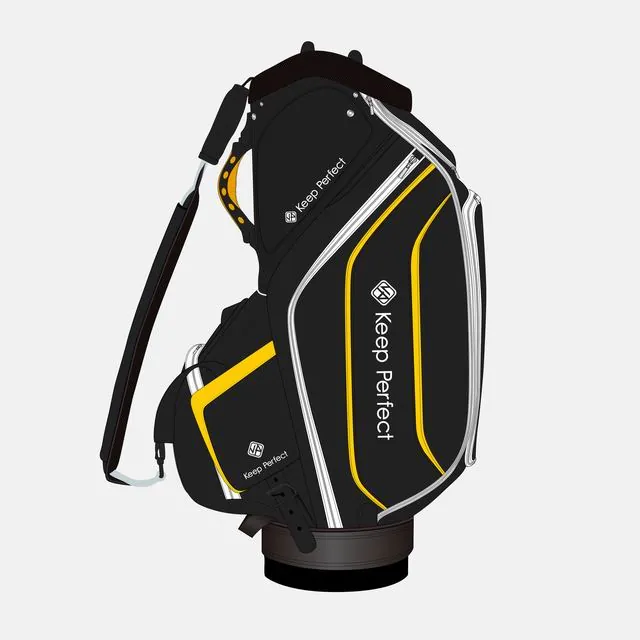
To secure a golf cart bag on an electric or manual cart, seat the bag base flat on the rack with its front facing the cart, secure the bottom strap around the bag's lower shell, then run the top strap around the bag's upper body and tighten so the bag cannot tilt or slide when shaken from the sides — repeat before every hole if your course has you moving on and off the cart. A cart bag that is not secured properly is not just an annoyance: on an electric cart it can slide sideways on a slope, and on a manual cart the momentum of a loose bag can rock the whole trolley and unseat a club or two every time you stop. This guide, written with input from the QUANZHOU JUNYUAN BAGS factory (founded 2014, our founder entered the golf bag industry in 2004), walks through everything from choosing a compatible bag to the exact strapping sequence on both cart types.
Why Securing a Cart Bag Properly Matters
Your golf bag carries between 12 and 14 clubs plus the essentials of a round, and on a cart it spends the whole day being shaken, jostled and hauled across uneven ground. A bag that slides, tips or clatters does three kinds of damage: it can scuff or bend club heads and shafts when it shifts, it can stress the bag's seams and zippers, and it wastes your concentration every time you look back to check it. A properly secured bag, by contrast, sits in the same place all day and lets you forget about it.
Securing is also a safety matter. On a sloped fairway, an unstrapped bag can shift the cart's balance or slide across and catch you getting in and out. On a manual trolley, an unbalanced bag makes the cart want to tip when you stop or lean it. Taking twenty seconds to seat and strap the bag properly protects your equipment, your cart and your walk. If you are choosing a bag specifically for cart use, our guide to cart bags for course use covers the design features that make secure mounting easier in the first place.
What a Purpose-Built Cart Bag Gives You
A cart bag is designed for exactly this job. It has a wider, flatter base so it seats evenly on a rack, a full-length 14-way or 5-way divider top that keeps clubs upright and protected, and — most importantly for securing — a grab handle on top and a strap-compatible shell so cart straps hold it firmly. Many cart bags also have a molded or padded base that grips the rack and reduces sliding.
If you mostly ride, a purpose-built cart bag is almost always the right choice over a stand or staff bag, because it is built to sit still. A stand bag can be mounted on most carts, but its legs must be folded and latched, and without the firmer base and grab handle it is simply less stable. Understanding when a cart bag beats a stand bag for riding is covered in our stand bag vs cart bag comparison and, for players who occasionally carry, in the walking vs riding guide.
Before You Mount: Pack and Balance the Bag
Securing a cart bag begins with how it is packed. A bag that is over-stuffed high or loaded lopsided is harder to keep stable no matter how tight the straps. Load the heavier clubs and balls low toward the bag's base, and avoid stacking so much weight in the top pocket that the bag becomes top-heavy, which makes it want to tip forward on the rack.
Also check the bag's orientation on the rack. A cart bag should ride with its front pocket facing toward the cart, putting the center of gravity closest to the cart and the bag low and balanced. If your bag has an offset top or a grab handle, align it so you can grab it easily when lifting the bag on and off. A quick balance check — push the loaded bag gently from the top forward and back — tells you whether it wants to tip before you ever tighten a strap.
There is also a practical point about cart bag hardware worth knowing before mounting: most cart bags do not rely on integrated straps built into the bag itself — the secure straps come from the cart. That is exactly why a bag with a clean, straight lower shell is easier to strap than one with awkward pockets or hard-molded lumps bulging where the cart strap wants to sit. When you are choosing a bag, look at where the cart's bottom and top straps would rest and check the bag has a smooth strap zone there, not a row of buckles or a protruding pocket that will distort the strap and leave it loose.
Accessories change the balance too. A rangefinder clipped to a side pocket, a heavy water bottle in a side sleeve or a full rain suit in an outer pocket all move weight around and can make a bag top-heavy or lopsided. If you mount the bag and it refuses to balance, remove the obvious contributors first and see if the instability was simply a load problem rather than a strapping one. Similarly, confirm the bag is not so overcrowded that the main zipper is forced open — a bag that cannot close properly has no stable, compact profile to strap, and its contents can shift inside as you ride. Getting the load right before mounting makes every strap adjustment easier and more effective, and it keeps the whole bag riding lower and safer for the round.
Step 1: Seat the Base and Secure the Bottom Strap
Every mount begins with a properly seated base. Place the bag on the rack so its entire base plate is supported, not hanging off the front or back edge. If the bag base overhangs, it has no stable platform and will always want to tilt. Once seated, secure the bottom strap: on most carts there is a lower strap that wraps around the bag near its base, holding it to the rack and stopping it from sliding.
Tighten the bottom strap until the bag cannot shift forward, backward or side to side when you push on it, but do not crank it so hard that you deform the base shell or stress the strap mounts. The bottom strap is the anchor that keeps the whole bag from walking its way off the rack during a long ride, so it deserves the first pass of attention. On a manual trolley the equivalent is often a clamp or channel that the bag base slots into — make sure the base fully engages the clamp before relying on the upper strap.
Step 2: Secure the Top Strap Around the Upper Body
The top strap is what keeps the bag from tilting, and it does more work than most golfers realize. Run the upper strap around the bag's upper body — below the top opening, at a point where the shell is solid — and tighten until the bag sits firmly upright with no forward lean. On many carts, this strap passes through or around the bag's grab handle zone, which is why a sturdy grab handle and reinforced upper shell on a purpose-built cart bag make mounting noticeably more secure.
The correct tension is "snug but not crushing": tight enough that the bag holds its position when you pull it from the top, but not so tight that it dents the shell or strains the zipper at the strap line. Lifting a bag by the strap, not by the full weight, is also gentler on the hardware. If you are mounting a taller bag or a staff-style bag, you may need to place the top strap at a slightly different height to keep it upright — adjustment works best on bags with a defined strap zone.
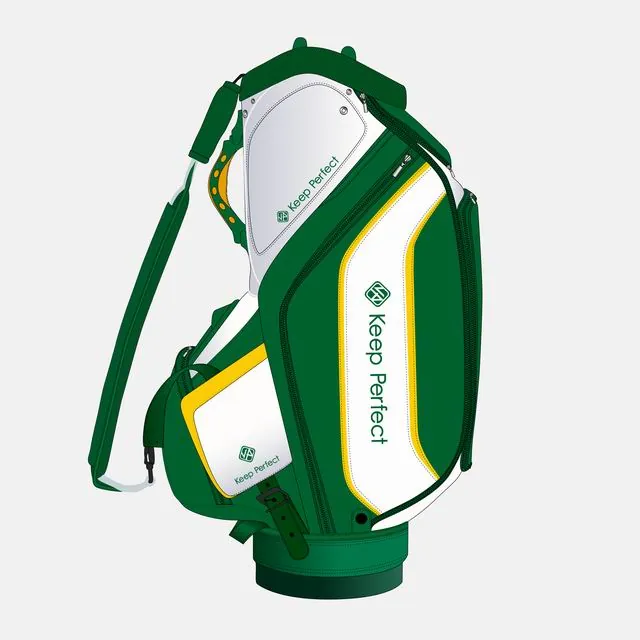
Anchor the Base First
The bottom strap keeps the bag from sliding; you cannot get a stable bag until its base is fully seated and anchored.
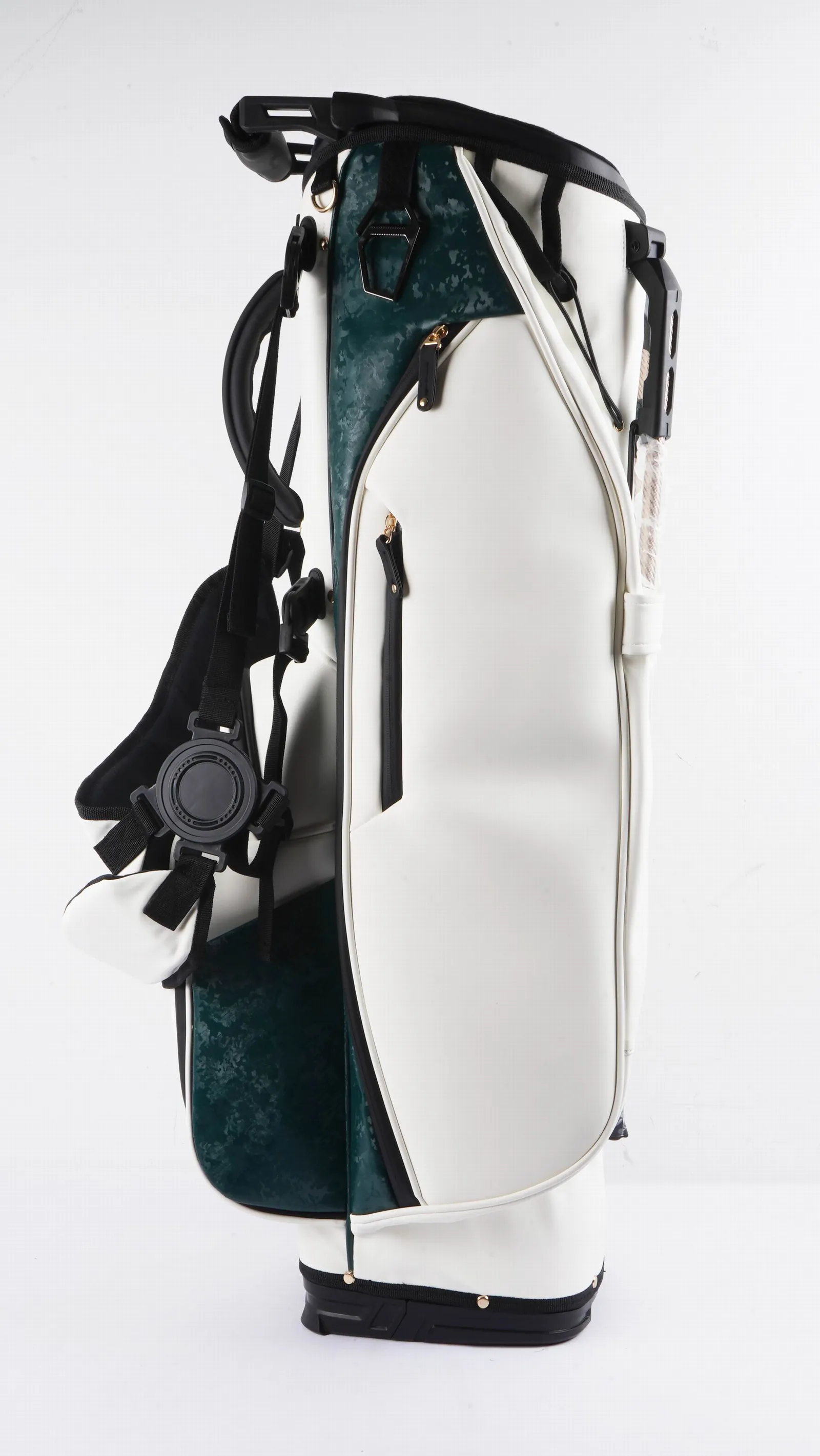
Stabilize the Top
The top strap stops forward lean; together the two straps hold the bag secure through a full round over uneven ground.
Electric vs Manual Cart: Does the Securing Differ?
Both cart types need the same principle — a seated base and two secure straps — but each has its own nuance. On an electric cart you ride, so the main risk is the bag sliding sideways or tilting as the cart leans on slopes and brakes. Securing is slightly easier to keep tight because the bag stays in place all day, but you should re-check the straps if you drive between holes even once the bag has shifted slightly under braking.
On a manual trolley, the extra challenge is that the bag is being actively pulled and stopped by hand, generating more inertia, and the cart must also stay balanced for you to walk comfortably. Make sure the bag is centered on the trolley, not offset to one side, or the whole cart will pull sideways. Some manual carts use a ratchet strap or a bungee rather than a fixed strap; whichever is fitted, use it the same way — bottom first, then top. If you push rather than pull, balance backward the opposite way. Compatibility between different types of push and pull carts is covered in our push cart compatibility guide.
The Stability Test Before You Drive Off
After strapping, do a ten-second stability test. Push the bag from the top in each direction: forward, backward and side to side. If it moves more than a few millimeters or rocks on its base, both straps are not doing their job — re-seat and re-tighten. Then lift the front of the cart slightly and listen for any clunk of motion. A bag that passes this test will hold for a full round; it takes seconds and prevents the one thing every player dreads — watching your bag and clubs hit the turf at the first sharp corner.
It is also wise to re-check the straps partway through the round, especially on a manual cart. Straps can loosen as the bag settles, fabric compresses and the cart vibrates. A quick re-tighten at the turn costs ten seconds and keeps the bag exactly where it started. If you find your straps continuously work loose, it may be worth looking at the strap hardware or the bag's strap guides; replacing tired webbing is cheaper than a dropped bag.
Beyond the two straps, some carts ship with a third, smaller securing point near the base or a bag-guard rail at the front of the rack. Use whatever hardware your cart provides rather than improvising: a bag that is clipped on three points rides measurably more stable than one held by two, and it removes almost all of the rocking that happens when a cart decelerates on a downhill dogleg. A quick read of your cart's manual for the intended strapping points is time well spent before the first tee.
Common Cart Bag Mounting Mistakes
The three most common mistakes are skipping the bottom strap, tightening only the top, and mounting the bag without centering its base. Skipping the bottom strap means the bag can slide and rock; relying only on the top strap makes the bag pivot at the top and flop forward. Failing to seat the base fully means the bag never has a true platform and no amount of strapping fully stabilizes it.
Two more subtle errors: over-tightening until the strap crushes the upper shell or strains a zipper, and leaving a stand bag's legs deployed or half-latched while mounting, which lets the legs jam or catch during the ride. Always fold and latch stand-bag legs before mounting, and never let a top strap rest directly across a zipper at full tension. Avoiding these keeps both the mount and the bag itself in good condition for far longer.
Cart Bag Securing Specifications at a Glance
| Mounting Step | Electric Cart | Manual Cart | Stability Check |
|---|---|---|---|
| Base seat | Full support, front facing cart | Centered, full clamp engagement | No overhang at the rack edge |
| Bottom strap | Anchored around lower shell | Firm clamp or ratchet | Bag cannot slide left, right or front |
| Top strap | Around upper body below opening | Around upper body, snugly | No forward lean when pushed at top |
| Re-check | After hard stops and turns | At the turn each round | No clunk when cart is lifted |
General securing guidance that applies to most carts and standard cart bags; always follow your specific cart's manufacturer instructions where these differ.
A final, easy win for riders is to protect the bag's own surfaces against the wear of thousands of mounts. The base and the strap zones are the two areas that always show age on a cart bag, so keeping the base clean and free of grit when you store it, and wiping down the strap lines after wet rounds, keeps the shell from staining and the webbing from fraying under constant friction. Minor attention at each round's end costs seconds and is the single biggest reason some course bags look new after a season while others look years old. It is the same logic we apply to durability engineering across all our cart bags, described in our cart bag trends and durability guide.
Choosing a Cart Bag That Mounts Securely
If you are ready to buy, a few features make a cart bag markedly easier to secure. Look for a wide, flat, non-slip base; a sturdy top grab handle; a reinforced upper shell with a clear strap zone; and quality strap-compatible webbing. A bag with a flimsy handle or a too-flexible upper shell will fight your best strapping efforts, while a well-built one makes secure mounting almost automatic.
Because these are design decisions made in the factory — base molding, handle construction, strap zone reinforcement — it is worth specifying them if you are commissioning a custom cart bag for a resort, club or brand program. Facility-grade cart bags that mount cleanly and hold up to thousands of rides are a real selling point. At QUANZHOU JUNYUAN BAGS we build cart bags across our cart bag range and can adapt base, handle and strap features through custom solutions.
Protecting Clubs and Bag on the Mount
A secure mount also protects what the straps hold. Keeping the bag upright prevents clubs from rattling against each other and prevents the bag's shell from taking lateral impact at every corner. A full-length divider top reduces that internal club movement even further, which is why cart bags with 14-way or well-structured dividers are popular with riders. If club protection is your priority, our guide to club-protecting cart bags goes into divider design in detail.
Beyond the mount, simple habits extend the life of both bag and cart: carry the bag by its handle rather than dragging it, don't overload the top pockets, and give the straps a quick wipe now and then so grit does not grind the webbing. Together, a correct mount and light-use habits keep a cart bag looking new through years of riding, which is exactly the longevity we design for and discuss in our cart bag lifespan guide.
Manufactured by an Experienced Golf Bag Factory
Cart bags built to the principles in this guide are produced by experienced factories with real capacity. QUANZHOU JUNYUAN BAGS works with an affiliated Quanzhou factory founded in 2014, whose founder entered the golf bag industry in 2004 and brings 20 years of experience. The facility operates 7 production lines with 126 sewing machines and 137 staff for a monthly capacity of about 200,000 pieces, and supplies more than 200 brands across more than 100 countries. The affiliated factory passed a third-party SGS factory audit in March 2026.
For cart bags, the standard MOQ is 200 pieces per design and colorway, with test orders from 100 pieces. Physical sampling takes about 10-20 days while bulk production runs about 45-60 days. Because cart bag straps are subject to daily pull and wear, the factory checks webbing thickness, buckle quality and strap seam strength through QC before packing. If you are commissioning OEM or private label cart bags, discuss your cartridge and strap spec with the factory at sampling stage.
Frequently Asked Questions
- How should a golf cart bag sit on a cart?
- It should sit flat on the rack with its base fully supported and its front facing the cart, keeping the center of gravity low so the bag does not tip forward.
- Do I need both the bottom and top straps on a golf cart bag?
- Yes. The bottom strap anchors the base, and the top strap stops tilting; using only one leaves the bag able to slide or pivot as the cart moves.
- Can I use a stand bag on a cart if I do not have a cart bag?
- Yes, most carts accept stand bags, but fold and latch the legs before mounting and expect a less stable ride than with a purpose-built cart bag.
- Why does my cart bag keep tipping forward on the cart?
- Usually the top strap is loose, the bag is too top-heavy, or the base is not fully seated. Re-seat the base and re-tighten both straps.
- How tight should the cart bag straps be?
- Snug enough that the bag cannot slide or tilt when you push or pull it from the sides, but not so tight that you strain the fabric or strap mounts.
- Is securing different on an electric cart versus a manual push cart?
- The principle is the same — seated base plus two straps — but manual carts need the bag centered for balance and straps checked more often because of hand-powered stops.
The Factory Verdict on Secure Cart Mounting
Securing a golf cart bag is not complicated, but it is a two-strap discipline: seat the base, anchor the bottom, stabilize the top, then pass the ten-second stability test before you drive. On both electric and manual carts the same sequence — a seated base, a bottom anchor and a top stabilizer — keeps your clubs, cart and concentration intact through a full round, on any slope. When the bag itself is built with a wide flat base, a sturdy handle and a reinforced strap zone, that secure mount is almost automatic.
QUANZHOU JUNYUAN BAGS has built reliable cart bags since its 2014 founding, serving 200+ brands across 100+ countries from an affiliated Quanzhou factory with 7 production lines, 126 sewing machines and 137 staff. If you are sourcing cart bags for a course, club or brand program, contact contact, service@junyuanbags.com, or call +86 17750020688.
Looking for a Reliable Cart Bag Partner?
Whether you need standard or custom cart bags with the base, handle and strap features your riders rely on, our team can build to your spec. Test orders from 100 pieces, sampling in 10-20 days, bulk production in 45-60 days.
Request a Bulk Quote →