TaylorMade is one of the market's most influential golf bag brands — named consistently alongside Titleist, PING, Callaway and Mizuno as a leading player in the roughly USD 1.25 billion global golf bag market (Mordor Intelligence, 2025). Its 2025 bag lineup anchors on the FlexTech carry series, the HydroLite waterproof cart line and a premium Select/MG cart range, and it competes less on enclosure gimmicks than on ecosystem integration with its industry-leading clubs. For wholesale and OEM buyers, TaylorMade's line is a valuable benchmark of what the premium tier expects — and a reference point for where a private-label program can profitably position. This review grades the 2025 TaylorMade bag range across performance, construction, price-band placement and trend alignment.
Brand reviews are useful to two audiences: golfers choosing a purchase, and wholesale/OEM planners benchmarking the competitive tier before speccing their own line. This review serves both, combining brand-line knowledge with an honest, sourcing-informed assessment of build, durability and positioning.
TaylorMade's Place in the Bag Market
TaylorMade sits squarely in the premium performance tier. The company's core strength is club innovation — drivers, irons and woods that dominate tour counts — and its bags are engineered to complement that ecosystem. In market-research rosters of leading bag brands, TaylorMade is a consistent entry, which gives its line outsized influence over consumer feature expectations. Its bag design philosophy emphasizes organization depth, light-to-moderate carry weight and premium aesthetics that signal a complete-set purchase.
TaylorMade's strength in bags is the whole being more than the sum: each bag is engineered to complete a set and feel at home in a club ecosystem, which raises its value beyond what a standalone accessory can command. That ecosystem pull is a durable advantage because it converts a club loyalist into a lifelong bag buyer, and it is a fair benchmark for any brand weighing whether to build a coherent product story rather than a series of one-offs.
TaylorMade enters the bag market with a premium, performance-first identity earned on the tour and reinforced by its club ecosystem. That identity lets it position bags as instruments that complete a set — an emotional and practical cost the standalone bag cannot match. Named among the leading players in independent market research, it competes less on price and more on the coherence of the whole product story, which is precisely what makes it a benchmark for ecosystem-led premium positioning.
For a private-label buyer, the takeaway is that TaylorMade's success validates the premium, feature-dense bag as a saleable category. The features it standardizes — 14-way full-length dividers, multi-pocket organization and branded styling — are now the recognized baseline a competitive product must match or beat.
The FlexTech Carry Series
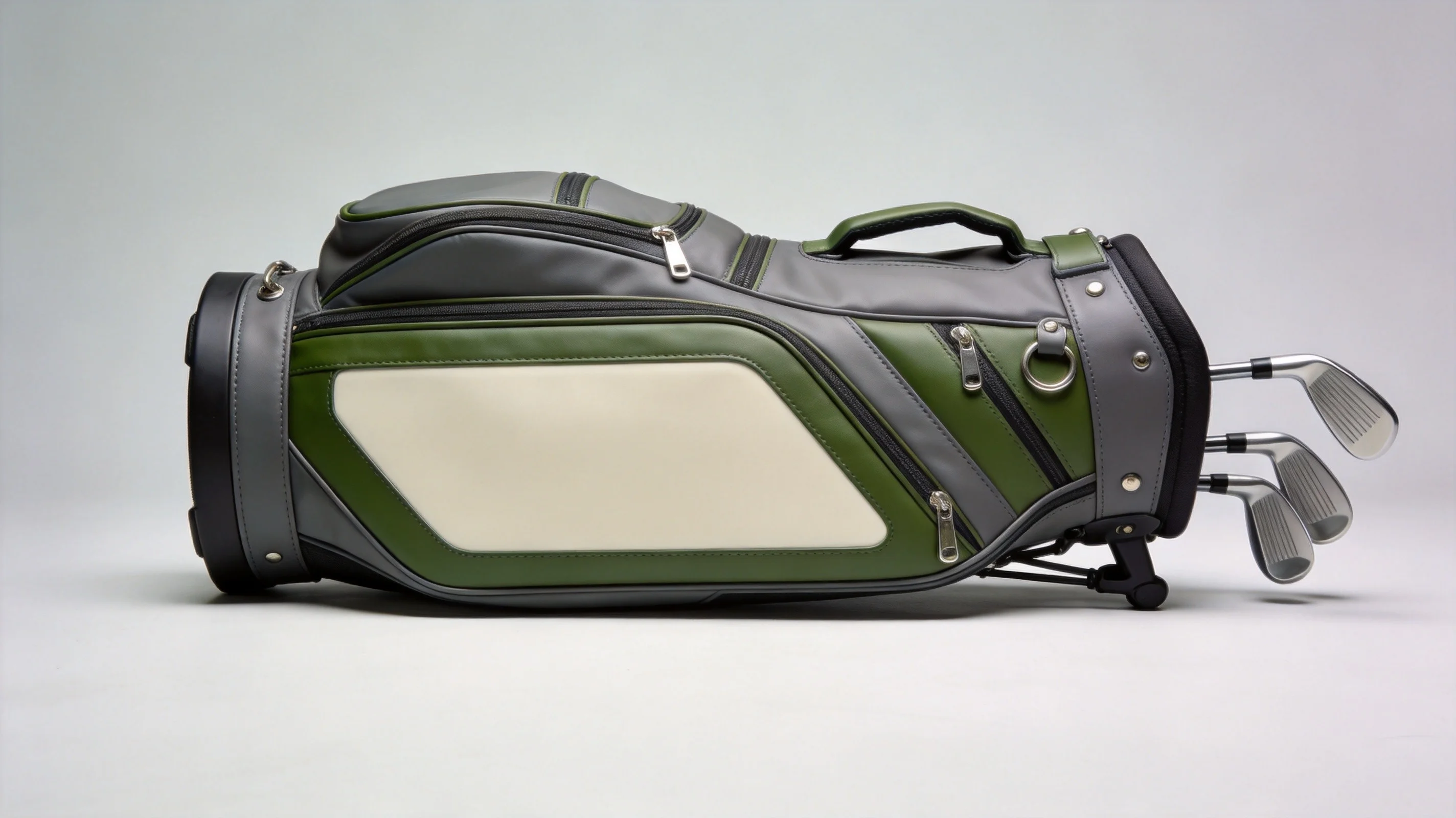
TaylorMade's FlexTech line is its flagship carry/stand offering, marketed around a self-standing frame that stays upright even when loaded. The series spans from a lightweight FlexTech Lite toward fuller-featured models, aiming at the golfer who wants a bag that doubles between walking and cart use. Key features typically include 14-way top crowns, integrated handle and legs that deploy reliably. The appeal is versatility: one bag that transitions from carry to cart without compromise.
The FlexTech series is engineered for the dominant walking demand: a carry bag with a self-standing frame that sets down level and stable while quickly transitioning to cart use, matched to lighter models for the weight-conscious walker. Full-length dividers and organized pockets round out daily function, and the combination answers walkers who refuse to trade stability for lightness. For a buyer targeting the carrying segment, the FlexTech blueprint — lighter weight plus a stand mechanism that genuinely works — is the spec to benchmark against.
From an engineering standpoint, self-standing mechanics are a genuine differentiator that requires precise leg-hinge manufacturing and stable base weighting — exactly the kind of structural feature an OEM must verify to avoid field failures. Bags that promise self-standing but tip under load generate exactly the returns a quality program must prevent.
The HydroLite Waterproof Cart Line
The HydroLite series is TaylorMade's waterproof cart-bag answer, using sealed, waterproof-rated construction suited to wet climates. It targets the cart-based golfer who prioritizes weather security. HydroLite construction reflects the industry's broader shift toward waterproofing as an expected baseline rather than a premium extra — a trend reinforced by market research pointing to strongest weather-resistant demand in high-rainfall regions.
Waterproofing is only as credible as the construction under it, and HydroLite is engineered with sealed seams, rated zippers and materials chosen for sustained wet-climate use. Beyond the rating, it keeps the full organization story — dividers, pockets and a stable base — so the weather buyer does not trade away functionality for protection. Successfully holding both weather security and everyday utility together is precisely the benchmark an OEM must match to credibly claim waterproof ability.
The HydroLite line is TaylorMade's answer to the weather-belt buyer: a cart bag designed and rated for genuinely wet conditions, with waterproof-rated construction built around sealed seams, rated zips and materials chosen to hold up in rain. Beyond waterproofing, it keeps the full organization story — dividers, pockets and base — that the rest of the range is known for. It demonstrates that a big, feature-rich brand can take waterproofing seriously, and sets the bar for an OEM that wants to claim real weather security.
For buyers, the HydroLite shows how far weather engineering has come: sealed zippers, waterproof-rated fabrics and minimal seams-or-structured closures now define what a credible waterproof cart bag looks like. Spec-level documentation — seam, zipper and rating — is the standard to request from any manufacturer claiming equivalent capability. We cover those requirements in our weather-protection guide.
Select and MG Premium Cart Bags
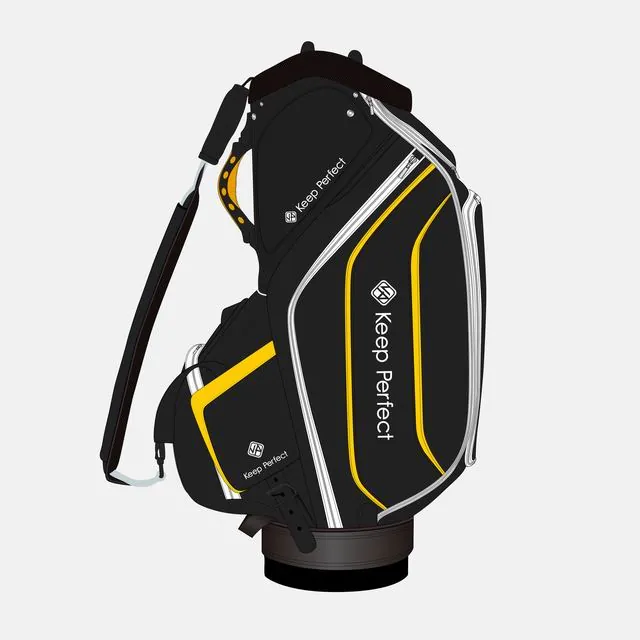
The premium end of TaylorMade's range — the Select and MG (My Custom) cart-bag families — targets better players and complete-set buyers with premium materials, generous organization and styling aligned to its tour presence. These bags emphasize large, accessible pockets, stable cart footprints, full-length dividers and clean branding panels. The MG line extends personalization, reinforcing the industry's premiumization and customization pull.
With the Select and MG bags, TaylorMade pitches its strongest cart argument: durable shells, 14-way divided tops and organized, stable construction for the everyday cart golfer. They reward their premium price through build integrity and hold their form through a long season, making them a reliable reference point for the mid-premium tier. For an OEM, they set a high but achievable bar on dividers, base rigidity and shell durability.
The Select and MG lines anchor TaylorMade's premium cart offering, using modern organization and durable shells to capture the everyday cart golfer who wants more than a basic bag. They balance the brand's performance identity with genuine utility, and their higher feature density sets a strong benchmark for the mid-premium tier. They reward 14-way-divided, stable-base models and hold resale form, giving buyers and resellers a reliable, well-built reference in a crowded category.
Premiumization is exactly the segment growing fastest per market research — Mordor projects premium bags to grow faster than the overall market, driven by customization and the fitting ecosystem. For an OEM buyer, this validates investing in premium-tier construction and personalization capability, which is a core strength of a flexible factory.
| TaylorMade Series | Best For | Standout Feature | Freight Positioning |
|---|---|---|---|
| FlexTech (carry) | Walkers, versatile play | Self-standing frame | Mid premium |
| HydroLite (cart) | Wet-climate cart golfers | Waterproof-rated construction | Mid premium |
| Select / MG (cart) | Better players, complete sets | Premium materials, customization | Premium |
| Staff / tour bags | Tour and pro-shop branding | Oversized branding panels | Flagship tour |
Construction, Materials and Build Quality
Across the range, TaylorMade spec favors durable fabrics, reinforced bases, robust zippers and day-one presentation quality — the hallmark of a brand invested in the complete-set experience. Abrasion resistance, stable construction under a loaded bag and clean stitching are consistent. The trade-off for premium build is typically higher weight in fortified models and a price premium that limits the brand to the upper tier. For many buyers, the durability and brand synergy justify the cost; for budget-focused shoppers, TaylorMade can sit beyond reach.
Reading a TaylorMade bag for construction means looking past the logo panel at the mechanisms: divider count and material, base rigidity, zipper and hardware quality, seam reinforcement and strap system. The modern range pairs 14-way full-length dividers with stable bases and durable shells tuned to each price point so the buying decision is honest — you pay more, you measurably get more. For an OEM setting the premium-adjacent benchmark, this is the exact construction bill to reverse-engineer and verify in sampling.
Evaluating TaylorMade construction means looking past branding to mechanisms: divider count and material, base rigidity, zipper and hardware quality, seam reinforcement and strap system. The modern range pairs 14-way full-length dividers with stable bases and durable shell fabrics tuned to price point. Buyers should inspect these at retail alongside data, and OEM buyers should reverse-engineer the exact construction bill that justifies each price tier.
From a sourcing lens, the build standard TaylorMade sets — base reinforcement, zipper quality, seam consistency — is a useful checklist for evaluating any OEM, because these are the details that separate premium from commodity. Our quality control guide details what to inspect.
Organization and Player Experience
Organization is where TaylorMade differentiates. Full-length 14-way dividers reduce club tangle; multiple strategically placed pockets keep balls, tees, apparel, valuables and hydration separated; and top-crown geometry protects head-to-grip. The overall experience is a bag that feels engineered around a round, not merely a container. For golfers who value setup speed and club protection, this organization depth is a decisive purchase factor — and it mirrors the broader market preference for comprehensive compartmentalization.
Retail evaluation of any premium bag should follow a short checklist that TaylorMade's range satisfies: fully divided organization that protects clubs, bases that ride level on carts and turf, hardware and zippers that cycle smoothly and materials that hold their finish across a season. These are the qualities that keep a golfer coming back and that protect a reseller's margin through fewer returns. For an OEM building to the premium benchmark, they are also the exact tolerances to hold in the spec and verify in sampling.
Organization is where TaylorMade builds lasting player experience. Pockets are placed where golfers actually reach, insulated and valuables compartments are clearly separated, and bases are shaped to ride level on carts and turf. These small daily wins reduce friction and become the repeat-purchase story, as important to a reseller as any static spec. The lesson is that a bag's value compounds through the routine it serves, not just the features it lists.
TaylorMade bags are designed as player ecosystems: pockets positioned where everyday golfers reach, insulated and valuables compartments clearly separated, and bottoms that ride stably on carts or turf. The result is a low-friction routine that drives repurchase and brags, which matters as much to resellers as static specs. The lesson is that organization is experience, and experience is the retention engine.
We explore how such pocket architecture translates into manufacturing in our compartment design guide, because replicating this depth reliably is where OEM quality shows.
Trend Alignment: Lightweight and Weather-Ready
TaylorMade's 2025 line aligns tightly with the two biggest trends in participation data: lightweight versatility and weather security. Lighter FlexTech models respond to walking golfers who reject heavy carry loads; the HydroLite responds to wet-climate cart golfers who expect waterproof construction. Both align with demographics that are growing — The R&A counts 112.2 million golfers with juniors and women the fastest-rising cohorts, both groups favoring manageable weight and reliable protection. A brand that reads these signals correctly stays relevant as the buyer base widens.
TaylorMade aligns two momentum themes precisely: lightweight walking models and the weather-secure HydroLite lineup. By betting on the carrying and wet-climate segments that participation data says are structurally growing, the brand positions itself in demand rather than chasing saturation. For a buyer, segue into these same aligned segments with equivalent verified specs.
Price-Band Positioning and Value
TaylorMade bags command a premium that places them above entry and mid-tier imports. The value proposition rests on brand cachet, ecosystem fit with TaylorMade clubs and consistent build quality rather than on lowest cost. For shop owners, that premium is protected by strong brand pull, which helps hold retail price integrity. For private-label planners, the lesson is that establishing a quality-tier baseline justifies premium pricing — but only if build and feature depth genuinely support it, which is precisely what rigorous spec verification protects against.
TaylorMade's flagships command premium pricing anchored in brand pull, ecosystem fit and consistent quality. That pricing is defensible when build and finishing meet expectation, which strong demand tends to confirm. Budget buyers find better value below; premium buyers find the reassurance they pay for. Total cost of ownership — hold-up over seasons — makes the premium defensible for committed golfers.
How TaylorMade Bags Compare to the Field
In a crowded premium field, TaylorMade differentiates on ecosystem integration and modern organization rather than on radical silhouettes. Titleist is often preferred for the walking-carry purist, PING for pure lightweight engineering and durability, and luxury houses like Vessel for premium materials — but TaylorMade's strength is a complete, coherent bag portfolio that matches its club ecosystem and advertises itself to complete-set buyers. We map this competitive field in our brand comparison analysis.
Compared with Titleist, TaylorMade favors modern organization and ecosystem integration over pure walking tradition; against PING it leads on premium design language rather than durability-obsessed minimalism; versus Callaway it is more considered and engineered; and beside luxury houses it offers far more range at a lower price. The resolution is never a single winner — it is alignment. A golfer who walks picks differently from one who catches, and a buyer who completes a set values ecosystem fit above all. Knowing which band you sit in turns a crowded comparison into a clear answer.
Versus Titleist, TaylorMade leans toward ecosystem integration and modern organization; versus PING, toward premium design language over durability-obsessed engineering; versus Callaway, toward more considered, engineered ranges; and versus luxury houses, toward broader feature sets at lower price. Each comparison resolves on priorities — that is why matching a brand to play style beats chasing a single 'best.'
Benchmarking Against TaylorMade for a Private-Label Line
If you are planning a private-label program, TaylorMade's book is a credible premium benchmark. Aim to match: full-length 14-way dividers, robust base and zipper construction, premium-feel materials, and clean branding panels — while differentiating on price/volume economics, personalization and the features a flexible OEM can add nimbly. A factory with documented quality control and material partnerships can reach this standard. Our customization guide and workflow guide cover the spec-to-production path.
TaylorMade offers a concrete premium baseline to replicate: 14-way dividers, stable base, durable zippers, premium-feel materials and clean branding. A capable OEM with strong quality control can match this profile at far better volume economics. The private-label opportunity is to deliver equivalent visible quality with faster customization — competing on agility where a big brand cannot easily follow.
Final Verdict on TaylorMade 2025

TaylorMade's 2025 bag range is a strong, coherent premium portfolio: versatile FlexTech carries, dependable HydroLite waterproof carts and premium Select/MG carts aligned to its club ecosystem. It is best suited to golfers who value brand synergy, modern organization and reliable build, and who accept a premium price. It is less suited to budget shoppers or those wanting feature-maximalist silhouettes. Its reliability and trend alignment make it a credible market leader and a useful benchmark for the entire premium tier.
TaylorMade enters the bag market with a premium, performance-first identity earned on the tour and reinforced by its club ecosystem. Flexible carry bags, a genuinely waterproof HydroLite option and the organization-dense Select and MG cart lines give walkers, cart players and wet-climate buyers a coherent premium choice. It competes on ecosystem fit and consistent build rather than lowest price, and that focus is exactly what makes it a fair, credible benchmark for any private-label program aiming at the premium tier.
Comparing TaylorMade's Carry and Cart Fittings Across Price Points
TaylorMade's range reward buyers who know the ladder. At entry, value bags deliver dependable organization for casual and junior players at a friendly price. As budget climbs, dividers go full-length and 14-way, materials gain weather and abrasion resistance, bases stiffen and strap systems comfort. At the premium end, weight drops, pockets multiply and finish tightens. The practical guidance is to buy the highest meaningful spec your use demands — a 14-way-divided, stable-base model returns its slight premium in club protection and daily convenience; going above that mainly serves brand preference and marginal comfort. Recognizing the ladder keeps a buyer from overpaying for features a higher price tier adds rather than needs.
TaylorMade's Trade-In, Warranty and Repurchase Dynamics
The repurchase loop is where TaylorMade converts one-time buyers into loyalists. A clear warranty on workmanship, credible trade-in programs and a product that consistently holds up across seasons lower the perceived risk of the premium price and accelerate repeat and upgrade purchases. For a reseller, this reliability translates into fewer returns and higher customer lifetime value; for a private-label brand, it is a direct prescription — document the warranty, honor it, and build trade-in momentum to keep customers inside your ecosystem rather than drifting to a competitor.
Frequently Asked Questions
- Which TaylorMade bag series is best for walking golfers?
- The FlexTech carry series is your walking-oriented option, with lighter models and a self-standing frame that also transitions well to cart use. Choose a lighter FlexTech model if carry weight is your priority.
- Are TaylorMade cart bags waterproof?
- The HydroLite series is designed specifically as a waterproof-rated cart bag for wet climates, with sealed construction and waterproof-rated materials. Other cart-bag lines offer weather resistance but aren't positioned as fully waterproof.
- How does TaylorMade fare against Titleist, PING and Callaway?
- TaylorMade excels at ecosystem integration with its clubs and modern organization. Titleist is favored by walking purists, PING for lightweight durability, and luxury brands for premium materials — each is a strong choice depending on priorities.
- Is the TaylorMade premium price justified?
- For most flagship buyers, yes — the premium reflects brand pull, ecosystem fit and consistent build quality, and strong demand protects retail price integrity. Budget-focused shoppers will find better value below this tier.
- What benchmark does TaylorMade set for private-label bags?
- A credible premium baseline: full-length 14-way dividers, robust base and zipper construction, premium-feel materials and clean branding panels. A capable OEM with strong quality control can match this standard at better volume economics.