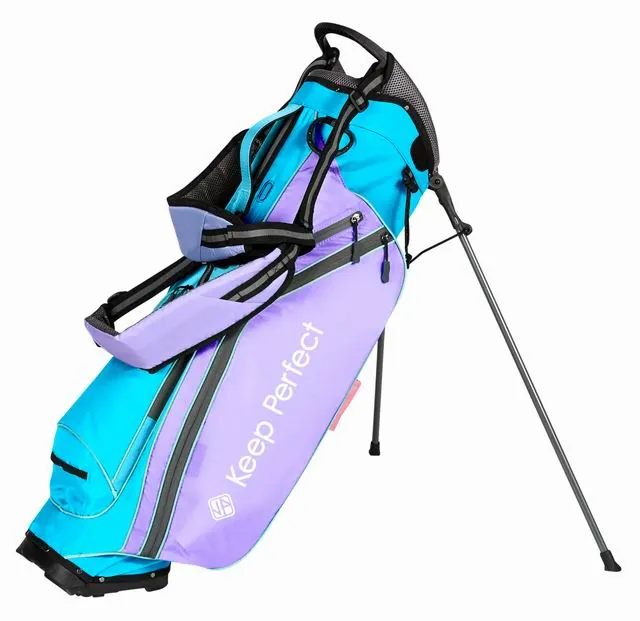
Testing a waterproof golf bag reliably means measuring three separate things — the fabric's water column rating, the bag's overall IPX ingress level, and the long-term behaviour of seams, zippers and drainage — and none of them can be inferred from a label alone. A bag marked "waterproof" may protect to an IPX4 splash level or survive full immersion at IPX8 depending entirely on the construction chosen. This guide explains how waterproof golf bags are actually tested, what the IPX ratings and IP codes mean in plain terms, what water column and hydrostatic-head figures tell you, and how an OEM buyer should verify claims before committing to a production order.
For anyone sourcing bags for wet markets, or buying a bag for exposed courses, understanding the test methodology is as valuable as the rating itself because it lets you read a spec sheet honestly. A factory may quote an IPX rating with confidence, yet the number only means something if the test method, sample conditioning and pass criteria are defined in writing. This article walks through the standards, the honest-by-design construction behind each level, and how to audit testing during production.
1. What IPX and IP Ratings Actually Mean
IP (Ingress Protection) ratings describe how well a housing keeps solid particles and water out, and the IPX variant, where the first digit is left generic, refers specifically to the water-resistance level. The scale runs from IPX0, which offers no protection, to IPX8 for continuous immersion, and for a golf bag the realistic targets sit lower because a bag is not a sealed electronic housing. In practice IPX4, which resists splashes from any direction, and IPX6, which withstands powerful jets, cover most on-course conditions a bag actually meets, from a passing shower to standing under a clubhouse downpour. The honest reading is that an IPX rating tells you how a split or lamination holds up under a defined water pressure, not that the entire contents will stay bone dry indefinitely in a storm, which is why the rating is read together with the water-column spec of the fabric and the seam-sealing method rather than on its own.
The IP (Ingress Protection) code is defined by the international standard IEC 60529 and describes how well an enclosure resists solids and liquids. The code has two digits: the first covers solids such as dust (IP6X means fully dust-tight, the top rating), and the second covers water. When only water is relevant, the code is written as IPX followed by the water digit, and it is this water rating that dominates golf bag marketing.
The water digits form a clear ladder. IPX4 protects against splashing water from any direction. IPX5 adds protection against low-pressure water jets. IPX6 protects against powerful water jets. IPX7 covers immersion in water up to 1 metre for 30 minutes. IPX8 covers continuous immersion deeper than 1 metre under conditions defined by the manufacturer. Each step is a meaningful threshold in what a sealed pocket or full bag can genuinely survive.
Critically, the IPX rating tests the whole construction — shell, seams, zippers and openings — against water ingress, which is different from a fabric water column test that measures only the material itself. This is the first thing to check in any marketing claim: does the "IPX7" refer to the entire bag, a single sealed pocket, or just the fabric?
2. Water Column and Hydrostatic Head Testing
Water column rating, measured in millimetres, and hydrostatic head are two ways of describing how much water pressure a fabric resists before leaking. The standard test, ISO 811, presses a column of water against the fabric and records the height at which leakage appears. A rating of 10,000 mm means the fabric withstood a 10-metre water column; above 10,000 mm is regarded as genuinely waterproof for garment and bag use.
| Water Column | Meaning | Suitable Use |
|---|---|---|
| Under 3,000 mm | Light drizzle / spray resistance | Covered or dry-climate bags |
| 3,000–10,000 mm | Moderate rain protection | Weather-resistant bags |
| 10,000 mm and above | Genuinely waterproof fabric | Premium all-weather bags |
| 20,000 mm and above | Extended waterproof warrant | Heavy-duty / pro-spec builds |
The water column test measures the fabric alone. To understand the finished product, combine it with the seam-sealing method and the closure ratings, because a 20,000 mm shell with unsealed seams and ordinary zippers still leaks at those points. This is why genuine manufacturers never quote a single number without explaining how the seams and closures perform.
3. From Fabric Rating to Full-Bag Testing
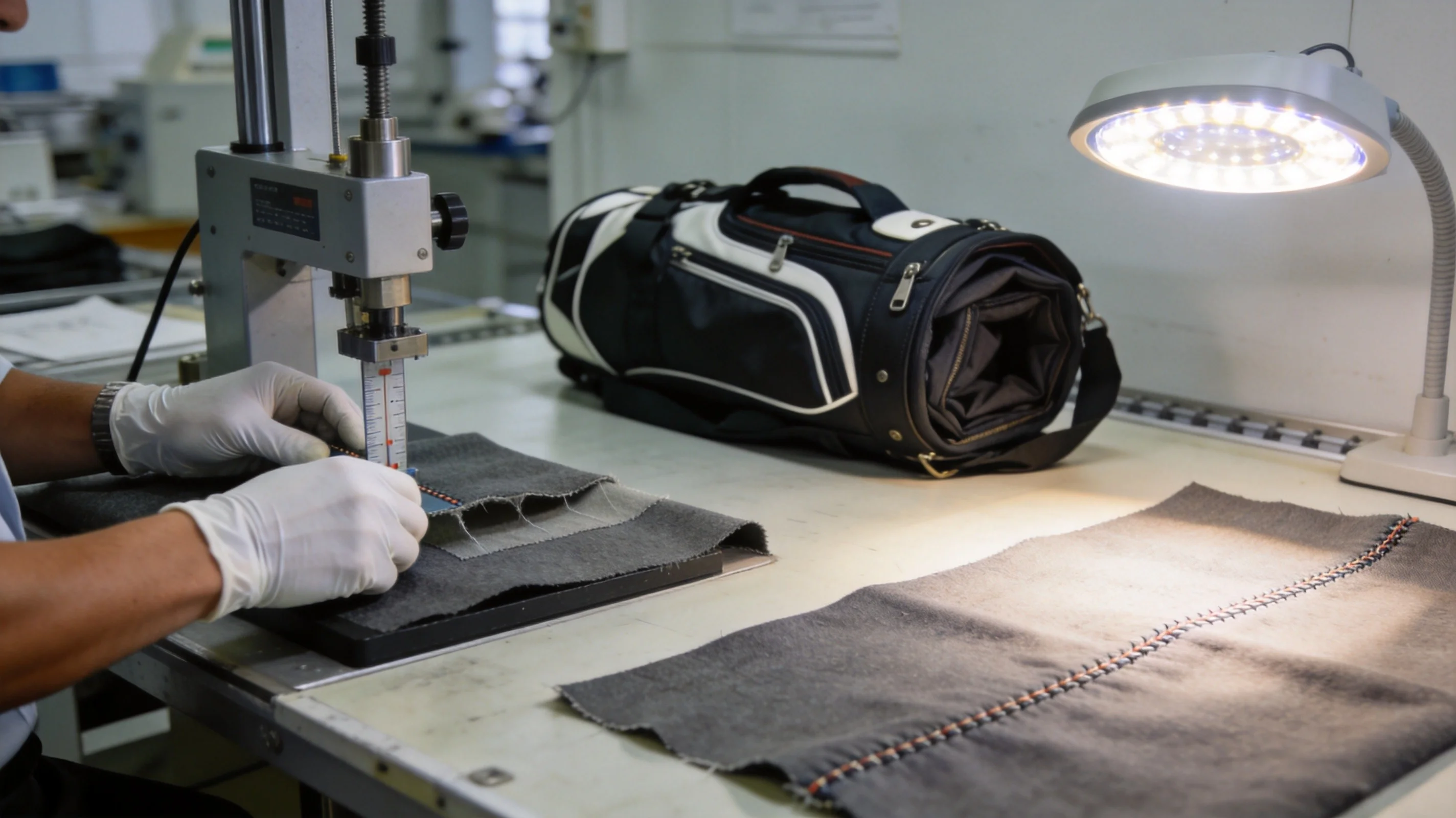
Once the fabric passes its water column test, the finished bag must be tested as an assembled system. A full-bag water test typically drenches the bag to simulate heavy rain, checks the sealed pockets for ingress, exercises the zippers, and verifies the drainable bottom expels water rather than holding it. Pass criteria should be defined in advance and in writing — for example, a stated maximum acceptable water ingress in grams over a fixed test duration.
Because it is impractical and expensive to test every unit, manufacturers use a test-sampling plan: a defined number of units from each production batch are subjected to the full test, while the rest rely on confirmed production consistency. Auditing the sampling frequency and understanding the tolerable defect rate is part of responsible sourcing. Ask the factory to share its sampling plan and the pass/fail thresholds for seam, zipper and drainage checks.
Independent verification adds confidence: a third-party body such as SGS, TÜV or Bureau Veritas can witness tests, sample units from production and issue certificates. QUANZHOU JUNYUAN BAGS, for example, completed an SGS inspection in March 2026 that re-validated quality controls on seams, hardware and fabric performance, and a similar third-party check can be scheduled for a specific batch before shipment.
4. The Weak Points: Seams, Zippers and Openings
Understand the places water always finds: seams, zippers and unsealed openings. Sewn seams pierce the waterproof film, so any fabric test number is immediately undermined if seams are not sealed. The leading methods are seam taping — heat-bonding a waterproof tape over the stitched line — and welding, which joins panels without needle holes. Welded seams offer the highest performance but are harder to produce and repair; taped seams are the common premium compromise.
Zippers mark the second weak point. Standard coil zips pass water freely, which is why waterproof bags use waterproof zippers with a sealing gasket, or water-resistant zips protected by a storm flap. Test the zipper line specifically, not just the fabric, because a leak at the zipper defeats a waterproof shell.
Finally, openings and closures — the mouth of the bag, valuables pockets and dividers — must be assessed for how they behave under water. A bag that tests well dry can still leak through an oversized, unsealed mouth when drenched. Design that uses a roll-top or secured closure on critical compartments performs far better in real rain.
5. Drainage: The Design That Keeps Water Out by Letting It Out
Paradoxically, a genuinely well-designed waterproof golf bag includes a way to let water out. No bag keeps every drop out forever, so a drainable bottom — one or more grommets or mesh panels at the base — lets any water that does enter escape rather than pooling. This prevents water from soaking the equipment, stops mildew and odour, and returns the bag to service faster after a wet round.
Drainage also protects the test outcome: a bag that holds water inside repeatedly will degrade its interior coatings and promote rust on metal hardware, shortening the very life the waterproofing is meant to extend. When you review a test report, check that the drainage design is included in the assessment and that the main compartments are not compromised to fit a drain. Good design keeps sealed compartments sealed while a small drain protects the lower structure.
6. Realistic Expectations and Test Durability
A rating is a snapshot, not a lifelong promise. Laminates and coatings degrade with UV exposure, abrasion, folding and cleaning, so a bag that passes an IPX6 test stands a better chance of holding that performance than one that barely scrapes IPX4. When sourcing, ask how the rating was validated over simulated use — repeated drench and dry cycles, folding, and zipper wear — rather than only at the point of manufacture.
Use this to set marketing claims honestly. Claiming "IPX7 waterproof" when the bag achieves IPX4 under realistic use invites returns and warranty disputes. A better approach is to rate the bag conservatively, document the test, and let the fabric's true water column and seam sealing exceed the headline claim, giving the product a margin of safety. This is both a quality and a commercial decision, and it builds the trust that converts first-time buyers into repeat customers. See how to test waterproof quality in a golf bag for a practical field checklist.
7. Specifying Tests in Your OEM Contract
The most effective way to guarantee waterproofing is to write the testing into your procurement specification. Define the water column rating for the fabric, the target IPX level for the whole bag and for any sealed pockets, the seam-sealing method, zipper rating, and the acceptable drain performance. Set sampling frequency, pass/fail thresholds and the procedure for resolving failed batches before you place the order.
Require written test reports against recognised standards — ISO 811 for hydrostatic head and IEC 60529 for IP ratings — rather than accepting internal marketing data. Where your customers or regulations demand it, arrange third-party inspection or certification and agree who bears its cost. A factory that offers this transparency, as QUANZHOU JUNYUAN BAGS does with its SGS-backed QUANZHOU JUNYUAN BAGS, established in 2014, has tested and supplied waterproof bags for more than twenty years of industry experience, with its founder active in the trade since 2004. quality program, is far easier to hold to contract than one that treats the spec sheet as flexible.
Remember the commercial levers: standard MOQ of 200 pieces and test orders from 100 pieces let you validate both the product and its test package on a small run before scaling, while sampling lead times of 10–20 days and production of 45–60 days give you room to review reports between stages.
8B. From Test Data to Consumer-Ready Claims
The test report a factory gives you is the raw material for the claims your brand will make, so translating data into honest, defensible marketing language matters commercially. If the fabric is certified to 20,000 mm water column but the bag's zippers are only water-resistant, the appropriate consumer claim is "waterproof fabric with weather-sealed pockets", not "fully waterproof bag". Match each claim to the component that was actually verified, and keep the evidence file so you can respond to any customer challenge.
This precision also protects retailers and distributors who pass your claims down the chain. Labelling clarity reduces online-review complaints, chargebacks and warranty disputes, which quietly erode margin. The standards discussed in this guide exist precisely so buyer, seller, retailer and consumer all use the same vocabulary — IPX, water column, seam sealed, drainable. Using that shared language consistently is a competitive advantage in saturated markets.
Finally, keep the test documentation current. Materials, suppliers and processes change, so re-verify ratings when you change a fabric supplier, alter a lining, or update a closure. A rating obtained on one construction does not automatically transfer to an updated product, and re-testing a small sample is far cheaper than managing a field failure.
8C. Waterproofing for Different Equipment and Compartments
Not everything in a golf bag needs the same level of protection, and specifying compartment-by-compartment protection saves weight and cost. Rangefinders, phones and valuables need the highest rating because electronics are ruined by minimal ingress; give these dedicated IPX6–IPX8 sealed pockets with truly waterproof zippers. Golf balls and some apparel tolerate light water, so standard weather-resistant pockets suffice there, backed by the drainable construction should anything get in.
Club compartments benefit from a protected top and a drain, since grips and shafts can survive water far better than electronics. Mapping the protection to the value of what is stored lets you build a bag that is genuinely fit for purpose without over-engineering every panel. Communicate this compartment-level spec clearly, because an informed buyer will value the fact that the expensive electronics are protected to a higher standard than the roof that holds a towel.
8. Common Testing Pitfalls to Avoid
Several errors undermine otherwise good products. The first is testing the fabric but not the finished bag, so seams and zippers leak despite a fine water column figure. The second is testing a single ideal sample rather than production units, which masks variation. The third is defining pass criteria so loosely that borderline batches pass, and the fourth is ignoring conditioning — fabric and film behave differently wet and dry, so test in realistic wet, cold and hot conditions.
Avoid the trap of "cherry-picked" marketing data by insisting the report shows the test date, method, sample identity and result spread across a batch, not just a single best number. And be wary of an IPX rating quoted on the fabric when the bag's closure is unrated; the two are not equivalent. Applying these checks turns a spec sheet from a sales story into an engineering fact you can defend, and it is exactly the discipline that keeps field returns and warranty disputes low.
9. Interpreting Ratings for Real Field Conditions
The link between a lab rating and what happens on a golf course is not automatic, and understanding it prevents both over- and under-buying. A golf bag on a moving cart is exposed to wind-driven rain that strikes from many angles, to vibration that works fasteners loose, and to repeated handling that strains seals. A lab splash test with the bag stationary can understate the severity of real rain; conversely, a rating reached with the bag left soaking may overstate routine use, so hold the claims to what the course actually delivers.
Consider also the frequency and intensity of rain in the target market. A bag certified to IPX6 against powerful jets gives genuine confidence for a windy, wet links course, while an IPX4 splash rating may be perfectly adequate for a region with light, infrequent showers. Pair the numeric rating with the market's real weather to choose the right spec, rather than always defaulting to the most extreme rating money can buy.
Field validation is the ultimate check: after confirming lab results, test a production unit through genuine wet play or a controlled garden drench test, opening every pocket and inspecting the seams and drain. This combination of standardised lab data and realistic field validation gives the most honest picture of how a bag will serve its owner.
Frequently Asked Questions
- What does IPX7 mean on a golf bag?
- IPX7, defined by IEC 60529, means the item is protected against immersion in water up to 1 metre for 30 minutes. On a golf bag the term should always be checked for whether it applies to the whole bag, a sealed pocket, or only the fabric.
- What is the difference between IPX6 and IPX8?
- IPX6 protects against powerful water jets, while IPX8 covers continuous immersion deeper than 1 metre under conditions specified by the manufacturer. IPX8 is the higher specification and is rarely needed for golf use.
- What water column makes fabric genuinely waterproof?
- A rating of 10,000 mm or higher, measured by the ISO 811 hydrostatic-head method, is the accepted threshold for genuinely waterproof fabric. Under 10,000 mm fabric resists light rain but will leak under sustained pressure.
- Can a whole bag really reach IPX8?
- Yes, a fully welded or seam-sealed bag with tested waterproof zippers and a drainable construction can achieve IPX8, but it is rarely necessary for golf. Most premium bags target IPX6–IPX7 on the whole bag and IPX8 on the sealed electronics pocket, which is a sensible and honest specification.
- Why do I need to test seams and zippers separately?
- Because they are the two main leak points that defeat a waterproof shell. Fabric can pass a water column test yet the finished bag leaks at unsealed seams or standard zippers, so the full assembly must be tested.
- How often should a factory test waterproofing?
- Use a written sampling plan: a defined number of units from each production batch undergo the full test, supported by confirmed production consistency and independent inspection if required. Ask the factory for the plan and thresholds before ordering.
- Can a coated fabric pass the same tests as a laminated one?
- Rarely at the high end. Laminated fabric with a bonded film and sealed seams is far more likely to pass the 10,000 mm water column and IPX6–IPX8 thresholds, while an unsealed coated fabric typically only reaches splash-level resistance and fails sustained rain testing.
- Is an internal test report enough, or do I need third-party certification?
- An internal report is a good start, but third-party verification such as SGS or Bureau Veritas adds independent confidence and is often required by large retail programmes. Check whether your customers need certification and who bears its cost.
Waterproofing is one of the few golf bag features that can, and should, be treated as a measured engineering property rather than a marketing claim. By applying the IPX code, the ISO 811 water column standard, honest full-bag testing and written verification, you can specify and source bags that genuinely meet their ratings and survive the field conditions they promise.
To source tested waterproof golf bags or arrange third-party inspection, contact QUANZHOU JUNYUAN BAGS at service@junyuanbags.com or +86 17750020688. The manufacturer runs seven production lines with a team of 137, produces roughly 200,000 pieces a month, and supports standard MOQ of 200 pieces with test orders from 100.
Related reading: the ultimate guide to waterproof golf bags, waterproof golf bag technology innovations and how waterproof bags perform in heavy rain.
Whatever your scale — a single golfer buying a bag for a coastal links season, a resort pro stocking the pro shop, or a brand sourcing a waterproof range for export to a rainy market — the principle is the same: or a brand sourcing a waterproof range for export to a rainy market — the principle is the same: demand evidence, understand the numbers, and match the spec to real exposure. The IPX code tells you how the whole bag resists water; the ISO 811 water column tells you how the fabric holds up; the seam, zipper and drainage checks tell you whether the assembly honours that fabric. Read all three together, verify them on production units, and you will be able to specify with confidence, defend your claims with documentation, and deliver a waterproof golf bag that does exactly what its label promises for years of wet rounds.