
A golf resort offers branded Sunday bags to guests for one data-backed reason: a light, reusable, logo-bearing bag converts a one-week stay into a years-long, low-cost advertising impression that travels home, onto the course and into social feeds. Because a Sunday bag holds only four to seven clubs and weighs a fraction of a full bag, guests actually take it and use it, so the resort mark keeps appearing long after checkout. This guide is written by the manufacturing team at QUANZHOU JUNYUAN BAGS, an affiliated Chinese factory established in 2014 (founder in the trade since 2004), which has produced branded golf bags for more than 200 brands across 100+ countries.
Why a Sunday Bag Is the Natural Resort Souvenir
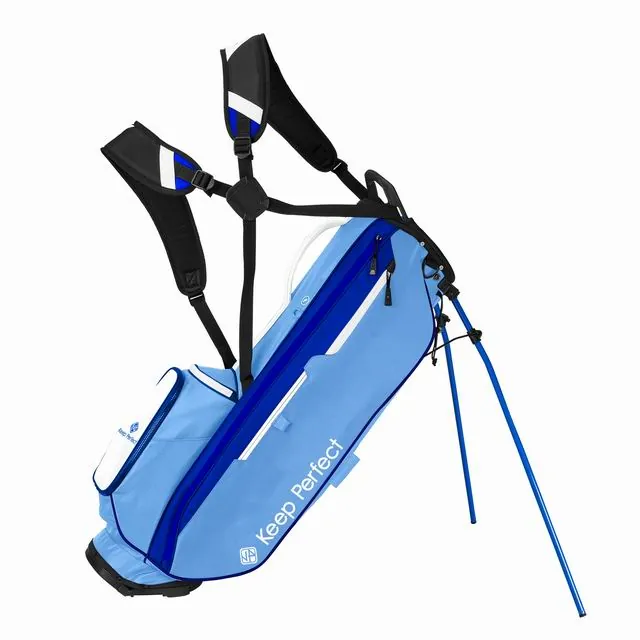
The Sunday bag — also called a featherweight, half-set or carry bag — sits at the intersection of everything a resort wants in a guest gift: affordable, lightweight, compact and endlessly reusable. Unlike a logo towel (stays at the pool) or a logoed stand bag (too heavy to travel with), a Sunday bag is small enough for a suitcase, light enough to carry on a nine-hole loop and useful enough to become a permanent part of the guest home game.
That usefulness is the entire point of the souvenir maths. An item a guest genuinely uses is a living advertisement: every round, every range session and every packed trip displays the resort brand to golfers and non-golfers alike. The branded Sunday bag is therefore less a one-off giveaway and more a long-lived channel with a single upfront cost and a multi-year return. For a resort, the attractive part is that the unit cost is modest while the perceived value to a loyal guest is high — a gap that makes it one of the healthiest-margin hospitality gestures available.
What a Branded Sunday Bag Must Deliver for Resorts
Not every lightweight bag belongs in a resort programme. The bag carries the property's name, so it has to meet three standards at once: it must be light and compact enough to encourage use, durable enough to protect the brand for several seasons, and cleanly enough branded to read in a mid-distance photograph or on a social feed. A bag that fails any one of these does the opposite of marketing — it puts a cheap or broken logo in front of thousands of guests.
From our manufacturing side, the practical definition of "resort-ready" is a bag that holds up under real guest use without turning into a maintenance story. That means a firm but light frame, reinforced stress points, reliable zippers and a large, high-contrast logo panel. The wholesale economics also have to work at resort volumes, which is where an experienced factory earns its keep: repeatable branding at a stable per-unit cost.
How the Bag Generates Brand Impressions After Checkout
The branded Sunday bag pays for itself through three compounding channels. First is travel: guests take the bag to other courses, their home clubs and practice facilities, and the resort mark travels with them. Second is photography: golf is one of the most photographed sports, so a bag that appears in holiday albums and social posts exposes the resort to a highly relevant audience — the people most likely to book a resort holiday. Third is retention: a thoughtful, useful gift with the resort's mark builds fondness that drives repeat bookings and word-of-mouth recommendations.
Because the Sunday bag reappears for years rather than fading after the trip, its impressions recur. A logoed bottle disappears on a shelf; a logoed Sunday bag reappears every time a guest pulls it from the locker. That recurrence is exactly why resorts treat it as a hospitality anchor rather than a generic giveaway, and it is the reason the economics of the branded Sunday bag outperform most other promotional items in the golf space.
Sizing a Sunday Bag Programme That Pays for Itself
The most common mistake resorts make is ordering too many bags or too little. A sensible programme starts with a small, properly branded test batch that matches the resort's high-season guest numbers, then scales once the design is proven. Because our standard MOQ is 200 pieces with 100-piece test orders, even a cautious first run is affordable, and it lets a resort validate colours, logo placement and guest response before committing to a larger cycle.
Sizing should follow the seasons: order a season ahead so stock is ready for peak play, member tournaments and corporate hospitality weeks. The realistic lead times — 10-20 days for sampling and 45-60 days for bulk production — mean a resort that plans around its calendar never faces an empty shelf. Ordering early also lets a resort dispute a design now rather than during peak season, which is why we always counsel resorts to treat the calendar as part of the spec.
From a resort's perspective, a branded Sunday bag also earns its place because it is genuinely different from every other giveaway on the property. Most promotional items are single-use or single-location: a towel stays poolside, a pen stays in a drawer, a keyring disappears. The Sunday bag, by contrast, is a piece of working equipment that a golfer carries out into the world again and again. That is the fundamental reason the economics work — the resort pays for the bag once. The impressions keep accruing every season, on course and online, without any further outlay. When a resort calculates the cost of alternative advertising against the lifetime exposure of a well-built bag, the comparison rarely stays close.
The bag also strengthens the emotional bond between guest and property. A gift that feels practical rather than promotional reads as genuine hospitality, and guests remember how a place made them feel. A branded Sunday bag that is useful enough to join the guest's own golf routine becomes a small, recurring reminder of the resort — the kind of positive association that drives repeat bookings and referral traffic far more reliably than a discount code. Resorts that treat the bag as a hospitality hand-off rather than a leftover advertising expense tend to see markedly stronger uptake, because guests are far more willing to carry a bag that feels like a favour than one that feels like a billboard.
The Build That Fits Resort Use, Storage and Branding
The ideal resort Sunday bag balances lightness against durability, because those two qualities do the branding work. A bag too heavy to carry will stay in the locker; a bag that falls apart mid-season damages the resort's name. The sweet spot is a light-but-solid frame, generous padding at the strap and a large, bold branding panel placed where it shows during play and in photos.
Storage and merchandising matter too. A stackable, packable design keeps dozens of logoed bags tidy in a pro shop or service room, and a clean silhouette photographs well in an e-commerce listing. Our facility runs seven production lines with 126 sewing machines and a team of 137 staff, producing up to 200,000 units a month, so we can hold consistent quality and branding across the volumes a resort needs — and back it with an independent SGS audit completed in March 2026.
The decision to run a branded Sunday bag programme is also a low-risk one compared with most resort marketing initiatives. Because the MOQ is modest and the unit cost small, a resort can test the concept with a single season's batch and measure uptake before committing to a larger run. If guests respond and the bags travel well, the programme scales naturally; if a particular design or placement underperforms, the loss is contained. That flexibility is valuable at a property where budgets are scrutinised, and it is one reason the Sunday bag has grown from a niche amenity into a mainstream resort staple.
Equally important is the consistency a resort can expect from a dedicated golf-bag factory. A property's brand is only as good as the last bag a guest sees, so a repeatable standard of stitching, weight, colour and logo application matters more than the material price. Producing on a schedule and to a tested spec takes a supplier that has done it thousands of times. That is why resorts increasingly source from factories that treat branding fidelity and production discipline as core skills, and why the SGS-audited quality documentation we hold has become a point of reassurance for properties putting their name on an everyday product.
Feature-by-Feature Spec for a Resort-Branded Bag
| Feature | Why it matters for resorts | Recommendation |
|---|---|---|
| Weight | Encourages guests to use and travel with the bag | Roughly 1.0-1.5 kg empty |
| Club capacity | Matches casual 4-7 club range play | 5-7 club slots with a divider |
| Pockets | Pockets keep the bag practical for a short round | 2-3 pockets incl. a ball and valuables pocket |
| Logo placement | Brand must read in photos and social posts | Large panel plus accent details |
| Materials | Must survive multiple resort seasons | Durable nylon/polyester, reinforced seams |
| MOQ and lead time | Aligns souvenir volumes and season timing | MOQ 200, test 100; sampling 10-20 days |
This spec is a starting brief, not a final answer. The best resort programmes are built in dialogue with an experienced factory that can adjust weight, durability and branding to the property's real guest behaviour. A factory that understands hospitality merchandising will push back on a design that is too heavy or too fragile, because it knows those two decisions determine whether the bag generates impressions or complaints.
Branding That Reads as Premium at Arm's Length
Resort branding lives or dies on legibility. A beautiful logo that is too small, too low-contrast or buried in the bag's shape does no promotional work — it vanishes in exactly the photo or feed the resort paid for. The rule we apply is simple: if the mark cannot be read in a mid-distance range photo, redesign it. That means a large, central logo panel, a distinctive colourway tied to the property and a clean, recognisable silhouette.
There is also a premium versus discount line to respect. Guests see a cheaply branded bag as a freebie, and a premium-branded bag as a keepsake. Choice of materials, stitching and finish move the perceived value far more than does the size of the logo, so resorts should brief quality first and let the logo ride on a build that already feels worth keeping. This is the same merchandising logic that drives our custom promotional Sunday bags, but sharpened for the stricter hospitality context.
Distribution Ideas That Turn Stock Into Stories
The bag only pays off if it reaches guests in a way that feels like a gift rather than leftover stock. The strongest distribution patterns are: a farewell gift at checkout that bookends the stay; a welcome amenity in the room for golf-package guests; a prize at member tournaments and corporate events; and a retail line in the pro shop for guests who want a second colour or a gift for a friend. Each placement tells a slightly different story and builds a different channel.
Retail is a particularly attractive stream because a Sunday bag is a low-cost, high-perceived-value item with a strong brand margin: the branding is cheap to apply, the unit cost is modest and a loyal guest is happy to pay retail. Many resorts run a gift tier to seed demand and a retail tier to capture it, so a guest who received a bag can buy one in another colour. For the merchandising side of the same decision, resorts often pair their bag programme with the guidance in our Sunday bag branding guide.
Guests Use It Differently: Design for Real Resort Habits
A resort Sunday bag is used for abbreviated play — nine holes, the driving range, a twilight round, the putting green. So the pocket zoning and club layout should match casual habits rather than a competitive set-up: a ball and tee pocket, a small valuables pocket and enough room for a water bottle or light jacket, with the number of pockets kept low so the bag stays light. Usable convenience, not maximal capacity, is the goal for this audience.
Design for the photo as well. Because guests post pictures, resort branding should read clearly at arm's length and in a mid-distance shot. That means a bold logo panel, recognisable colours and a clean silhouette that looks good framed in a range or course background. For resorts, this is the return-on-investment detail — if the logo fails in frame, none of the marketing work the resort paid for actually happens.
The Revenue Streams Behind the Gift
Resorts monetise branded Sunday bags through three proven routes. The first is a guest gesture: the bag is priced into a golf package or holiday as a perceived favour, received with goodwill and carrying the brand home. The second is standard pro-shop retail, selling logoed Sunday bags at a healthy margin to convert walk-ins into walking advertisements. The third blends both — a gift tier that seeds demand and a retail tier that captures it.
The wholesale economics support all three because a Sunday bag is one of the most margin-friendly items a resort can stock: modest unit cost, cheap branding, high perceived value and genuinely repeat exposure. Resorts that treat the bag as both a hospitality and a retail asset get two income streams and one promotional channel from a single SKU. The same cost-to-value logic is explored in depth in our wholesale Sunday bag pricing guide.
Sourcing and Quality: What a Resort Should Verify
Because the bag carries the resort's identity, sourcing quality is a brand decision, not a procurement detail. A resort should verify three things before ordering: the factory's production capacity and consistency, its quality and testing process, and its ability to reproduce branding across repeats without drift. An experienced partner will also advise honestly on materials, weight and lead times so the programme reaches guests on time and in spec.
Independent verification is the strongest signal of all. Our affiliated factory passed an SGS audit in March 2026 — third-party documentation a resort can rely on when the bag will be seen by thousands of guests. Resorts planning a line can also use our guidance on factory consistency and the OEM versus ODM overview to brief their supplier with confidence.
When to Order and How to Scale a Resort Bag Line
Timing is everything in resort merchandising. Because sampling takes 10-20 days and bulk production 45-60 days on a 200-piece MOQ (with 100-piece test orders), a resort should place orders a season ahead so stock is ready for peak play, tournaments and package weeks. Ordering early also allows a small test batch to validate the design before a larger run, which de-risks the whole programme.
Scaling should be deliberate. A resort that starts with a test batch and grows with each season's booking data builds a programme that is both cost-effective and guest-tested. As the bag becomes a fixture of the guest experience, complementary items and repeat orders at higher volume naturally follow — and the storage practicality of a packable Sunday bag keeps even a large stock manageable across the property. The storage and travel advantages of Sunday bags explain why this category is so easy to hold and deploy at scale.
Bringing the elements together, a successful resort Sunday bag programme is neither complicated nor expensive — it is simply disciplined. Start with a light, durable build and a logo that reads from across a range; size a test order to the season and place it early; distribute the bags so they feel like a genuine gesture rather than leftover stock; then measure guest response and scale what works. Every one of those steps is controllable and repeatable season after season.
For resorts at any stage of that journey, the manufacturing team at QUANZHOU JUNYUAN BAGS is happy to advise on weight targets, materials, branding panels and realistic lead times. As an affiliated factory established in 2014 by a founder who entered the trade in 2004, with seven production lines, 126 sewing machines and 137 staff producing up to 200,000 units a month for more than 200 brands in 100+ countries, we have the capacity and the consistency to support a growing resort programme.
Conclusion: A Hospitality Gesture That Keeps Paying
A golf resort offers branded Sunday bags to guests because they convert a one-week holiday into a long-lived, travelling advertisement: light enough to use and take home, useful enough to reappear on courses and feeds for years, and emotive enough to strengthen guest loyalty and drive pro-shop sales. Nail the lightness-to-durability balance, make the branding read in a photo, time the order to the season, and the Sunday bag quietly promotes the resort everywhere a happy guest takes it.
For resorts ready to build or refine a branded Sunday bag programme, the manufacturing team at QUANZHOU JUNYUAN BAGS can advise on weight targets, materials, branding and lead times. Reach us at service@junyuanbags.com or +86 17750020688 to start with a test order sized to your season.
Sources
- Golf Digest – Golf travel, course and equipment coverage
- Golf Channel – Hospitality, course and resort reporting
- SGS – Third-party quality inspection and auditing services
- Golf.com – Golf lifestyle and merchandising insights
Frequently Asked Questions
- Why give guests a Sunday bag instead of a bigger bag?
- A Sunday bag is light and compact, so guests will actually travel with and use it. That makes it a living brand advert rather than a cupboard souvenir, and it is an easy gift to accept.
- What club capacity should a resort Sunday bag have?
- About 4-7 clubs, matching the casual range and abbreviated play most resort guests enjoy — enough for a quick nine or a driving-range session.
- How do resorts make money from branded Sunday bags?
- Through three routes: priced into holiday packages as a perceived favour, sold in the pro shop at retail margin, or a gift tier that seeds demand for the retail tier.
- What is the minimum order for resort-branded Sunday bags?
- The standard MOQ is 200 pieces with 100-piece test orders accepted. Sampling takes 10-20 days and bulk production 45-60 days, so order a season ahead.
- How durable does a resort Sunday bag need to be?
- Durable enough to last multiple seasons, since a resort brand on a bag that fails quickly does negative marketing. Specify a light-but-solid frame, good zippers and reinforced seams.
- Can a resort customise colours and logo placement?
- Yes. A large logo panel, custom colourways, embroidery and print accents are standard, and a factory can reproduce them consistently across repeats.
Resort-Branded Sunday Bags
Light, durable Sunday bags with crisp resort branding, built to last multiple seasons. 200-piece MOQ, test 100, SGS audited March 2026.
Contact Factory