Golf Bag Manufacturing Process: Complete Step-by-Step Guide
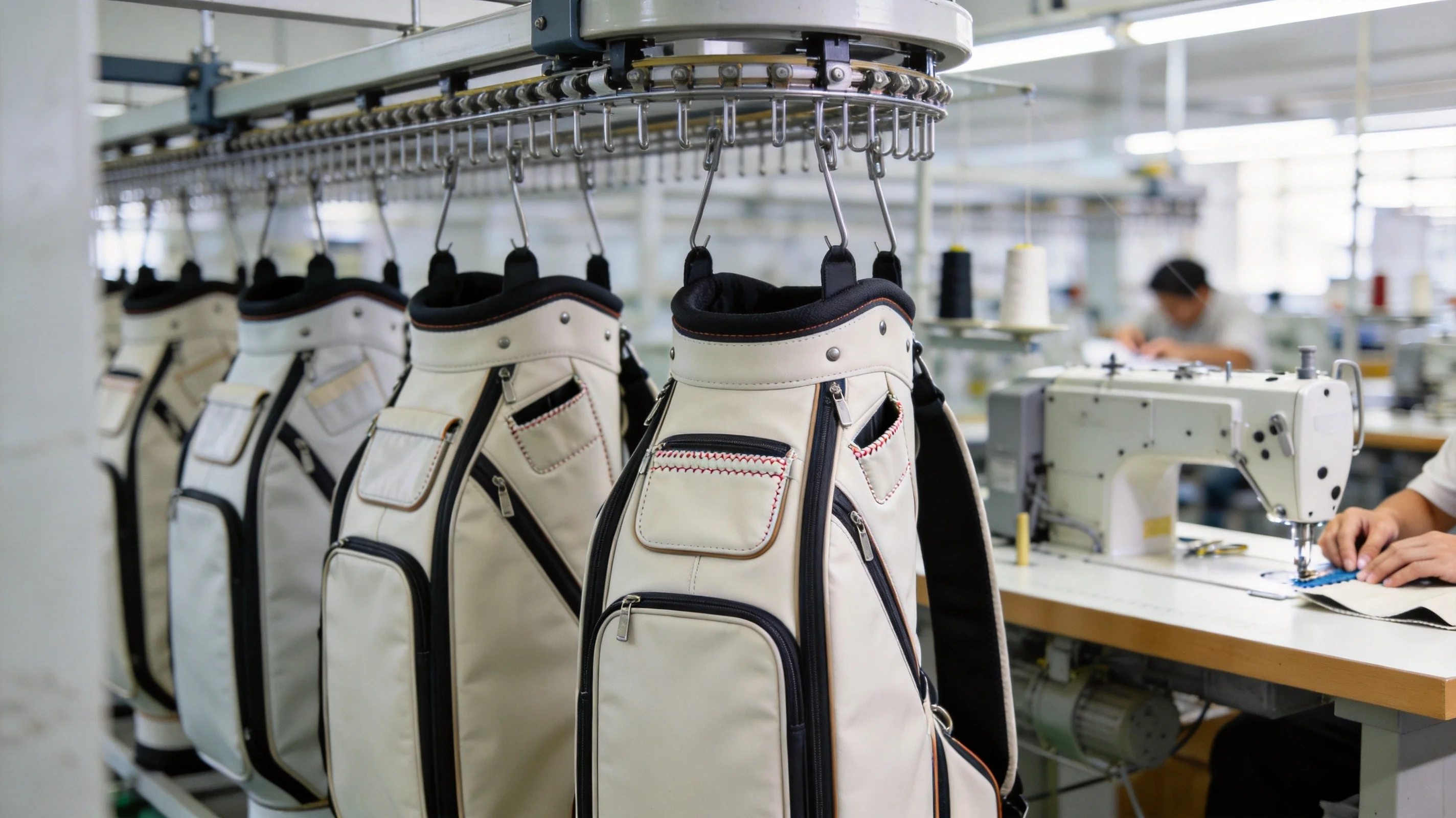
The golf bag manufacturing process is a structured sequence of eight stages — design and specification, sampling, material selection, cutting, sewing and assembly, finishing and decoration, quality control and packing — that together turn raw fabric, hardware and padding into a finished product over a 10-20 day sampling window and a 45-60 day bulk production run, delivered from a 7-line factory with a 200,000-unit monthly capacity. This guide takes you through each stage so you understand exactly how a golf bag is made and what to expect at every point in production.
Why Understanding the Process Matters
For anyone buying custom golf bags — whether a brand, retailer, academy or club — understanding the manufacturing process is not optional background knowledge; it is the foundation of negotiating capability, price, quality and delivery. A buyer who knows the process can ask the right questions, spot a weak supplier and make decisions that protect their product and their budget. A buyer who does not is at the mercy of whatever the factory chooses to tell them.
This knowledge also drives realistic planning. Because the process unfolds across defined stages, each with its own time cost, a buyer can schedule sampling and production accurately, allocate materials and negotiate timelines from an informed position. The more precisely you understand the eight stages below, the more control you hold over the entire project — from the first sketch to the loaded container.
Stage 1: Design and Specification
Every golf bag begins as a design and a specification. The design defines the product's look, layout and functionality — how many pockets, what divider system, whether it is a cart bag, stand bag, staff bag, carry bag or a speciality design. The specification gives the design its measurable reality: exact dimensions, construction methods, material grades, hardware types and decoration requirements.
The quality of the specification at this first stage largely determines how smoothly the rest of the process runs. A complete, unambiguous spec closes gaps before they reach the factory floor, preventing costly revisions later. When your design is well-documented, the factory can quote accurately, schedule efficiently and produce a first sample that matches your intent on the first attempt. This is the stage where the foundation of the whole project is laid, and it is worth doing thoroughly.
To give yourself the strongest possible hand at this stage, it helps to understand what a complete custom brief contains. Our OEM/ODM process guide provides a detailed specification checklist, walking you through every element a factory needs to produce your bag correctly the first time.
Stage 2: Sampling and Prototyping
With an approved design, the factory produces a physical prototype or sample. This is the first tangible expression of your design, and it typically takes 10-20 days. The factory patterns the design, cuts a test set of panels, sews them into a prototype and finishes it, giving you something real to hold, inspect and test rather than a drawing to imagine.
The sample is the most important checkpoint in the whole process. It is the moment to verify every dimension, test every zipper, strap and fastening, confirm material and colour, and check that the construction matches your specification point by point. Because whatever you approve at the sample stage becomes the benchmark for every production unit, a rigorous, decisive review here protects the entire run.
For a staff approach to what exactly you should inspect on a prototype — from seam quality to hardware function and decoration placement — our sampling guidance provides the point-by-point checklist that turns sample approval from a gamble into a controlled, reliable step.
Stage 3: Material Selection and Procurement
Once the sample is approved, the factory locks the material bill and procures materials in volume. The primary fabric — generally a durable woven such as nylon, polyester or a blend — is selected for the weight and strength the design requires. Padding and foam give the bag its structure and club protection. Dividers keep clubs organised. Hardware, zippers, buckles, straps and the rigid base complete the construction.
Material selection sits at the junction of cost and quality. The fabric's weight and grade, the padding's density and the hardware's quality each carry a price, and choosing the right balance for your product's purpose — whether it is a lightweight carry used a few times a month or a hard-wearing cart bag used every round — is a genuine design decision rather than an afterthought. Our materials guide maps the common materials and their trade-offs so you can specify with confidence.
Materials are also controlled by batch and dye lot. All panels for one order are kept within the same dye lot so colour stays uniform across every bag, and each incoming lot is inspected to confirm it matches specification. This discipline, applied before cutting, prevents the colour drift and construction inconsistency that plague loosely managed production.
Stage 4: Cutting
With materials procured and inspected, production moves to cutting. Panels are cut from the approved fabric using the patterns generated during sampling. The accuracy of cutting directly determines how cleanly the bag's components fit together, which is why cutting is done to tight tolerances and checked for dimensional accuracy and material flaws before the cut panels move to the sewing floor.
Cutting is the last point where a defective panel is inexpensive to replace. Once a panel is sewn into an assembly, correcting it means unpicking seams and re-stitching. Cutting inspection therefore catches flaws at the cheapest possible point, protects the expensive sewing and finishing labour that follows, and keeps the panel set complete so sewing never stops short of a component.
The cutting stage also enforces dye-lot discipline. By keeping panels for one bag — and one order — within the same dye lot, the factory ensures that the bags read as uniform in colour to the eye. A panel drifted into a different shade would be immediately visible on the finished bag, so this discipline is both a quality and a brand-protection measure.
Stage 5: Sewing and Assembly
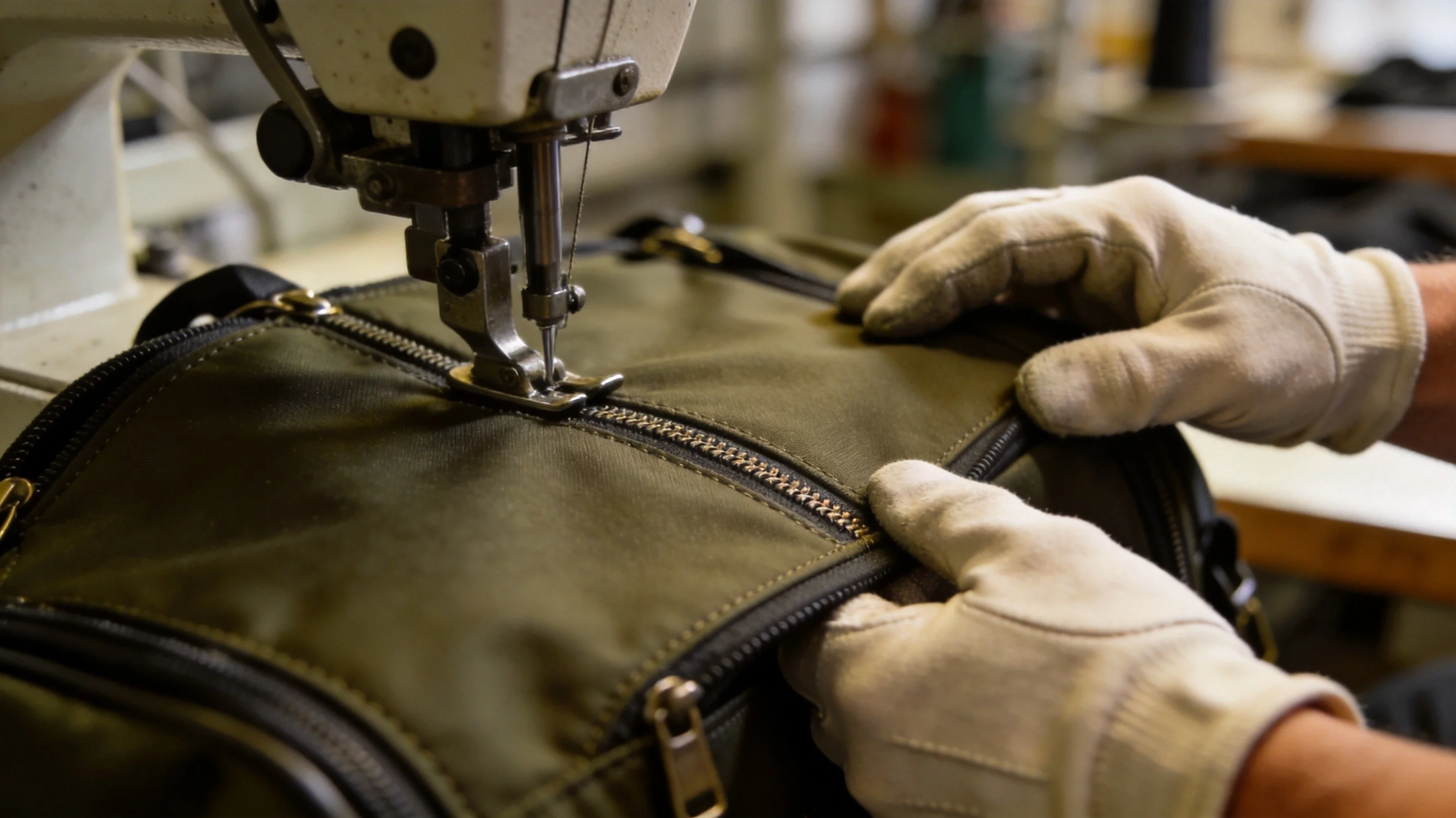
Sewing is the heart of the manufacturing process and by far the most labour-intensive stage. Cut panels are stitched into sub-assemblies — pockets, dividers, the main shell — and then joined into the complete bag. Depending on the design, this involves reinforcing load-bearing seams at the handles, straps, base and pocket connections, and fitting the hardware and dividers. On a high-volume facility, this runs across multiple production lines simultaneously.
Our facility organises this work across 7 production lines using 126 sewing machines, staffed by 137 employees, together sustaining a 200,000-unit monthly capacity. Experienced sewers handle the skilled work, and quality control samples each station's output at defined intervals to catch any slip in seam tension, stitch density or assembly while it affects only a few units.
Because golf bags carry real weight — a full set of clubs, balls, shoes and accessories — the reinforcing of load points matters enormously. A seam that fails at a handle or strap is not a minor cosmetic problem; it is a structural failure in the field. The sewing stage builds this durability in, and the in-process inspection verifies it before the bag proceeds to finishing.
Stage 6: Finishing and Decoration
After assembly, the bag is finished: edges and seams are trimmed, hardware is finally fitted, and the bag receives its decoration. Decoration is where your branding appears — logos, names, numbers or full artwork. It can be applied by embroidery, printed branding or branded panels, and it must match the approved artwork exactly in placement, colour and durability.
Decoration is high-stakes because it carries your brand identity. A misaligned logo or a colour that fades is not merely a cosmetic flaw; it damages the brand every time the bag is seen. The finishing stage therefore includes close validation of decoration against the approved design, confirming placement, colour accuracy and finish quality on every unit before the bag is cleared for packing.
The combination of clean finishing and precise decoration is what gives a custom golf bag its premium, professional appearance. It is the difference between a product that looks manufactured and one that looks designed — and for anyone building a brand around their bags, it is the stage that most visibly rewards attention to detail.
The Process at a Glance
For a buyer planning a programme, the eight stages map cleanly onto a schedule. Holding each as a defined checkpoint keeps the entire project on track.
| Stage | Key Activity | Typical Timing |
|---|---|---|
| Design & specification | Define product and spec | At kickoff |
| Sampling | Prototype & approval | 10-20 days |
| Material selection | Procure & inspect materials | Before cutting |
| Cutting | Cut & inspect panels | Core build |
| Sewing & assembly | Build the bag | Core build |
| Finishing & decoration | Trim, hardware, branding | After sewing |
| Quality control | AQL inspection | Before packing |
| Packing & shipping | Pack, palletise, export | 45-60 days total |
Working With the Complete Process?
Our factory runs the full eight-stage process across 7 lines and 126 sewing machines, from a facility founded in 2014 with 20+ years of experience. Let's take your design through every stage together.
Start Your Project →Stage 7: Quality Control
Quality control runs throughout the process, not just at the end. Incoming materials are checked at intake, cutting is inspected for accuracy, in-process sewing is sampled along the lines, and finished goods are validated against the approved sample. Before export, a final pre-shipment inspection under an AQL (Acceptable Quality Limit) plan draws a representative sample from the lot and verifies it against the agreed criteria.
This layered QC protects the product at every cheap point of correction. Catching a bad panel at cutting, a seam slip at the station or a decoration error at finishing each costs far less than finding the same issue in a finished, packed, shipped container. Our facility holds ISO 9001:2015 certification and passed formal SGS and Alibaba factory verification in March 2026, applying documented, measurable quality standards to every order. For the specific criteria to define, our quality standards guide is the reference.
Stage 8: Packing and Shipping
The final operational stage is packing and shipping. Finished, quality-inspected bags are packed to protect them in transit, palletised and loaded for export according to your incoterms and delivery terms. This stage is where the timeline reaches its conclusion, with bulk production of 45-60 days completing before freight adds its variable transit time to the destination.
For planning purposes, a full custom programme from kickoff through production spans roughly 70-90 days, before freight. Because golf demand is seasonal, working backwards from your target launch date and adding a buffer protects you from slippage at any of the stages above. Our lead-time and production timeline guide walks through scheduling a launch in detail.
Timing, MOQ and Production Reality
Timing within the process is governed by the standard production MOQ of 200 pieces per design, with 100-piece test orders available to validate a new market before committing to volume. Each design or colourway carries its own MOQ, so consolidating variants is the most effective way to hold unit cost down and use production capacity efficiently.
The 45-60 day bulk production window is realistic for a factory of genuine scale. A facility running seven lines at a 200,000-unit monthly pace has the capacity to complete orders without the queue delays that stretch smaller workshops, yet the physical process of sewing and finishing thousands of units is inherently time-bound. Understanding this reality lets you set expectations honestly and plan inventory with confidence, pairing the timeline with realistic volume and cost modelling.
Conclusion
The golf bag manufacturing process is a disciplined, eight-stage sequence — design, sampling, materials, cutting, sewing, finishing, quality control and shipping — that transforms raw materials into a finished, branded product over a 10-20 day sampling window and a 45-60 day bulk run. Each stage matters, and understanding it gives you the knowledge to specify correctly, sample rigorously and hold the factory accountable. With an ISO 9001 and BSCI certified, independently audited partner running the process at scale, you can expect a product that arrives as designed, on time and built to last.
Common Golf Bag Types and Their Build Differences
The manufacturing process adapts in detail according to the type of bag being built, because each type stresses different components and therefore different stages of construction. A cart bag is designed primarily to ride on a golf cart, so the process emphasises a stable base, secure attachment to the cart and generous cart-friendly storage pockets that open outward. A stand bag must be self-supporting on the course, so its build centres on a durable stand mechanism, a rigid base that anchors the legs and a lightweight construction that is easy to carry.
A staff bag, by contrast, is the largest and highest-capacity type, carried on a cart or by a caddie, and its construction uses the most material and the most sewing per bag. Because it carries substantial branding and is highly visible at tournaments and courses, the finishing and decoration stages receive particular attention. A lightweight carry or Sunday bag, built to be minimal and portable, shifts the emphasis towards reducing weight and simplifying structure, often at the cost of some storage capacity.
For a designer or buyer, choosing the right type is the first substantive decision because it cascades through the whole process — from the specification and sampling to the materials bill, the sewing complexity and ultimately the unit price. Understanding how the type influences the stages above lets you trade off features, weight, durability and cost deliberately rather than discovering surprises later in the programme.
Quality Systems Behind the Process
The reliability of the manufacturing process rests on the formal quality systems that govern it. ISO 9001 quality management requires documented process control, measurement and continuous improvement, which is what turns the eight stages from an ad hoc routine into a disciplined, auditable system. Because ISO 9001 is independently audited, its presence is evidence that the process is managed to a standard rather than improvised.
Social and labour compliance is addressed in parallel through BSCI (amfori Business Social Compliance Initiative), which audits working conditions and the treatment of the workforce. This matters to the process practically: a stable, fairly treated workforce is a skilled, consistent one, and operator consistency is one of the largest factors in uniform output. The two systems — ISO 9001 for quality and BSCI for labour — therefore support each other in producing reliable results order after order.
Independent factory verification adds a third layer of credibility. Passing SGS and Alibaba factory verification in March 2026 evidences that our facility's stated capacity, equipment and systems are real and operating as claimed. For a buyer, this trio of quality system, social accreditation and independent audit turns the process's promises into a verifiable, trustworthy foundation for a long-term sourcing relationship.
Automation, Equipment and Skilled Labour in Manufacturing
Modern golf bag manufacturing balances automated equipment with skilled handwork. Automated cutting systems bring precision speed to panel production, while automated zipper setting and hot-seal for waterproof seams take over repetitive, quality-critical operations. Yet the heart of the bag — the sewing that shapes and joins it — remains skilled manual work, because only a trained operator can manage the curve, tension and reinforcement that distinguish a durable bag from a fragile one.
This balance of machines and people shapes both the process and its economics. Equipment drives precision and throughput; people drive the craftsmanship that customers can feel and see. A facility that invests in both — as ours does, with a dedicated equipment base backing 137 trained employees across seven lines — is investing in the two foundations of consistent quality. Equipment alone cannot produce a fine bag; skilled hands alone cannot hit volume. The two together define a mature facility.
For a buyer, this balance is worth probing during supplier evaluation. Ask what equipment supports the production lines, how operators are trained and retained, and how the factory allocates work between automation and manual assembly. The answers reveal whether a facility is genuinely equipped to deliver repeat quality at volume, or whether it is merely quoting as one. Beneath the eight stages, this marriage of machinery and craftsmanship is what makes the whole process reliable.
How the Process Protects Your Investment
Every stage of the process exists in part to protect the buyer's investment. The specification closes scope before it becomes expensive; sampling verifies the product before bulk commitment; material selection locks quality before it is cut; inspection gates catch defects at their cheapest point of correction; and AQL pre-shipment sampling verifies the finished lot before it enters a container. Layers of protection compound rather than overlap.
Choosing a partner who runs the entire process transparently — who documents checks, offers records and welcomes third-party inspection — is how you translate the process from theory into protection. A factory willing to be audited and inspected is one with nothing to hide behind its stages. When evaluating suppliers, treat genuine transparency about the process as a leading indicator of reliable, repeatable quality, and treat resistance to it as a warning.
The Factory Behind the Manufacturing Standard
The process described here is how QUANZHOU JUNYUAN BAGS actually builds golf bags, in a 4,950 sqm affiliated production facility. The operation was founded in 2014, and its founder entered the golf bag industry in 2004, carrying more than twenty years of manufacturing experience. Seven production lines and 126 sewing machines support a team of 137 people, who together produce about 200,000 golf bags a month for more than 200 brands serving over 100 countries.
Custom work begins at a 200-piece MOQ, with a 100-piece test order offered for early validation. Prototype sampling takes 10-20 days and bulk production 45-60 days, figures we publish because they are real. The facility has completed SGS factory audits and operates its management system to the ISO 9001 standard, and its working practices align with BSCI expectations, giving you independent reason to trust the output of every stage this page describes.
Our export team is happy to map these stages and numbers to your specific order; reach us at service@junyuanbags.com or +86 17750020688. You can also review the services we offer on our OEM/ODM services page and on the OEM/ODM process guide. These are the operating facts behind the process this article explains.
Sources
Frequently Asked Questions
- What are the main steps in the golf bag manufacturing process?
- Design and specification, sampling, material selection, cutting, sewing and assembly, finishing and decoration, quality control and packing. Each stage feeds the next.
- How long does the golf bag manufacturing process take?
- Sampling takes 10-20 days and bulk production 45-60 days after approval, before freight. A full design-to-delivery programme is roughly 70-90 days.
- What materials are used to manufacture a golf bag?
- Durable woven fabrics, padding and foam, dividers, hardware, zippers, straps and a rigid base, all selected and graded against the design specification.
- How do factories control quality during golf bag production?
- Through incoming material checks, cutting inspection, in-process sewing samples, finished-goods validation against the sample and AQL pre-shipment inspection.
- What is the MOQ for golf bag manufacturing?
- The standard MOQ is 200 pieces per design, with 100-piece test orders available. Each design or colourway carries its own MOQ.