Golf Bag Materials Guide: Nylon vs Polyester vs Leather vs PU
A factory-level, engineer-tested comparison from QUANZHOU JUNYUAN BAGS — a golf bag manufacturer in business since 2014 — so you can spec the right materials for your own brand, on your first sample, without guesswork.The short answer: for most custom golf bag programs, 1680D or 1200D nylon is the best all-rounder — it offers the highest tear strength (typically 250–350 N for the coated face fabric) and the best weight-to-durability ratio; polyester (defined by its 600D–1000D twill weaves) delivers 15–25% lower cost per panel but dries slower and shows abrasion wear sooner; full-grain leather and bonded PU give a premium finish and structured silhouette but add 400–900 g to the bag and raise unit cost 2–5x; and hybrid blends such as nylon-face/polyester-back or 840D bag-pack flocked fabrics are where most pro-tour bags actually sit. Below is the complete, factory-floor guide to how each material is made, measured, and cut, with the denier and abrasion data we use in our 7 production lines every day.
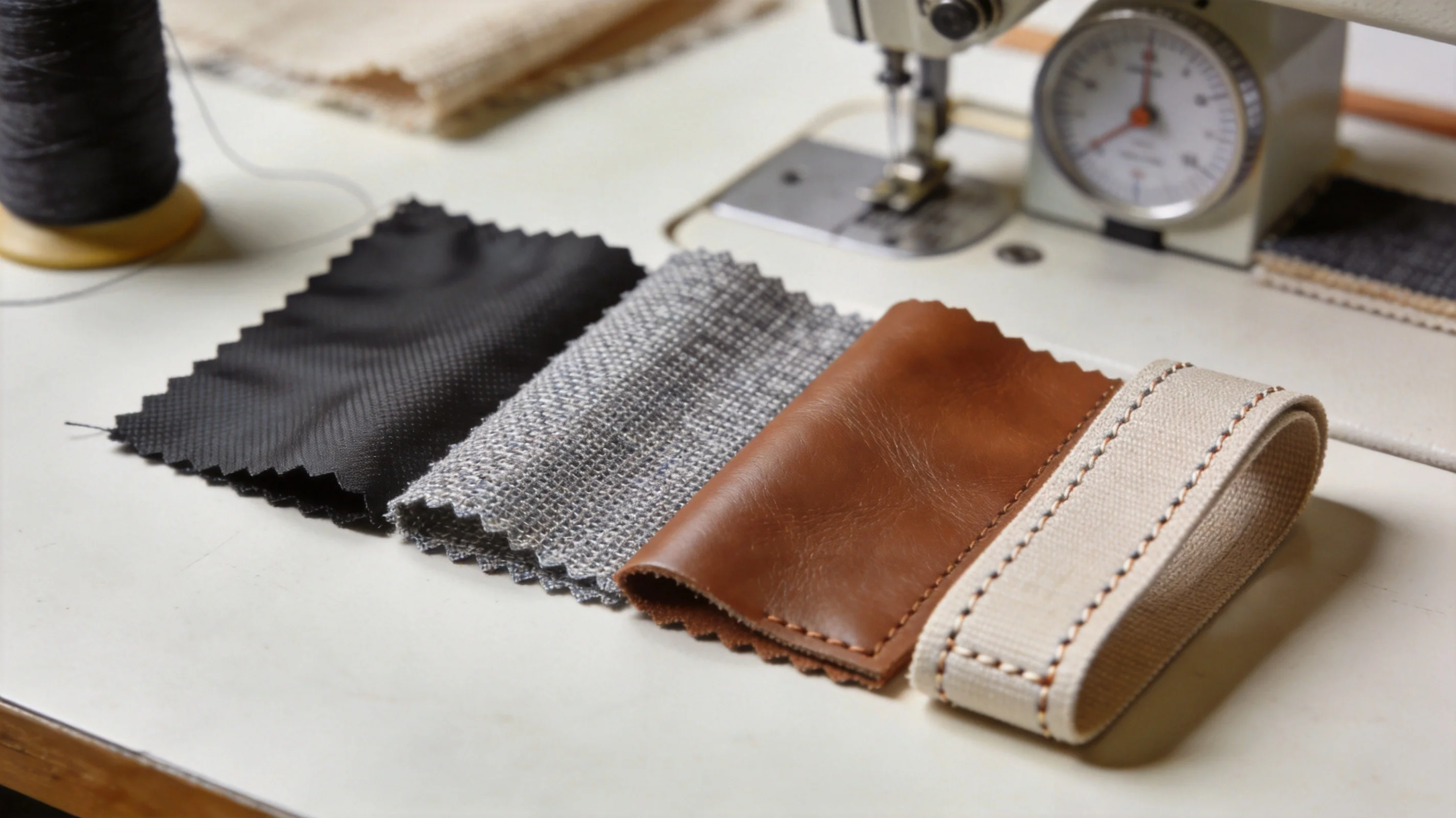
Nylon, polyester, PU and hybrid fabrics are matched by load, tear strength and finish — weighing cost against durability for each bag type.
Why Material Choice Determines Your Bag's Real Cost and Quality
Material is typically 40–60% of a golf bag's total manufacturing cost, before any hardware, zippers or branding. That single decision cascades into every downstream step: which cutting pattern the factory can use, which needle size and thread tension the sewing line runs (we operate 126 sewing machines across our affiliated plant), how the fabric behaves under a 45–60 day production run, and finally how the bag survives the airport conveyor belt, the rain, and the cart strap wear your end customer will put it through.
At QUANZHOU JUNYUAN BAGS — founded in 2014 by an owner who entered the industry in 2004 — we have produced golf bags for more than 200 brands across more than 100 countries, with a monthly output of about 200,000 pieces across 7 production lines and 137 employees. What we see in the shipping container tells a consistent story: bags fail not because of a bad zipper or an over-stressed seam, but because the wrong fabric was specified for the bag's job. This guide exists to stop that.
Below we break down the four material families — nylon, polyester, leather and PU, and hybrid blends — with the fabric data (denier, abrasion, weight, cost) we actually use when quoting, and the internal links point to our deeper guides on material evolution, waterproofing, and luxury finishes.
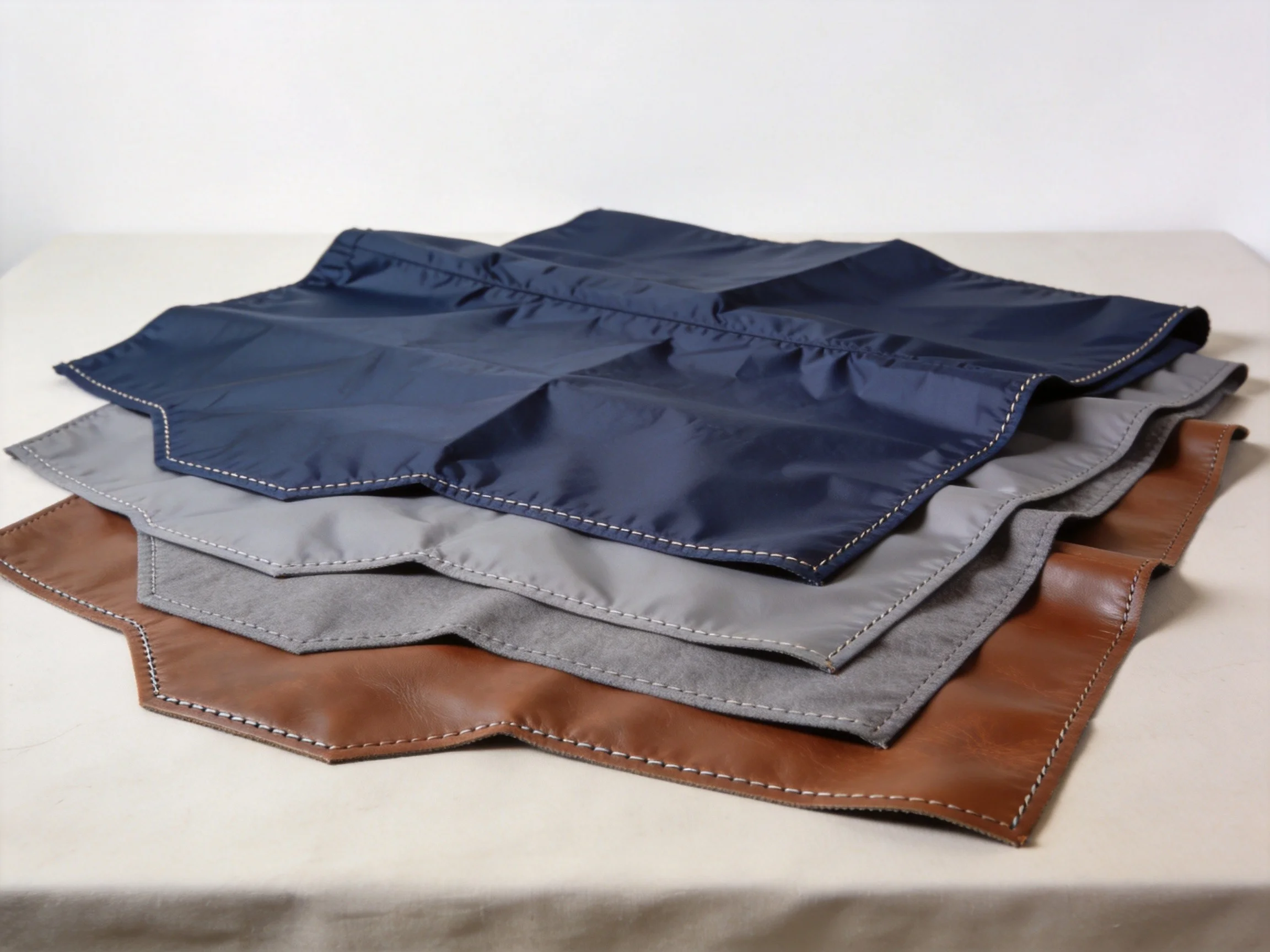
Waterproof nylon, ripstop polyester, PU leather and canvas — the materials we match to your bag
Nylon — The High-Tear, Water-Resistant Default
Nylon (polyamide) is a synthetic fiber with high elasticity and tear strength, which is why it dominates the main body and side panels of most travel bags, cart bags and stand bags. In roll dimensions, the two workhorse weights are 1680D ballistic nylon (used on premium travel and pro-staff bags) and 1200D/840D nylon (used on mid-range combo bags). A 1680D coated nylon fabric typically weighs 400–500 g/m² and resists tearing at roughly 250–350 N in the warp direction.
Nylon's biggest operational advantage is that, because it is extruded and can be textured, it accepts water-resistant coatings (PU or TPU coatings up to 1,000–5,000 mm hydrostatic head) better than polyester does, and it retains drizzle resistance for longer. Nylon is also lighter per unit of strength, which matters because every 100 g counts against airline weight limits on travel bags.
The trade-off is cost: nylon fiber is typically 15–25% more expensive than polyester of the same denier, so at high volume the price gap is real. Nylon fabrics also melt rather than char against a hot surface (relevant if a bag is left against a vehicle exhaust), and they can yellow slightly under prolonged UV exposure unless a UV stabilizer is added.
Best used for: main body panels of travel bags, stand-bag leg wear zones, and any panel that must resist being snagged during transport. Watch for: specifying a coated nylon on bags that need to flex (like stand-bag legs) — over-coating can reduce flexibility and add stiffness marks at the fold line.
If your program runs light-travel bags or stand bags, see our full breakdown of the evolution of golf bag materials to see how nylon displaced leather as the volume material.
Polyester — The Cost-Efficient Volume Workhorse
Polyester is the most common fabric across promotional, value and mid-tier golf bags simply because it is the cheapest reliable option at scale. The standard specs are 600D polyester twill (about 150–220 g/m², a good value entry) and 1000D polyester (250–350 g/m²) with a TPU or PVC backing used on lower-cost travel shells that still need stiffness.
Measured honestly, polyester's tear strength is lower than nylon of the same denier — typically 15–25% lower in ASTM D2261 tongue-tear testing — which is why pure-polyester bags show surface abrasion and snag damage after repeated cargo handling faster than a nylon bag. Polyester also dries more slowly once wet (it holds roughly 10–20% more moisture on a fungal test board), which is a real complaint on rainy tournament days.
But polyester has two strong suits. First, price: at our factory, cutting to comparable denier, a polyester body can be 15–25% cheaper per square meter than nylon, and because it dyes with disperse dyes it reproduces brand colors and gradient printing more saturated and colorfast — excellent for loud, multi-color brand graphics. Second, UV resistance: polyester naturally resists sunlight fading better than many nylons, which matters for bags that live on a cart under direct sun.
Best used for: promotional and value cart bags, club-packing sleeves, children's sets, and any bag where price per unit must be minimal. Watch for: if a customer's brand demands "premium feel," raw 600D polyester will feel less supple in hand than bonded or flocked versions — a poly with a nylon face or a printed flock solves that feel problem cheaply.
For the waterproofing trade-offs across both nylon and polyester, read our guide to best waterproof materials for all types of golf bags.
Leather and PU — The Premium, Structured Finish
Real leather — most commonly full-grain or corrected-grain cowhide from 1.4–1.8 mm thickness — is reserved for the most premium staff bags and heritage/logo bags. Genuine leather adds weight immediately (a leather body can add 400–900 g versus the same nylon panel) and raises unit cost by roughly 2–5x versus nylon depending on grade and hide yield. Its selling point is uncompromising durability: correctly tanned full-grain leather can outlast every synthetic fabric on earth while developing a patina that reads as "quality" to the end customer.
The problems with real leather at production scale are real and often underestimated: hides have natural variation, so color and grain matching across a 500-piece production run requires skilled hand-cutting and extra waste allowance (typical hide yield on irregular bag panels is 75–85%); leather absorbs water and requires periodic conditioning; and genuine leather is subject to export-customs and CITES scrutiny for certain origin. That is why most "leather-look" golf bags on the market today are not leather at all — they are either bonded leather or, far more commonly, PU-coated fabric.
PU (polyurethane) coating is applied to a knitted or woven base — typically a 0.5–1.2 mm PU coat on a nylon or polyester knit — to imitate the hand-feel and sheen of leather at about 20–40% of the real-leather cost and without the weight penalty. PU offers a clean, structured silhouette and easy cleaning (wipe clean with a damp cloth), which suits staff bags precisely. Its weakness is surface wear: PU can peel or crack over years, especially on flex points like handle wraps, and it is slightly heavier than plain nylon for the same stiffness.
Best used for: staff bags, signature logo panels, trolley trousers and trim where a structured premium look is worth the weight and cost. Watch for: never specify PU on high-abrasion areas like the bottom wear plate — that should stay an abrasion-rated fabric — and always request a peel-resistance test (ASTM D751 or a simple 180° tape peel) when the PU coat is below 0.8 mm.
For the killer detail upgrades that separate a $200 staff bag from a $2,000 one, read luxury materials used in pro-level golf staff bags.
Hybrids and Specialty Materials — What Pro-Tour Bags Are Actually Made Of
The bags that win on the tour — and the bags your most demanding retail customer will buy — are almost never a single fabric. They are engineered laminates. The most common construction is a nylon face / polyester backing laminate (which gives nylon's tear resistance with polyester's color and cost), or a 840D bag-pack flocked fabric, a technical weave borrowed from premium backpacks that shaves weight while maintaining stiffness.
Beyond the body, the specialty bill of materials includes: PVC or TPU-coated polyester for the waterproof bottom wear plate and rain-hood; mesh (100% polyester or nylon) for the divider walls, which must breathe to allow club moisture to escape and prevent mildew in the club chamber; TPU-laminated tricot for elasticized handles and stand straps; and foam laminates — EVA or polyethylene foam in 3–8 mm — bonded behind the fabric to give a structured silhouette that holds its shape when the bag is empty.
For zipper-heavy programs, note that nylon coil zippers slide more easily over curved top openings but polyester chain is cheaper; the industry standard we specify is a #5–#8 coil with a YKK or equivalent slider rated to tens of thousands of cycles. On hardware, a zinc die-cast or machined buckle on a hybrid bag signals "pro" far more than a plastic one, which is the entire trick of the premium tier.
Best used for: pro-staff bags, high-end stand bags, and any bag where weight, stiffness and perceived quality must coexist. Watch for: every added laminate layer adds a sew-ability constraint — over-laminating a flexible panel raises seam-puckering risk, so we always run a couple of sample meters of your exact hybrid before committing the full sample cycle.
Spec a hybrid body and you will almost certainly land in the same build family as our product catalog; if you want a bespoke combination, our custom bag solutions team will engineer it with you panel by panel.
Golf Bag Material Comparison Table
A fast-reference comparison of the four material families across the attributes that matter when quoting. Figures are typical industry ranges; your exact spec depends on denier, coating and laminate build.
| Material | Abrasion / Tear | Water Resistance | Weight | Cost | Typical Use | Recommend |
|---|---|---|---|---|---|---|
| Nylon (1680D / 1200D) | Excellent — tear 250–350 N | Good with PU/TPU coat (up to 5,000 mm head) | 400–500 g/m² | $$$ (15–25% above polyester) | Travel, pro-staff, stand bag body | ★★★★★ |
| Polyester (600D / 1000D) | Good — tear 15–25% below nylon | Fair, dries slower | 150–350 g/m² | $ (most economical) | Promo, value cart, kids' sets | ★★★★ |
| Leather (full-grain 1.4–1.8 mm) | Superior long-term | Absorbs water, needs care | +400–900 g vs nylon | $$$$$ (2–5x nylon) | Prestige staff and logo bags | ★★★★ (premium programs) |
| PU-coated fabric (0.5–1.2 mm) | Good; peel risk on flex points | Good, wipe-clean surface | Slightly heavier than plain nylon | $$ (20–40% of real leather) | Staff bags, logo panels, trim | ★★★★ |
| Hybrid laminates (nylon face / poly back) | Excellent (nylon's tear) | Good with coating | Engineered to shave weight | $$–$$$ | Pro-staff, high-end stand bags | ★★★★★ |
Beyond the two dominant fabrics, a few specialty materials earn their place on specific bags. Ballistic nylon, a 1000-denier-plus weave originally developed for military use, is increasingly specified on premium staff and tour bags where puncture resistance matters more than weight. Laminated and welded constructions — where an outer fabric is heat-sealed to a waterproof inner membrane — are the upgrade path for rain-ready bags, replacing a removable rain hood with permanent protection. And for value-driven cart bags at high volume, a 210–420 denier PU-coated polyester keeps the landed cost down while still clearing seam-strength and zipper-cycle tests. Naming these trade-offs precisely is what separates a material spec sheet that survives a factory audit from one that gets renegotiated on the line.
How to Choose Material by Bag Type
Different bag formats impose different material demands, so your "best material" answer changes with the SKU. Use this as your decision shortcut:
- Travel bag: optimize for tear resistance and coating capacity. Spec 1680D nylon with a TPU bottom plate and a PVC-reinforced wear base; leather is pointless here — it adds weight and catches snags.
- Stand bag: balance weight and durability. A 1200D nylon body with a hybrid nylon-face/flocked base and flexible leg panels keeps the bag under 1.8–2.5 kg while surviving ground friction.
- Cart bag: weight is less critical, stiffness and pocket waterproofing matter. Polyester at 1000D works well and saves 15–25% in material cost; upgrade to nylon if the brand wants premium hand-feel.
- Staff / pro bag: the image product. Leather panels or PU-coated fabric for the structured silhouette, reinforced with mesh dividers and foam lamination for the crisp empty-bag shape.
For a format-level walkthrough across every bag style your catalog might add, our golf bag types guide covers the full lineup.
Testing and Quality Checks That Follow the Fabric
Every material spec should be verified before a custom run, not after. In our affiliated factory's routine, the fabric gate includes: a tensile and tear test (e.g., ASTM D2261 for tearing strength on coated fabrics), a Martindale abrasion test (typical target 20,000–40,000 cycles before surface wear on main panels), a hydrostatic head test (the actual mm rating of your coating, e.g., 1,000–5,000 mm), and a colorfastness-to-light test for outdoor exposure. On hardware, zipper slider durability is cycled and buckles are load-tested.
We operate 7 production lines with around 126 sewing machines and 137 employees, and our affiliated main plant is a 4,950 m² facility. Our systems and export processes have been verified under an SGS factory audit commissioned in March 2026 for Alibaba; manufacturing is carried out by our affiliated factory while the export entity handles trading and documentation. Whatever material you choose, a rigorous in-line QC program is the difference between a great spec sheet and a great bag — our golf bag quality standards guide explains the checks in detail.
Frequently Asked Questions
- Which is better for a golf bag — nylon or polyester?
- Nylon wins on tear strength and coating retention; polyester wins on price and color saturation. For durable travel and stand bags, nylon is the stronger choice. For promotional and value cart bags where cost per unit rules, polyester at 1000D is the pragmatic pick.
- What does "1680D" mean in a bag spec?
- Denier (D) is a measure of the yarn's linear density — the weight in grams per 9,000 meters of the fiber. Higher denier = heavier, stronger yarn. 1680D is a classic premium ballistic nylon; 600D–1000D are standard mid-tier polyester/nylon weights.
- Is a leather golf bag worth the extra cost?
- Only for premium staff or heritage branding where the patina and structured silhouette justify a 2–5x unit-cost lift. For performance or volume bags, PU-coated fabric gives 80% of the look at 20–40% of the genuine-leather cost.
- Which material is the most waterproof?
- None is waterproof on its own — waterproofing comes from the coating. A TPU or PVC-coated nylon/polyester with a sealed seam construction reaches the highest hydrostatic ratings (up to 5,000 mm head), which is why rain hoods and bottom wear plates use coated fabric, not raw cloth.
- Why do pro-staff bags feel stiff but light?
- They combine a hybrid nylon-face laminate with foam lamination (EVA or PE foam, 3–8 mm) bonded behind the fabric. The foam gives a crisp silhouette that holds its shape when empty while the light nylon face keeps weight down.
- Can I mix materials across one bag?
- Absolutely — most premium bags are hybrid builds: a coated-nylon main body, a PVC/TPU bottom wear plate, mesh dividers, and PU or leather trim on handles and logo panels. Mixing adds sew-ability complexity, so always run a couple of sample meters of your exact combination first.
- What are the MOQ and lead time for a custom material spec?
- Our standard MOQ is 200 pieces per SKU, with a 100-piece trial for testing orders. Sampling takes 10–20 days, and a full production (MOQ) order takes 45–60 days once the sample is approved. Reach us at service@junyuanbags.com or +86 17750020688 to discuss your spec.
- How do I prevent a PU bag from peeling?
- Require a PU coat of at least 0.8 mm, avoid putting PU on high-flex points like handle wraps, and request a peel-resistance test (e.g., ASTM D751 or a 180° tape peel) in your lab report before committing to the run.
- Does the material affect how well the bag resists mildew?
- Yes. Polyester dries slower than nylon, holding roughly 10–20% more moisture after wetting, which raises mildew risk inside the club chamber. Using breathable mesh dividers and a quick-drying fabric (nylon) significantly reduces internal mildew.
- Which fabrics does your affiliated factory sew on normal-line equipment?
- All four families — nylon, polyester, PU-coated, and hybrid laminates — run on our standard sewing line. Genuine leather requires skilled hand-cut and heavier feed bindings, so it is quoted separately with a longer sampling time and lower hide yield allowance.
Sources
- ASTM D2261 Standard Test Method for Tearing Strength of Fabrics by the Tongue (Single Rip) Procedure
- ASTM D4964 Tear Strength of Geotextiles / coated-fabric test references
- Martindale Abrasion Test — Wikipedia on fabric abrasion measurement — (dofollow)
- PU vs Nylon fabric comparison — an industry-facing fabric resource
- Denier (unit) — fiber density measurement explainer) — (dofollow)
All company figures above (founded 2014, industry experience since 2004, 7 production lines, 126 sewing machines, 137 employees, ~200,000 monthly capacity, 200+ brands, 100+ countries, 4,950 m² affiliated plant, SGS audit verified March 2026 for Alibaba) reflect the unified data we publish across our sites. Material technical ranges in this guide are typical industry values used for engineering reference, not product-specific guarantees.
QUANZHOU JUNYUAN BAGS teams up with an affiliated factory for manufacturing and exports as a trading entity. For a material consultation and a quotation on your next custom golf bag, email service@junyuanbags.com or WhatsApp +86 17750020688.