Golf Bag Quality Control and Testing Standards 2025
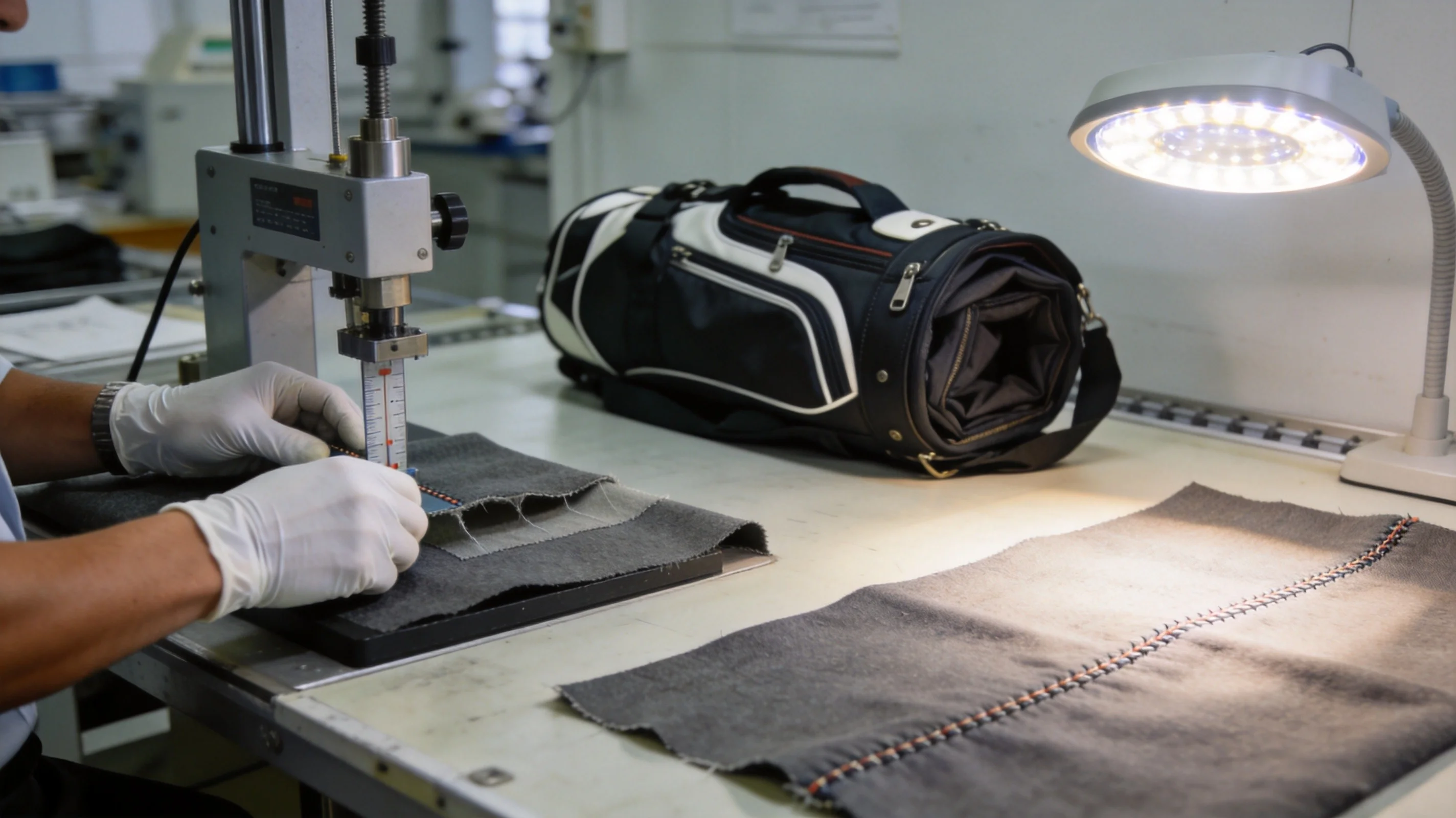
In 2025 professional golf bag quality control rests on a defined battery of testing standards — seam strength at load points, zipper cycle life, strap and handle pull strength, base rigidity, fabric abrasion and water resistance where relevant — verified through production function tests and an AQL-based pre-shipment sample (commonly AQL 2.5 major / 4.0 minor), all executed to measurable criteria. This guide defines those standards so you can specify them for any order.
Why Testing Standards Matter
A golf bag endures a demanding life: it carries a full set of clubs, rides in carts and vehicles, enters and exits cars, faces heat, cold and rain, and is subjected to years of zipping, strapping and hauling. Testing standards exist to confirm, before a bag ships, that it will perform under these conditions rather than fail in the hands of a customer. Standards convert quality from an opinion into a set of objective, measurable requirements.
For buyers, explicit standards are the difference between a vague agreement to make "a good bag" and a contract to meet "seam strength of X under Y load, zipper rated for Z cycles." The latter is enforceable and inspectable; the former invites dispute. Setting clear standards up front is therefore a genuine commercial advantage, not paperwork.
Seam and Stitch Standards
Seams are where most structural strength lives, and they are governed by three variables: stitch density (stitches per inch), stitch type and seam reinforcement. Higher stitch density gives stronger, more water-resistant seams but is slower to produce. Load-bearing seams, particularly at straps, handles and the bag's base, are double-stitched or taped with webbing for reinforcement.
Seam strength is tested by applying a measured pull to a seam and verifying it holds without tearing or stitch failure. For our factory, seam quality is verified both in process and against the approved sample at finished-goods inspection. This is a core standard because a bag that fails at a seam fails everywhere — you cannot sell it, and you cannot easily repair it. Our quality standards guide quantifies these seam criteria so they can be written into an order.
Zipper and Closure Standards
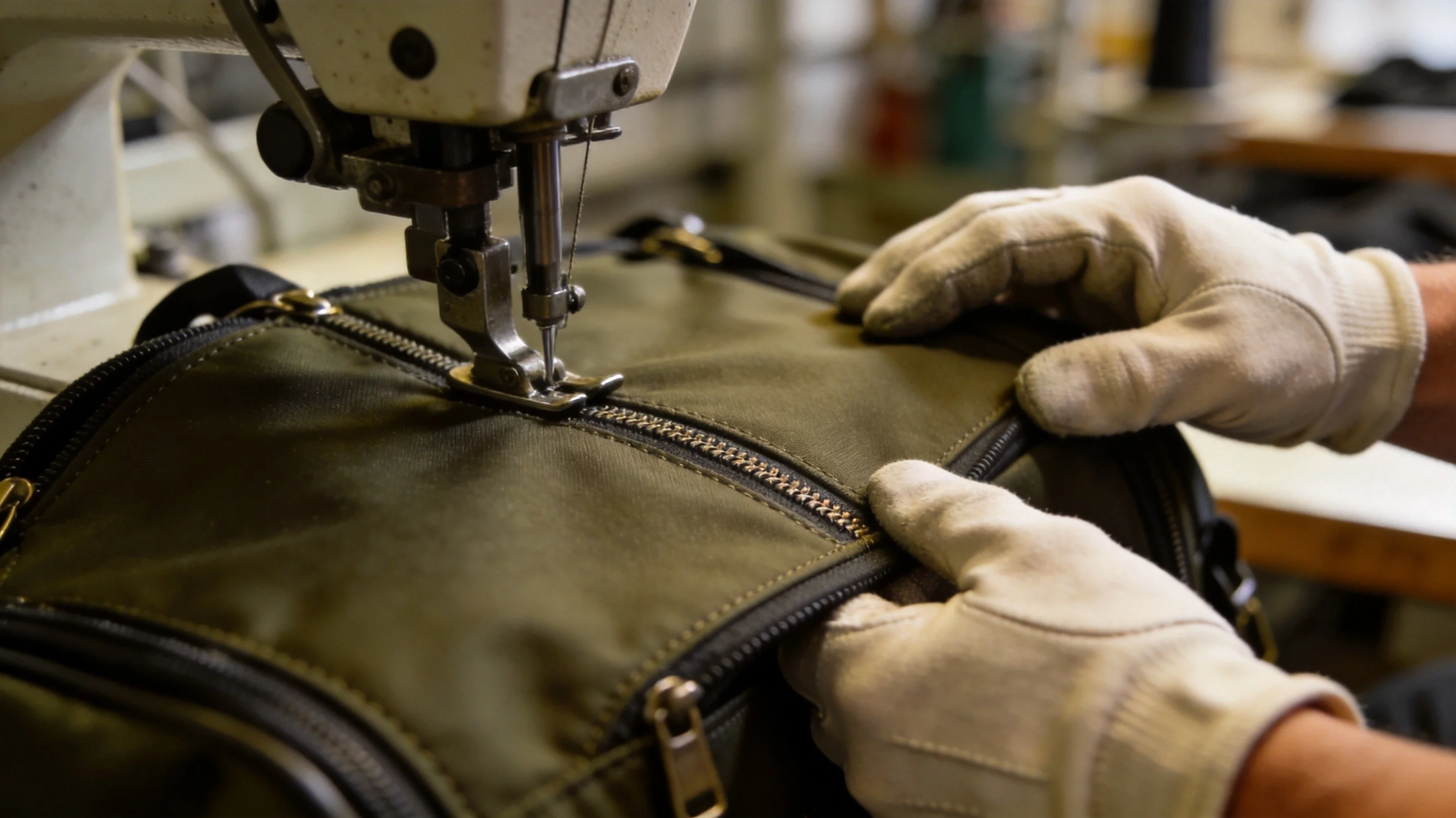
Zippers are the most-used functional component on a golf bag and among the most likely to fail. Standards govern both the zipper grade and its cycle life. A zipper on the main club-access pocket may be specified for thousands of open-close cycles, while decorative zippers can use lighter construction. Slider quality, tooth shape and tape attachment all determine real durability.
Testing cycles the zipper a defined number of times and inspects for smooth operation, track damage and slider failure. This is a pure function test — a zipper that looks good in a photo can still jamb or shed teeth after use. Specifying the cycle-life requirement and having it tested protects the product from the most common point of field failure.
Strap, Handle and Base Standards
Load-bearing components carry the entire weight of a loaded bag, so they carry the strictest structural standards. Straps and handles are pull-tested under a defined load to confirm the anchoring and stitching hold without pulling free or tearing. This matters most on carry and staff bags, where a handle failure while lifting a heavy loaded bag is both a product failure and a safety issue.
The base is tested for rigidity and integrity under a full club load. A weak base deforms, destabilising the bag whether standing, on a cart or on the ground, and damaging clubs. Reinforced base panels and riveted feet are verified in test. Together, the strap, handle and base standards define the bag's ability to simply do its primary job reliably — carrying equipment day after day.
Fabric and Water-Resistance Standards
Fabric standards cover strength, abrasion and, where applicable, water resistance. Abrasion resistance is tested by rubbing the fabric a defined number of cycles and checking for wear-through, important for surfaces that contact carts and the ground. Water-resistant and waterproof bags are tested by exposing them to water under defined conditions and confirming no ingress or damage, referenced to the product's claimed rating.
Dyeing and finish quality are also checked — colour fastness under light and washing, and coating adhesion for waterproof laminates. These fabric-level standards ensure the bag looks good and performs for its rated purpose over time, rather than degrading in the first season. For the full picture of material options and their performance trade-offs, our materials guide is the companion reference.
Set Rigorous Testing Standards for Your Order
We test to defined standards — seam strength, zipper cycle life, strap and base integrity — and verify through AQL inspection. ISO 9001 & BSCI certified, audited March 2026.
Define Your Testing Standard →The 2025 Testing Battery at a Glance
Specifying which tests apply and their pass criteria turns "good quality" into something measurable and auditable. Here is a common standard set for a professional golf bag.
| Test | What Is Verified | Common Standard |
|---|---|---|
| Seam strength | Load-point seam integrity | Pull test, no tear/stitch fail |
| Zipper cycle | Slider & track durability | Thousands of open-close cycles |
| Strap/handle pull | Anchoring under load | Defined load, no pullout |
| Base rigidity | Base under full load | No deforming |
| Fabric abrasion | Wear resistance | No wear-through in N cycles |
| Water resistance | Ingress protection (rated) | No ingress per claim |
AQL Acceptance Criteria in 2025
Testing standards meet the acceptance process at the pre-shipment inspection, which is governed by an AQL (Acceptable Quality Limit) plan. A statistically drawn sample of the finished lot is inspected, with defects classified as critical, major or minor. A common contract is AQL 2.5 for major defects and 4.0 for minor, with critical defects always grounds for rejection.
The AQL plan operationalises the testing standards: it defines how many units are inspected, how defects are categorised, and at what count the lot is accepted. Agreeing this before production gives both parties an objective basis for the container release. Independent third-party firms such as SGS commonly execute the AQL inspection and issue the report, adding an unbiased check to the factory's own testing.
How Testing Interacts With Quality Systems
Testing standards are most credible when embedded in a formal quality management system. ISO 9001 requires documented standards, recorded test results and corrective action, giving the testing battery institutional force rather than leaving it to ad hoc judgment. BSCI social compliance protects the workforce whose skill is central to meeting structural standards.
At our facility, testing is part of the documented ISO 9001 process, reinforced by the SGS and Alibaba factory verification passed in March 2026. This means the standards described here are not marketing language; they are tested, recorded and auditable claims. For buyers, this is how individual test requirements connect to the broader credibility of the factory's quality system.
Setting Testing Standards With Your Factory
The most reliable way to get the standards you want is to write them into the specification at the sampling stage. Specify the test battery, the pass criteria and the AQL plan; require recorded results for your order; and reserve pre-shipment inspection. Our OEM/ODM engagement process supports this by making testing an agreed part of the production contract from the first sample.
Be careful not to over-specify beyond what the product needs, as aggressive standards raise cost for little benefit. Choose tests that reflect real use — a waterproof cart bag needs water testing; a Sunday carry may not. A factory with real testing capability, such as ours running 7 production lines, 126 sewing machines and 137 employees, has the laboratory and procedure depth to apply standards sensibly rather than cosmetically.
Conclusion
2025 golf bag quality control and testing standards move quality from assertion to measurement. By specifying seam strength, zipper cycle life, strap and base integrity, fabric durability and water resistance — and verifying them through an AQL pre-shipment plan under a documented ISO 9001 system — a buyer can confidently ship a product that performs as promised. Standards you can name and test are the ones you can enforce; they are the strongest protection your brand has after the container leaves the factory.
How Testing Standards Relate to Real-World Use
The most effective testing standards are those rooted in how a golf bag is actually used. A bag does not get inspected on a lab bench; it gets loaded with a full set of clubs, dragged onto carts, bounced around vehicles, left in heat and rain, and zipped open and closed hundreds of times. Testing that mirrors this real-world abuse produces standards that predict the field experience far better than cosmetic checks alone.
This is why the test battery pairs visual inspection with function and performance tests. A bag may look flawless and still fail where it matters — at a seam under load, a zipper mid-cycle, a strap at full weight, a base on a hard surface. Standards that capture these failure modes are standards that protect the user from a product failing at the worst possible moment.
For a buyer, tying tests to use also stops over- or under-specification. A waterproof cart bag needs rigorous water and durability testing because it is exposed to weather every round; a lightweight Sunday bag does not need the same water battery and would pay for it needlessly. By choosing tests that match intended use, you get protection where it counts and avoid paying for protection you do not use — a balance our materials guide and performance framing both help you strike.
Documenting Test Methods and Results
For testing standards to be meaningful, the methods must be documented and the results recorded. A documented test method specifies exactly how the test is performed — the load applied, the number of cycles, the pass criterion — so that it is reproducible and the result is comparable across orders. A vague "we tested it" claim cannot be verified, replicated or argued about fairly.
Recording results turns every test into evidence. Our facility documents test methods and results within its ISO 9001 quality system, so there is a verifiable record for each order rather than a recollection. This documentation also feeds continuous improvement: when a test reveals a pattern of weakness, the factory traces the cause and corrects it, making future runs stronger.
For a buyer, asking to see documented test methods and results for a recent order is a powerful vetting tool. A factory that can produce them is demonstrating genuine testing rigour; one that cannot is claiming quality without the evidence that supports it. Documentation is the bridge between a standard written on paper and a standard verified in practice, and it is the basis for an enforceable quality agreement.
Aligning Testing With AQL and Pre-Shipment
Testing standards and the AQL pre-shipment inspection work together rather than separately. The testing battery defines what good performance looks like for the product; the AQL plan determines, statistically, whether the finished lot meets it. A representative sample drawn under the AQL plan is subjected to the agreed testing, and the lot is accepted or rejected on the result combined with overall visual and construction criteria.
This alignment gives the buyer a complete picture. Individual function tests verify the product's capability; the AQL sample verifies that the lot, as a whole, holds to standard. Together they convert "this product is well made" into "this batch has been sampled and meets the agreed specification and performance criteria," which is the assurance that actually protects a shipment.
Our facility runs this combined approach — documented testing plus AQL pre-shipment — under ISO 9001 and independent audit. For a buyer with specialist criteria, combining your own test requirements with a third-party AQL execution such as SGS gives the most independent and credible verification. Defining the tests, agreeing the AQL plan and documenting the results is how standards move from intention to enforced reality.
Testing at the Right Scale and Cost
Testing standards must be economically proportionate to the product, or they become a cost without a benefit. Requiring laboratory-grade destructive testing on a low-cost bag, or demanding water-resistance certification on a product never exposed to water, inflates price with no performance payoff. Sensible testing applies strict standards where failure is costly and lighter standards where it is not.
Proportionality is a mark of a sophisticated factory. A mature facility can discuss what testing is justified for your product and why, rather than reflexively agreeing to every test in the quest to close a sale. This honesty protects the buyer from over-specification as surely as weak standards protect from under-specification. The goal is protection matched to risk, not maximum testing at any price.
At our facility, testing is applied proportionally across the products we make for 200+ brands, balancing protection with cost so each client gets the performance they need at a price their market will bear. Specifying the right tests with your factory — neither more nor less than the product demands — is a genuine design skill, and it is the way standards become an asset rather than a burden for your product line.
Who Applies Testing Standards in the Factory
Testing standards are only as reliable as the people and facilities that apply them. A genuine factory testing regime uses trained testers and appropriate equipment — pull testers for seam and strap strength, zipper cycle testers, base and stand rigs, and water-testing setups for rated products. The equipment and the trained staff are the tangible infrastructure behind a testing standard rather than a claim.
Trained testers know how to set up the equipment correctly, apply the specified load or cycles and interpret results without bias. Consistent testing requires consistent technique, and that is produced by training. A factory that invests in testing equipment and trains its people is demonstrating that its standards are operational, not decorative — the difference between a lab that verifies and a sales sheet that asserts.
Our facility pairs testing equipment and trained staff with the documented methods of the ISO 9001 system, giving the standards real force. For a buyer, this is worth probing: ask what testing equipment is available, who operates it and whether test methods are documented. A factory that can show its testing depth can be trusted to apply the standards you specify to your product.
Setting Realistic Standards for Your Market
Testing standards should also be set with the target market in mind. A flagship bag sold at a premium price supports — and demands — a higher testing standard than a value-priced line, because the cost of field failure is proportionally higher for the premium product and customers expect more. Calibrating standards to positioning protects your reputation where it matters most without inflating cost where it does not.
Market and expected conditions should inform the test battery. A bag sold in rainy, demanding environments justifies stronger water and abrasion testing; a bag used mainly on fair-weather driving ranges may not. Choosing standards to match where your product will be used and at what price protects both your customers' experience and your margin.
Our facility applies testing proportionally across the wide range of products we build, matching each standard to the product's role and market. Writing the right standards — rigorous where it counts, proportionate where it does not — is a genuine competitive discipline. When your standards match your reality, your testing protects your brand without taxing your price, which is the balance a sustainable product line depends on.
Testing Standards as a Competitive and Compliance Advantage
Adopting recognised testing standards is not just risk management; it is a competitive and compliance advantage. A documented testing regime under ISO 9001 gives you a defensible claim of quality in markets where buyers and retailers increasingly scrutinise sourcing. Compliance with audited standards such as SGS alignment and BSCI principles protects access to demanding, compliance-conscious channels.
This advantage compounds into buyer confidence. When a brand can show that its product has passed defined tests against accepted standards, it converts an abstract quality claim into hard evidence. Retailers evaluating you against competitors respond to documented testing, and importers can secure finance, insurance and partnerships more readily when quality is verified.
Our facility maintains a documented testing regime and has completed SGS factory audits, giving the standards real force in the market. Testing standards are therefore not a burden but an asset: they protect your product, your compliance and your reputation. Choosing a factory that can back its claim with documented testing lets your brand compete on verified quality rather than on assertion alone.
Getting Started With a Qualified Partner
The most practical way to turn this groundwork into a reliable product is to engage a factory with verifiable credentials, proven output and transparent process. A qualified facility founded in 2014, staffed by a team whose founder entered the industry in 2004, brings more than twenty years of hands-on knowledge to every programme. That experience shows in faster sampling, fewer defects and sound advice at each decision point.
At our facility in China, seven production lines and 126 sewing machines support a 137-person team producing about 200,000 golf bags a month for 200+ brands sold to 100+ countries. Backed by SGS factory audits and BSCI-aligned practices, we combine real capacity with documented quality control, so you can validate us before committing. Whether you begin with a 100-piece test order or move straight to a full production run, the milestones you have read here are the milestones we apply to your order.
To start, bring a detailed specification and an honest sense of your volume and deadline, and we will map the stages, timings and costs for your exact programme. With direct contact to our export team, service@junyuanbags.com or +86 17750020688, you can begin a conversation that moves quickly into a structured plan. The process and standards described above are not theory; they are the operating reality you are welcome to verify before your first container ships.
Our Factory Profile and How It Shapes This Standard
The standards and timings described here reflect how we actually operate. QUANZHOU JUNYUAN BAGS runs a 4,950 sqm
factory as an affiliated production partner, a facility founded in 2014 by a founder who entered the golf bag industry in 2004 — more than twenty years of hands-on manufacturing experience. It operates seven production lines with 126 sewing machines and a team of 137 employees, producing on the order of 200,000 golf bags per month for more than 200 brands in over 100 countries.
For custom and OEM/ODM work, our standard MOQ is 200 pieces, with a lower 100-piece test order available to validate a design before scaling. Prototype sampling runs 10-20 days, and bulk production runs 45-60 days, giving you a realistic, verifiable window rather than an optimistic promise. Our quality and compliance record is independently confirmed: the factory has completed SGS factory audits and its management system is documented under the ISO 9001 framework.
Questions on how these numbers apply to your product are welcome. Our export team is reachable at service@junyuanbags.com or +86 17750020688, and you can explore the services we offer through our OEM/ODM services and process guide pages. Wherever an order begins, these are the concrete operating figures behind every bag we build.
Sources
Frequently Asked Questions
- What testing standards apply to golf bags in 2025?
- Seam strength, zipper cycle life, strap and handle pull strength, base rigidity, fabric abrasion and water resistance, verified by function tests and AQL pre-shipment sampling.
- How is golf bag seam strength tested?
- A measured pull force is applied to load-point seams; the seam must hold without tearing or stitch failure. Stitch density and reinforcement determine the result.
- How is a golf bag zipper tested?
- Zippers are cycled a defined number of times and inspected for smooth operation, track damage and slider failure. Main pockets need more cycle life than decorative ones.
- What AQL levels are used for golf bag inspection?
- A common contract is AQL 2.5 major and 4.0 minor, with critical defects always grounds for rejection. The plan is agreed before production.
- How are waterproof golf bags tested?
- By exposing the bag to water under defined conditions and confirming no ingress or damage, referenced to the product's claimed rating.