Golf Bag Smart Technology Digital Features

The digital features of a modern smart golf bag form a small, mature and genuinely useful set: digital GPS places the bag and serves course distances to within a few metres outdoors, a companion app gathers location, inventory, weight and charge into one view, digital power management charges your devices and runs the bag's sensors, weighing and RFID add club and carry data, and all of it is coordinated, sealed and made serviceable so the digital core keeps working reliably and privately for years. This guide, written from a golf bag factory in Quanzhou, China, breaks down each digital feature honestly, explains what is worth paying for and how to keep the digital side of a bag from becoming the weak point of the purchase.
Digital Features: Separating What Is Real
It helps to begin by separating the real digital features from the marketing. The genuinely useful digital features in a 2025 bag are, at their core, simple and well-established: a GPS receiver that returns positions and distances, a Bluetooth link to your phone, weighing and club sensors, a rechargeable battery with power management, and the software that binds them. Nothing here is exotic — the same silicon and radio technologies run phones, vehicles and logistics networks — and that is precisely why the category is now dependable rather than futuristic.
What still separates products is execution, not invention. The best bags coordinate these digital parts through one app, one power source and one sealing and service plan, so they behave as a coherent system; the worst pile them on awkwardly and trade on a long spec list that their engineering cannot support. When you read a feature list, the question is not whether the functions are real — with mature components they almost always are — but whether they were integrated, protected and supported well enough to keep working next season and the season after.
A useful mental model for any digital bag is to think of its specifications as raw ingredients rather than the finished meal. Raw ingredients tell you what is possible; the skill of the manufacturer determines what those ingredients actually become in daily use. Two bags can share the same GPS chip, the same battery chemistry and the same radio, yet differ enormously in how often the app crashes, how long the battery genuinely lasts and whether the module still works after its first soaked season. That is why buyers who pay attention only to numbers are the ones most surprised, while those who weigh integration, sealing and support end up with the dependable tools.
The Digital Core: Sensing and Data
At the centre of any digitally enabled bag is its ability to sense and produce data. Load cells in the base estimate carry weight and occasionally club count, movement sensors detect when the bag is carried or set down, and an RFID reader confirms the presence of tagged clubs. These are the digital inputs that turn a passive container into a source of genuinely useful information, and they form the foundation every other feature builds on.
The honest scope of this data is worth repeating: it is indicator-level, needs occasional calibration and only knows what its sensors can measure — weight estimates rather than precise scales, club checks limited to tagged items, locations bounded by satellite visibility. A good design presents this clearly rather than pretending to lab-grade precision. Understood that way, the digital core is one of the most continuously useful parts of a smart bag, because it quietly supports the habits that matter — keeping carry balanced, never leaving a club behind — every single round.
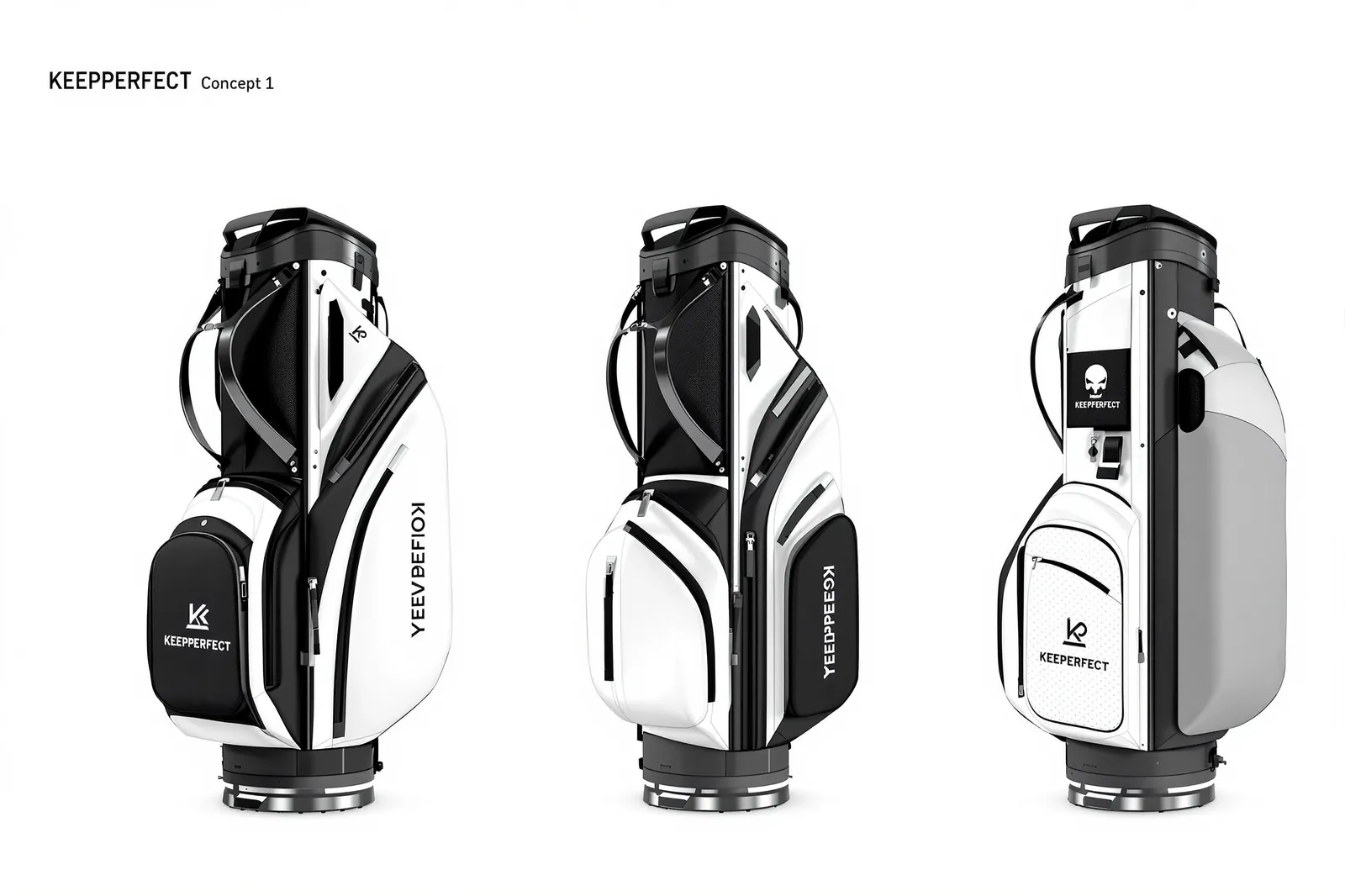
Digital GPS and Course Distances
The digital feature most golfers reach for first is GPS. A multi-constellation receiver positions the bag to within a few metres outdoors and pulls the course map with front, middle and back distances, giving a walker or rider confident numbers on every shot without a separate device in hand. It is the feature that makes a bag feel genuinely smart, and in 2025 it works reliably in the open-air conditions where golf is played.
Honest limits keep expectations useful: dense tree cover widens the error and indoors the fix is lost entirely, so the bag gracefully returns a last-known position rather than guessing. GPS is superb course intelligence, not an indoor tracker, and it is best understood as one layer in a broader stack — with Bluetooth confirming the bag is at hand and RFID confirming the set is complete. Our 2025 technology guide and GPS integration guide describe this stack in full.
The practical delight of digital GPS is how quickly it fades into the background. Once it is set up, the distances simply appear when you pause by your ball, the bag quietly records where you left it, and the feature becomes something you trust without thinking about — the mark of any mature digital tool. The small behavioural choices matter as much as the silicon here: how fast the receiver acquires the sky after being lifted from a trunk, how surgically it manages battery while keeping location available, and how sensibly it handles the gap when the satellites disappear. Paying attention to these everyday details tells you far more about the quality of a digital bag than the advertised accuracy ever will.
Connectivity and the Companion App
Connectivity is the layer that makes the digital features usable. Bluetooth Low Energy links the bag to your phone within about 100 metres of open air, carrying sensor readings, notifications and status updates throughout a round, and a companion app assembles distance, location, inventory, weight and charge into one calm interface. This is where the bag's digital life becomes something the golfer actually experiences rather than a set of buried specifications.
Two design choices determine whether the app helps or hinders. First, it should keep the bag's essential digital functions working offline, treating the cloud and internet as optional convenience rather than a gatekeeper. Second, it should behave as one coordinated view of a genuinely integrated bag — the same maker's coherent product — rather than an awkward merge of mismatched features. A single, well-maintained app that speaks for the whole bag is a strong sign the digital side was designed as a system, and it is the everyday place where good integration is felt.
Interoperability is the quiet companion to a good app. The bag should fit naturally into the digital life you already lead — pairing with the phone in your pocket, coexisting with the distance app you prefer and the charging cables you pack — rather than demanding a new proprietary world of its own. A digital bag that plays well with the ecosystem around it reduces friction instead of adding it, and that reduction of friction is, in everyday terms, a large part of what "smart" really means. Fewer logins, fewer cables, fewer separate things to remember: those small disappearances of admin are how a connected bag earns its keep.

Digital Power Management
Power is the quiet digital backbone of every smart bag, and in 2025 it is managed intelligently rather than simply provided. A rechargeable battery of roughly 5,000 to 20,000 mAh runs the digital modules and doubles as a power bank for your devices, with smart power states waking the GPS only when useful and sleeping the radios otherwise, so a full weekend's play does not hinge on a forgotten cable. Clear charge reporting and a removable, replaceable pack complete the picture.
The realistic trade-off is weight and a charging rhythm. The battery, wiring and modules add measurable mass and a maintenance routine that a purely mechanical bag avoids, and manufacturers that state life tested under real load — GPS active, phone connected — deserve more trust than those quoting idle standby. Because power touches every digital feature, our power management breakdown goes deep on capacities, charging standards and how to keep a connected bag's battery healthy across years of use.
A sensible power design also plans for the realities of a golfing day rather than a lab bench. That means a bag that has enough reserve to finish the 18th even after a morning of heavy use, a charging path that does not force you to pack yet another proprietary cable, and behaviour that tells you clearly when a top-up is needed before you are caught out at the turn. Power management is, at its best, the least noticed digital layer in the bag precisely because it is engineered so well that running out of battery almost never happens — and comfort with that quiet reliability is a better test of a digital bag than any headline capacity figure.
| Digital feature | What it delivers | Realistic limits | Most valuable when |
|---|---|---|---|
| Digital GPS | Distances + bag location | A few metres, outdoors | On-course numbers + finding bags |
| Companion app | One view of all status | Best offline-capable | Integrated daily use |
| Digital power | Runs modules, charges devices | 5,000-20,000 mAh packs | Long rounds, dead phone |
| Weighing + RFID | Carry weight, club inventory | Indicator-level; tagged clubs | Walkers, premium / fleet |
Digital Security and Privacy
A digitally connected bag carries a digital responsibility. It generates genuine personal data — where and when you play, your club set, your carry over a season — so security and privacy are design decisions, not afterthoughts. Security means encrypted links, authenticated pairing and secure firmware updates; privacy means data kept on your device and account by default, opt-in cloud sharing and the freedom to delete or export it, with a complete wipe available before resale.
The standard to hold a digital bag to is the one you already expect from a phone: no hidden third-party sharing, no unexplained background cloud traffic and no requirement to hand over location history for basic operation. If a maker is vague on any of these, that vagueness is itself the answer — a solid digital bag makes its data practices easy to find and easy to understand without a fine-print scavenger hunt. Our digital innovation and anti-theft technology articles explore security and protection in more depth.
Reliability of Digital Systems
The digital side of a bag is only worth anything if it keeps working, and reliability is the feature that governs every other. Mature digital components are dependable when they are sealed behind waterproof laminated fabric in impact-resistant housings, when ports sit under rated covers, when wiring is routed through a protected channel and when the battery and module can be replaced rather than condemning the whole bag. The IPX ingress rating is the short check; serviceability is the longer one.
This is where careless digital integration most often reveals itself. A module seated at the base to sit in water, cabling crushed by the stand mechanism, or a battery that cannot be replaced turns a promising smart bag into a short-lived disappointment. Because reliability is a design trait rather than a given, read our quality standards and materials guides to see what a durable shell must be before it is asked to protect electronics.
Choosing the Right Digital Features
Because digital features each carry real cost and weight, the sensible approach is to match them to your game rather than buy the longest list. A walker who wants numbers and a manageable load might take GPS plus weighing with a slim battery. A traveller with a premium set wants location, RFID and generous charging. A golfer who always finishes with a dead phone prioritises power above all. A club managing many sets wants location, inventory and fleet reporting together.
Whichever combination you choose, insist that it is genuinely integrated — one app, one power source, one sealing and service plan — rather than a collection of bolt-ons, and verify the claims the way you would for a serious tool: accuracy, IPX rating, battery under load, offline capability and privacy posture. The disposable-app trap, where the bag's value evaporates when cloud support lapses, is worth avoiding by preferring local-first designs. For the foundation all of this rests on, our bag type guide helps you choose the right shell.
Digital Value for Different Players
The digital features of a smart bag earn their keep differently for different players, so matching the investment to the user is the wisest way to buy. For the individual, the daily value is practical — distances, loss-prevention, carry feedback and charging — and it lives in the bag's reliable, offline-capable core. For the institution, the value scales into fleet management, where location and inventory across many sets become a single auditable operation that saves real time and reduces loss.
The trap to avoid is buying the wrong specification for your use. An individual who adopts a heavy fleet-grade digital spec pays for power and connectivity they barely use and shoulders pointless weight; an institution that under-invests in fleet reporting forfeits the very efficiency that justifies the technology. Let the actual user define the features, and let the arithmetic of cost, weight and recurring benefit decide the purchase. Digital value is real, but it is precise about who it serves and how.
Where Digital Features Are Heading
The next steps for digital features are towards lighter, quieter and more open systems. Chips and batteries keep shrinking, steadily easing the weight and cost penalty that currently keeps full digital stacks in cart bags rather than light carry bags. Charging is normalising around standards, and digital bags are opening to the ecosystems golfers already trust — the distance app they keep, the rangefinder they use — instead of policing a proprietary platform. More value, less friction, is the trend, and it is likely to accelerate as component costs fall and the same connectivity logic that already pervades phones and cars reaches the bag.
What persists is the principle that digital features serve the bag, never the reverse. The durable shell, sealing and comfortable carry remain the foundation, and digital capability is an enhancement layered responsibly on top. Buy the bag for its construction, add the digital features that fit your actual rounds, and verify sealing, serviceability, offline function and privacy as you would for any long-term purchase. The roadmap beyond these features lives in our AI applications and future trends articles.
Making the Digital Bag Last
A digital bag rewards the golfer who treats its electronics the way they treat a good phone. Keep it charged on a sensible rhythm, protect the ports and charging cable, update the app and firmware willingly, replace the battery when it ages and give the module the service the manufacturer intended. Done this way, the digital features comfortably outlast several batteries and keep adding value through the bag's long working life. In practice this means protecting the charging port from dust between rounds, being gentle with the seams that guard the module and never forcing a fogged device back into service before it has dried — small habits that prevent the majority of early failures.
The other half is choosing well at the start. Favour a bag whose digital core is local-first and offline-capable, whose maker commits to updates and support, and whose design is serviceable rather than disposable. A durable shell plus a maintained, serviceable digital layer is a purchase that keeps working for a decade; a shell plus an abandoned, orphaned app is a lesson in buying specification instead of longevity. Keep both halves of that equation in view, and the digital bag becomes one of the smarter long-term purchases in the category.
Digital Features Built on a Bag That Lasts
GPS, apps, power and sensing coordinated into durable, weather-sealed, serviceable golf bags. Custom digital-bag programs for brands.
Explore Digital Custom Bags →Conclusion
The digital features of a smart golf bag are a mature, honest and useful set: digital GPS for distances and location, a companion app that unifies status, digital power management that keeps you charged, and sensing that watches over weight and clubs — all coordinated, sealed and serviceable inside a durable shell. They carry real cost and weight and demand a charging and maintenance rhythm, so choose the features that solve your recurring problems, favour local-first and integrated designs, and verify sealing, reliability and privacy. Approached that way, the digital bag is a quieter, longer-lived and genuinely worthwhile upgrade rather than an expensive and short-lived gadget.
Sources
Frequently Asked Questions
- What are the main digital features of a smart golf bag?
- Digital GPS for distances and location, a companion app for status, digital power management for charging, weighing and club sensors, and RFID set protection — coordinated as one connected system.
- Do the digital features work without internet?
- Mature designs keep the core digital features working offline and treat the cloud as optional. Prefer local-first bags so value survives poor connectivity or a discontinued cloud.
- How reliable are the digital parts of a smart bag?
- Digital modules are reliable when sealed, protected and serviceable — check the IPX rating, port protection and whether battery and module are replaceable. Poorly integrated digital parts fail early.
- Which digital feature is worth the most?
- Digital GPS for on-course numbers and finding bags; charging for long rounds; RFID for protecting a premium or fleet set; weighing for walkers. Match the feature to your recurring problem.
- Is my data safe with a digitally connected bag?
- A responsible bag keeps location and round data on your device by default, encrypts it, shares only with consent and offers a complete wipe. Read the privacy policy and verify a factory reset.
- Will the digital features become outdated quickly?
- Core standards such as GPS and Bluetooth are mature and unlikely to vanish, but apps and clouds can be discontinued. Choose offline-capable, local-first features with a clear update commitment.