Golf bag weight and portability in 2025 are engineering trade-offs, not simple preferences: a full-featured stand bag typically weighs 2.2–3.2 kg (4.8–7.0 lb), a lightweight walker bag 1.3–2.5 kg, and a Sunday bag under 1.5 kg, while the practical "walkable" ceiling for most amateur golfers is around 3 kg once the bag is loaded with a 14-club set. Portability is decided by empty weight, strap geometry, frame stiffness and how weight shifts when loaded, not by a single figure. This analysis breaks down the weight ladder, the materials that move the needle, the carrying systems that convert weight into comfort, and what an OEM buyer should verify before sourcing a carry or cart bag.

The Weight Ladder: How Golf Bags Stack Up in 2025
Understanding where a bag sits on the weight ladder explains most of the performance and price differences buyers see today. At one end, lightweight carry bags commonly land between 1.4 and 1.9 kilograms, prioritising portability for walkers and short rounds; in the middle, hybrid and stand bags hover around 2.0 to 2.6 kilograms and balance carry comfort with fuller features such as more dividers and larger pockets; at the top, cart and staff bags climb past three kilograms and sometimes well beyond, because they are engineered to ride rather than be carried. The ladder is not purely a quality ranking, it is a use-case map: a heavy cart bag is not a worse product, it simply answers a different brief. What the ladder does make clear is that weight is the single clearest proxy for a bag role on course, and the reason so many brands now publish the empty weight on the spec sheet the way they publish capacity and divider count.
Golf bags fall into predictable weight bands that reflect their intended use. At the very light end, Sunday and minimalist bags run from about 0.7–1.5 kg; they carry six to eight clubs and trade storage for freedom. Above that, lightweight walker bags occupy 1.3–2.5 kg, carrying a full set with an integrated stand and a handful of essentials. Standard stand bags trend 2.2–3.2 kg, adding more pockets, a 14-way top and heavier frames. Cart bags, built to ride on a trolley rather than your back, often exceed 3.2 kg with large top openings and multiple apparel pockets.
These bands overlap because brands interpret "lightweight" differently. A 2.9 kg bag marketed as lightweight may simply have less hardware than a 3.1 kg one, while a true lightweight bag reaches 1.8 kg through material science. The reliable signal is the empty weight printed on the spec sheet and the full-loaded weight, because a bag's mass grows by several hundred grams once a range finder, water bottle, a layer and a full set are inside.
For the walking golfer, the practical ceiling sits around 3 kg empty. Above that, fatigue rises measurably over 18 holes, particularly at the back nine. Below roughly 1.3–1.5 kg, most bags sacrifice either durability or storage. Understanding this ladder frames your buying decision honestly, whether you are choosing a bag or specifying a product line for your brand.
The Seven Factors That Decide Bag Weight
Seven construction elements add up to a bag's final mass, and each can be traded against the others. First, the shell fabric: a 100–210 D ripstop nylon is dramatically lighter than 600–840 D twill. Second, the lining: a thin 70–120 D lining saves weight versus a coated heavyweight liner. Third, the frame or base ring: aluminium and glass-fibre beat steel. Fourth, the top configuration: a four- or five-way top removes the dividers and guide rings of a 14-way top. Fifth, the stand and legs. Sixth, the strap system. Seventh, zips, pulls and small hardware.
Weight is the sum of these choices, so a "lightweight spec" is really a system of coincident decisions. A factory that only swaps the shell to a lower denier while keeping a steel frame and a 14-way top will barely move the needle. The most efficient savings generally come from the frame, the top and the lining together, which can remove 400–600 g versus a conventional build.
Crucially, every saving must be verified against stiffness and durability. Removing frame material makes the bag flex under load; removing seam tolerance creates weak points. That is why professional lightweight engineering is a balance exercise, and why a bag's spec sheet should carry both a target weight and a target tear strength, not just a number on the scale.
Comparison of Weight Categories and What They Deliver
| Category | Empty Weight | Capacity | Best For |
|---|---|---|---|
| Sunday / minimalist | 0.7–1.5 kg | 6–8 clubs | Quick nine, range, travel |
| Lightweight walker | 1.3–2.5 kg | Full set | Serious walkers |
| Standard stand bag | 2.2–3.2 kg | Full set + extras | Versatile play |
| Cart bag | 3.2 kg and above | Full set, large pockets | Riding or trolley |
These categories overlap and evolve yearly, but the relationship is stable: more storage, top layout and robustness cost weight. A buyer choosing between a walker bag and a cart bag for a product line must first answer how the end user will move around the course, then finalise capacity and weight together.
Portability Is About Load, Not Just the Empty Bag
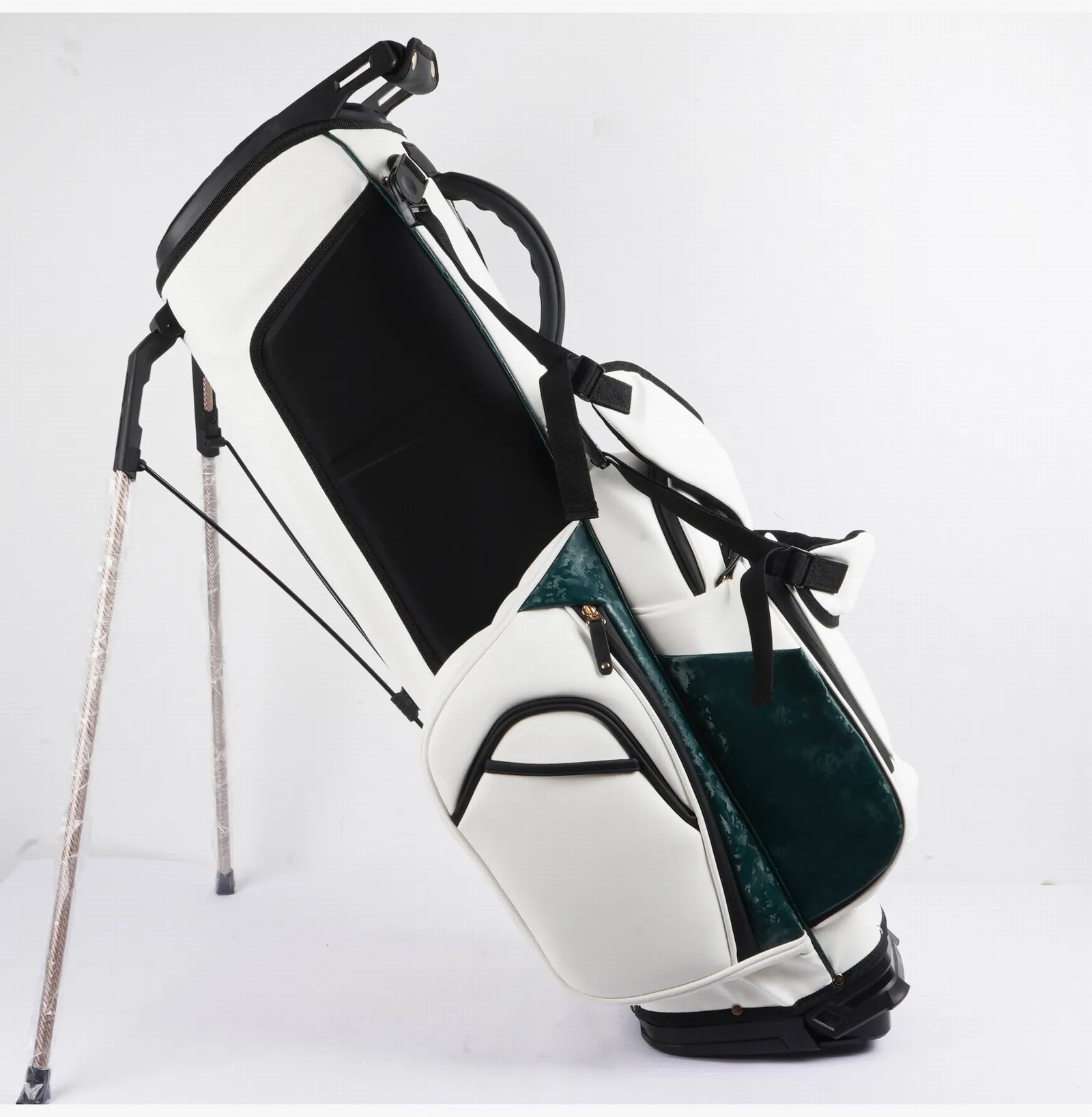
Portability is the experience of carrying a bag around a course, and empty weight is only half of the story. Loaded weight, strap geometry and balance determine perceived portability. A bag that stays close to the spine, sits high on the back and shares load across both shoulders feels dramatically lighter than a heavier bag that drags rearward.
Handle design also matters. A comfortable top handle lets you lift the bag into a car boot or on a trolley without straining, and a well-placed base handle aids single-hand carry through car parks. For travellers, portability extends beyond the course: many buyers pair a walker bag with a soft or hardshell travel cover, because a bag that is easy to lift and to strap inside a case makes airport transfers far smoother.
Finally, portability depends on the bag's footprint. A narrow, deep profile passes through barriers and sits easily on trolleys, while a wide, shallow one is awkward to carry against the hip. The ratio of depth to width, plus the position of the stand, determines how inherently portable a design feels in real life.
Materials That Move the Weight Needle
Fabric choice is the most visible weight lever. High-tenacity low-denier nylons (100–210 D) deliver surprising strength at low mass, especially in ripstop form, where a reinforcing grid stops tears from running. Polyester twills are cheaper and UV-stable but slightly heavier for equal strength. Nylon 66 twill offers a good balance of abrasion resistance, handfeel and weight for mid-tier designs.
Framing and hardware carry their own weight. Aluminium and glass-fibre frames beat steel by 30–60%, and carbon fibre pushes further at added cost. Zips are a hidden contributor: lightweight water-resistant zips on valuables pockets add very little mass while protecting electronics, whereas heavy coil zips across many pockets add grams everywhere. A disciplined design counts every puller.
Lining and foam follow a similar logic. Thin 70–120 D linings reduce weight without sacrificing club protection, and high-density foam that is thick only at strap anchor points saves mass compared with uniform padding. None of these choices can be made in isolation, which is why a fully specified bag from one engineering team outperforms a bag patched together from off-the-shelf components.
Carrying Systems: Straps, Hip Belts and Load Transfer
The double-strap system is the single biggest upgrade for portability. Two padded straps distribute the bag's weight across both shoulders and the strong muscles of the back, rather than hanging it on one shoulder. Adjustable sternum straps keep the shoulder straps in place, and optional waist or hip strapping transfers a portion of the load to the pelvis, which is biomechanically able to carry weight for far longer than the shoulders.
Padding quality is what separates a comfortable carry from a painful one. High-density and memory foam maintain their shape under load, while cheap foam compresses to a hard cord within a season. Look for padding that is thick at the shoulder point and tapers at the ends so it wraps without bunching under a jacket. Anti-slip backing prevents the straps sliding on a wet or sweaty shirt.
For OEM buyers, the strap system is a testable specification. A solid programme documents the strap anchor's seam strength (commonly ≥ 250 N per anchor), runs load-cycling tests on the stand, and verifies padding compression after repeated use. Insisting on these field-relevant checks during sampling prevents the most common warranty issue — a comfortable strap that fails after human-load abuse.
Weight Distribution: How Load Shifts When the Bag Is Full
An empty bag and a full bag are entirely different products. Filling a 14-club set, a range finder, water, a layer and balls adds roughly 3–4 kg, more than doubling the carried mass. How that mass is distributed inside determines whether the bag tips, drags or carries beautifully. If heavy clubs sit near the centre of gravity, the bag balances; if they sit at the edges, it wants to roll.
Bag designers control distribution through the pocket layout and the position of the top relative to the base. A deep, central apparel pocket keeps mass inboard, while a large side pocket pushes the centre of gravity outward and off the spine. The feet and base plate also matter: when set down, a bag with a broad stable base stands confidently, whereas a narrow one tips over mid-round.
Manufacturers therefore test loaded bags, not empty ones, for balance and stability, and a responsible supplier publishes its recommended load weight alongside the empty figure so buyers understand the real carrying envelope. This transparency separates brands that understand portability from those simply quoting a low number. A good spec sheet tells you the empty weight, the recommended max load, and the tested balance behaviour. When a buyer can only hold the empty sample, the smart move is to fill it with representative clubs and verify the centre of gravity before approving production.
Player Type, Climate and Bag Choice
Who plays with the bag shapes the right weight. A competitive walker wants the lightest durable option, often a sub-2 kg lightweight bag with a four-way top. A casual golfer who rides in a cart values storage over a few hundred grams and can carry a 3 kg+ cart bag comfortably. A senior or a golfer with back issues benefits from a hip-transferring strap system and a low bag that loads high on the shoulders.
Climate interacts with weight, too. In a wet environment, buyers may trade a little weight for a higher water-column shell (400–1,000 mm) and water-resistant zips, since a light bag that lets clubs rust is a false economy. In a hot climate, breathable mesh pockets and a ventilated base add negligible weight while improving comfort and helping the bag dry.
Equipment policy also matters: a golfer strictly limited to carry bags has different needs from one allowed a trolley. Matching the bag's weight and capacity to the player's walking or riding pattern — not to the flashiest feature list — is the most honest way to recommend a model.
Verifying Portability Claims Before You Buy
Several objective checks separate a well-engineered portable bag from a light-but-flimsy one. The seam-strength test confirms the critical load-bearing seams survive strain. The stand-cycle test simulates the 30,000–50,000 deployments a bag sees over seasons. A tear test on the shell confirms a lighter denier still resists tear propagation. And a weight verification confirms the printed figure matches the sampled product to within tolerance.
Ask the supplier for the test numbers in writing, not a pass/fail sentence. If during the sample review the base flexes, the stand wobbles or the straps lose padding under load, the correction belongs in the prototype stage. Reviewing samples for both function and test data is the most effective way to buy a bag that is genuinely portable rather than merely light.
For brands, these same checks should be part of your factory's quality programme, ideally verified by a third-party inspector. A supplier that can show you its in-house testing equipment and its third-party audit results is far more likely to deliver a weight-optimised bag that survives real use.
OEM Sourcing for Weight-Optimised Golf Bags
QUANZHOU JUNYUAN BAGS, established in 2014, has applied more than 20 years of industry experience (the founder began in 2004) to engineering weight-optimised golf bags. The company runs OEM and ODM programmes with a standard MOQ of 200 pieces and test orders from 100 pieces, offering sampling in 10–20 days and bulk production in 45–60 days. Its 7 production lines, 126 sewing machines and staff of roughly 137 enable a monthly output of near 200,000 pieces, supported by a 4,950 m² affiliated factory with SGS-verified quality checks.
The factory has served more than 200 brands across 100+ countries, translating briefs such as "a 1.9 kg walker bag with a five-way top and a 700 mm water column" into tested, reproducible products. Because portability is a system, the engineering team works from a complete spec sheet — target empty and loaded weight, top configuration, pocket list, frame and strap type — and confirms the achievable weight window before sampling. This shared measurement protocol removes costly back-and-forth.
The practical path for most brands is a small test order to lock in the engineering, followed by scale-up once the sample passes the balancing and durability checks. Transparent MOQ and lead times make this staged approach predictable, and documented test data gives you confidence that the "lightweight" claim will survive the first season on real golf courses.
Ergonomics, Trends and the Changing Demography of Carrying
Golf's widening demographic is reshaping how much weight a bag can carry. Older players, junior golfers and a growing population of women taking up the game all place a premium on portability, and manufacturers have responded with lighter shells, hip-transferring strap systems and more compact travel-friendly footprint. Ergonomics research on load carriage shows that asymmetric single-shoulder loading increases perceived effort and injury risk, which is why the dual-shoulder configuration has become standard across pretty much every serious walker bag.
Materials progress feeds the same trend. High-tenacity low-denier nylons now achieve tensile and tear strengths that once required heavier 600 D fabric, letting engineers cut weight without cutting durability. Carbon fibre and glass-fibre frames push further at the premium end, while efficient aluminium frames bring meaningful savings at accessible price points. The result is that the "lightweight" segment has become the growth area of the category rather than a niche.
For buyers, the business implication is straightforward. A product line built around weight-optimised bags can command a higher price band and attract walking golfers, who tend to buy repeatedly and value durability. Retail differentiation now rests on verifiable numbers — empty weight, loaded weight, strap performance — rather than vague marketing claims. A brand that publishes these figures and backs them with third-party inspection stands out in a crowded market.
Travellers also drive steady demand for portability beyond the course, and the same weight and balance engineering that helps a walker protect his back also makes a bag easier to lift into a case, easier to carry through an airport and easier to pack into a limited boot space. Soft and hardshell travel covers, compact folding stand bags and stable lightweight trolleys all benefit from a well-designed bag that is easy to lift, easy to strap and easy to store. As tournament travel and golf tourism grow, a bag's behaviour in transit becomes part of the purchase decision, not just its behaviour on the fairway.
Frequently Asked Questions About Golf Bag Weight and Portability
- What is a good weight for a golf bag I will walk with?
- For walking, aim under about 3 kg empty if you carry a full set, and nearer 1.3–2.5 kg for a lightweight design. Loaded weight and strap balance matter as much as the empty figure.
- Does a lighter bag always mean a better walking round?
- Not necessarily. A heavier bag with a well-distributed load and a comfortable dual-strap system can carry easier than a light bag that sits unbalanced. Portability is a system, not a single number.
- Are weight-optimised bags as durable as standard ones?
- Yes, when the engineering is honest. Real weight savings come from smart denier selection, lighter frames and refined construction, and pass the same seam, tear and stand-cycle tests. Request the test data to confirm.
- Should I choose a walker bag or a cart bag?
- Decide how you move around the course first. If you walk, buy a walker bag with a good strap system. If you ride or use a trolley, a cart bag's extra storage and wider top justify its higher weight.
- Does water resistance add much weight?
- A moderate water-resistant coating or a 400–1,000 mm water-column shell adds only a little weight. Fully sealed constructions are heavier, so most walkers accept tactical water resistance to protect the clubs without crippling portability.
- Does a wider top significantly change perceived portability?
- Yes. A 14-way top is heavier and slower for club access, and it shifts the bag's centre of gravity outward. A four- or five-way top keeps the bag lighter, easier to balance and faster to play from, which is why walkers usually prefer it. If you rarely carry, a wider top's organisation may outweigh the extra weight.
- Are carbon-fibre frames worth the extra cost?
- Carbon fibre saves the most weight but is costly and more fragile, suiting premium lines and serious walkers. For most buyers, a well-built aluminium or glass-fibre frame delivers most of the savings at a far better price and durability balance.
- How do I evaluate an OEM supplier for a portable bag line?
- Look for transparent MOQ and lead times, published test data, and third-party inspection such as SGS. A standard MOQ of 200 with test orders from 100, sampling in 10–20 days and production in 45–60 days is a realistic, credible range.