Golf Sunday Bag vs Stand Bag: Which Is More Practical?

The practical answer to "golf sunday bag vs stand bag" is that the sunday bag is more practical for par-3, executive, twilight and travel rounds — carrying 6-8 clubs at roughly 1-2 kg and leaning against a cart or tree — while a stand bag is more practical for walking golfers who play full 18 with most of their clubs and need the bag to stand on its own. There is no universal winner; both are practical in the situations they're built for. This guide, written from a golf bag factory in Quanzhou (QUANZHOU JUNYUAN BAGS, founded 2014), compares the two honestly by the factors that actually drive a buyer's decision: capacity, weight, standing ability, storage, travel, cost and the specific rounds each serves.
Defining the Two Bag Types
The sunday bag and the stand bag answer genuinely different questions. A sunday bag is the lightest possible way to take a reduced set of clubs on a short or casual round, valued for its minimal weight, compact footprint and ease of slinging over the shoulder. A stand bag is a fully featured carry bag built for walking a full eighteen, with a built-in stand that lets the bag rest upright on the fairway, more dividers to organise a complete set, larger pockets, and a heavier but far more robust build. The practical choice therefore hinges on how you play: if most of your golf is short rounds and relaxed social games, the sunday bag keeps the day light; if you walk full rounds on demanding courses with a conventional set, the stand bag earns its extra weight in organisation, stability and durability.
A sunday bag is a lightweight, minimal carry bag designed for golfers who bring fewer clubs — typically 6-8 — on casual, short or travel rounds. It has a simple 2-way or 3-way top, three or four practical pockets, and usually a single padded shoulder strap with no legs. It is built to be grabbed, carried and leaned, not stood up on its own. A stand bag adds two pop-out legs and a fuller feature set: a 4- or 5-way top holding 10-14 clubs, better pocket architecture, a dual-strap carry system and a rigid frame that lets the bag stand upright on the fairway between shots.
These differences are structural, not cosmetic, and they determine use. The sunday bag trades capacity and self-standing ability for lightness, small size and packability; the stand bag trades some of that for the utility of carrying a full set and standing on its own. The right choice is a function of how you actually play. To see the full landscape of bag categories, our golf bag types guide maps sunday, stand, cart and other bags to their best uses.
If You Play Short or Casual Rounds
For the golfer whose dominant golf is par-3, executive, twilight or occasional casual resort rounds, the sunday bag is clearly more practical. On these courses you rarely need more than a driver, a hybrid or two mid-irons, a wedge and a putter — and the sunday bag lets you carry exactly that at a fraction of the weight. Because the bag is small and light, it is a pleasure to carry for two hours, fits easily in a small car, and can be kept ready at home for an impulse round without dominating a closet or trunk.
The trade-off is that a sunday bag doesn't stand on its own, so on a short course you'll lean it against a cart, a bench, a tree or your own leg. On courses with frequent waits, some golfers find that inconvenient; others find it trivial. If your dominant play is genuinely short-form golf, the sunday bag's weight and convenience savings decisively outweigh the lack of legs. Our sunday bags for beginners and juniors covers this use case in depth, and the product line lives on our sunday carry bag page.
If You Walk Full 18 on Hilly Courses
For walkers who carry a full set across 18 hilly holes, the stand bag is more practical in almost every way. It holds all 14 clubs, so no shot options are sacrificed; its legs let you drop the bag anywhere on the fairway and grab a club without kneeling or hunting for a place to lean it; and its dual-strap system balances the load across both shoulders, which is much more comfortable over several kilometres. On long, hilly walks, that weight distribution and self-standing ability translate into genuine practical value.
Stand bags are heavier and bulkier than sunday bags, but for a full walking round that extra capacity and carrying ergonomics are worth it. If you primarily play full-length walking rounds, a stand bag should be your primary bag, with a sunday bag optionally as a light second bag. To understand how bag design supports walking posture and comfort, our stand bag posture guide and lightweight stand bag features are useful reading.

Sunday Bag for Short Rounds
Light, packable and easy to carry with 6-8 clubs for par-3, executive, twilight and travel play.
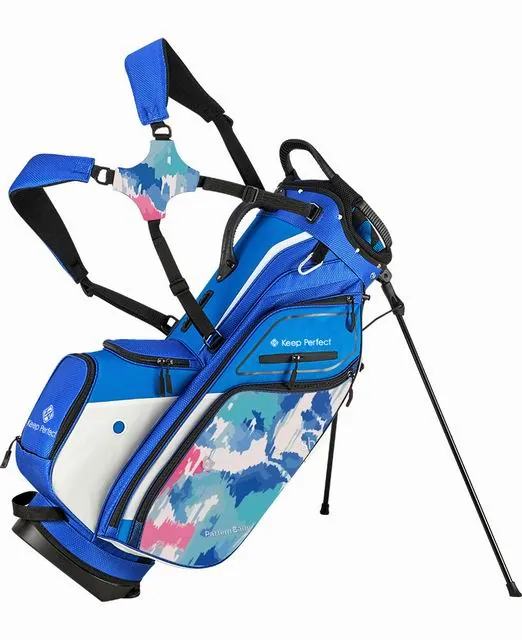
Stand Bag for Full Rounds
Full 10-14 club capacity with legs that stand the bag on the fairway for walking golfers.
Capacity and Weight: The Real Differences
The practical difference is best understood in hard numbers. A typical stand bag weighs about 2-3 kg (4.4-6.6 lb) empty and carries 10-14 clubs in a 4- or 5-way top. A typical sunday bag weighs about 1-2 kg (2.2-4.4 lb) empty and carries 6-8 clubs in a 2- or 3-way top. That roughly halves the empty weight when you compare the lightest sunday bags to the heaviest stand bags, and it's the weight saving that makes the sunday bag so pleasant to carry on short loops.
The flip side is capacity. With 6-8 clubs you must be disciplined about your set; with 10-14 you never think about it. For the short-round player, that discipline is part of the fun and saves weight; for the full-course player, it's a constraint. Weight also shapes carrying style: a sub-2-kg sunday bag is comfortable even on a single thin strap, while a loaded stand bag needs a quality dual-strap system. If minimising carried weight is your top priority while keeping enough clubs, see our ultra-light sunday bag guide and club capacity guide.
Storage, Travel and Portability
Where the sunday bag runs away from the stand bag is storage and travel. A sunday bag flattens, packs into a fraction of the space, fits lockers and small trunks, and travels as a light second bag on resort trips. A stand bag's rigid frame and legs make it bulky to store and awkward to travel — it needs a proper travel cover and a larger car spot. For the golfer who juggles small storage or travels light, the sunday bag is decisively more practical day to day.
That's why many golfers own both: a sunday bag for short, casual and travel rounds; a stand bag for full walking days. Each is practical in its own domain, and the pair covers every situation without compromise. Our sunday bag storage and travel advantages details the portability case, and how to pack a travel bag covers protecting either when you fly with clubs.
Practicality on the Course: Handling and Convenience
On the course, practicality is about handling, not just weight. A sunday bag's light weight makes it quick to grab, sling and reposition, and its small footprint is unobtrusive on a cart or in a crowded staging area. But because it has no legs, every club change means either holding the bag, leaning it, or wedging it — small friction that some golfers never notice and others find frustrating. A stand bag, meanwhile, drops anywhere and stands, at the cost of heavier weight and a bulkier footprint.
For golfers who use a cart or buggy most of the time, the standing question is largely moot — the cart holds the bag. In that case the sunday bag's light weight and small size simply make it easier to lift on and off carts, which can itself be the more practical choice for a light, 6-8 club round. For players sharing a cart or using a push trolley, compatibility matters too; our push cart compatibility guide and walking vs riding guide show how each bag pairs with different transport.
Cost and Value Comparison
| Factor | Golf Sunday Bag | Stand Bag |
|---|---|---|
| Typical club capacity | 6-8 | 10-14 |
| Empty weight | ~1-2 kg | ~2-3 kg |
| Stands on its own | No | Yes |
| Storage footprint | Very small, packable | Large, rigid |
| Travel friendliness | Excellent | Manageable with cover |
| Typical cost | Lower | Higher |
| Best rounds | Par-3, exec, twilight, travel | Full walking 18 |
Representative production figures; exact values vary by model, brand and construction.
A Concrete Decision Framework
Rather than agonise, answer three questions. First, how many clubs do you genuinely need for the rounds you play most? If the answer is routinely six to eight, a sunday bag is practical; if you want your full set at hand every round, a stand bag wins. Second, do you need the bag to stand on its own? If you carry on open fairways with frequent waits, stand bag legs earn their weight; if you lean against carts or benches easily, they don't. Third, where do you store and travel? If space and portability are tight, the sunday bag is your friend.
Many golfers resolve the question by buying both — a sunday bag as the everyday short-round and travel companion, a stand bag reserved for full days. Because sunday bags are inexpensive relative to stand bags (less material and trim), adding one as a second bag is an efficient upgrade rather than a luxury. If you're a retailer or brand deciding which to stock, the answer is typically both, in different tiers; our golf bag types guide and cart bag range help you map the full lineup.
Durability and Longevity Honest Note
A worthwhile honesty point: because both types are made of similar materials, both are durable when built to grade — a sunday bag does not automatically outlast a stand bag. What differs is what fails. A sunday bag's single strap junction and top handle bear all the abuse, so reinforcement there matters most; a stand bag's legs and hinge mechanism add failure points a sunday bag simply doesn't have. You should judge durability by construction quality, not by bag type. Our sunday bag durability tips and durability standards apply the same factory logic to both.
How Weight Feels on the Shoulder in Real Rounds
To appreciate the practical difference, think about what a few kilograms actually feel like over two hours. A loaded sunday bag with 6-8 clubs stays light enough to carry on a single strap without much fatigue — ideal for a short course where you're on your feet for two hours or less. A loaded stand bag with a full set is heavier and needs a quality dual-strap system just to distribute the load acceptably; on a long hilly walk that system earns its weight, but on a flat par-3 it's overkill. The practical truth is that weight is context-dependent.
Many golfers only realise the difference mid-round: on a par-3 with a sunday bag you barely think about the bag; on a full course with a loaded stand bag you feel the pack strap bite by the 12th hole. Neither is "wrong" — each is matched to a different kind of walking. If you want to test empirically which bag suits your course, play your next short round first with each and note your fatigue. Our sunday bag portability test and posture guide compare how each load feels and supports the body.
The Second-Bag Solution Most Players Adopt
The cleanest practical answer many golfers land on is owning both. A sunday bag serves as the everyday light bag for par-3s, executive rounds, twilight games and travel; a stand bag is reserved for full walking 18 with the whole set. This is not owning two of the same thing — each covers a distinct use case — and because sunday bags are the inexpensive category, adding one as a second bag is a modest cost, often less than a single premium stand bag. For players who regularly mix short and full rounds, the pair removes every compromise.
This dual-ownership pattern is why so many ranges and retailers cluster sunday and stand bags together: they complement rather than compete. If you're choosing a first bag as a beginner, a light sunday bag is a friendly introduction; if you're a seasoned player adding travel light options, the sunday bag completes the set. To map the full lineup and where each fits, our sunday carry bag range and stand and cart bags are good starting points, backed by the bag types guide.
A Step-by-Step Way to Decide
If you're still torn, work through four questions in order. First, how many clubs do you routinely need — if six to eight reliably, a sunday bag; if you want your full set every round, a stand bag. Second, does your dominant course let you lean the bag, or do you need it to stand on open fairways — the latter points to a stand bag. Third, how much do storage and travel matter — if they're high on your list, the sunday bag wins the practical day. Fourth, what's your budget — sunday bags are lower cost, so they're the easier first purchase. At the end, match the answer to one bag, and treat the other as an optional second purchase later. The goal isn't to settle for a compromise; it's to buy the bag that is genuinely more practical for the rounds you actually play most of the time.
Practicality for Retailers, Academies and Brands
The sunday vs stand question also matters on the business side. For a retailer or pro shop, sunday bags are compact, fast-moving, lower-priced SKUs that pull in casual and beginner customers and pair naturally with stand bags in a range — stocking both lets you serve every walker. For an academy or resort, a mix of sunday bags for short courses and guest play plus stand bags for full rounds covers demand efficiently, and the compact sunday bags store in a fraction of the space. For a brand, the sunday bag is the affordable, low-risk entry product that builds volume before you expand into stand bags.
Because the practical value splits so cleanly by market segment, most buyers who enquire about "sunday or stand" end up ordering both at different tiers. Our typical factory-direct terms help you test the water: a 200-piece MOQ with 100-piece test orders, sampling in 10-20 days and bulk production in 45-60 days from our 4,950㎡ affiliated factory. If that fits your plan, our wholesale and pricing guide give the full costing picture.
Which Bag Travels and Stores Better?
If you travel or store your clubs tight, this is where the decision can be made for you. A sunday bag flattens, packs into a fraction of the space, fits lockers and small trunks, and travels as a light second bag on resorts — no travel cover ceremony, no bulking out the boot. A stand bag, with its rigid frame and legs, needs a proper travel cover, a larger car spot and more floor space at home. For anyone squeezed for car boot space, a hallway closet or luggage allowance, the sunday bag's practicality is the deciding factor.
That space saving is why many travellers default to a sunday bag for short trips even when they own a stand bag: why haul a bulky full bag for a two-day resort weekend when a light 6-8 club kit does the job? The stand bag stays home for full walking days, and the holiday is light. Our storage and travel guide and how to pack a travel bag confirm exactly how much easier the sunday bag makes moving clubs on a trip.
Frequently Asked Questions
- When is a golf sunday bag more practical than a stand bag?
- For par-3, executive, twilight and travel rounds with 6-8 clubs, where light weight, packability and easy storage matter more than a bag standing on its own.
- When is a stand bag more practical?
- For walking golfers who play full 18 with most of their clubs, want the bag to stand on the fairway, and need large storage and a dual-strap carry system.
- How many clubs can each bag hold?
- A typical sunday bag holds 6-8 clubs; a stand bag holds 10-14. This is the main reason sunday bags are lighter and more packable.
- Does a sunday bag stand on its own?
- No. It leans against a cart, bench or tree. A stand bag stands upright on the fairway thanks to its legs.
- Can I use a sunday bag for a full 18-hole round?
- You can, but with only 6-8 clubs and no stand it's not ideal for hilly, full-length courses without a cart; a stand bag suits full walking rounds better.
- Which is better value for a casual golfer?
- A sunday bag is usually better value for casual golfers because it's cheaper, lighter and covers short-form play; a stand bag adds capacity and legs at higher cost.
- Where can I source both bag types in bulk?
- QUANZHOU JUNYUAN BAGS builds sunday, stand and cart bags with 200-piece MOQ and 100-piece test orders. Contact service@junyuanbags.com or +86 17750020688.
The Factory Verdict
Seen from a golf bag factory, the sunday bag vs stand bag question isn't about which is "better" — it's about which is more practical for how you actually play. For short, casual and travel golf, the sunday bag's 6-8 club capacity, ~1-2 kg weight and packability make it the practical choice. For full walking rounds on hilly courses, the stand bag's 10-14 club capacity, legs and dual-strap comfort make it the practical choice. Honest buyers match the bag to the round, and many keep both.
QUANZHOU JUNYUAN BAGS (founded 2014, serving 200+ brands in 100+ countries) builds and sources both categories at factory-direct pricing, sampling in 10-20 days and bulk production in 45-60 days from our 4,950㎡ affiliated factory, with SGS verification completed in March 2026. To discuss which bag suits your line or game, reach us at contact or service@junyuanbags.com.
Looking for a Reliable Manufacturing Partner?
Whether you need sunday bags, stand bags, cart bags or travel covers, our team is ready to bring your vision to life with factory-direct pricing. Test orders from 100 pieces.
Request a Bulk Quote →