Wholesale Golf Bags: Pricing, MOQ & Lead Time Guide for B2B Buyers
For B2B buyers sourcing wholesale golf bags in 2026, dependable OEM/ODM pricing on a FOB Quanzhou basis typically ranges from USD 6–14 per unit for Sunday bags, USD 15–28 for stand bags, USD 18–32 for cart bags, USD 18–45 for soft travel bags (40–80 for hard cases), and USD 35–70 for tour/staff bags, with a standard minimum order quantity of 200 pieces per style (100 pieces on approved test orders), sampling in 10–20 days, and full production lead time of 45–60 days. That is the realistic planning envelope before you factor in incoterms, payment structure and shipping, which together can move your landed cost by 15–30%. This guide breaks down exactly how wholesale golf bag pricing is built, what each price band buys you, how MOQ and lead time work at a real American-and-European-focused Chinese exporter, and the full procurement checklist that protects your margin from first sample to dock delivery.
Every figure below uses the verified operating profile of QUANZHOU JUNYUAN BAGS — a trading entity that handles the full design, QC, and export process, with production carried out through an affiliated factory that was SGS-verified for Alibaba.com in March 2026 (4,950 sqm, 7 production lines, 149 machines of which 126 are sewing machines, 137 staff, and a monthly line capacity of 200,000 pieces). The company itself was established in 2014 and is led by a founder with bag-industry experience dating from 2004. We have served 200+ brands across 100+ countries. Where we quote a price band, we mark it clearly as an estimate for 2026 with your spec determining the exact number — no honest supplier hides the variance between a basic polyester Sunday bag and a pro tour bag with full metal hardware.
If all you need is the bottom line, skip to our wholesale terms, browse the products we make in our product line, or get a live quote at contact. Otherwise, read on — knowing how the numbers are built is what lets you negotiate from data instead of from hope.
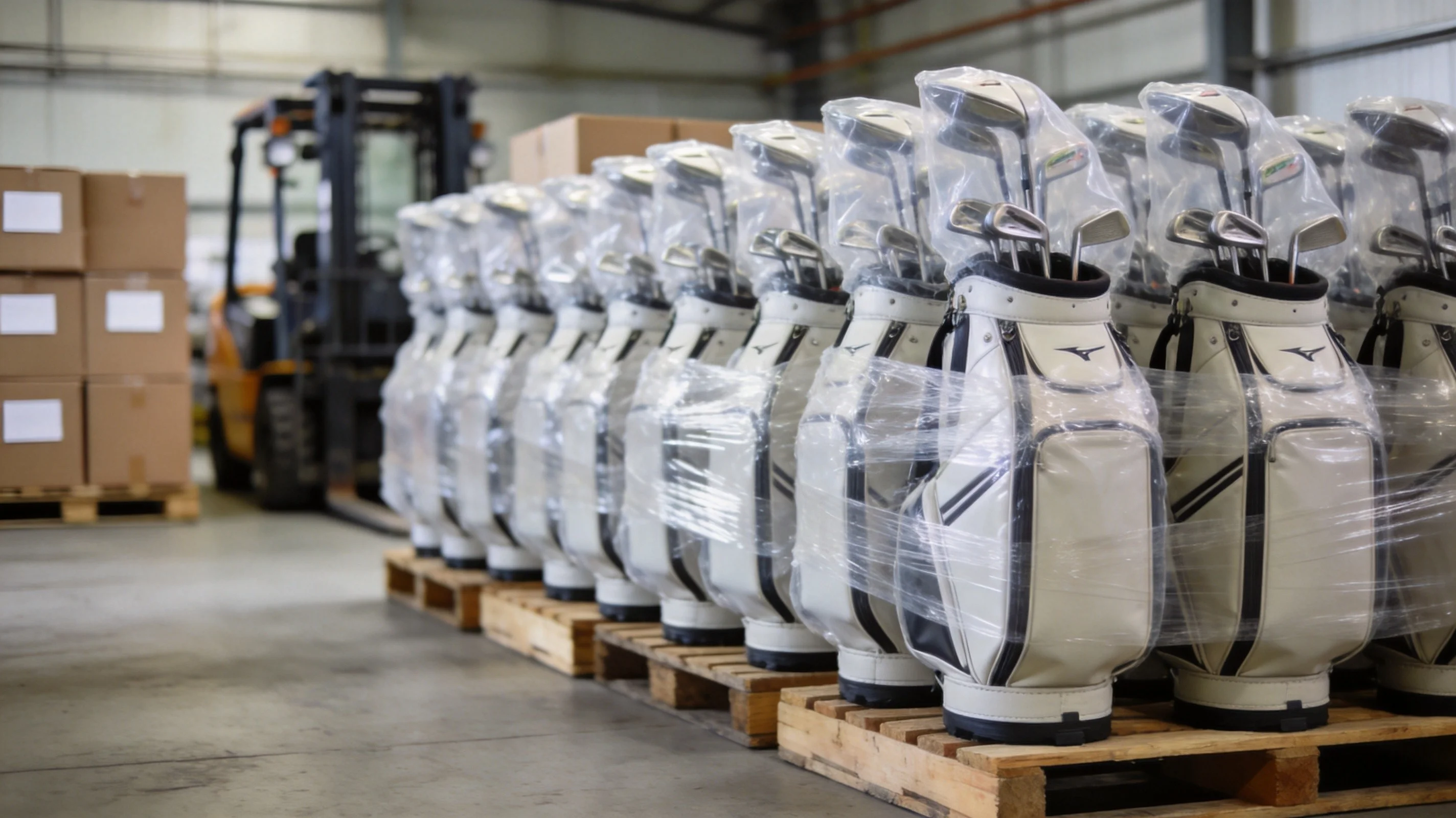
Bulk lots are wrapped, palletized and bagged by destination — FOB Quanzhou with full cargo inspection before the container is sealed.
How a Wholesale Golf Bag Price Is Built
A wholesale golf bag price is never one number — it is a stack. Understanding the stack lets you see exactly where a supplier's margin hides and where you should push. For a typical mid-priced cart bag (FOB, about USD 24), the cost build usually looks like this:
- Raw materials (45–55%) — fabric (600D–1680D polyester, nylon, or PU), zippers, buckles, webbing, foam, stand legs and stays, and trims. Material is the single biggest lever; a 210D to 1680D upgrade can move a bag by USD 3–6.
- Cutting & sewing labor (18–25%) — pattern cutting, stitching, and assembly on the sewing line. Bags with curved panels and complex pocketing cost more because each seam is a skill and a minute.
- Accessories & hardware (8–15%) — cart straps, stands, handles, wheels on travel bags. Metal hardware can double from basic to premium.
- Packaging (4–7%) — polybag, carton, insert and barcodes. A rigid travel hard case requires far more packaging than a soft Sunday bag.
- Overhead, QC, management & margin (8–12%) — the factory's running costs and a sustainable (not inflated) margin.
Two practical consequences follow. First, material selection and trim complexity drive more of your price than anything else — if your target price is firm, the fastest negotiation lever is the fabric grade and the number of pockets, not the factory's margin. Second, honest sourcing partners like QUANZHOU JUNYUAN BAGS publish transparent cost break-downs during quotation so a buyer can see where re-engineering is possible. For a deep look at how materials change the final number, see our golf bag types guide, which cross-references each build to a realistic price range.
Always ask your supplier to quote in a landed context (FOB, EXW or DDP — explained below) and to show you the line-item build. A quote that refuses a breakdown is usually quoting you a guess built around what they think you will pay.
Wholesale logistics and packaging — how bulk golf bag orders ship and protect margin
Wholesale Golf Bag Price Bands by Category (2026 FOB Estimates)
Price bands are the fastest way to sanity-check a quote. The ranges below are 2026 FOB estimates for OEM/ODM orders at standard MOQ from a mid-to-high volume Chinese exporter; your exact spec (fabric, hardware, embroidery, stand type) moves the number within and occasionally past the band. Our full range of types and specifications is on the products page.
| Golf Bag Category | Typical 2026 FOB (USD/unit) | Key Spec Drivers |
|---|---|---|
| Sunday / carry bags | USD 6 – 14 | Fabric grade, single vs. double strap, pocket count |
| Stand bags | USD 15 – 28 | Stand mechanism, leg material, weight, waterproofing |
| Cart bags | USD 18 – 32 | Number of pockets, cart-strap pass-through, dividers |
| Tour / staff bags | USD 35 – 70 | Full metal hardware, larger capacity, premium build |
| Travel bags (soft) | USD 18 – 45 | Padding thickness, wheels, handles, zipper quality |
| Travel bags (hard case) | USD 40 – 80 | Molded shell, latches, wheels, impact resistance |
| Waterproof bags | USD 18 – 38 | Waterproof coating, sealed seams, TPU-backed fabric |
| Cooler / beverage bags | USD 12 – 28 | Insulation layer, liner quality, closure, hardware |
Two things to keep in mind. First, these are equilibrium bands, not ceilings — a tour bag with full stainless hardware and premium dobby fabric can push USD 80+, and a no-frills Sunday bag can dip below USD 6 at very high volume. Second, mixed-category orders are common and earn you better blended pricing than single-category runs. Many buyers combine a travel line with cart bags and a cooler line on one shipment to fill a container and amortize freight. For a category-level breakdown including which suits travel versus course use, our golf bag types guide is the companion read.
For buyers who want a bespoke line rather than an existing style, the price bands widen because tooling and development enter. That transition is exactly where a clear custom solutions process pays off.
FOB, EXW, DDP: Incoterms and Price Ladders That Protect Your Margin
The same bag has many prices depending on where risk and cost transfer. Understanding these is the difference between comparing quotes apples-to-apples and accidentally paying twice for freight.
- EXW (Ex Works) — lowest quoted number: you collect from the factory. Buyer handles domestic trucking, export, freight, insurance, import and duties. Best only for experienced importers with their own forwarder.
- FOB (Free On Board) — the most common B2B benchmark. The supplier pays to get goods on board at the named port (typically Xiamen or Quanzhou for this region). Your landed cost = FOB + ocean/handling + insurance + duty + inland freight.
- DDP (Delivered Duty Paid) — supplier handles everything to your door, including duty. A premium that shields you from hidden costs but typically adds 8–15% over FOB and requires the supplier to manage your destination's customs and taxes competently.
Beyond incoterms, real wholesale pricing moves down a ladder. A typical printed ladder at QUANZHOU JUNYUAN BAGS looks like: 200–499 (base price), 500–999 (–3%), 1,000–2,499 (–5%), 2,500–4,999 (–8%), 5,000+ (–10% or more, negotiated). The ladder rewards consolidation — fewer SKUs, more units per SKU, and repeat orders — not just raw volume. An importer who commits to a rolling 12-month volume locks a better base price than a one-off order of the same size, because the factory can plan fabric purchasing and line scheduling.
Landed-cost discipline is where B2B buyers either protect or destroy their margin. Add every FOB-plus item before you compare suppliers, because a cheap FOB with expensive, unmanaged freight and a surprise duty bill is rarely a saving. For the full negotiation playbook — how to trade volume for price, where to ask for free tooling, and what a fair FOB-to-DDP conversion really is — read our dedicated guide on how to negotiate pricing for wholesale golf bag orders.
And on this site, wholesale is where those negotiations land — a standing agreement beats a fresh negotiation every single order.
MOQs, Test Orders, and Why 200 Pieces Is the Real Starting Line
The market's honest wholesale MOQ for custom OEM/ODM golf bags is 200 pieces per style, with 100 pieces accepted on test orders for new or unproven buyers. That 200-per-style number is not arbitrary: it is about the minimum run that lets a factory buy fabric, cut, and set up the line without pricing itself out of viability, while 100-piece test orders let new partners validate quality, delivery and communication before committing to scale. If a supplier quotes a "no MOQ" number, be skeptical — it usually means catalog stock dropshipping or a heavy per-unit premium to absorb line-setup cost.
Three MOQ realities matter more than the headline number. First, MOQ is per style, not per order — ten styles at 100 each is much harder than one style at 1,000, because each style needs its own pattern, cutting and setup. Second, mixed-style orders at the same shared base (same fabric, same hardware) can be more flexible; many suppliers aggregate a program across colors or minor variants to soften the per-style floor. Third, a test order is an investment, not a cost — 100 pieces that validate your partner's QC and lead time is dramatically cheaper than a 5,000-piece first run that arrives wrong.
- Test order of 100 pcs: validates sample accuracy, production quality, packaging, and communication.
- Standard wholesale order 200–499 pcs per style: the planning floor for most programs.
- Volume break at 500+/1,000+ pcs: earns ladder discounts and often free or subsidized tooling.
If you are just starting a private-label or custom line through a factory, the practical path is: request a sample → place a 100-piece test order → inspect → roll into a 200–500-piece first season, then grow on the volume ladder. QUANZHOU JUNYUAN BAGS also processes custom solutions and full OEM/ODM services through this exact sequence, so you are not reinventing the process.
And keep the math honest: at a USD 24 mid-range cart bag, a 100-piece test order is roughly USD 2,400 FOB — a small, recoverable bet compared to the cost of a failed container.
Sampling and Production Lead Times: 10–20 Days to Sample, 45–60 Days to Bulk
Timeline planning is where B2B golf programs succeed or slip their season. The realistic, honest lead time from a mid/high-volume golf bag manufacturer is 10–20 days for a sample (from confirmed artwork and spec) and 45–60 days for bulk production after sample approval and deposit. Plan your calendar around 60–75 days from kickoff to on-the-water for a custom program, then add shipping time to your port. These are the numbers we quote because they are the numbers we can hold — a supplier who promises 5-day samples and 20-day bulk for a custom OEM bag is very likely buying time somewhere else.
Sampling is the stage most buyers under-budget. A good sample loop costs roughly USD 30–80 per sample (sometimes refundable or credited against the first bulk order) and takes one to two rounds. What actually eats lead time is unfinalized artwork — logos, color codes, hardware selection, and print/embroidery placement. Every round of art revision adds 2–4 days. Lock your specification document (tech pack) before you order samples and you compress the entire chain.
The production calendar also bends with seasonality. Golf bag programs cluster toward spring and pre-season shipping, so book factory capacity 3–4 months ahead if you need guaranteed lane time for a Q1 launch. Off-peak production (summer/autumn) often runs faster and lets you negotiate better slots and prices. For a step-by-step walk through pattern making through final QC, our golf bag OEM/ODM process guide shows where each day goes.
The one question worth asking every supplier: "What is your current lane wait?" A factory running at 70% will ship faster than one at 98% — and QUANZHOU JUNYUAN BAGS, running 7 lines at a 200,000-piece monthly capacity (see manufacturing), can usually quote honest current slots rather than marketing averages.
The Wholesale Golf Bag Procurement Checklist
This is the field guide that keeps freelance and first-time buyers from learning expensive lessons. Work through it before you sign anything:
- Lock your spec sheet (tech pack) — exact dimensions, weight target, fabric (with gsm/denier), hardware, pocket layout, divider count, and color codes (PMS). Ambiguity here is where cost and disappointment both hide.
- Ask for a transparent cost breakdown — material vs. labor vs. hardware, so you know which lever to pull on price.
- Confirm the MOQ, the ladder and the per-style rule — in writing.
- Order a physical pre-production sample and validate weight, stitching, zipper tug, and hardware durability — not just a glossy photo.
- Define QC in the contract — inspection at mid-production and pre-shipment, with an agreed AQL (acceptable quality level) basis and documented defect policy.
- Clarify packaging — polybag, inner carton, master carton, carton dimensions and weight (they drive freight), barcodes, and any retail-ready requirement.
- Fix pricing validity — 30/60/90 days, and how material index changes are handled (so a fabric price hike does not surprise you).
- Confirm incoterm and port — FOB Xiamen versus DDP your-door changes everything downstream.
- Agree a liability clause for delay and defect — not just a handshake.
Attention to these nine points is exactly why buyers choose a structured OEM/ODM partner over an unstructured middleman. With OEM/ODM services that include spec development, sampling, QC and export, most of this checklist is handled inside the supplier's workflow rather than left to you to chase.
Print this list, keep it beside your next quotation, and you will catch more problems in the RFQ stage — where they are free to fix — than in production, where they cost money and time.
Payment Terms, Incoterms and the Contract Clauses That Matter
Money is where trust is proven. The standard and genuinely fair wholesale structure for custom golf bag orders is: 30% deposit to run the production, 70% balance against the copy of the Bill of Lading (or before shipment / against a scanned BL). This is the industry norm because it shares risk: the buyer confirms the factory is spending on materials, the factory does not hold all payment until after an ocean crossing. For established repeat buyers, terms can flex to net 30 or partial credit, but expect a proven history first. Documents always include a formal PI (pro forma invoice), commercial invoice, packing list, and B/L.
Beware the "100% T/T upfront" outlier. For a genuinely verified manufacturer with SGS/AliBaba credentials and a multi-year exporter track record, a full-upfront request is a yellow flag — though not always dishonest. Conversely, a supplier who ships goods you have never seen on terms with no deposit and no QC is carrying risk it will price into you. The middle path — deposit + balance against BL — is where reputable factories actually live.
Contract clauses to insist on, beyond price and quantity: (1) delivery date and a defined delay consequence; (2) defect policy with a clear rework/replacement window; (3) conformity to the signed sample (the "confirmation sample" is the legal quality benchmark in most cross-border bag contracts); (4) packaging specification; (5) incoterm and risk transfer point; (6) intellectual property — your logo, brand and design are yours and must not be reproduced for other buyers. The IP clause matters more in golf bags than in many categories because branded and team-spec designs are common.
A supplier that documents all this in a standard, readable contract — rather than vague email promises — is the one to build a repeat program with. On structured negotiation and what to ask for at each stage, our guide on how to negotiate pricing for wholesale golf bag orders covers the tactical side; our wholesale terms put the standard documentation in writing up front.
In short: deposit + BL-balance is the fair baseline, IP and QC clauses are non-negotiable in writing, and flexibility upward comes only after track record.
Logistics, Shipping and Import Duties
The price on the PI is not the price at your door. Logistics and duty typically add 15–30% to your landed cost depending on destination, lane rates, and tariffs — so plan the full chain before you commit to a retail price. Freight for golf bags is charged by volume (CBM) more than weight because bags are light but bulky; consolidating into full-container loads (FCL) for larger programs usually beats LCL per-unit, especially for voluminous travel and tour bags.
Duty varies by destination and harmonized code. For the United States, golf bags generally fall under USITC HTS code 4202.92.31 (travel, sports and similar bags), where the base ad valorem duty is around 17.6% for the "other article/sports bags" category before any additional Section 301 margin on Chinese-made goods; the exact applicable rate depends on the specific 8-digit commodity line and current tariff status. Always verify the live rate with your customs broker or the official Harmonized Tariff Schedule, because tariffs change and a mis-coded entry is an expensive mistake. For EU buyers, the Combined Nomenclature classification and the EU's import VAT (payable at entry) plus duty must be weighed into your price; most EU importers use DDP precisely to offload this complexity.
Beyond duty, budget for: ocean freight + terminal handling charges, marine insurance (usually 0.5–1% of cargo value for general coverage), inland freight to your warehouse, and customs clearance brokerage. On a USD 24 FOB bag, a typical US-landed total often lands in the USD 27–32 range all-in — which is why deeply discounted FOB quotes rarely become deeply discounted shelf prices.
Logistics planning tips from our daily export operation (we ship programs from Xiamen/Quanzhou to 100+ countries): lock your forwarder early, book FCL once volume warrants, and consolidate fillable products (cooler bags, accessories) to top up containers and lower per-unit freight. For the sourcing side that flows into these shipments, our factory-direct page explains how trading and production are structured on this group's model — the export entity is a trading company; manufacturing is executed by an affiliated factory that shares the SGS-verified quality system, giving you one accountable commercial face with factory depth.
Plan duty and freight into your margin before you order, not after, and you will never discover a "freight ate the profit" surprise at your door — the exact reason wholesale buyers ask for landed-cost modeling up front.
Frequently Asked Questions
- What is the typical MOQ for custom wholesale golf bags?
- The standard MOQ is 200 pieces per style for OEM/ODM production, with test orders of 100 pieces accepted. MOQ is per style, not per order; volume ladder discounts begin around 500 pieces.
- How much do wholesale golf bags cost per unit?
- As 2026 FOB estimates: Sunday bags USD 6–14, stand bags USD 15–28, cart bags USD 18–32, soft travel bags USD 18–45, hard travel cases USD 40–80, tour/staff bags USD 35–70, waterproof USD 18–38, coolers USD 12–28. Your exact spec moves the number within the band.
- How long does it take to produce a custom golf bag order?
- Sampling takes 10–20 days; bulk production takes 45–60 days after sample approval and deposit. Plan 60–75 days from kickoff to on-the-water for a custom program, then add shipping time to your port.
- Which is cheaper, FOB, EXW or DDP?
- EXW is the lowest quoted number but loads all cost/risk onto the buyer; FOB is the standard benchmark and best for experienced importers; DDP includes delivery to your door and duty but typically adds 8–15% over FOB. Compare on landed cost, never on the base quote alone.
- What drives golf bag price differences between quotes?
- Material (fabric denier/gsm) is 45–55% of cost and is the biggest lever. Hardware, labor complexity, packaging, and volume ladder follow. A supplier that shares a line-item breakdown lets you re-engineer to your target instead of guessing.
- What is a fair payment structure for a wholesale golf bag order?
- The industry norm is 30% T/T deposit to run production and 70% balance against the Bill of Lading copy for custom orders. Established repeat buyers may earn net-30 terms. Beware routine 100% upfront requests.
- Should I order a sample before a bulk order?
- Yes. Order a physical pre-production sample (USD 30–80, sometimes credited against bulk) and validate weight, stitching, zippers and hardware — not just photos. A sample catches defects while fixes are still free.
- What import duty applies to golf bags from China?
- In the US, golf/travel/sports bags commonly fall under USITC HTS 4202.92.31 with a base ad valorem duty of about 17.6% before any additional tariff status on Chinese goods. Rates change and depend on the exact 8-digit subline — verify the live rate with your broker or the official HTS schedule.
- Can I combine different golf bag categories in one order?
- Yes, and it is encouraged — mixed-category programs (travel + cart + cooler) earn blended pricing and fill containers to lower per-unit freight. MOQ still applies per style within the mix.
- Are you a trading company or a factory?
- The export entity is a trading company handling design, QC and export, with production executed through an affiliated factory that operates 7 lines, 149 machines, 137 staff and a 200,000-piece monthly capacity, SGS-verified in March 2026. This gives you one accountable commercial face with factory depth.
Sources
- USITC Harmonized Tariff Schedule, HTS 4202.92.31 — travel, sports and similar bags: base ad valorem duty reference: USITC HTS.
- Market context for golf equipment and B2B sourcing volumes: Grand View Research — Golf Equipment Market.
- Third-party facility verification (SGS, Alibaba.com, March 2026): 4,950 sqm plant, 7 production lines, 149 machines (126 sewing), 137 staff, monthly line capacity 200,000 pieces — per SGS report on QUANZHOU JUNYUAN BAGS; production performed by its affiliated factory.
Price bands above are 2026 FOB estimates for OEM/ODM orders at standard MOQ and vary with specification, fabric, hardware, packaging and current material markets. Verify live duty and freight rates with your customs broker and freight forwarder before final costing.
Ready to price a program? Browse our products, start a custom or OEM/ODM project, or send your spec and target price to contact us — we quote with a transparent line-item build, MOQ 200 (test orders 100), sampling in 10–20 days and production in 45–60 days. Email service@junyuanbags.com or WhatsApp +86 17750020688.