Lead Time for Custom Golf Staff Bag Bulk Orders
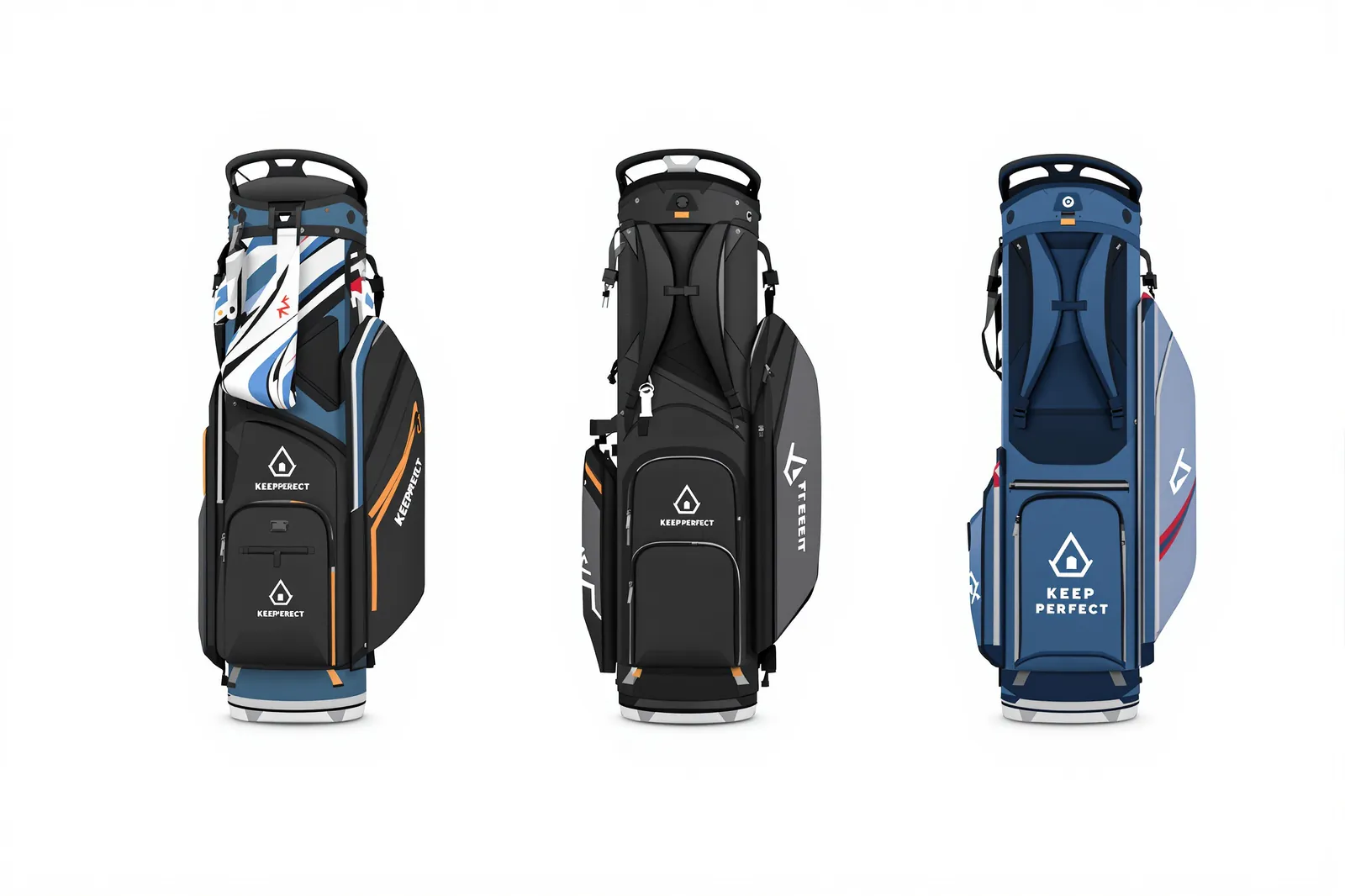
For custom golf staff bags produced at a factory-direct manufacturer, the realistic turnaround is 10–20 days for sampling and 45–60 days for bulk production after sample approval, with total elapsed time from confirmed order to FOB port typically landing between 65 and 90 days. That range assumes a stable specification, on-time material release, a single consolidated production window and standard ocean freight. Understanding where those days are spent — rather than treating lead time as one opaque number — is what separates a well-planned staff bag programme from a season that slips. This guide breaks down each stage of the timeline, the variables that compress or stretch it, and the exact data every B2B buyer should use when quoting retail availability.
Why Lead Time Has Three Distinct Phases
A custom golf staff bag is not built in one continuous run. It moves through three separable phases, each with its own calendar: sampling (10–20 days), bulk production (45–60 days), and freight plus customs clearance (variable by route). Buyers who compress the first phase on paper but ignore the production and logistics phases consistently miss the real delivery date. The professional approach is to build a schedule from the release of the specification backwards, protecting each phase rather than adding a blanket buffer on the final date.
| Programme stage | Typical duration | Key gate / output |
|---|---|---|
| Specification & quotation | 1–3 days | Approved brief, costed technical sheet |
| Sampling (staff bag) | 10–20 days | Approved pre-production sample |
| Material procurement | 5–10 days | Rolls booked, trims in house |
| Bulk production | 45–60 days | QC inspections passed, packed cartons |
| Freight & customs | 1–6 weeks | Arrival at destination warehouse |
The Sampling Stage: 10–20 Days
The sample is the single largest swing factor in the whole timeline. In our affiliated factory — a 4,950 m² facility operating 7 production lines with 126 sewing machines and 137 employees — a staff bag sample typically takes 10 to 20 days depending on the degree of customisation. A standard staff bag with logo embroidery and colour matching sits near the lower end; a bag with new structural hardware, unusual pocket architecture or complex printing requires the longer window. The sampling stage is complete only when the buyer signs off a written approval, because production cannot lock without a fixed reference.
A staff bag is structurally unlike a stand bag in ways that directly affect lead time. It carries a full set with minimal internal club confusion, which means the dividers and the reinforced top ring are central to the build; it often adds a weighted base and heavy-duty stand hardware; and its larger silhouette consumes more material and more sewing time per unit. Because of this, the time required per piece on the line is higher than for a simple stand construction, and a factory that quotes the same production window for a staff bag as for a lightweight carry bag is not being honest about its own capacity. The correct expectation, expressed in the calendar, is that staff bags command the longer end of the 45–60 day production range even at identical volumes.
For the buyer, the practical translation is that staff bag lead time cannot be improvised late in a season. Because the construction is heavier and the sample more involved, a brand should back-date its programme by the full sampling window plus a production buffer, and treat the sample approval as an immutable gate. Many brands find that running a pre-season sample—ordering the sample as soon as the design is even provisionally set—lets them hold valuable placeholder slots while the final brand decisions are still being made. This sequencing is one of the highest-leverage habits in the whole bulk sourcing calendar.

Sampling Variables That Move the Clock
Three choices during sampling have an outsized effect on lead time. First, the reference: sending a physical reference bag or detailed manufacturing drawing removes rounds of clarification that can add a week. Second, the materials: staff bags frequently need ballistic nylon, PU-coated fabrics or reinforcement webbing that must be sourced, and special-order materials extend procurement. Third, the finish: embroidery and tacked logos are quick, while full-colour sublimation or multi-layer screen printing is slower. A buyer who locks these decisions before the brief is sent can hold the 10-day end of the range; a buyer who iterates through three sample rounds should plan for the full 20 days plus margin.
Material Procurement and Cutting
Once the sample is approved, material is ordered to cover the committed volume. For the common materials in staff bag construction — 1680D and 840D nylon, laminated polyester and heavy webbing — lead time is typically 5–10 days when the fabric is standard stock, and longer when a buyer specifies a proprietary colour or a coated specialty textile. Fabric is received, inspected, and laid onto cutting tables; patterns are graded and the cut parts are bundled into kits for the sewing lines. Brands that need a more involved build explore our custom solutions at this stage. Because production capacity is shared across orders, the sequence on the cutting floor is scheduled against confirmed programmes, which is why volume honesty at quotation time protects the planned slot.
The Production Phase: 45–60 Days
Bulk production of a custom staff bag is the longest and most capacity-dependent phase. In a factory with 7 lines and a monthly capacity of roughly 200,000 golf bags, a staff bag order occupies line time that must be scheduled against commitments to other buyers. The realistic production window for a bulk staff bag order is 45 to 60 days. Structural elements — the divided club section, the reinforced stand or bottom assembly, the multi-pocket gusset work — are all labour-intensive, which is why staff and cart bags sit at the upper end of the capacity curve compared with simpler stand constructions.
Quality Control Gates Inside Production
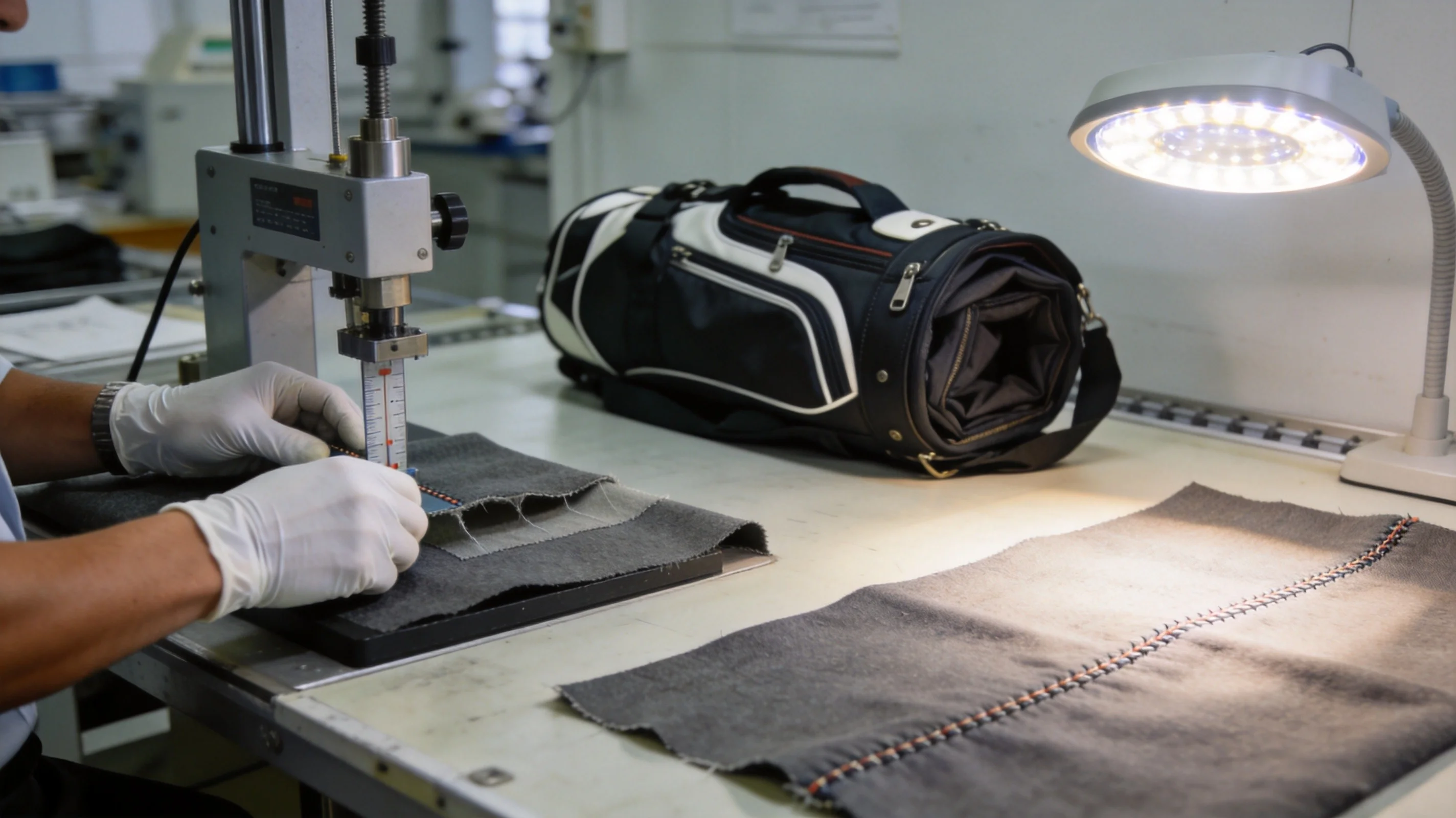
A disciplined factory runs several inspection gates rather than one final check. In our workflow, fabric and trim are inspected on receipt; in-process checks are taken on the sewing lines; a mid-production inspection samples units against the approved sample; and a final AQL-based inspection verifies the packed cartons before the container is loaded. Each gate produces a report that the buyer can request, which creates a paper trail that protects both parties. Buyers who schedule a third-party inspection into the 45–60 day window find that issues surface at the gate where they are cheap to fix, not after the goods are on the water.
How Volume Shapes Production Lead Time
Volume determines how many lines an order occupies and therefore how fast it moves. Our standard MOQ for a custom staff bag is 200 pieces, with a reduced 100-piece test order option for first-time brand validation. The difference between 200 and 2,000 pieces is not a linear addition of days; it is a question of scheduling one line versus multiple lines in parallel. A larger order that can be split across two lines can sometimes finish in a similar number of calendar weeks as a smaller single-line order, because the constraint is line-to-line scheduling rather than absolute quantity. The practical guidance is that order consolidation into fewer, larger turns tends to protect the schedule more reliably than many small orders.
Communication Cadence as a Lead-Time Tool
The fastest way to stretch a timeline is silence. A factory cannot hold a slot open indefinitely while waiting for an answer, and a buyer cannot hold a season without a confirmed schedule. The professional cadence is: a written schedule at order confirmation, a sampling checkpoint with a named deadline, a production-start confirmation with a line plan, a mid-production progress update, and a preshipment inspection notification. We issue these updates with hard dates so that both sides always know the next gate. Buyers who reply to sample feedback within 48 hours and freeze the spec before production protect the fastest possible path on every order.
The relationship between sampling rounds and the production slot deserves its own emphasis. In a factory with shared line capacity, the production slot is reserved against the expectation that the sample will be approved by a certain date. If the buyer takes three sample rounds instead of one, the reserved slot does not simply wait—it is re-sequenced around other confirmed programmes, and the order finds itself back in the queue. This is the mechanism behind the common complaint that “sampling took a week longer and production took three weeks longer.” The two are not independent; a late sample feeds directly into a later production window. Keeping sampling to the first round, with disciplined and complete feedback, is therefore not just a design convenience—it is the cheapest and most direct way to protect the downstream schedule.
A second lever is the confirmation of order terms at the same moment as the sample approval. When a buyer signs the production terms—MOQ, unit price, delivery basis, inspection standard—in parallel with approving the sample, the factory can immediately cut fabric and book the line in one motion. Splitting these decisions into separate conversations inserts a gap of days that shows up at the end of the programme. Efficient buyers bundle the approval and the confirmation into a single written handover, so that nothing waits on a second round of communication.
Changing the Specification Mid-Order
Specification changes are the most common hidden cause of slippage. Every change — a new colour, an added pocket, a different hardware finish — re-enters the material and line scheduling loop and moves the promised date unless it is absorbed by buffer. The professional rule is to treat changes as formal revisions with a declared impact on both price and schedule. Freezing the spec at sample approval is the single most effective way to hold the 45–60 day production window. When a change is unavoidable, agree the new date in writing at the moment of the change, not after the original date has already passed.
Freight and Customs: Know the Route
Ocean freight from the port of departure to a US or EU destination typically takes 1 to 6 weeks depending on the lane, the service level and the season. Two numbers matter more than the total today in the roadmap: the transit days and the customs clearance days. A buyer should model both. For the US, the relevant classification is HTSUS heading 4202 for travel and sports bags; a reliable customs broker or the authoritative tariff schedule published by the USTR/USITC (hts.usitc.gov) should be consulted for the correct subheading and duty rate. For the EU, the corresponding heading is CN 4202 under the Union Customs Code, administered by the European Commission’s Taxation and Customs Union. Booking freight only after the production date is confirmed — and issuing the bill of lading documents promptly — keeps the customs step from adding days at the destination.
Planning Backwards for a Launch Date
The whole point of understanding lead time is to plan backwards from a concrete retail or launch date. A buyer who needs goods at a US warehouse by a specific date should subtract transit and clearance, then subtract production, then subtract sampling, and set the brief release at that point. This backwards planning surfaces exactly how early the specification must be final. For peak-season arrivals — spring launch stock, for example — the schedule is tighter because freight windows and port congestion inflate, so an extra week of buffer is prudent.
Comparing Factory Capabilities Transparently
When evaluating suppliers, lead time promises should be scrutinised against real capacity, not marketing language. A credible factory quotes sampling and production ranges and can show the lines, machinery and headcount behind them — for example, 7 production lines, 126 sewing machines, 137 employees and roughly 200,000 units of monthly capacity, verified by a third-party SGS audit conducted in March 2026. Claims that sound too fast for the construction described, or vague “fast” promises without a line plan, are a warning sign. The most reliable way to compare is to give two factories the identical specification and ask each for a dated schedule with named gates.
Working With an Affiliated Factory
Since 2014 the manufacturing arm has operated as an affiliated factory (rather than a loose broker arrangement), giving brand buyers a single accountable point for sampling, production and compliance through our factory-direct manufacturing channel. The founder has been in the trade since 2004, and the facility is registered in Quanzhou, Fujian, China. This structure means MOQ decisions, inspection standards and schedule commitments are made by the people who physically run the line, not by a middle agent. For buyers that value traceability, this makes audit trails — from fabric usage to inspection reports to bill-of-lading documents — straightforward to reproduce.
National Market Compliance and Clearance
Different markets add their own clearance variables to the freight phase. For EU-bound shipments, buyers should confirm that the product information complies with the EU’s GPSR and that any textile materials meet the restriction limits set under REACH regulation, administered by ECHA (echa.europa.eu). For US-bound shipments, the importer should verify correct classification under HTSUS 4202 and ensure supplier records support the declared value. These steps do not lengthen production, but they do belong in the lead-time model because a documentation gap at the border can hold an entire container. A factory that can produce the necessary compliance documentation from its own quality and materials files shortens this step.
Inventory and cash planning follow directly from a well-built lead-time model. If a buyer knows that a reorder will take 45–60 days of production plus freight, then stock cover must be set high enough to bridge that gap without stockouts, and purchase cycles should be scheduled so that a fresh container arrives before the previous one runs dry. Because staff bags are a higher-value, slower-moving category than volume carry bags, the cost of both overstock and stockout is amplified, which makes accurate lead time a genuine margin driver rather than an academic exercise. A brand that plans its annual staff bag programme as a series of overlapping turns, rather than one annual panic order, converts lead time from a risk into a predictable input.
There is also a compliance dimension to planning. Confirming the correct tariff classification and any market-specific requirements—REACH restrictions and GPSR product information for the EU, correct HTSUS 4202 classification and declared value for the US—at the order stage means the documentation package travels with the goods rather than being assembled after arrival. In practice this avoids unexpected clearance holds that add real calendar days to a schedule that was otherwise on time. The factory’s ability to supply the supporting compliance documentation from its own records is a practical advantage that shortens the end of the timeline.
How to Read a Realistic Lead-Time Quote
When a factory quotes a lead time, a professional buyer reads it as a commitment with conditions attached. The quote should state the sampling window, the production window, the point at which freight is additional, and the assumptions — on-time material release, approved sample, frozen specification, and scheduled line slot. Ask for the specific gate dates rather than a single number. A realistic quote is one that a buyer can reverse-engineer into a calendar of named checkpoints; a vague one is a risk that will be discovered at the worst moment. We quote our gates explicitly so that brands can build their own availability calendars.
One final practical point concerns buffer allocation. The most successful buyers do not apply a single blanket buffer to the final date; instead they place small, deliberate reserves at the points where uncertainty is genuinely concentrated. A few days of buffer at the sampling decision, a line of protection around the production start confirmation, and an allowance for freight variability at the destination—each absorbs the specific risk where it actually lives. Distributing buffer this way produces a more accurate expected delivery date than inflating the whole schedule by an arbitrary number of weeks, and it is the approach that keeps a staff bag programme both credible to retail partners and reproducibly on time.
Frequently Asked Questions
- How long does it take to produce a custom golf staff bag in bulk?
- Bulk production typically takes 45–60 days after sample approval, with sampling at 10–20 days. Total from confirmed order to FOB port is usually 65–90 days excluding ocean freight.
- What is the minimum order for a branded staff bag?
- The standard MOQ is 200 pieces per design, with a reduced 100-piece test order for first-time validation before committing to volume.
- Can I reduce the lead time for a repeat order?
- Yes. A repeated, unchanged design skips samplerework: because materials are known and the sample is already approved, some repeat orders can compress the timeline by shortening the sampling phase.
- What happens if I change the design after production starts?
- Changes after sample approval re-enter the material and scheduling loop and usually move the promised date. Freezing the specification is the most effective way to hold the 45–60 day window.
- Does freight time count as part of the factory lead time?
- No. Factory lead time covers sampling and production up to FOB port. Ocean transit and customs clearance are additional and depend on the destination route.
- How do I verify a factory’s claimed capacity and lead time?
- Ask for the physical basis — production lines, machines, headcount, monthly capacity — and for dated schedule gates. Third-party audits such as the March 2026 SGS inspection provide independent verification.
Sources and Further Reading
For authoritative tariff and compliance information, consult the USITC Harmonized Tariff Schedule for HTSUS 4202, the U.S. Customs and Border Protection guidance for import requirements, and the European Commission’s Taxation and Customs Union for CN 4202 and customs procedures. For chemical and product safety limits on textiles in the European market, review the European Chemicals Agency REACH guidance and the EU’s Product Safety requirements under GPSR. These references provide the regulatory context that belongs in any professional import plan.
For a wider view of sourcing, pricing and factory-direct partnerships, see our guides on wholesale golf bags, the golf bag wholesale pricing guide, and our OEM & ODM services, all designed for brand buyers planning bulk programmes.