MOQ and Pricing for Custom Golf Stand Bag Bulk Orders
Quick Answer
Custom golf stand bag bulk orders typically require a minimum order quantity of 300–500 units per color/design, with unit pricing ranging from $12–35 for mid-range models and $45–80 for premium configurations. Orders exceeding 1,000 units generally unlock 15–20% volume discounts. Lead time for bulk orders averages 30–45 days, including sample approval (5–7 days) and mass production (25–35 days).

For a custom golf stand bag ordered at a factory-direct manufacturer, the practical MOQ is 200 pieces per design, with a reduced 100-piece test order for first-time brand validation, and unit pricing that is driven primarily by specification depth, material grade and order volume rather than by arbitrary factory markup. Understanding how a factory actually constructs its MOQ and price—which costs are fixed, which scale with volume, and where the buyer’s choices genuinely move the number—turns a golf stand bag quote from a black box into a negotiable, analyzable document. This guide decodes the MOQ and pricing math for bulk stand bag buyers, with the real cost drivers, the volume economics, and the exact questions to ask before signing an order.
Why the MOQ Exists
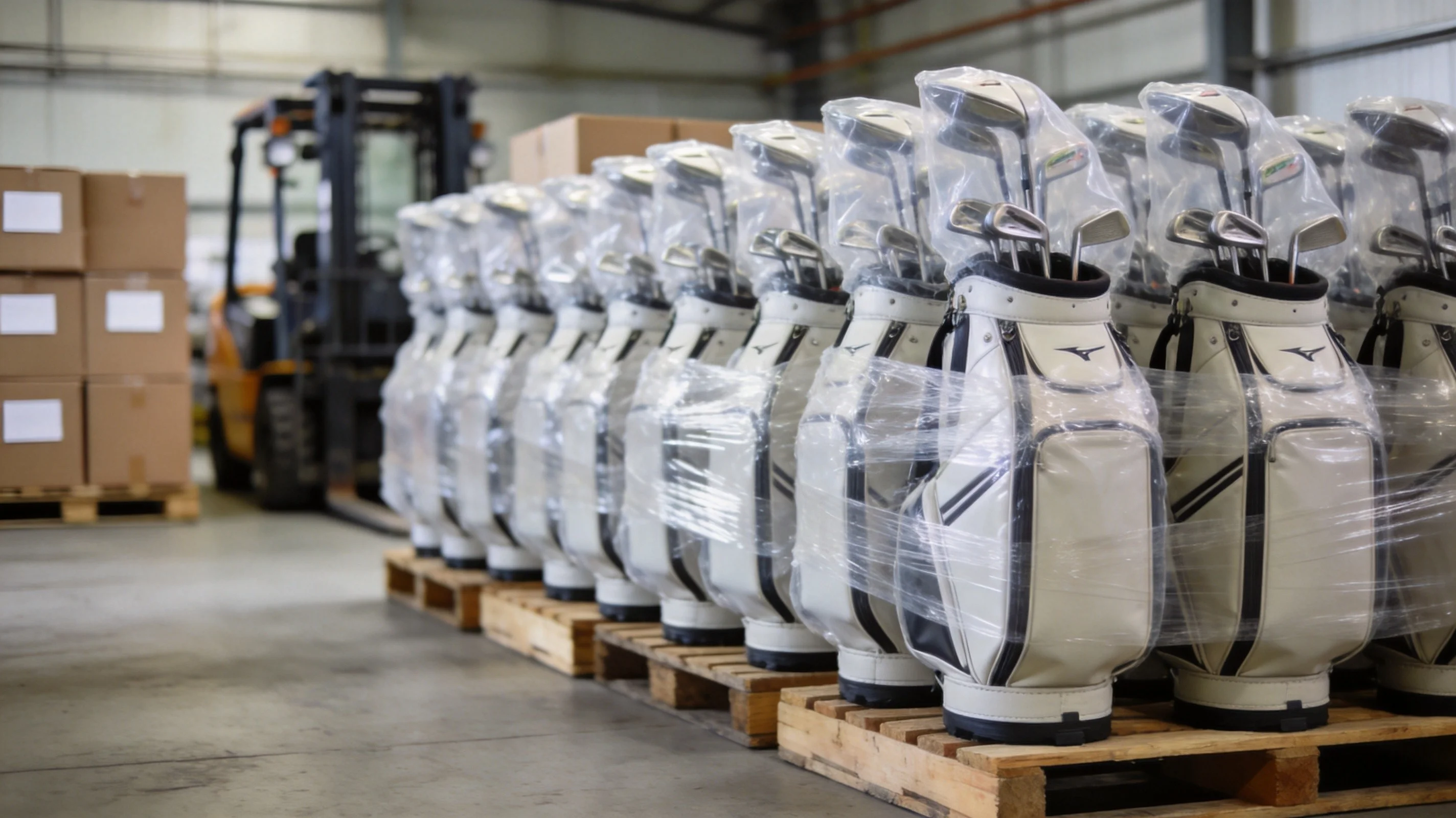
A minimum order quantity is not an arbitrary gate; it reflects the economics of running a production line economically. Every stand bag order consumes fixed setup costs—pattern cutting, sample confirmation, fabric booking, line changeover, threading and machine setup—that do not shrink with the order size. Below a certain volume, those fixed costs crush the unit price, so a factory sets a floor at which the economics still work for both parties. In our affiliated factory, the standard MOQ for a custom golf stand bag is 200 pieces per design, with a 100-piece test order available for brands that want to validate the market or the factory before committing to volume.
The 100-Piece Test Order Option
The test order is the most buyer-friendly mechanism in the modern factory-direct model. A 100-piece run lets a new brand confirm quality, sample consistency, packaging and service before locking in large volume, without paying the full cost penalty that tiny orders usually carry. In our case, the test order uses the same materials, lines and inspection regime as a full run, so the quality the buyer validates is the same quality the volume order will deliver. The natural path is to run the 100-piece test, verify the product and the partnership, then scale into the 200+ standard MOQ with confidence and a validated reference.
MOQ and pricing for custom golf stand bag bulk orders hinge on a 200-piece MOQ with 100-piece test orders, sample fees and fabric and hardware grade.
There is also a strategic argument for using the test order deliberately rather than treating it as a fallback. A 100-piece run is small enough to be genuinely low-risk but large enough to exercise the real production line, the real inspection process and the real packaging—so it is a far more informative trial than a single sample. The buyer who runs a test order with the specific goal of validating the factory’s communication, on-time behaviour and quality consistency gets information no brochure provides. By the time the volume order is placed, the brand has seen exactly what it is buying, priced against a real run, and the MOQ becomes a scaling decision rather than a leap of faith.
What Drives Stand Bag Unit Price
| Pricing driver | Impact on unit price | Buyer lever |
|---|---|---|
| Specification depth | Highest | Simplify pockets, hardware, structure |
| Material grade | High | Choose standard fabrics vs specialty coatings |
| Order volume | High | Consolidate into fewer, larger turns |
| Decoration & logo | Medium | Embedding vs patch vs multi-colour print |
| Packaging | Medium | Plain vs branded hang tags, polybags, carton config |
| Delivery terms | Low-medium | FOB vs DDP changes where costs sit |
The single largest variable in a stand bag quote is specification depth. A stand bag is defined by its stand mechanism, its club-dividing system and its weight balance, each of which carries engineering cost. A simple carry-stand configuration with standard fabrics sits at the low end; adding a full-length divider system, a more intricate stand, coated water-resistant materials or additional storage architecture moves the price up. When comparing quotes, always compare the specification sheet, not just the headline number—a lower unit price on a thinner specification is not a bargain.
The physics of a stand bag complicate its cost in ways that are easy to underestimate at quotation time. The stand mechanism—the legs, the hinge, the balance point—is a moving system that must survive years of use, and the way it integrates with the base and the club pocket governs both durability and the number of sewing operations per unit. A bag that sits on a cart for most of its life forgives minor weight imbalances; a stand bag that must deploy reliably on the course does not. This is why a credible factory prices the stand mechanism as a real engineering component rather than a cost line to be minimized, and why curtailing that mechanism to chase a lower number usually surfaces later as returns and complaints.
The club-divider system is the second structural cost that many first-time stand bag buyers overlook. Full-length dividers that protect graphite shafts from chatter are a genuinely different product from a simple top-ring pocket arrangement, and the difference shows in material usage, assembly time and price. When a buyer sets the divider specification—number of slots, full or partial length, protective lining—they are, in effect, setting a significant fraction of the bag’s cost. Locking that decision in the quote avoids the awkward moment where the comparator price is really for a bag with fewer dividers than the one the buyer intends to sell.
Material Cost and Grade
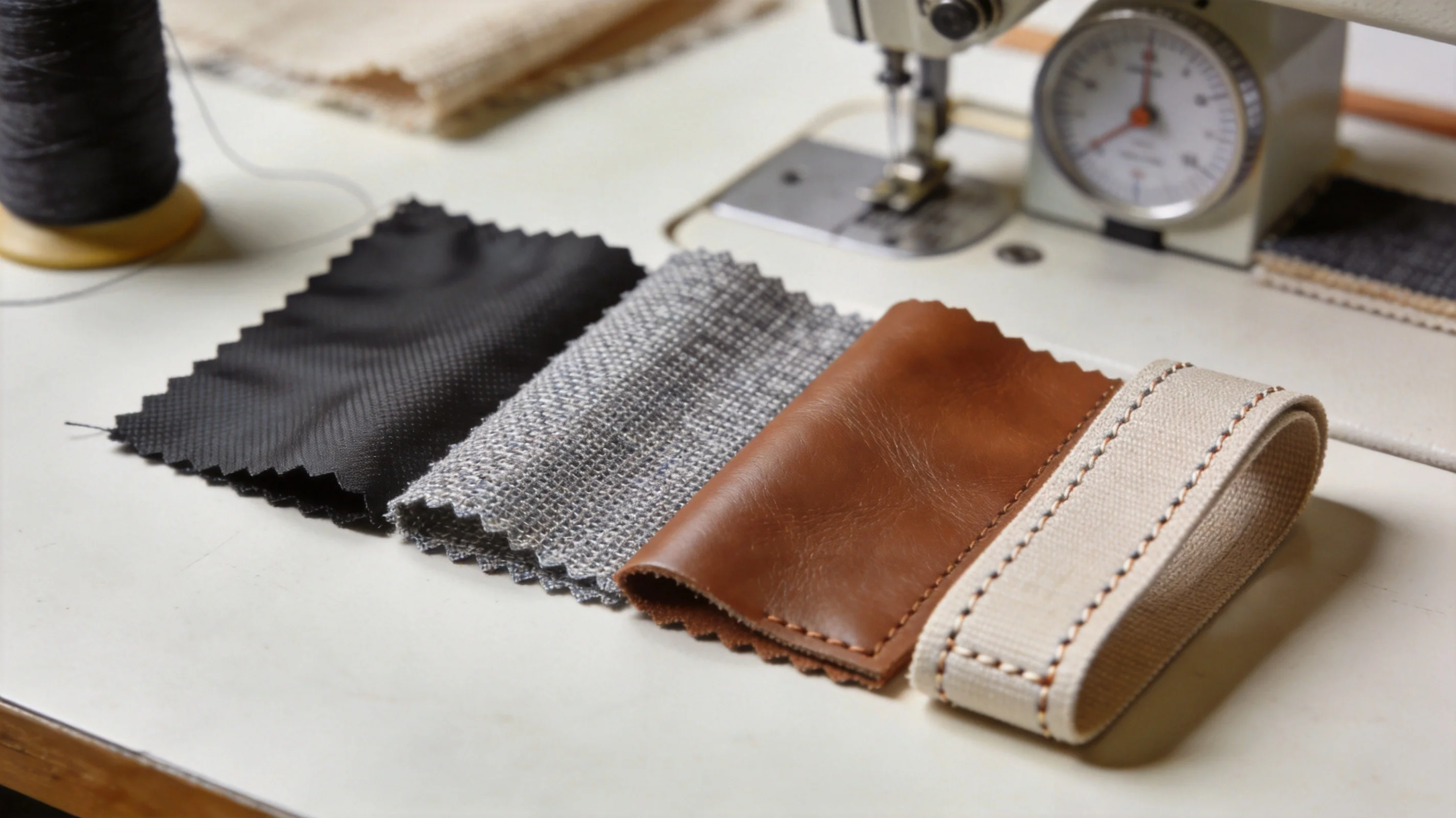
Material is the most direct contributor to price per unit. Standard 600D and 840D nylons are widely available and cost-effective, while 1680D ballistic nylon, PU-coated fabrics, and specialty water-resistant or recycled textiles command premiums. In our factory’s own costing, material choice typically moves the unit price more than any other single decision the buyer controls. The professional conversation is to decide the grade first—what durability and water performance the product genuinely needs—and then optimise the rest of the specification around that decision, rather than letting material be an afterthought.
Volume Economics and Price Breaks
Unit price declines with volume because the fixed setup costs are spread over more pieces and because material can be bought in larger, more economical lots. The gradient is steepest between the 100-piece test order and the 200-piece minimum, then flattens progressively at larger volumes. There is no magic formula across factories—each publishes its own breaks—but the reliable pattern is that a brand buying 1,000 pieces of one design gets a materially better unit price than three separate orders of 333, because one line setup and one material lot are purchased instead of three. Consolidation is the most dependable pricing lever in bulk stand bag sourcing.
Testing and inspection are part of the price that a serious factory cannot cut, because in a bulk run they protect both parties. In our workflow the inspection regime follows an AQL-based sampling plan across multiple gates—fabric on receipt, work in progress on the lines, and a final packed-goods check before the container loads—with each gate producing a written report the buyer can request. This is not an optional add-on to be stripped for a lower quote; it is what makes volume purchasing trustworthy in the first place. A buyer comparing two quotations should ask each factory exactly what inspection the price includes, because the cheapest price that skips the middle and final inspection gates is a price that downloads the risk of defects onto the buyer’s own stock and reputation.
A related point is how the price treats the approved sample. The sample represents a physical commitment—the factory’s costing is validated against it, and the production line is set up to reproduce it. Some low-cost suppliers quote a base price at the enquiry stage and then add a “sample matching” surcharge once production has to replicate the approved sample’s exact colours, logo and finish. The professional quote includes sample matching in the base price, because the whole point of approval is that production matches it. Asking “does your price cover production to exactly the approved sample, including colour and decoration matching?” is one of the most useful questions a stand bag buyer can ask.
Decoration and Branding Cost
How the brand is applied is a real cost driver. Embroidery and tacked-on logos are cost-effective at volume, while full-colour sublimation, multi-layer screen printing, or high-density patches each add steps. A logo that must match across thousands of units also affects the inspection stage. The professional move is to fix the branding method in the spec—so the price is quoted once against a locked decoration—rather than leaving it as an optional line. This avoids the common surprise where a quoted base price rises sharply once branding is specified.
Packaging Variables
Packaging sits inside the quote and is frequently underpriced or overlooked. Standard bulk packaging is a polybag per unit packed into export cartons; branded hang tags, premium carton printing or retail-ready packaging add cost. Because packaging travels through the whole freight and duty calculation, changes there also affect landed cost. The professional approach is to decide the packaging grade—exports vs retail-ready—upfront so that the quote and the landed-cost model use consistent numbers.
Reading a Factory Quote Correctly
A professional stand bag quote should decompose price into identifiable components: materials, labour, setup, decoration, packaging, inspection and margin. It should state the delivery basis clearly—typically FOB port—and list the MOQ, the sampling window and the production window alongside the price. In our case a quote covers sampling at 10–20 days and bulk production at 45–60 days, with a 200-piece standard MOQ and a 100-piece test option. If a quote gives only a single lump number with no decomposition, ask for the breakdown; it is the only way to compare fairly and to know where negotiation is actually possible.
Where Negotiation Is Real and Where It Is Not
Not everything in a price is negotiable, and a mature buyer knows the difference. Fixed costs—line setup, sampling, each product’s fixture—are inelastic below the MOQ. Volume-driven components, material grades and packaging are genuinely movable. The most effective negotiation lever is therefore volume commitment and specification simplification, not aggressive bargaining on a fixed-cost floor. A buyer who offers a larger, consolidated volume or a simplified spec will move the price more than one who simply asks for a discount while keeping a complex specification and tiny volume intact.
Landed Cost & Duty Considerations
Unit price is not the whole story. The landed cost includes freight and any duties—and for golf stand bags, the classification matters. For the US, golf bags fall under HTSUS heading 4202, whose correct subheading and duty rate should be confirmed against the authoritative schedule published by the USITC (hts.usitc.gov); the importer of record handles the duty liability. For the EU, the corresponding classification is CN 4202 under the Union Customs Code, administered by the European Commission’s Taxation and Customs Union. Buyers should always model landed cost, not quoted unit price, when comparing sources.
The Economics Inside Our Factory
Understanding where a price comes from is easier when the factory’s physical base is transparent. Our affiliated factory in Quanzhou operates 7 production lines with 126 sewing machines and 137 employees, with a monthly capacity of roughly 200,000 golf bags, producing under a third-party SGS audit conducted in March 2026. Since 2014 the firm has manufactured for brand buyers, with the founder in the trade since 2004. This transparency lets a buyer see that a quoted price is built on real, verifiable capacity—not on thin overhead that will crack under production pressure.
Aligning MOQ With Seasonal Demand
The MOQ must be reconciled with real demand to avoid either stockout or dead stock. A 200-piece per design minimum supports practical buying—enough for a meaningful retail or wholesale programme without warehousing what cannot sell. The test order lets a brand size its first bet. The professional rhythm is to validate with 100, then commit at the standard MOQ, then repeat across seasons with accumulated demand data. Over a few cycles a brand builds a demand baseline that lets it negotiate larger, consolidated turns at better unit prices without guessing.
Seasonality also shapes both price and MOQ planning. Stand bag demand clusters around the golf season in each market, which means the same factory’s line capacity is scarcest exactly when a brand most wants to place a large order. Buying on a steady, pre-season schedule—validating with a test order, then committing at the standard MOQ in time for the factory to slot the line and buy material ahead of the rush—both protects the schedule and shoulders the buyer into a better position for volume pricing. Waiting until the market is already buying is the most expensive ordering habit, because it combines scarce line time with freight windows that are themselves congested.
Finally, keep a disciplined record of the specification, the approved sample reference and the agreed price on every programme. Stand bag pricing depends on a long list of small choices, and without a written reference it is easy for any one of them to drift between the quote and the delivery. The buyers who run the smoothest, most predictable programmes are the ones who freeze the spec and the price together, in one document, at sample approval—so that the number they negotiated is the number they pay, and the bag they approved is the bag that ships. That single discipline removes the majority of pricing disputes from bulk stand bag purchasing.
Beyond the unit price itself, the buyer should work out the total programme cost—the figure that includes sampling, the quoted unit price over the planned volume, packaging, inland transport to the port, ocean freight and duty—before making a sourcing decision. Because the export basis is typically FOB, the inland and ocean legs are the buyer’s responsibility, and their relative weight changes with the destination. A quote that looks marginally higher on the unit line can be the cheaper programme once freight routing, container load efficiency and documentation simplicity are counted. The habit of comparing total programme cost rather than a single price converts stand bag sourcing from guesswork into a financial decision a brand can defend.
It is worth stating plainly what the price does not include, because misunderstandings in either direction erode trust. The quoted unit price covers the bag built to the approved specification on the agreed export basis; it does not automatically include rush-scheduling premiums, unusual rush freight, or penalties absorbed for late decisions by either side. When a programme runs to plan—spec frozen, sample approved on time, volume committed—the price holds as quoted. When a programme is changed mid-flight, the impact is transparently declared rather than hidden in a surprise invoice. A factory that quotes this plainly, and holds to it, is the dependable partner a brand can build a season around.
Currency and payment terms belong in the same cost model. Quotations are frequently issued in USD, and the exchange rate and the payment schedule interact with the total. Favour terms—deposit against production, balance against shipping documents—protect both sides and are standard in the trade; understanding exactly how the payment schedule maps to the production gates keeps the programme funded at the right moments and avoids a stalled line while paperwork clears. A mature buyer settles the currency, the payment milestones and the documentation together with the price, so that no element of the financial picture is left to be invented after the order has started.
For buyers new to importing, there is a concrete payoff to getting the MOQ and pricing conversation right on the first order: it establishes the baseline every future negotiation builds on. The specification sheet, the agreed price breakdown and the volume history from the first programme become the reference both sides use for the second, the third and the steady repeat business that follows. A brand that enters this relationship with a clear spec, a real test order and a defensible cost model sets up years of cleaner pricing and stronger scheduling than one that starts with an ambiguous brief and a vague negotiation. The MOQ is not the obstacle; it is the floor beneath a dependable, repeatable sourcing relationship.
Frequently Asked Questions
- What is the minimum order quantity for custom golf stand bags?
- The standard MOQ is 200 pieces per design, with a reduced 100-piece test order available for first-time validation before committing to volume.
- Why is the MOQ set at 200 pieces?
- It reflects the fixed costs of line setup, material booking and sampling spread over a volume that keeps unit pricing economical for both buyer and factory.
- What most affects the unit price of a stand bag?
- Specification depth and material grade are the largest drivers, followed by order volume, decoration method and packaging grade.
- Can I get a better price with a larger order?
- Yes. Consolidating volume spreads fixed setup over more units and enables larger material lots, lowering unit price at the steepest point between test and standard volume.
- Does the quoted price include freight and duty?
- Usually no. Quotes are typically FOB port; freight and any duty (HTSUS 4202 in the US, CN 4202 in the EU) are additional and belong in the landed-cost model.
- What is a reasonable production lead time once the order is placed?
- Sampling is 10-20 days and bulk production is 45-60 days after sample approval, before freight and customs clearance.
- How do I compare quotes from different factories fairly?
- Compare specification sheets and price breakdowns on the same basis—same materials, decoration, packaging and delivery terms—not just headline unit prices.
Sources and Further Reading
For authoritative tariff and compliance information, consult the USITC Harmonized Tariff Schedule for HTSUS 4202, the U.S. Customs and Border Protection import guidance, and the European Commission’s Taxation and Customs Union for CN 4202. For chemical and product-safety limits on textiles in the EU, review the European Chemicals Agency REACH guidance and the EU Product Safety requirements. These references anchor the regulatory context of any import plan.
For the wider sourcing picture, see our guides on wholesale golf bags, the golf bag wholesale pricing guide, and our OEM & ODM services, along with our factory-direct manufacturing and custom solutions pages.