OEM Waterproof Golf Bag Production Guide
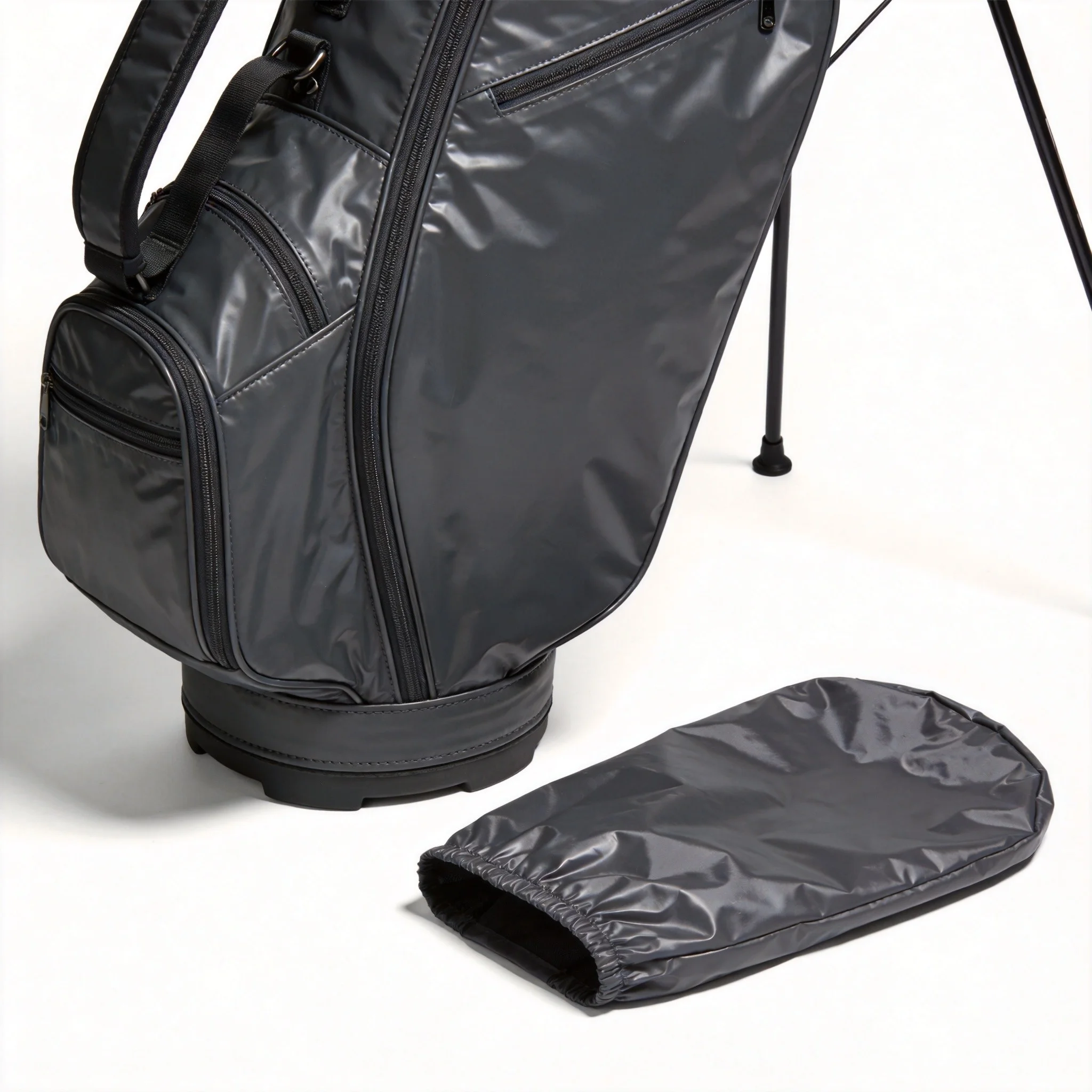
The direct answer: to produce a genuinely waterproof OEM golf bag, you must spec four linked layers in writing—a fabric hydrostatic-head minimum under ISO 811 (a serious storm shell typically holds 3,000–10,000 mm of water column), an IPX class under IEC 60529 (IPX4 for splash, IPX6 for heavy rain, IPX7 for temporary immersion), heat-taped or welded seam sealing, and waterproof or storm-flapped zippers on the main and valuables openings—then validate a finished sample before volume. Every waterproof line at the affiliated QUANZHOU JUNYUAN BAGS facility is checked against simulated rainfall, water-column pressure and seam inspection before a lot ships, whether you start with a 200-piece MOQ (100-piece test order) or scale to a full production run. This guide walks step by step through what "waterproof" actually means in manufacturing, how to write the spec sheet, what happens inside the factory, and how to verify quality before you commit.
1. Why Waterproofing Is a Production Discipline, Not a Fabric Choice
Most first-time OEM buyers assume that "waterproof golf bag" is defined entirely by the shell fabric. In practice, a waterproof bag is an engineered system with at least five cooperating components: the textile, the coating or lamination on that textile, the seams between panels, the closure hardware, and the bottom or drainage. If any one layer fails, the whole claim collapses. A 10,000-mm shell with untaped seams still leaks through the stitch holes within minutes of heavy rain. This is the single most important idea in waterproof OEM production, and it explains why two bags that look identical on a catalogue page perform so differently in a downpour.
For a buyer, the practical consequence is that you cannot evaluate a waterproof golf bag by a hero image or a single headline number. You have to evaluate a stack of verifiable specifications and, ideally, a sample. The good news is that every element of that stack is a standardised, inspectable quantity—there is nothing mysterious about it. This guide gives you the exact language you need to send a supplier a quote that leaves no room for ambiguity.
2. The Real Standards: IPX, Hydrostatic Head and Rain Simulation
Three public standards dominate waterproof golf bag validation, and knowing their names lets you interrogate a supplier precisely instead of accepting a vague "water resistant" claim.
IEC 60529 (the IP / IPX code) classifies protection against water in numbered steps. On a golf bag the first digit (solid-particle resistance) is usually irrelevant, so suppliers drop it and write "IPX." The scale runs from IPX0 (no protection) to IPX8 (continuous immersion). For golf the realistic range is narrow: IPX4 means splash resistance from any direction, IPX5 adds low-pressure jets, IPX6 handles strong jets or heavy rain, and IPX7 means the item survives temporary immersion in up to one metre of water for 30 minutes. Crucially, an IPX rating defines a test condition on a clean new sample—it is not a lifetime promise and says nothing about abrasion after three seasons of cart rides.
ISO 811 / hydrostatic-head testing measures how much water pressure a fabric resists before penetration, reported in millimetres of water column. This is the workhorse number for the fabric itself, and it is continuous—2,000 mm is meaningfully better than 1,000 mm. A light-shower nylon might hold 300–800 mm; a serious laminated storm shell frequently achieves 3,000–10,000 mm. Use it to separate marketing from engineering.
Rain-spray simulation (AATCC TM35-style methods) reproduces real rainfall at controlled rates, commonly near 100 mm/h, over 30 minutes to several hours, and inspects the interior for water. This is the test that best matches "what happens in an afternoon thunderstorm," and it is the one most credible factories run on finished assemblies rather than on flat panels.
| Specification Layer | What It Means | Recommended Floor for Storm Use | Standard / Method |
|---|---|---|---|
| Shell fabric | Base textile strength and density | 420D nylon or polyester, PU/TPU coated | Fabric spec / construction |
| Water resistance | Pressure before fabric penetrates | ≥3,000 mm hydrostatic head | ISO 811 |
| IPX class | Defined water test condition | IPX6 for rainy regions | IEC 60529 |
| Seams | Closes stitch-hole capillaries | Heat-taped or welded, full coverage | In-house seam QC |
| Zippers | Barrier at closures | PU-laminated or storm-flapped | Zipper spec |
| Bottom + drainage | Evacuates any ingress | Drainable bottom, sealed grommet | Assembly inspection |
| Finished assembly | Whole-bag weather test | Rain spray near 100 mm/h, dry interior | AATCC TM35-style |
3. Materials: What Actually Goes Into a Waterproof Shell
The shell of a waterproof golf bag is built around a dense woven textile, almost always nylon or polyester, made waterproof by a coating or lamination rather than by the weave itself. A plain weave nylon is porous to water; it becomes a barrier only when one side is coated with a water-repellent substance such as polyurethane (PU) or thermoplastic polyurethane (TPU), or when a waterproof membrane is laminated between fabric layers. The difference matters for weight, flexibility and long-term durability.
PU-coated nylon is the most common and economical option. A PU coating is applied to the reverse side of the fabric, giving a good balance of water resistance, weight and cost. It performs excellently for a storm shell rated IPX6, provided the seams are sealed and the zippers protected. The main caveat is that PU coatings can be prone to hydrolysis over many years in humid storage, so durable-grade PU is worth specifying for a bag expected to last.
TPU-laminated constructions add a tougher, often more flexible laminate, and TPU is generally more resistant to hydrolysis and abrasion than standard PU. It carries slightly more cost but extends the useful life of the shell in demanding use. Many serious storm bags favour TPU because the barrier holds up better to repeated folding, cart vibration and trunk storage—the exact stresses that break down cheap coatings.
Coated polyester is a lighter, lower-cost alternative used widely for bag bodies where maximum storm performance is not the top priority. Polyester holds coatings well and resists UV degradation somewhat better than some nylon options, which makes it a reasonable choice for a bag that spends long hours on a sunny cart. The right selection depends on your climate and your cost target; a manufacturer can help match a construction to both. For a deeper look at how textile choices interact, our golf bag materials guide breaks the whole material landscape down.
4. Seams, Zippers and Drainage: The Three Failure Points
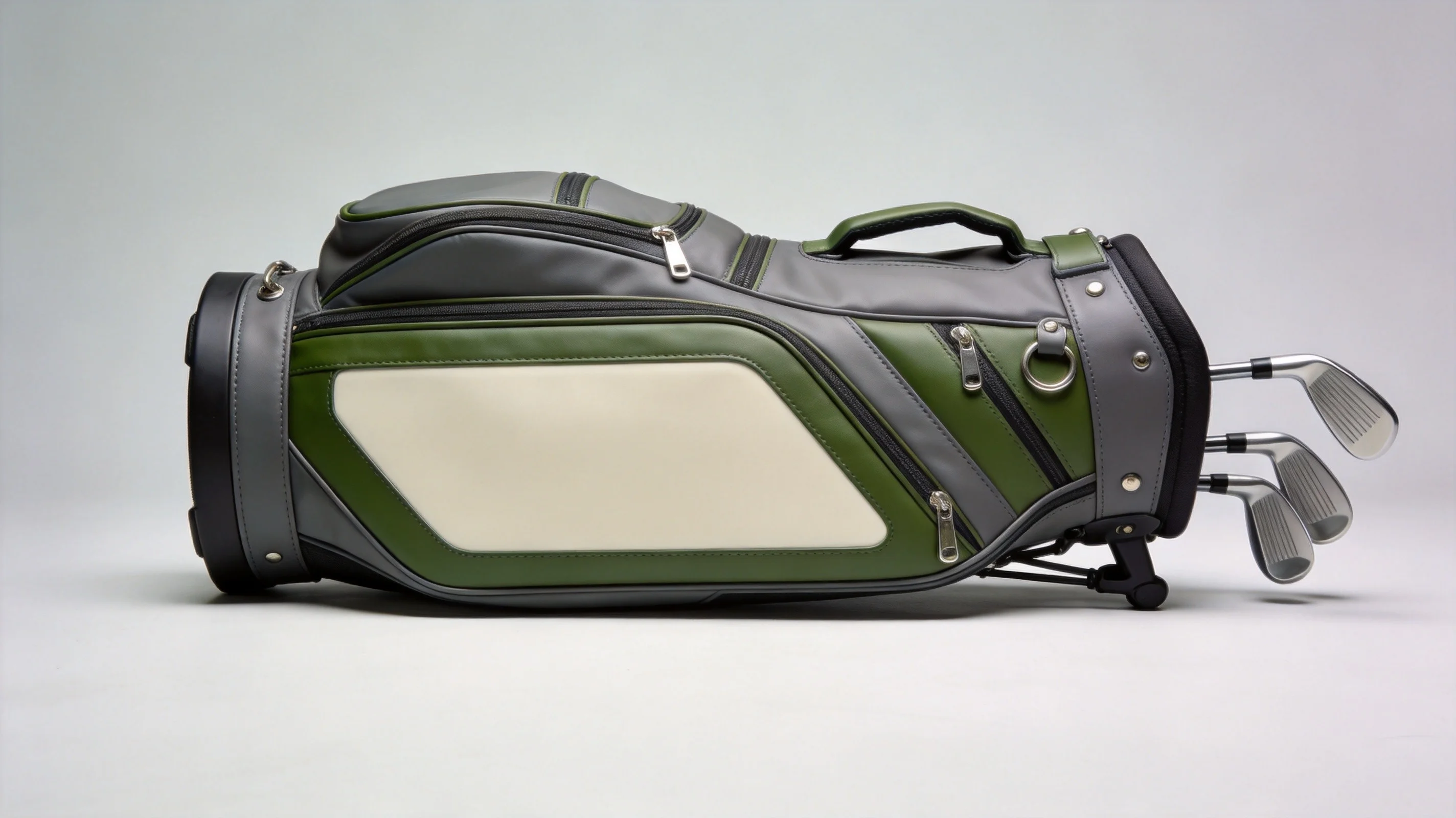
Once the fabric is waterproof, water has three remaining entry routes on a golf bag, in this order of likelihood: the closures, the seams, and the bottom. A production discipline that ignores any of these will leak regardless of how strong the shell is.
Closures. Standard coil zippers breathe water; a waterproof PU-laminated zipper or a storm flap turns the zipper track into a barrier. On a storm-proof bag, the valuables pocket and any electronics pocket deserve the highest closure protection, because that is where wallets, phones and range finders live. This is also where a thoughtful pocket architecture earns its keep—sealing is far easier when the items that most need protection have a dedicated, sealable home.
Seams. Every needle hole is a microscopic capillary. Heat-tapping or welding the seams closes those capillaries. The more complex the shell—multi-panel quilting, pockets, strap mounts—the more seams exist and the more sealing matters. When you compare suppliers, ask how sealing is applied on complex, multi-panel designs and whether the coverage is stated panel by panel. A factory that seals flat rectangles but cannot handle a curved, heavily pocketed shell is not a real wet-weather partner.
The bottom. A bag can be sealed brilliantly and still collect water through the stand, the base plate or a torn grommet. A drainable bottom converts ingress into a nuisance: water that gets in flows out again instead of pooling around grips and valuables. Never commit to a serious weather bag without confirming how the bottom behaves under ingress.
5. Writing the Waterproofing Spec Sheet
When you approach a factory through an OEM inquiry, a custom-solutions team or a direct manufacturing contact, send a spec sheet that leaves no room for interpretation. A minimum-viable waterproofing brief looks like this:
- Target class: "Shell to meet IPX6 per IEC 60529, verified on finished-sample rain and nozzle tests."
- Fabric: "PU/TPU-coated nylon or polyester, minimum 3,000 mm hydrostatic head (ISO 811), lab report required per incoming lot."
- Seams: "All shell seams heat-taped or welded; taping coverage stated panel-by-panel; inspection standard defined."
- Zippers: "Main and valuables openings: waterproof PU-laminated zipper or storm flap with covered housing."
- Bottom: "Drainable bottom with sealed grommet; stand mechanism mounts weather-sealed."
- Validation: "Rain simulation near 100 mm/h for 60 minutes; interior dry inspection; sample and lot-level results shared."
A supplier that can quote these details precisely is a supplier that actually tests in a reproducible way. If a partner can only say "water resistant," treat that as a red flag, not an answer. Because a fully sealed bag can run heavier than a standard shell, you should also settle weight and portability trade-offs in the same brief—see our weight and portability analysis for the trade-offs involved.
6. Inside the Factory: The Production Floor and Process
At the affiliated QUANZHOU JUNYUAN BAGS facility, waterproofing validation is a repeatable ladder woven into an established production floor. The operation runs seven production lines, employs 137 full-time staff working on roughly 126 industrial sewing machines, and turns a monthly capacity near 200,000 units. It is an affiliated manufacturing partner rather than an in-house factory—an important distinction for buyers who verify capacity and independence—and it ships to more than 200 brands across 100+ countries.
The waterproofing sequence begins before cutting. Incoming fabric is checked against a hydrostatic-head spec on a water-column tester; a roll that falls below target is returned rather than allowed onto the floor. Assembled shells then move to seam-seal application in sealed-tape or welded zones, and those seams are inspected for continuity. Finished samples run through rain simulation and nozzle tests at the rated class, with interior inspection after exposure. Finally, a proportion of each production lot is pulled for the same battery, and results are logged against lot numbers so any issue is traceable to a specific run. This lot-level traceability is exactly what separates a credible factory from one that prints a claim on a hero image.
None of this is exotic, but it is time-consuming, which is why "waterproof" is cheap on a spec sheet and expensive on a production schedule. That cost shows up in lead time: sample development typically runs 10–20 days and production 45–60 days, with the waterproofing validation folded into those windows. A buyer who needs a genuinely sealed bag should budget that time rather than assume a rush order can skip the tests.
7. MOQ, Sampling and Scaling to Volume
Custom waterproof golf bag orders scale predictably if you understand the volume structure. At the affiliated facility, the standard minimum order quantity is 200 pieces per design, which lets a factory run a full production lot efficiently against its 126 sewing machines. New partners can start smaller with a 100-piece test order to validate the design, the waterproofing and the fit before committing to volume. This staged approach is standard and pragmatic: it limits financial risk while proving the product on a real production line rather than only a hand-made sample.
Whichever volume you begin at, the waterproofing baseline stays the same. The test that protects a single golfer at retail—the seam inspection, the rain simulation, the hydrostatic-head check—is the same test that protects an OEM brand shipping thousands of units a quarter. Never accept a lower validation standard on a test order than you require on the full run, or you will discover the gap only after receiving a container of product that fails your customers.
8. Verifying Quality: From Sample Testing to Lot Audits
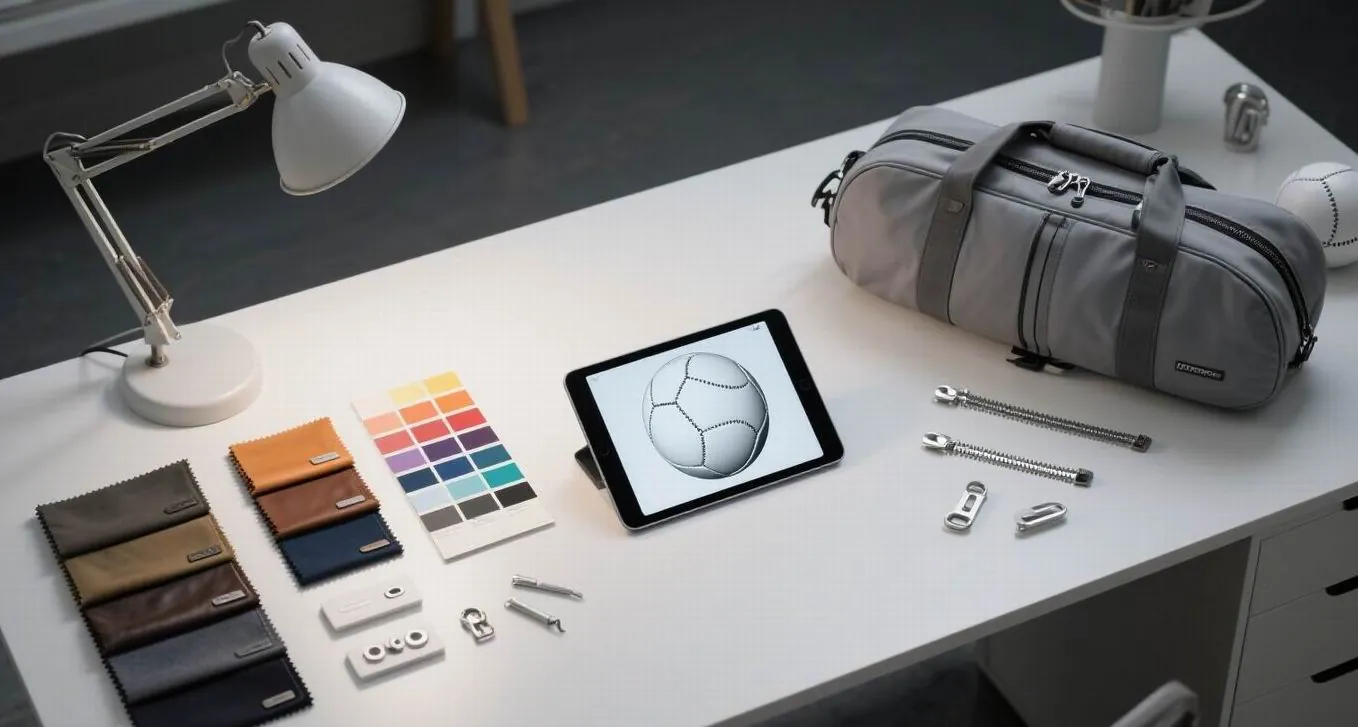
Before volume, use three verification steps. First, run a local rain test on a sample—take it under a garden hose at a steady spray for half an hour, or set a shower head above it, then inspect the interior for dampness. This catches the gap between a laboratory panel test and a real assembly. Second, do a seam crawl: run a finger along every taped seam and feel for gapping, and open and close each zipper under spray to check the storm flap. Third, ask for the factory's test logs and how lot-level results are shared.
Once you move to volume, the contract should commit the factory to lot-level re-testing rather than a one-time sample pass. The waterproofing warranty should be scoped honestly to workmanship—seams and zippers—with clear care guidance for the coating, because nobody can honestly guarantee lifetime waterproofing against an owner who stores a bag damp and never re-proofs it. For a fuller inspection rubric when choosing a partner, our factory certification guide covers which credentials to verify.
9. The Buyer's Waterproof Production Checklist
Before you finalise any waterproof golf bag order, run this ten-point list so no layer of the protection stack is left to assumption.
- Is the target IPX class written into the quote, with the IEC 60529 test condition named?
- Does the contract specify a fabric hydrostatic-head minimum and require a lab report for each incoming fabric lot?
- Is seam-sealing coverage stated panel by panel, with the taping or welding method defined?
- Are the main and valuables closures speced as waterproof or storm-flapped zippers?
- Does the bag have a drainable bottom with sealed grommets, and are stand mounts weather-sealed?
- Is a finished-sample rain test part of pre-production approval, with a shared protocol?
- Does the factory commit to lot-level re-testing rather than a one-time sample pass?
- Is the waterproofing warranty scoped to workmanship, with coating care guidance?
- Have weight, portability and climate been balanced so protection matches the playing environment?
- Does the supplier have a quality system behind the test battery—certifications, traceability, capacity?
Work down the list and you remove most of the risk that turns a "waterproof" label into a soggy disappointment. The process is deliberately unglamorous: it trades one dramatic number for a stack of verifiable details.
10. Sourcing Context and Who to Work With
For buying teams, the waterproofing spec is one line in a broader sourcing decision that includes factory certifications, production capacity and quality systems. The affiliated QUANZHOU JUNYUAN BAGS facility has been active in the industry since the founder entered the trade in 2004 and the company was established in 2014—roughly two decades of bag-making experience. It passed an SGS factory audit in March 2026, operates seven production lines, and works with more than 200 brands selling into 100+ countries.
That context matters because waterproofing validation is only meaningful inside a reliable quality system. A factory that cannot trace a lot, cannot share test logs and cannot consistently hold a seam-taping process will fail your IPX claim even with the same fabric and zipper on paper. When you compare partners, ask how the test battery is logged and shared, not just whether a sample passed once. You can start the discussion on our OEM / ODM services page or, when you are ready to talk specifications, contact our manufacturing team and we will walk the validation ladder with you.
11. The Bottom Line
Waterproofing in OEM production is never a single number. It is a stack—fabric, coating, seams, zippers, drainage and honest maintenance—and each layer must hold for the label to mean anything. Rank the IPX class and hydrostatic-head figure first, but judge the product by the weakest link: the untaped seam, the breather zipper, the non-drainable base. Send a spec sheet that names every layer, validate a sample locally, and keep the bag maintained after it reaches the consumer. Do that, and an IPX6 rating stops being a marketing line and starts being a dry set of grips on a rainy round.
A Manufacturing Checklist That Protects Your IPX Rating
When you commission a waterproof bag from an OEM, the decision is made at the spec sheet stage, not at the invoice stage. Name each layer explicitly: the waterproof PU or TPU film, the seam-taped construction, the YKK zipper with a sealed or storm flap, and a non-drainable raised base with sealed grommets. Ask the factory to validate a pre-production sample in a rain simulator or under a five-minute static water spray, then repeat the test on the mass-production first article. Budget for the fact that true waterproofing adds fabric, tape, and labour cost per bag, so a quoted price that looks surprisingly low usually means the waterproofing is being skipped. Keep one sealed sample from every production lot as your QA benchmark and re-test it at 30-day and 90-day intervals so a drifting line can never reach your customer silently.
Frequently Asked Questions
- What is the MOQ for a custom OEM waterproof golf bag order?
- At the affiliated QUANZHOU JUNYUAN BAGS facility, the standard MOQ is 200 pieces per design, with a 100-piece test order for new partners. Sampling typically runs 10-20 days and production 45-60 days.
- What waterproofing standard should I specify for a golf bag?
- Name a target IPX class under IEC 60529 (IPX4 splash, IPX6 heavy rain, IPX7 temporary immersion), a fabric hydrostatic-head minimum under ISO 811, seam-sealing coverage, and waterproof or storm-flapped zipper specification. The more specific, the more honest the quote.
- How long does OEM waterproof golf bag production take?
- Sample development usually takes 10-20 days and full production 45-60 days, with waterproofing validation folded into those windows. Budget that time rather than expecting a rush order to skip the tests.
- How do factories test waterproof golf bags?
- With three standard methods: hydrostatic-head testing on the fabric (ISO 811), IP splash/jet/immersion tests (IEC 60529), and rain-spray simulation near 100 mm/h with interior inspection after exposure.
- Why do two bags with the same IPX rating perform differently?
- Because the rating is earned on a lab panel, while real performance depends on seam sealing, zipper design and drainage. Taped seams and storm-flapped zippers outperform identical-labelled bags with untaped seams and coil zippers.
- What materials are used for waterproof golf bags?
- Common shells include PU-coated or TPU-laminated nylon and polyester. Serious storm bags use coated or laminated fabric with sealed seams, waterproof zippers and a drainable bottom.
Sources
- IEC 60529 — Degrees of Protection Provided by Enclosures (IP Code)
- ISO 811 — Determination of resistance to water penetration (hydrostatic head)
- AATCC — Textile water resistance and rain-spray test methods
- IP Code (International Protection Marking) reference
- ASTM International — Textile and coated fabric standards