Private Label Golf Cart Bags: Manufacturing Process Explained
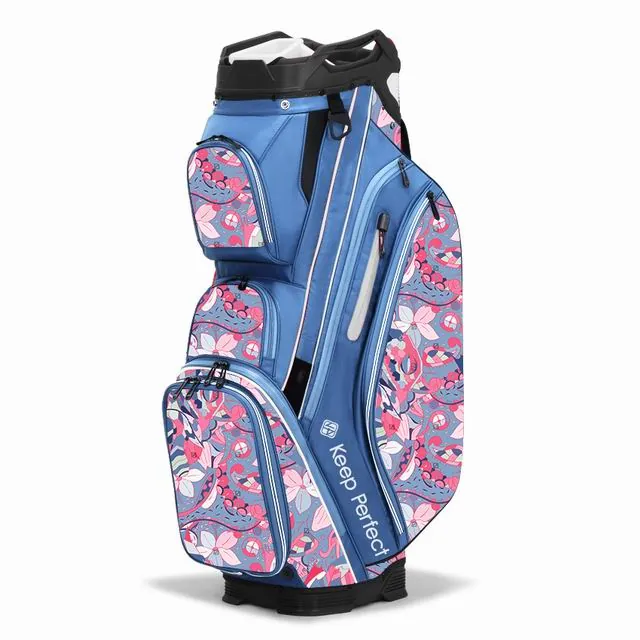
Private label golf cart bag manufacturing runs through six steps — design brief, material sourcing, physical sampling, bulk production, decoration and multi-checkpoint QC — and at QUANZHOU JUNYUAN BAGS typically completes sampling in 10-20 days and bulk production in 45-60 days from a 200-piece MOQ (100-piece test orders), so a brand can go from spec sheet to a shippable, logoed cart bag in roughly one season. Private label lets you sell a high-quality golf cart bag under your own name without owning a sewing machine or paying for a factory building; what you provide is the brand, the spec and the quality expectation, while the factory handles fabric, hardware, construction, decoration and certification. This guide walks through every step of that process from the floor of our affiliated Quanzhou factory (founded 2014, our founder entered the industry in 2004), so you know exactly what happens, what it costs and how to control quality at each stage.
Step 1: The Design Brief and Product Spec
Every private label cart bag starts with a written spec. Your brief does not need to be a full engineering document, but it should answer the core questions: what size and capacity (a standard cart bag fits 14 clubs, but you may want a 5-way or 14-way divider top), what shell material and colors, what pockets and features, what decoration and where the logo goes, and roughly what target retail price you need the bag to hit. The clearer the brief, the closer the sample comes on the first attempt and the faster the whole project moves.
A good factory will respond to your brief with a set of concrete choices rather than vague agreement: which 600D or 840D polyester, which zipper grade, which base construction, which strap style. That is where the real design work happens, and it is the moment a capable partner earns its keep. If you are starting without a defined design, many factories offer ODM too, where they propose designs from their catalog for you to brand — you can see the difference between OEM and this full-design service in our OEM vs ODM guide.
Step 2: Material and Hardware Sourcing
Once the spec is agreed, the factory sources materials against it. For a cart bag, the shell is most often a 600D or 840D polyester chosen for weather resistance and tear strength, backed by a coated interior for extra waterproofing where your design requires it. The hardware — zippers, buckles, a grab handle, base reinforcement and any cart-strap features — comes from approved suppliers and is traced by lot, so the material quality matches the sample every time.
Sourcing also sets the floor under cost and quality. A cheaper shell or an ungraded zipper quietly lowers the quote, but it also lowers the bag's life in service, and for a private label product your name is on the result. Brands that insist on a named zipper grade and a documented fabric weight get a bag that holds up on the course, which is precisely the trade-off our golf bag materials guide walks through in detail.
Step 3: Physical Sampling in 10-20 Days
With materials sourced, the factory builds a physical prototype from your spec in roughly 10-20 days of sampling. This sample is where the design becomes something you can hold: you measure its weight, test its dividers, check the pocket layout, verify the strap and handle construction and, critically, review the logo placement and color accuracy. Treat this sample as the baseline contract for everything that follows, because the production run is built to match it, not to match memory or a low-resolution render.
The sample stage is also where cost surprises surface, so review it methodically. Check the empty weight against your target, the club capacity, the zipper feel and the color of the shell and logo under daylight. Request changes now — after the sample, every revision adds lead time. A disciplined review here is the cheapest quality control you will ever buy. If you are new to the process, our guide to requesting samples gives a practical review checklist.
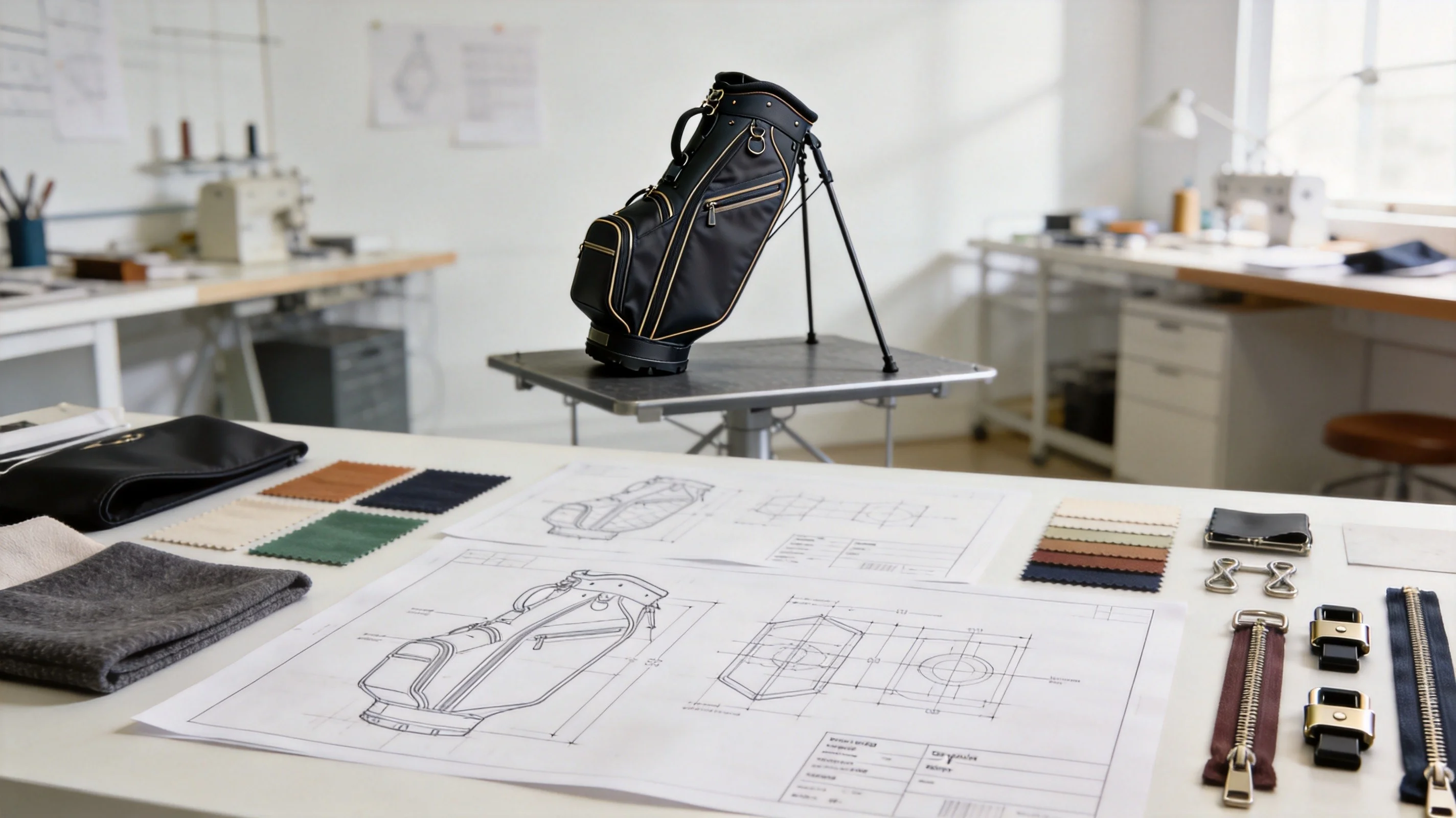
Lock the Sample
The approved physical sample is the baseline for the entire bulk run — weight, colors, dividers and logo placement all get frozen here.
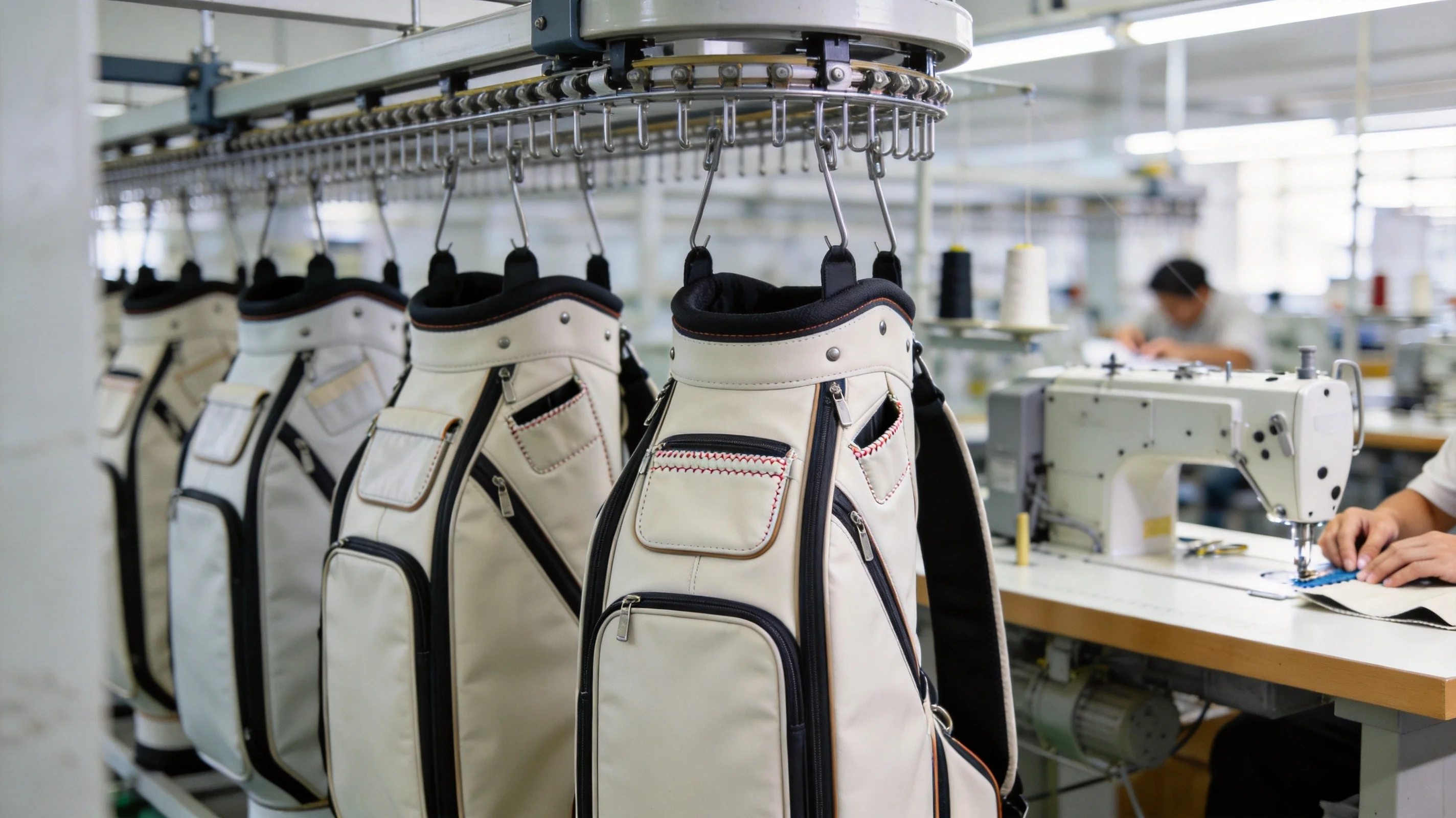
Standardized Production
Documented patterns and calibrated machines mean the 200th cart bag matches the approved sample, not an operator's memory.
Step 4: Bulk Production in 45-60 Days
Once the sample is approved, bulk production begins and runs 45-60 days depending on fabric availability and the complexity of construction and decoration. The shell fabric is cut against the approved pattern, components are assembled in sequence — main body, dividers, pockets, base, handle, straps — and each unit moves through the production floor to the next station. Across 7 production lines and 126 sewing machines at our affiliated factory, this is where a small brand's order joins steady capacity of roughly 200,000 pieces per month.
The MOQ is what makes this efficient and consistent: a standard private label run is 200 pieces per design and colorway, with test orders from 100 pieces so you can validate the product before scaling. Production calendars should be locked at the quotation stage, because during peak seasons capacity fills up and waiting for fabric or line time adds to the timeline. A written schedule from the factory, with buffer built into each milestone, is the single best protection against a missed launch date.
Step 5: Decoration, Branding and Custom Colors
Decoration is where your private label identity gets applied. Screen printing on a smooth front panel is the most cost-efficient and repeatable method; embroidery and woven labels add a premium accent at a slightly higher cost; and heat-pressed PU or leather-look patches give a clean logo finish. For a cart bag, the branding zones are typically the front panel and top handle area, sized to read clearly at range. Your brand colors are matched to a Pantone reference so they are consistent across the whole run.
Think about placement as carefully as method. A single dominant logo zone on the front upper panel reads better and costs less than several scattered marks, and it holds brand impact every time the bag is set on a cart or carried to the practice green. Custom colorways — a shell matched to your palette with a contrasting logo panel — are one of the cheapest ways to make a cart bag unmistakably yours. The full range of marking options and which suits which fabric is covered in our logo printing and embroidery guide.
Step 6: Quality Control Across Three Checkpoints
Your private label name rides on every bag in the run, so QC is non-negotiable. At QUANZHOU JUNYUAN BAGS every cart bag lot moves through three checkpoints: incoming material inspection for fabric weight and color fastness, 100% in-line inspection during sewing for seam integrity, bar-tacks and zipper operation, and a final AQL-based random inspection before packing. That ladder catches drift early, when it is cheap to fix, and keeps small defects from shipping at scale.
Independent verification adds another layer of confidence. In 2026-03 our affiliated Quanzhou factory underwent on-site SGS and Alibaba verification, giving private label buyers a third-party confirmation that the capacity and QC described here exist. When you compare factories, ask how many inspection checkpoints they run and whether they can produce a third-party audit — it is the fastest way to separate a quality-conscious factory from a talkative one. Our quality standards guide details the inspection checklists to apply.
Packing, Trade Compliance and Shipping a Private Label Cart Bag Run
Private label work does not end at the last stitch of QC; how the finished cart bags are packed, documented and shipped determines whether they arrive saleable. Each finished bag is folded or laid flat into a poly bag, then packed into a five-layer export carton sized to protect the shell and dividers in transit. A typical export carton holds several cart bags depending on whether they ship flat or assembled, and each carton carries a shipping mark with your brand, carton count and destination so your forwarder and local customs can reconcile the shipment against the packing list.
Trade compliance is the part new private label buyers most often underestimate. For shipments into the United States, the two biggest rules of thumb are classifying your bags correctly under the Harmonized Tariff Schedule (sporting goods / travel goods headings) and preparing the documentation a customs broker expects: commercial invoice, packing list, bill of lading, and origin information from the manufacturing facility. For shipments into the European Union, CE considerations are rarely relevant to a textile golf bag, but you should confirm your packaging avoids restricted substances and that any recycled-material claims you print match the certificate you hold. Working with a factory that ships to the US, EU and Japan every week removes most of this guesswork, because the documentation templates are already in place.
Freight choice is the last lever. Full container loads give the lowest per-unit cost for large runs; less-than-container or air freight makes sense for test orders and time-critical launches. Because freight and duties can rival the bags themselves on small runs, build the landed cost into your unit math before you commit a price. A dedicated import guide for your destination market saves you from a surprise at the port; for US buyers seeking cart bags, our importing cart bags to the US guide walks through the steps in order.
Scale, Capacity and Factory Credentials for Private Label Cart Bags
Behind every smooth private label run is manufacturing capacity that can actually hold your volumes. QUANZHOU JUNYUAN BAGS operates an affiliated Quanzhou factory with 7 production lines, 126 sewing machines and 137 staff, giving a monthly capacity of about 200,000 pieces across our bag categories. That scale means a private label cart bag order of a few hundred or a few thousand pieces never competes with another customer for machine time — your run has dedicated lines and dedicated sewing staff for the duration of production.
Ask any factory shortlist two questions beyond price: how many simultaneous production lines exist, and what independent certifications the facility holds. Real capacity protects your schedule when demand spikes, and certifications protect your brand in retail and online marketplaces. The affiliated facility passed a third-party SGS factory audit in March 2026, evidence that working conditions, quality systems and social compliance hold up to an external reviewer, not just to the factory's own sales pitch. For a deeper look at the audit marks worth verifying, our factory certification guide lists the checks that matter for a private label buyer.
Capacity also shapes lead times. With 200,000-piece monthly capacity, standard cart bag production is rarely the bottleneck in a 45-60 day bulk window; the schedule is far more often set by fabric sourcing and by how many decoration passes your design requires. Plan your production timing around those two variables and your private label launch lands on time. For buyers weighing how many units to commit to, our MOQ and bulk pricing guide is a useful planning reference.
MOQ, Sampling and Lead Time at a Glance
| Process Stage | Typical Duration | MOQ / Scale | Buyer's Key Action |
|---|---|---|---|
| Design brief | 1-2 weeks (iterations) | n/a | Lock size, material, features and target price |
| Material sourcing | Parallel to brief | n/a | Confirm fabric grade and zipper spec |
| Physical sample | 10-20 days | 1-2 units | Measure, test, review logo under daylight |
| Bulk production | 45-60 days | 200 pcs standard, 100 test | Lock calendar; add freight buffer |
| QC & shipping | Per terms | Full lot AQL check | Request final inspection report |
Standard factory-direct parameters at QUANZHOU JUNYUAN BAGS; actual timelines vary with decoration complexity, materials and seasonal capacity.
What Private Label Actually Costs You
Private label cart bag cost splits into four buckets: shell material and hardware, construction labor, decoration, and freight and duties. Material is the largest line; construction is relatively fixed per unit at a production line; decoration scales with design complexity; and freight and duty can rival the bags themselves for small overseas runs. A line-item quotation — not a lump sum — is the only way to see where savings are possible, such as standardizing on one colorway or confining decoration to a single panel.
Because cart bags are larger and use more material than a sunday or stand bag, their unit cost is naturally higher, but private label still buys you a professional product for a fraction of the tooling and overhead of manufacturing in-house. The trade-off to weigh is volume: private label is efficient at the 200-piece tier and above, so it suits brands planning to sell a line, not a one-off. Our wholesale pricing negotiation guide helps you compare quotes on a like-for-like basis.
Choosing the Right Factory for Private Label
Because your brand's reputation is sewn into every cart bag, the factory choice is the most consequential decision in the whole process. A capable private label partner should show you a decoration portfolio of real past orders, name the fabric and zipper grades they use by default, describe their QC checkpoints and put the production calendar in writing. Independent verification, such as the on-site SGS and Alibaba audit our Quanzhou factory passed in 2026-03, adds objective confirmation of capability.
If volume justifies it, ask for a video audit or a visit — production-line discipline is hard to fake and instantly visible. A structured supplier check is exactly what our manufacturer selection guide walks you through, and our OEM/ODM process guide frames the whole private label workflow from both sides of the table.
Finally, set expectations about after-sales support before you order, not after a problem appears. A reputable private label factory should explain its policy on defective units, the threshold for a replacement claim, and how long you have to report quality issues after a delivery. A service window that is clearly spelled out — for example, a set number of days to inspect and report with photographic evidence — protects both sides, and it is the mark of a factory that plans to work with you across multiple seasons rather than one transaction. For a broader view of what a durable supplier relationship looks like, see our building long-term factory partnerships guide.
Common Private Label Pitfalls and How to Avoid Them
Most failed private label cart bag projects trace to a few preventable causes. Ordering too late — planning only for production but not for freight, customs and buffer — is the most common; events arrive and bags don't. A second is approving a sample too quickly, without measuring it or reviewing the logo under daylight, then discovering issues in bulk. A third is comparing only lump-sum prices, which hides worse materials and shakier QC behind a low number. And a fourth is changing the design after the sample, which adds lead time and cost to a run that should be frozen.
The remedies are simple and the same for every brand: lock a complete spec before sampling, review the physical sample methodically, get the calendar in writing with buffer, and compare line-item quotes against stated quality. Budget a full season from inquiry to landed product, and you give yourself room to get the details right exactly once. If you are importing internationally, our importing from China guide and EU compliance guide cover the logistics side in detail.
Frequently Asked Questions
- What is the difference between private label and OEM in golf cart bags?
- Private label usually means you supply an existing design or spec and the factory manufactures it under your brand; OEM broadly covers manufacturing to your production spec. Both let you sell a cart bag under your own name without running a factory.
- How long does it take to manufacture a private label golf cart bag?
- Sampling takes 10-20 days to lock the design, after which bulk production runs 45-60 days depending on fabric, hardware and decoration complexity.
- What is the minimum order quantity for private label cart bags?
- The standard MOQ is 200 pieces per design and colorway, with test orders from 100 pieces for new brands to validate a design before scaling.
- What materials go into a private label golf cart bag?
- Most use 600D or 840D polyester shells chosen for durability and weather resistance, with quality zippers, a padded base and full-length or structured dividers.
- Can I add my logo and brand colors to a private label cart bag?
- Yes. Choose from screen printing, embroidery, woven labels and heat-pressed panels, plus custom colorways matched to your brand palette.
- How do I verify a private label factory's quality?
- Ask about QC checkpoints, request a decoration and fabric portfolio, and look for independent verification such as the on-site SGS and Alibaba audit our affiliated Quanzhou factory passed in 2026-03. Contact service@junyuanbags.com or +86 17750020688 for a quote.
The Factory Verdict on Private Label Cart Bags
Private label golf cart bag manufacturing is a well-trodden, six-step process — design brief, sourcing, sampling, production, decoration and QC — that gets predictable the moment you treat each stage with discipline. An approved sample, a 200-piece MOQ (100-piece test option), sampling in 10-20 days and bulk production in 45-60 days give brands a clear, repeatable path to a shippable, logoed cart bag in roughly one season. The brands that succeed are the ones that lock the spec, review the sample, guard the calendar and buy from a factory that can put its controls in writing.
QUANZHOU JUNYUAN BAGS has built private label cart bags since its 2014 founding, serving 200+ brands across 100+ countries from an affiliated 4,950㎡ Quanzhou factory with 7 production lines, 126 sewing machines and 137 staff. Send your spec sheet to contact, service@junyuanbags.com, or call +86 17750020688.
Looking for a Private Label Cart Bag Partner?
Whether you need standard or fully custom cart bags under your brand, our team can manage the whole process from brief to shipping. Test orders from 100 pieces, sampling in 10-20 days, bulk production in 45-60 days.
Request a Bulk Quote →