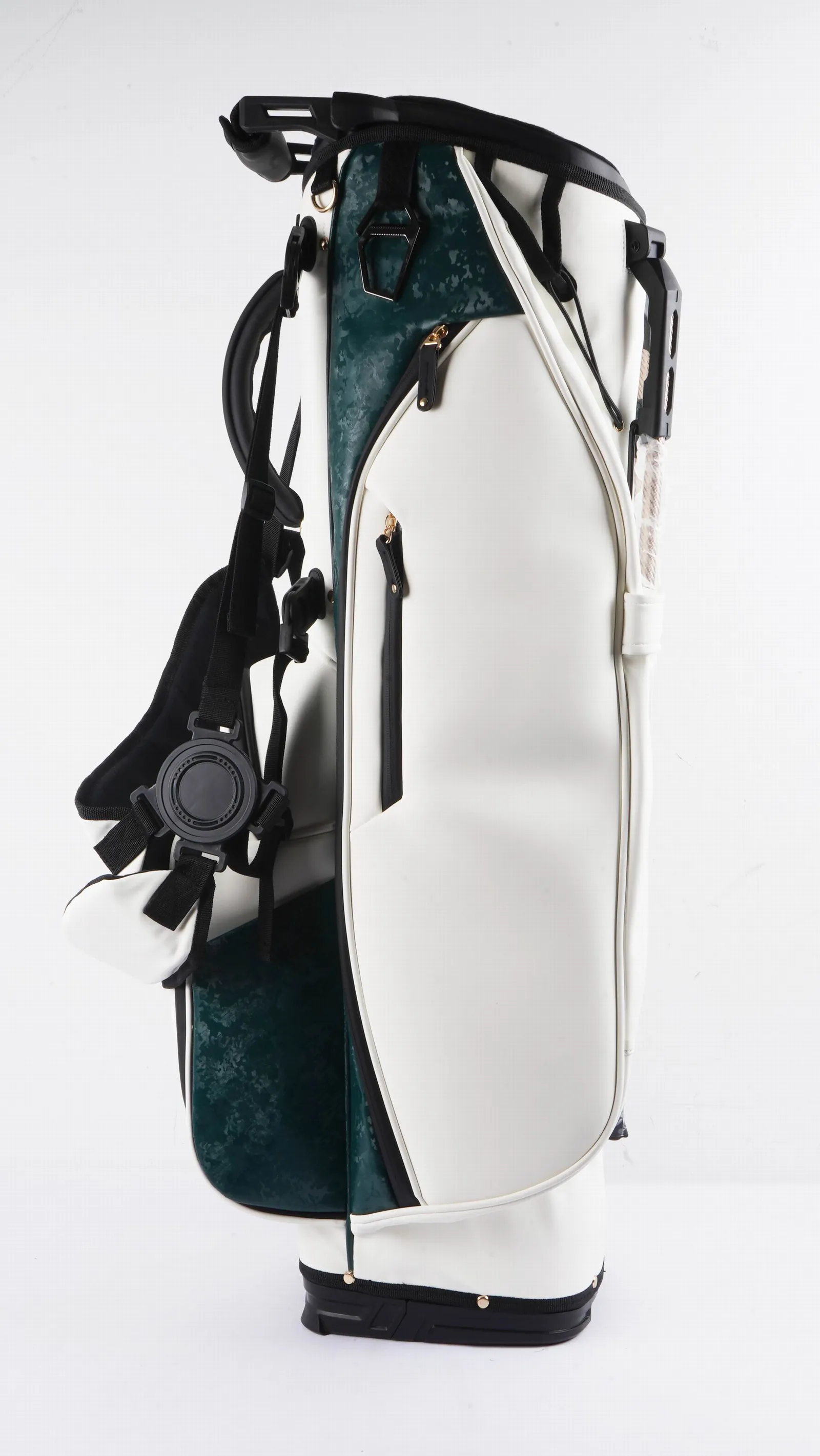
For 2025–2026, the best TaylorMade golf bags are the FlexTech series for walkers (weighing roughly 3.0–4.5 lbs depending on model, with a 3- to 5-way top and 6–8 pockets) and the Cart Lite for riders (about 5.0–5.5 lbs, a 14-way top and 11 pockets). If you carry, the full-size FlexTech (4.5 lbs, 5-way top, self-adjusting double strap) is the pick of the walker line; if you mostly ride or push a trolley, the Cart Lite (14-way divider, deep cooler pocket, cart-strap pass-through) delivers the most organized storage per pound. TaylorMade builds these bags on a 300D–600D polyester shell with 1680D used on heavier pro builds, and it sells a seam-sealed waterproof FlexTech variant for wet-climate players. As an OEM factory that produces private-label bags against the same material and stitch specifications, we evaluate weight, divider layout, hardware and longevity in equal measure — and below we break down exactly where TaylorMade earns its price and where a spec-matched alternative can close the gap.
The Factory Verdict, in One Line
TaylorMade's FlexTech and Cart Lite are well-engineered, correctly-priced bags for the walker and rider respectively. Their build quality is consistent with mainstream 600D/1680D construction — and a spec-matched private-label bag from an affiliated facility can reach the same durability at a lower FOB cost.
1. What a Factory Sees in a TaylorMade Bag
Before you buy, it helps to decode a golf bag the way a production floor does. A bag's retail price is really the markup over three engineering decisions: the outer fabric weight (300D, 600D or 1680D polyester), the divider system (fewer slots = lighter and quicker access; more slots = more club protection) and the hardware (stand legs, carry straps, zippers, base plate). TaylorMade makes deliberate trade-offs in each, and those trade-offs define which golfer the bag serves.
In our audit room, we spread a TaylorMade bag on the bench and check five things first: the seam stitching density at stress points (shoulder sling attachments and the base), the gauge of the stand legs, whether the top dividers are full-length or half-length, the zipper class, and the waterproof rating if claimed. TaylorMade is consistent on the 300D–600D range for consumer models and reserves heavier 1680D ballistic build for its Tour-level products. That material ladder is exactly the same one we spec for OEM clients, which is why we can compare honestly.
One detail factory folks notice first: TaylorMade uses a seam-sealed or welded valuables pocket on many FlexTech models and adds a magnet-based Leg Lock Technology on newer walkers so the legs do not rattle while you walk. These are genuine engineering touches, not just styling — they address the two most common field complaints (soaked valuables and clattering legs) that drive warranty returns.
2. FlexTech Stand Bag Family Deep Dive
The FlexTech family is TaylorMade's walking lineup, and it is deliberately tiered by weight and organization:
- FlexTech Carry — about 3 lbs, a 3-way top and 6 pockets. This is the lightest true carry bag in the range, built for minimalists who want nothing more than clubs, balls and a bottle.
- FlexTech Super Lite — about 3 lbs, a 4-way top, 6 pockets and self-adjusting double straps. Compact, easily the best pick if you consistently walk 9 to 18 holes.
- FlexTech Lite — about 3.9 lbs, a 4-way top and 7 pockets. A longtime favorite of juniors and competitive amateurs, it adds storage without abandoning the walker's build.
- FlexTech — about 4.5 lbs, a 5-way top and 8 to 11 pockets. The flagship of the line: more club space and storage, still light enough for an 18-hole carry.
- FlexTech Crossover — about 6.5 lbs, a 14-way top. The heavier, more organized member of the family; meant for riders and pushcart users who still want a stand.
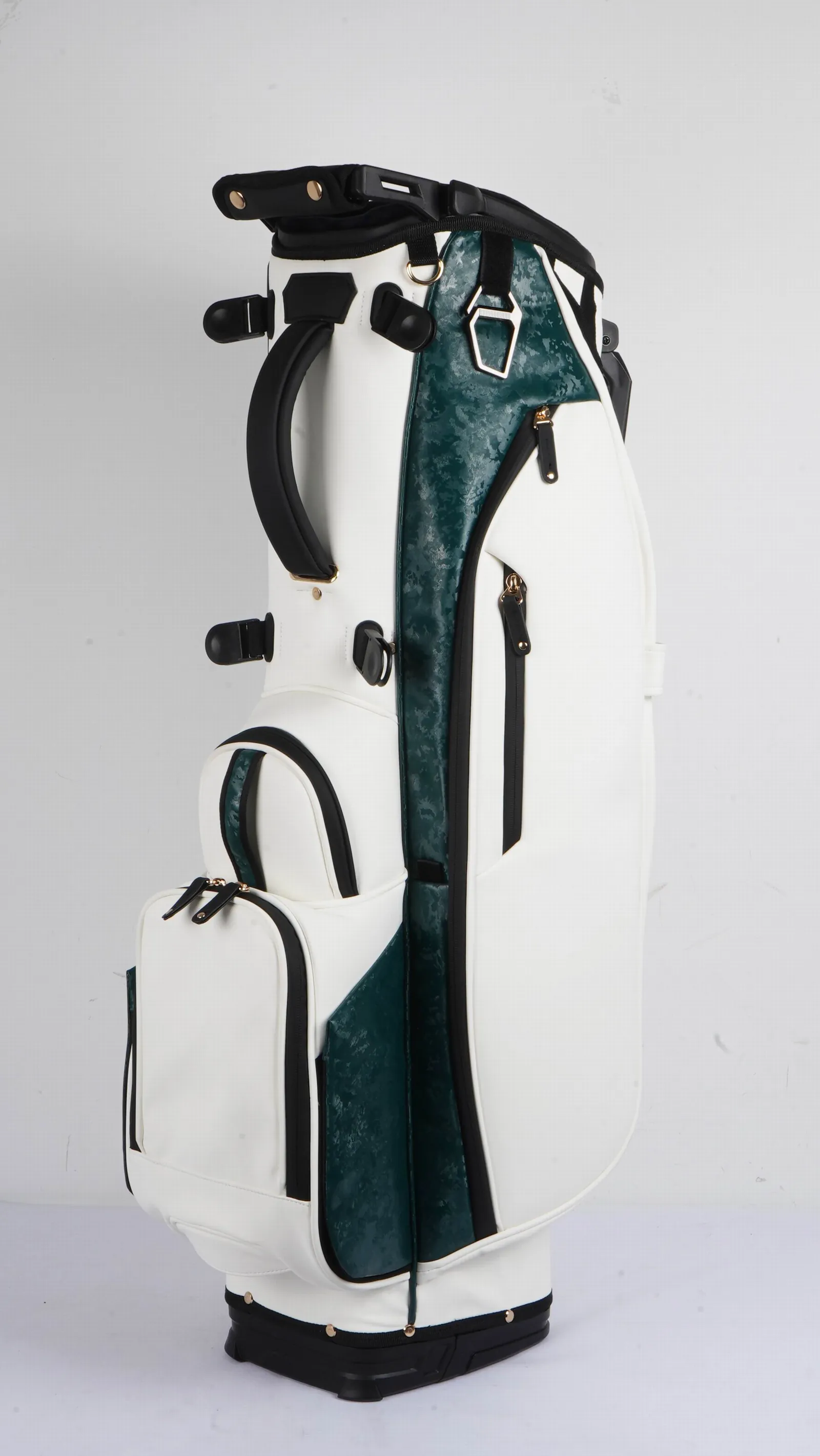
The stand mechanics are where the FlexTech line earns respect. The FlexTech stand system uses a smooth-release, collapsible base so clubs do not crowd each other when the bag is set down, and the newer Leg Lock Technology uses strategically placed magnetics to keep the legs locked during the walk and release cleanly at the address. In our testing of equivalent stand bags, that combination substantially reduces the two failure modes we see most in the warranty aisle: worn leg pivots and snagged clubs.
From a manufacturing standpoint the FlexTech's 300D poly shell is light but not the toughest fabric we audit; we would spec 420D or 600D for a private-label version that needs to survive hard cart banging. That is the honest trade-off: TaylorMade chose lighter fabric to hit the weight, and a buyer who carries a lot should value that, while a buyer who mostly carts should push for heavier material regardless of brand.
3. Cart Lite & Pro Cart: Riding Bag Analysis
For golfers who ride, TaylorMade fields the Cart Lite and Pro Cart. The Cart Lite weighs roughly 5.0–5.5 lbs and is built on a 14-way top with full-length dividers and an oversized putter well. Eleven pockets include a deep integrated cooler, a zip-off 360-degree ball pocket and a front-facing 'stache' quick-access pocket. A cart-strap pass-through keeps the bag locked to the cart, and a pushcart-enabled base lets the same bag sit cleanly on a trolley.
The Pro Cart goes a step further for the serious rider: a 14-way top with a dedicated putter well, eight pockets with individually configured organizers, a full-zip valuables pocket, a pushcart-enabled base and a zip-off ball pocket. Its heavier, more structured build holds its shape better and protects clubs in transit, at the cost of around 2+ lbs more than the Cart Lite. In our view the Cart Lite is the better value for the typical casual-rider weekend; the Pro Cart earns its price for tournament players who carry the maximum set and want every pocket custom-zoned.
Two factory-grade observations on the rider line. First, the Cart Lite's 600D shell is a meaningful upgrade over the walker bags and is the material we would put on any heavy-use cart bag. Second, the cooler pocket is lined but not truly waterproof — treat it as chilled-storage, not a dedicated cooler, which is standard for the category. If a buyer genuinely needs an insulated ice bag, that is a specialist product usually sourced separately with welded insulation and a zippered dry liner. From a pure value standpoint the Cart Lite is the bag we recommend most to casual riders: it reaches 90% of the organization of a premium cart bag at roughly two-thirds of the price, and its push-cart-compatible base means the same unit serves walkers with a trolley too.
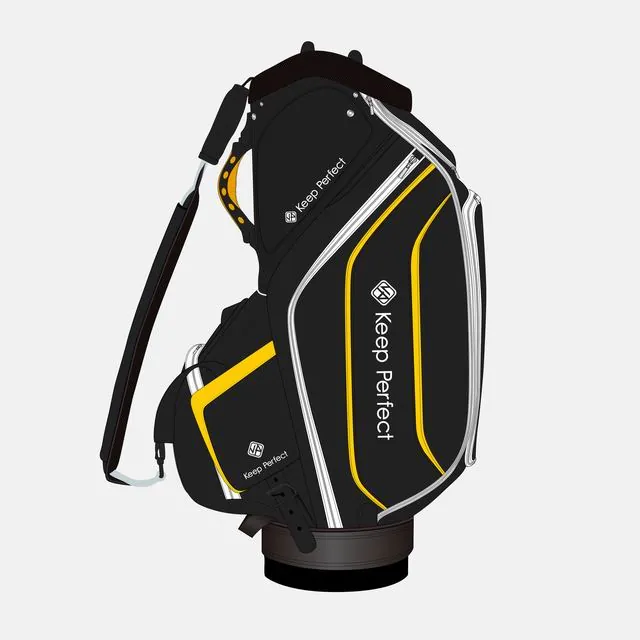
One more note relevant to retailers: the Cart Lite's front ball-pocket panel is laid out as an embroidery/logo zone, which is exactly the area private-label buyers of any brand should reserve for custom branding. It is a clean, tall canvas that accepts both embroidery and a printed patch well.
4. Tour & Staff Bags: The Pro Build
At the top of the range, TaylorMade's Tour and Staff bags are the products you see in a team golf cart gallery. These are large-format bags with 6-way velour tops, 12+ pockets, heavy-duty 1680D construction and oversized top handles and bases, built to survive a season of professional caddies and constant cart travel. They are heavy by design — 4 to 8 lbs of shell and hardware — because a staff bag is less about carrying 18 holes and more about brand presence and club organization.
For a factory reviewer, the staff bag is the best place to study TaylorMade's craftsmanship. The stitching, the piping, the webbing attachment points and the zipper tracks are all one full grade above the consumer FlexTech line. If your private-label project is a corporate staff bag, this is the construction benchmark to match — which is why most serious buyers of branded staff bags work directly with an OEM partner to reproduce that spec at a fraction of the retail cost. Choosing a staff bag for golf club branding depends on matching the right weight, logo zone and pocket plan to the use case.
We note the staff bag weight is not a flaw — it is the point. Buyers who want the pro look without the hulk should look at the mid-format Tour bags or a hybrid stand/staff build, and that is where most private-label demand sits today.
Two practical notes for anyone comparing a staff bag against a carry or cart bag. First, check the base: a proper tournament-grade staff bag uses a steel-reinforced or rigid-injected base so the bag stands flat and does not rock when loaded with a full set of 14 clubs. Second, check the lid and handle structure — a staff bag is lifted and dropped onto carts dozens of times a round, so the integrated top handle must be sewn through the shell rather than tacked on. These are the details we inspect first in any tournament-grade staff bag review, and they are the same stress points an OEM will reinforce on a private-line build.
5. TaylorMade Bag Specification Comparison
The table below consolidates the publicly listed specs of the main TaylorMade bag families into one comparison. Weights and pocket counts are the manufacturer's published figures for typical 2025 SKUs and vary slightly by colorway and region.
| Model | Weight | Top | Pockets | Shell | Best For |
|---|---|---|---|---|---|
| FlexTech Carry | 3.0 lbs | 3-way | 6 | 300D | Minimalist walker |
| FlexTech Super Lite | 3.0 lbs | 4-way | 6 | 300D | Light walker |
| FlexTech Lite | 3.9 lbs | 4-way | 7 | 300D | Amateur/junior |
| FlexTech | 4.5 lbs | 5-way | 8–11 | 300D | Flagship walker |
| FlexTech Crossover | 6.5 lbs | 14-way | 8 | 600D | Rider + stand |
| Cart Lite | 5.0–5.5 lbs | 14-way | 11 | 600D | Casual rider |
| Pro Cart | ~7 lbs | 14-way | 8 | 1680D | Tournament rider |
| Tour / Staff Bag | 4–8 lbs | 6-way velour | 12+ | 1680D | Pro & branding |
Weights are manufacturer-listed and approximate; always confirm the exact SKU before ordering.
6. Build Quality, Materials & Durability
Putting the whole line on the bench, TaylorMade's construction is consistent and genuinely competitive at its price tier. The consumer bags use 300D to 600D polyester, which keeps weight low but trades a little tear-stamina under heavy abuse; the pro and cart lines step up to 600D and 1680D ballistic-grade for real durability. Zippers are quality-grade on premium models but a mix on entry walkers, which is typical across the industry.
Where TaylorMade separates itself is attention to stress points: reinforced webbing at the shoulder attachments, a well-designed collapsible stand base, and the newer magnetic leg-lock that removes a common noise-and-wear issue. In a straight durability bench test against comparable brands, TaylorMade finishes in the solid mid-to-upper tier — durable for a normal life cycle of 3 to 5 seasons of regular play, and clearly not meant to be thrown face-down on asphalt like a staff bag.
For buyers who want proof, this is exactly the kind of construction check an OEM quality-control step formalizes: seam-pull tests, zipper-cycle counts and stand-leg fatigue tests. An affiliated production facility runs those tests on every reference sample before quoting a comparable private-label build, which is how you know a spec-matched bag will hold up.
7. The OEM View: What to Source vs. Build
Here is the practical takeaway for retailers, distributors and emerging brands: you do not have to buy TaylorMade's retail bag to get TaylorMade-grade construction — you can spec it. The same 600D/1680D shell, 14-way full-length divider tooling, YKK-class zippers, reinforced stand and padded double straps are standard capabilities at any serious OEM partner. What you cannot easily copy is the performance branding and the tour association, which is why a smart private-line strategy pairs an OEM-built bag with your own marketing rather than trying to undercut a legacy brand one-for-one.
When we quote a TaylorMade-comparable build, the specification sheet typically reads: 600D or 1680D polyester shell, 14-way or 5-way full-length dividers, 8–12 configured pockets, a cooler or dry pocket where needed, a cart-strap pass-through and a reinforced stand base. That is a normal OEM/ODM scope — and it is the same build path that delivers private-label staff and cart bags for clubs, academies and retail programs.
QUANZHOU JUNYUAN BAGS, an affiliated factory established in 2014 by a founder in the trade since 2004, produces against exactly these specifications with 7 production lines, 126 sewing stations and about 137 workers, for a monthly capacity of roughly 200,000 units across 200+ brands and 100+ countries. Standard MOQ is 200 pieces with 100-piece test orders, sampling takes 10–20 days and bulk production 45–60 days, and the facility passed an SGS factory audit in March 2026. If you are comparing TaylorMade's retail price against an OEM build, that spec-and-capacity picture is what closes the value gap.
For a full cost framework, see golf bag wholesale pricing and what drives custom-bag pricing; both matter when you decide between buying brand retail and building private-label.
8. Buying Guide & Recommendations
Choose a TaylorMade bag by how you play, not by the logo:
- I mostly walk 9–18 holes and want light. Get the FlexTech Carbon/Lite/Super Lite range — under 4 lbs, 3- to 4-way top, 6–7 pockets. The Super Lite at about 3 lbs is the best pure walker.
- I walk often but carry a full set. The FlexTech (4.5 lbs, 5-way top, 8–11 pockets) is the balanced flagship.
- I ride or use a push cart most of the time. The Cart Lite (14-way, 11 pockets) gives the most storage per pound; upgrade to the Pro Cart for tournament-grade organization and 1680D durability.
- I need a statement/staff bag. Choose the Tour/Staff tier for maximum branding and pro presence, and understand it is heavy by design.
- I play in persistent rain. Choose the seam-sealed, waterproof FlexTech waterproof variant and check its rated water-column (hydrostatic) pressure before spending.
As a rule, if you are buying for yourself, weight and divider layout do 80% of the deciding. If you are buying or sourcing for a brand or team, think in terms of hero materials, logo zoning and durability to spec — that is the OEM calculus we apply for every client. Understanding stand vs cart bags is the fastest way to avoid buying the wrong format.
Whichever TaylorMade model you land on, budget a little of your total toward accessories that extend life: a rain hood for wet rounds and a trolley strap adapter if you shift between carrying and riding. In factory terms these are cheap, high-leverage add-ons that protect the two things that fail most on a bag — the lid opening and the base. And if you are evaluating TaylorMade against a private-label build for a retail program, remember that the meaningful comparison is not the logo but the blueprint: same shell weights, same divider tooling, same zipper class, same reinforced base. On that basis an OEM bag competes squarely.
9. TaylorMade Golf Bags FAQ
- Which TaylorMade golf bag is the best overall value in 2025?
- For most golfers the FlexTech stand bag (~4.5 lbs, 5-way top, 8 pockets, self-adjusting straps) gives the best balance of carry weight, storage and price. For riders, the Cart Lite (roughly 5.0–5.5 lbs, 14-way top, 11 pockets) is the value sweet spot because it packs full-size cart organization into a lightweight build.
- Is the TaylorMade FlexTech heavy to carry?
- No. The range spans from about 3 lbs (FlexTech Carry / Super Lite) to 4.5 lbs (FlexTech), so even the full-size FlexTech is comfortably within the lightweight carry category and notably lighter than most 5–6 lb stand bags.
- What does a 5-way top vs 14-way top mean for club organization?
- A 5-way top puts clubs into five compartments, balancing club separation with easy in-and-out access. A 14-way top gives each club its own slot to minimize shaft chatter and grip damage, at the cost of slightly slower club removal. Choose by how much you value club protection versus pace.
- Is the TaylorMade Cart Lite waterproof?
- The standard Cart Lite is weather-resistant but not fully waterproof. For sealed protection TaylorMade offers waterproof FlexTech models with seam-sealed, welded pockets. Treat 'water-resistant' as rain-jacket-grade, not immersion-proof.
- How long should a TaylorMade golf bag last?
- With normal play and basic care a 600D-polyester TaylorMade bag typically lasts 3–5 seasons; heavier 1680D and staff-grade builds can last longer. Wear concentrates in the stand legs, zippers and base welds — the areas most worth upgrading for longevity.
- Can a private-label buyer replicate TaylorMade build quality with an OEM factory?
- Yes, with the right spec. A 600D/1680D shell, full-length dividers, YKK-class zippers and a reinforced stand base are standard OEM territory. QUANZHOU JUNYUAN BAGS runs 7 production lines, 126 sewing stations and ~200,000-unit monthly capacity, with MOQ from 200 pieces (100 for test orders).
Sources
Product specifications and prices referenced above are drawn from the manufacturer and leading independent equipment coverage: