Wholesale Golf Cart Bags: OEM Specifications for B2B Buyers
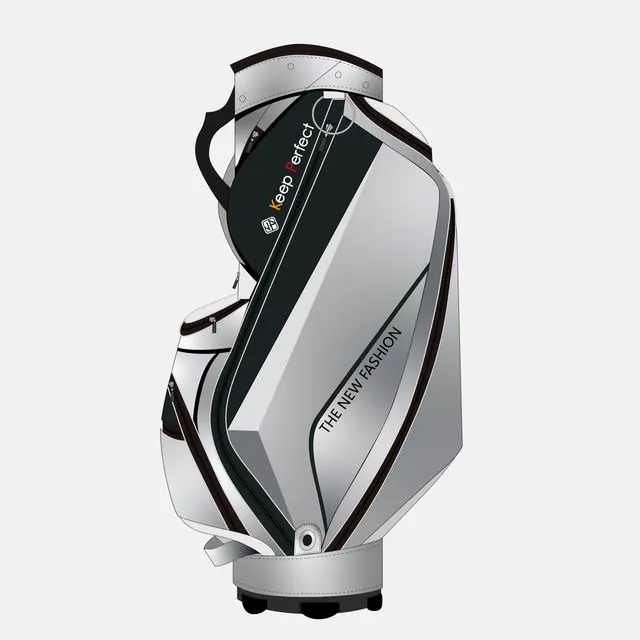
For B2B buyers commissioning golf cart bags under OEM or ODM terms, the specification that matters is a written, engineering-grade document—covering dimensions, materials, construction, hardware, the cart-compatibility criteria and the packaging—agreed and frozen at sample approval, so that production, inspection and every future reorder run against the same fixed reference. An OEM brief is more than a design drawing; it is the contract that turns a cart bag idea into an inspectable, reproducible product. This guide lays out the complete OEM specification for golf cart bags, the compatibility requirements that most affect function, the inspection and compliance checkpoints, and how B2B buyers can set an OEM programme up to repeat cleanly across seasons.
What an OEM Specification Actually Includes
A complete OEM specification for a golf cart bag is a layered document. At its core are the technical dimensions—height, diameter, club capacity—then the materials (fabric grade, hardware, webbing), the construction method (stitching, seam reinforcement, gusset work), the function (pockets, dividers, handle, strap, cart-mounting placement) and finally the branding and packaging. Each layer carries tolerances and test criteria. In an affiliated factory with real production capacity, this specification is converted into a production sheet the cutting and sewing lines work from, and it is locked at the point of sample approval so there is one authoritative version of the product.
The Golf Cart Bag: A Structural Profile
The golf cart bag is engineered to live on a cart, which shapes its whole anatomy. Its silhouette—typically a larger, rounder or semi-round body—provides the storage capacity for a full set plus accessories; a dedicated well or foot area sits against the cart; pockets are positioned for access while the bag is mounted; and the base is weighted and reinforced for stability when the bag stands independently. Because the bag spends most of its life mounted, weight and balance are still relevant, but the handling priority differs from a carry stand bag. The OEM specification must capture these structural choices precisely, because they determine both the look and the function the buyer will sell.
A well-written OEM specification also anticipates the questions the production line will actually ask. A drawing or a photograph communicates the intended look, but it does not answer how the seam is reinforced, how much load the main handle must bear, which zipper deflects the stress of daily cycling, or how the base is locked to the body. The most productive way to write a specification is to stand in the factory’s shoes: for every component that carries load, moves, or will be touched by a customer, state the material, the construction, the test and the acceptance limit. When a specification answers these practical questions, production has no room to improvise, and the buyer receives exactly the product that was priced.
In practice this means the specification and the price are written as one document. Because every line in the spec—a heavier fabric, a full-length divider, a named zipper grade, a branded carton—moves the unit cost, trying to define the quality after the price has been agreed produces exactly the mismatch that leads to disputes. The professional sequence is to finalise the specification and the commercial terms together, then freeze both at sample approval, so that the number the buyer pays and the product the buyer approved are the same single commitment. This is the discipline that keeps OEM cart bag programmes from drifting between quotation and delivery.
Cart Compatibility: the Requirement That Defines the Product
| Compatibility factor | What must fit or clear | Why it matters |
|---|---|---|
| Base well / foot | Cart well and securing clip | Stability and zero wobble |
| Handle position | Cart frame clearance | Easy lifting and mounting |
| Pocket access | Reachable while mounted | Usability during play |
| Club length | Full set with covers | Capacity to spec |
| Strap / handles | Cart and manual carry | Dual-use handling |
Cart compatibility is the quality attribute that most distinguishes a good cart bag from a poor one, because it is entirely about fit and placement. A bag whose pockets are unreachable when mounted, whose handle collides with the cart frame, or whose base sits loosely in the well fails at the one job the product exists to do. The specification should therefore state the design assumptions—the typical cart geometry and the securing arrangement—so the factory builds to a compatibility reality rather than a guess, and the sample should be validated against the target cart type before bulk approval.
The choice of destination market rightly enters the OEM design conversation. A cart bag exported to the US is classified under HTSUS heading 4202, whose correct subheading and duty rate should be confirmed against the authoritative schedule published by the USITC (hts.usitc.gov), with the importer of record holding the duty liability. A bag shipped to the EU is classified under CN 4202 under the Union Customs Code, administered by the European Commission’s Taxation and Customs Union, and it should carry the product information required under the EU’s GPSR, with any textile materials meeting the restriction limits set under REACH regulation, administered by ECHA. Including these compliance requirements in the OEM brief—so that the necessary documentation travels with the goods—keeps the customs step from adding unplanned days at the destination.
Compliance is not a separate appendix to an otherwise artistic brief; it is part of the specification because it affects materials and documentation. A coating, a dye or a component that fails a market’s chemical or safety limits would be a defect in that market, and no amount of well-sewn construction would make the product importable. The disciplined OEM buyer confirms the destination rules with the factory at design stage, so that the bag is legal where it will be sold from the first sample rather than discovered as a problem after a container has been produced. This forward planning is cheap, and the failure to do it is expensive.


Materials: Choosing the Right Grade for a Cart Bag
Cart bags carry a full set and absorb more handling on carts and in carts, so material grade must match the duty. Durable nylons—typically 600D to 1680D—are common, with 840D and 1680D offering higher abrasion resistance for the high-wear panels of the body and base. Heavy reinforced webbing carries the handles and strap points, and the base often uses a stiffer, moulded or heavily reinforced construction for stability. The OEM decision on material grade is a genuine cost-and-quality trade-off: specifying a higher-denier, coated or recycled fabric raises the unit price but delivers the durability a premium-positioned cart bag needs. The professional approach is to specify material grade explicitly per panel, not as a single vague description.
Construction and Stitching Standards
The construction method determines how long a cart bag survives. Key elements are the stitch density (stitches per inch), the seam reinforcement at stress points—the handle attachment, the strap points, the base and the divider seams—and the reinforcement of the edges and openings. A cart bag loaded with a full set generates real forces at these points, especially the handle and base, where premature failure shows as torn webbing or a damaged bottom. The specification should state the minimum stitch density and the reinforcement method, and the physical test should verify seam strength under load. This is where a thin specification saves pennies at quotation and forfeits the customer’s trust on the course.
Hardware: Zippers, Buckles and the Details
Hardware is where cheap cart bags visibly fail and where quality bags quietly justify their price. The specification should name the zipper grade, the buckle and clip type, the D-rings or accessory loops and the hardware finish. Zippers on club-storage and garment pockets take daily cycle loads; cheap zippers jam or pull apart, which is among the most common customer complaints in the category. The OEM brief should include a zipper-cycle test as a quality criterion and fix the hardware brand or grade in the spec so the production line cannot substitute lower-cost parts. Hardware quality is also a safety consideration, as a failing buckle or clip on a moving cart poses a real risk.
Dividers and Club Protection
The divider system is a function and a safety feature in one. Full-length dividers protect graphite shafts from colliding and chattering during transit and play, which is particularly important for a cart bag that holds a full set. The OEM specification should state the number of divider slots, whether they are full or partial length, and whether they are lined to protect finishes. Dividing systems add material and assembly time—the classic trade against the number of slots and the liner—so the decision belongs in the spec with the price, not left to float into a surprise later.
Branding Methods for an OEM Programme
Branding is the most visible part of an OEM order and one of the most controlled by the specification. Options include embroidery, woven or printed patches, transfer prints, full-colour sublimation on select panels and labels on the bag or the packaging. Each method carries cost, placement and durability characteristics, and each must be fixed—including colour matching to the brand’s palette—before production. Because a logo reproduced badly across thousands of units is a brand-damaging defect, the spec should set the reproduction standard and the acceptance criteria for the logo itself. Locking the branding method at sample approval protects both the look and the inspection threshold.
Packaging and Protection for Cart Bags
Cart bags are large, structured and relatively heavy, so packaging matters more than for lighter categories. The specification should cover per-unit protection—typically a polybag—and a carton configuration that protects the contents in transit without damage to the structure or the dividers. The number of units per carton, the carton dimensions and weight, and the marking are all part of an OEM spec, because they affect both freight cost and the arrival condition. Retail-ready or branded packaging is an upgrade option with its own material and printing cost. A cart bag that arrives crushed is a lost sale regardless of how well it was sewn.
Inspection: Verifying the OEM Spec Was Met
The specification only protects the buyer if it is inspected against. In our workflow, a bulk OEM run moves through the same disciplined gates as every production—incoming material on receipt, work-in-progress checks on the lines, a mid-production sample and a final AQL-based inspection of the packed cartons before loading—with each gate producing a written report. The inspection checks units against the specification sheet, the physical test criteria and the approved sample. For a cart bag, cart-compatibility, divider placement and hardware function are specific checkpoints. This multi-gate structure catches defects where they are cheap to correct, which is the entire point of enforcing quality at scale.
The physical test regime for a cart bag should mirror the way the product is actually used. Because a cart bag is repeatedly lifted by its handle, loaded fully and mounted and dismounted from carts, the handle pull strength, the strap-point seam strength and the base integrity are the tests that predict real-world survival better than any surface inspection. A specification that includes these load tests, and a factory that can run them and report the numbers, converts a cart bag from a cosmetic product into an engineered one. For a B2B buyer, asking for the physical test results on the approved sample establishes the baseline that the full production run is later measured against.
Equally valuable is verifying consistency across the production run—that units pulled from different lines and different days match the approved sample within tolerance. This is where the multi-gate inspection earns its keep: in-process checks catch drift early, a mid-production sample verifies the line is still on spec, and the final AQL check on packed cartons gives the statistical assurance for the whole batch. The buyer who plans these gates into the production schedule—rather than expecting quality to be an afterthought at the end of a rushed run—gets the assurance the specification was designed to provide.
Capacity and Production Reality Behind OEM
An OEM programme is only as reliable as the factory capacity standing behind it. Our affiliated factory in Quanzhou—operating since 2014 with a principal in the trade since 2004—runs 7 production lines with 126 sewing machines and 137 employees, at a monthly capacity of roughly 200,000 golf bags, verified by a third-party SGS audit in March 2026. For a B2B buyer, this base means an OEM order can be scheduled, inspected and repeated on a dependable basis. A factory that can show its lines, machines, headcount and audit history makes its capacity claims verifiable rather than rhetorical.
MOQ, Sampling and Lead Time for OEM Cart Bags
The commercial frame around an OEM cart bag programme is consistent across the catalogue. The standard MOQ is 200 pieces per design, with a 100-piece test order option for first-time validation; sampling runs 10–20 days; and bulk production runs 45–60 days after sample approval, before freight and customs clearance. The test order is a deliberate instrument—it lets a buyer confirm the cart bag matches the specification on real production before committing to volume. This frame lets a B2B buyer model the full programme—cost, schedule and risk—before the first large order is placed.
Documentation for an OEM Programme
An OEM relationship should be documented like a business asset. The permanent record includes the approved specification, the approved sample reference, the material test reports, the inspection reports and the agreed commercial terms. This file serves three purposes—it proves each order met the standard, it resolves any later dispute instantly, and it becomes the baseline every reorder references. Because OEM cart bags are often reordered season after season under the same or evolving specs, the versioned document is what keeps a brand’s product consistent, its records auditable and its negotiations grounded in evidence rather than memory.
For a buyer managing a full OEM catalogue across stand bags and cart bags, there is real efficiency in treating the specifications as a coordinated family rather than a set of isolated documents. Common materials, shared hardware grades and a uniform quality standard across the range let a single factory buy material in larger lots and run the lines more predictably, which translates into better pricing and more reliable scheduling for the buyer. Because many brands source both categories from the same partner, the consolidated programme is simpler to inspect, simpler to document and simpler to replenish across seasons. When cart bag and stand bag specifications share a common framework—same fabric family, same zipper brand, same inspection regime—the whole portfolio becomes cheaper to run and easier to trust.
Finally, treat every completed OEM programme as the starting point for the next. The approved specification, the test reports and the inspection record of a successful run become the reference for reorders, refinements and any scale-up in volume. Because the versioned document makes every change visible and costed, the buyer can evolve the cart bag—adding a pocket, changing a fabric, updating the branding—without ever losing the baseline or reopening settled arguments. Over several seasons this disciplined accumulation builds a defined, documented, best-practice cart bag that the factory produces more reliably each time, and that the brand can defend on quality, compliance and cost. That is the real return on writing a proper OEM specification in the first place.
The commercial importance of a well-specified OEM cart bag is easiest to see in the numbers it protects. A clear spec cuts sampling and rework rounds, reduces inspection rejections and avoids the dispute costs that ambiguous products attract—all of which compound into better realised margin on the order. It also protects the brand’s reputation, because each unit that ships matches the approved product, and each unit that matches the approved product becomes another consistent experience for the customer. In a category where the buyer may not have the product in hand before it clears, the specification and the inspection record are the only evidence the quality is true. Supplying that evidence well is what a serious OEM partner does, and verifying it is what a serious B2B buyer does in return.
Frequently Asked Questions
- What should an OEM specification for a golf cart bag include?
- It should cover technical dimensions, material grade per panel, construction and stitching, hardware type, divider system, branding method, packaging and cart-compatibility, all with tolerances and test criteria.
- Why is cart compatibility critical for a cart bag?
- Because the product exists to be mounted on a cart; a bag whose pockets, handle or base do not fit the cart fails its core function regardless of build quality.
- What is the minimum order for an OEM golf cart bag?
- The standard MOQ is 200 pieces per design, with a 100-piece test order for first-time validation before committing to volume.
- How long does an OEM cart bag order take?
- Sampling is 10-20 days and bulk production is 45-60 days after sample approval, before freight and customs clearance.
- What quality checks protect an OEM order?
- Multi-gate inspection from incoming material through in-process checks to a final AQL-based check, with written reports at each gate and physical tests for strength and hardware.
- Can I adjust the specification between reorders?
- Yes, but every change should be a formal, versioned revision to the specification with a declared impact on price and schedule, so the new baseline is never ambiguous.
- How do I verify a factory can deliver OEM at volume?
- Ask for verifiable capacity—lines, machines, headcount, monthly output—and independent evidence such as a third-party audit and reference orders.
Sources and Further Reading
For the regulatory context that frames an OEM import programme, consult the USITC Harmonized Tariff Schedule for HTSUS 4202 (US import classification), the U.S. Customs and Border Protection import guidance, and the European Commission’s Taxation and Customs Union for CN 4202. For textile chemical and product-safety limits in the EU, review the European Chemicals Agency REACH guidance and the EU Product Safety requirements.
For the sourcing path around OEM, see our guides on OEM & ODM services, wholesale golf bags, the golf bag wholesale pricing guide, plus factory-direct manufacturing and custom solutions.