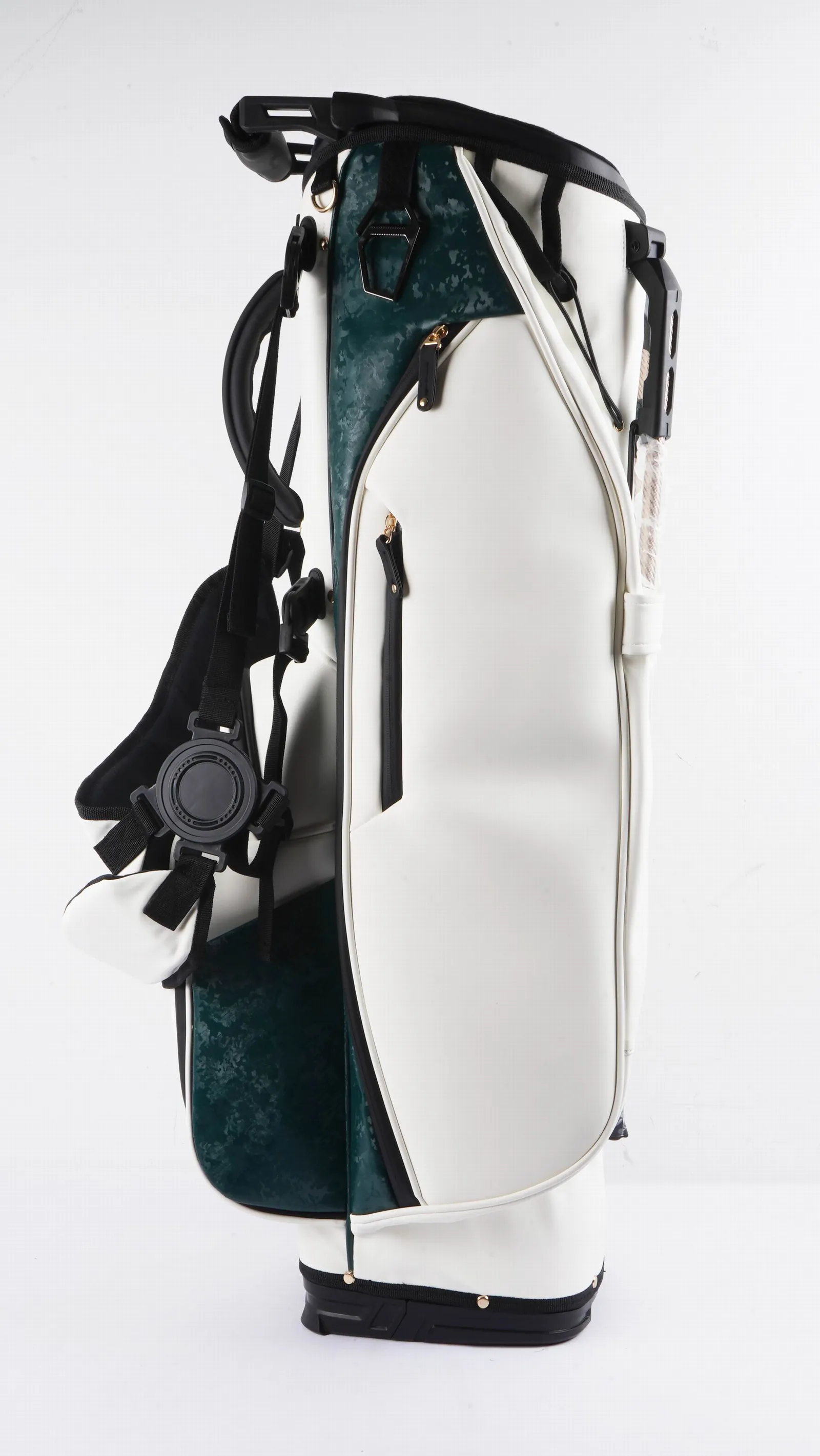
Professional golfers prefer custom cart bags because tournament logistics — riding a cart, needing fast club access, and engineering the bag to a specific bag-well and trolley — reward a bag built around a wide flat base, full-length dividers and purpose-driven organisation that a stock retail bag cannot deliver at the tour’s pace.
Riders, Walkers and the Two Bases of the Pro Choice
The cart bag is built around one decisive specification, so it is worth leading with it: its base is wide, flat and designed to sit on a cart platform rather than to be carried. That flat contact area is what makes it the natural match for riding golf, and it is the reason professionals who ride in carts or who want maximum club protection from a platform-seated bag choose it. By comparison, a stand bag trades that flat base for fold-out legs, which is better for walking but leaves a less stable, less predictable footprint on a cart cradle. Knowing which base you need settles the biggest part of the decision before any styling.
That said, most professionals are not one-format players. A touring professional on a hilly course may walk some rounds, ride others, guess a friend's cart at a club and take a stand bag along to a short course. The modern "hybrid" cart bag anticipates that mixed routine, with a base and profile that sit confidently on a cart but stay compatible with casual carrying. Our cart-ready range on the products page is built around exactly this flexibility, and separating your own mix of riding and walking tells you whether you need the hybrid or the pure cart build.
The Pocket Layout Mirrors an In-Round Routine
A professional's bag is not a container; it is a workbench arranged to mirror the flow of a round, and the cart bag's strength is room to lay out that routine precisely. The pattern is familiar to anyone who plays seriously: a large lined pocket for the all-weather gear, a clearly marked valuables pocket for phone and wallet, a cooler or insulated pocket for drinks, a range of slots for tees, balls, tools and the putter, and a dedicated rangefinder or glove pocket close to hand. When every item has one consistent home, the golfer reaches without looking, and the round speeds up.
That organisation is measurable, and it is a major reason professionals prefer the cart format rather than a styling habit. Because the bag sits on a platform and is rarely carried, weight can be spent on structure, full-length dividers and pocket zoning instead of on keeping the bag light. So the professional gets both the protection of full-length shafts and a genuinely usable layout — the two things that matter most in real rounds and are exactly what our cart-bag size and dimensions guide walks a buyer through.
Full-Length Dividers Are the Protection a Set Deserves
Clubs flare, some drivers, heavy irons and putters slide and grind against one another when they are loose, and over time the shifting batters the shafts and wears the grips. A full-length 14-way divider top is the professional's answer: where a cheaper bag lets clubs touch, full-length dividers keep each club separate from the top collar almost down to the bottom, so shafts stay quiet, protected and individually retrievable. Given the cost of a modern set, protecting it with dividers is not a luxury, it is the cheapest insurance the bag can contain, which is why every serious cart bag spec leads with this feature.
The 14-way layout also slots into the round logic: the driver out the back, fairways there, the short clubs and wedges forward, and the putter in its own channel. Consistency is the point — the golfer never reshuffles, never hunts, and lowers the odds of a reachy pull that drags a neighbouring club out with it. This is the quiet, repeatable value a professional relies on every round, and a quality test a factory runs as standard.
Evaluating Construction Like a Buyer, Not a Fan
Beyond the base and the dividers, the professional judges a cart bag on construction details that predict its life under hard use. Give the shell a thick, abrasion-resistant fabric that shrugs off cart edges, bunker sand and baggage handlers. Press the base and confirm it does not flex or rock under a full set. Pull every zipper under a little tension and feel for smoothness. Check the handle and strap anchors for the reinforced stitching that holds the bag together at its stress points. Run those checks and you have read the real build quality of the bag, independent of any badge. The property-level checks that matter are the same set our affiliated factory and our quality standards guide hold every cart bag to, and they are what separates a bag that lasts four seasons from one that looks tired after two.
Customisation: When Pros Travel With Their Own Mark
For individual players the appeal of a custom cart bag goes beyond fit to identity. A player who carries their name, their initials or a personal mark on the main panel gets a bag that is unmistakably theirs at the club, on the cart and in photographs — practical, since a personalised bag is far less likely to be confused or taken, and presentational, since it reads as a deliberate choice about the game. For teams and brands the same custom panel carries a crest, a colourway and a sponsor mark, which is the reason tour staff bags function as rolling billboards.
The customisation options for cart bags — set out on the logo and embroidery overview for all types — let a player fix the brand zone once and repeat it exactly across a fleet or a single bag. Because the cart bag is one of the largest, flattest surfaces in golf, it takes a big, crisp logo well, which is precisely why it is the format most used to make a mark.
Why Professional Golfers Prefer Custom Cart Bags: Performance, Fit and the Borderline Advantage
A professional golfer does not choose a custom cart bag for a logo — they choose it because the bag is engineered around exactly how they play, rigged and travel. On tour and in high-level amateur golf, players ride or mount their bag more often than they walk, and a cart bag's flat, reinforced base is built for that mounted life. When that already-specialist bag is also custom — sized, pocketed, padded and organised to a specific player's routine — it stops being equipment and becomes part of the game-day system. That combination of form-fit engineering and personal routine is the real reason pros prefer them.
The Cart Bag's Structural Advantage on a Mounted Life
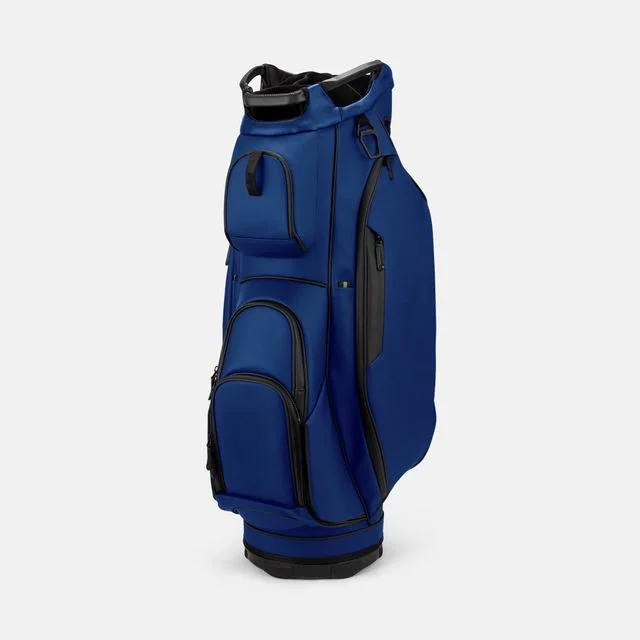
A cart bag is the correct platform for anyone who rides, because its design spends everything on organised capacity and a stable base rather than on carrying. Professionals and serious players, who may have multiple staff members, caddies or a tour van, ride more than they carry, so the flat, wide, reinforced base that seats level on a trolley is exactly the foundation they need. The moment a bag stops being balanced on a shoulder and starts sitting on a cart, the cart bag's trade-off — heavier but more capable — becomes a pure advantage.
That structural choice matters to a professional because tournament rounds are long and the cart or trolley environment is unforgiving. A bag that rocks, tilts or lets clubs rattle is a distraction on every hole; a bag whose base is wide and solid and whose 14-way full-length dividers hold every shaft separate keeps the club-selection routine fast and undisturbed. For a player who reaches for a club dozens of times a round, that reliability is not a nicety — it is part of the performance.
Custom Fit: Pocket Zoning Around a Player's Routine
The custom part is what upgrades a good cart bag into a personal system. A pro has a fixed pre-shot and in-round routine, and a custom bag zanes its pockets to mirror it: a specific pocket for the rangefinder, a lined valuables pocket, an insulated cooler in the right position, oversized apparel space. When every tool sits where the player naturally reaches, the routine becomes faster and more automatic, freeing attention for the shot instead of the hunt. That is a real, physical gain across a tournament's four rounds.
Custom also means exact club organisation and protection. A pro values a reliable 14-way full-length divider so each club has its own channel, and the pocket layout reinforces a personal order system that is hard to describe but impossible to overstate on a tight leaderboard. The bag becomes second nature — for the player who uses it, and for the caddie or staff member who must keep it organised to the professional's standard under pressure.
Branding, Sponsorship and the Professional Image
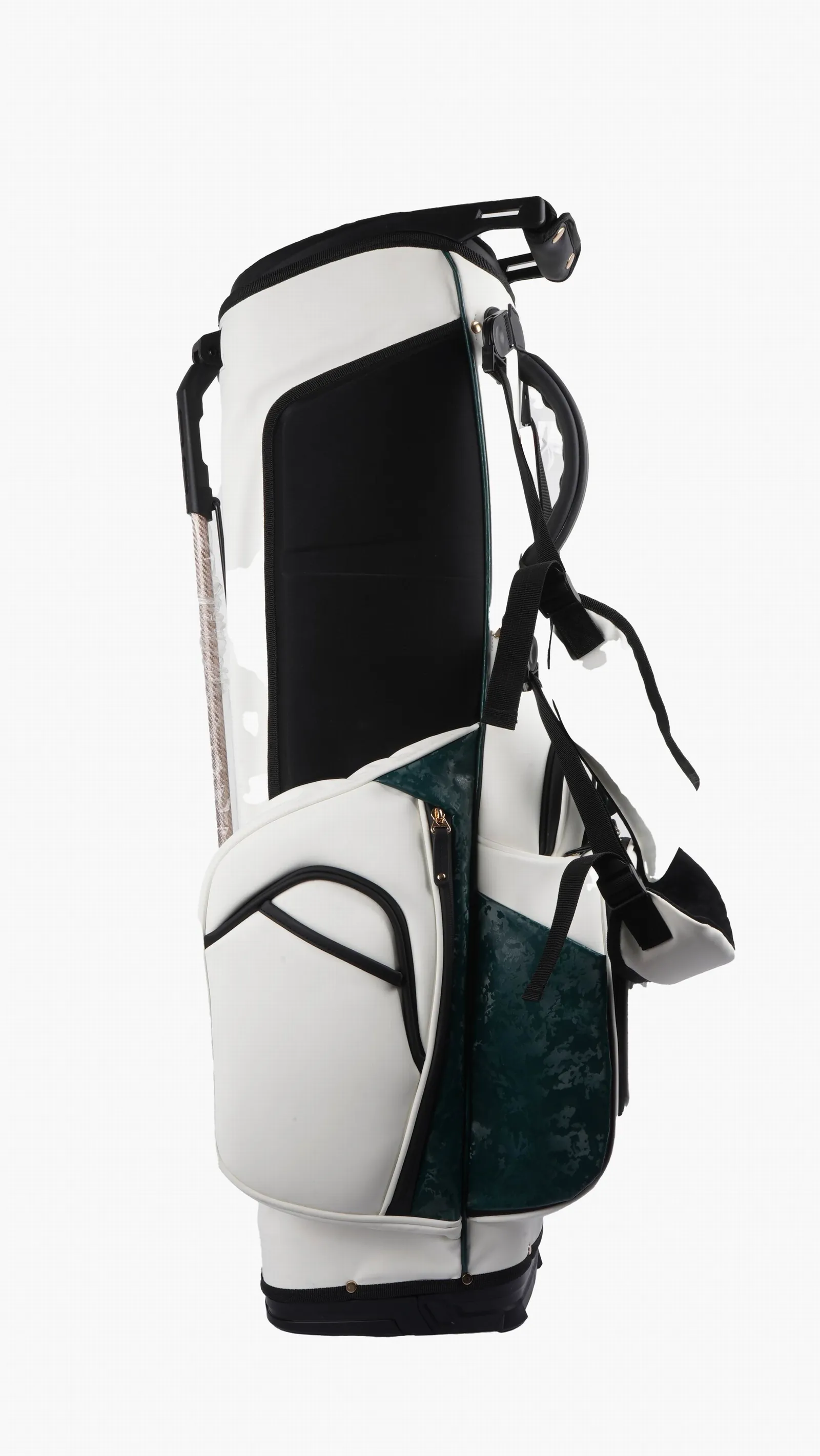
Beyond function, a custom cart bag is the primary canvas for a professional's branding. On a mounted bag, the large front and side panels carry a player's name, a sponsor's logo or a team mark, and that branding is seen in every broadcast frame and official photograph. For a sponsored professional, the bag is contracted advertising space that also happens to hold clubs; for a serious amateur or coach, it is a statement of identity and professionalism. Titans get both the performance and the image from one custom-built object.
The branding value is one reason professionals are careful about how the bag is made: an unprofessional finish on logo, stitching or panel alignment undermines the very image the branding is meant to project. A factory that executes badgework cleanly — crisp embroidery or print, exact colour matching, tidy panels — is protecting the professional's reputation as much as the bag's durability. That is a spec a serious player and their sponsor both care about.
What a Pro's Custom Cart Bag Spec Looks Like
| Spec element | Typical pro requirement | Why it matters |
|---|---|---|
| Divider top | 14-way full-length | Every club separate, protects shafts |
| Base | Wide, flat, reinforced | Stable level seat on any trolley |
| Cooler pocket | Insulated, positioned low | Cold drinks reachable without top-heaviness |
| Valuables pocket | Lined, secure | Phone, wallet and keys protected |
| Brand panel | Large, crisp | Name and sponsor visible on broadcast |
| Pocket zoning | Mirrors in-round routine | Fast reach, fewer distractions |
The specification is deliberately firm on the structural items (dividers, base) and flexible on the cosmetic ones (colours, panels). That split is the secret of a good custom brief: the parts that determine durability and performance are non-negotiable, while the parts that express identity are free. A professional or their agent should write this distinction into any brief before approaching a factory, so the badge and colourway do not come at the expense of the build.
Durability and the Longer Season a Pro Puts on a Bag
Professionals season a bag far harder than a weekend golfer: more rounds, more cart miles, more handling on and off tour buses. For that schedule, durability is not optional. The reinforced base that takes endless cart mounts, the robust zippers that glide under constant use, the bar-tacked stress points at the handle and strap anchors — these are the load-bearing choices that decide whether a pro's bag is still trustworthy in its third season or failing in its first. A pro who skips on build quality pays for it with distraction and replacement cost at the worst time.
This is why serious players specify inspected, verified construction and work with factories that document quality. A custom cart bag from a source with consistent QC — where seams, zippers and base reinforcement are checked before shipment — protects both the player's equipment and their routine. The quality standards guide enumerates the factory checks that prove a bag is built for this level of use, and the guide to custom logo and embroidery on cart bags covers the branding execution alongside it.
Custom Cart Bags as a Team or Brand Programme
For teams, academies and manufacturers' rep programmes, a custom cart bag is a unified visual and functional identity: the flat base suits the mounted tournament life, the large panels carry the team or sponsor branding, and the consistent spec means every member gets the same performance. Scaling that is a matter of a firm brief and a reliable factory. The standard MOQ of 200 pieces (with 100-piece test orders), sampling in 10-20 days and bulk production in 45-60 days lets a programme source a consistent, branded fleet ahead of a season.
A well-managed programme tiers the brief: a flagship spec for first-team or sponsored players, a value tier for wider squads, all sharing the same brand. That keeps the premium impression where it matters while controlling total spend. Whether you are a professional building one bag, an agent spec'ing a sponsorship, or a team sourcing a fleet, the OEM/ODM services overview walks through framing the brief so the structural spec and the branding spec land with the factory in one coherent order.
Conclusion
Professional golfers prefer custom cart bags because a mounted, cart-life bag engineered to a specific player's routine outperforms a general bag at the margin that scores — organisation, protection and routine speed. The flat reinforced base and full-length dividers deliver the structural all-day reliability a long season demands; the custom pockets, branding and fit deliver the personal system and image a professional relies on. Split the spec so the build is non-negotiable and the branding is free, source from a factory that proves its QC, and a custom cart bag quietly supports a game plan every round. For a pro, that is exactly why the bag is never just a bag.
How Pro Demands Differ From Retail Specs
The starting gap between a pro custom cart bag and a retail cart bag is not a different species of engineering; it is a stricter version of the same specification, applied with more discipline. Where a retail bag trades weight against structure, a pro spec spends weight on the two things that survive a mounted season: a base that does not flex and dividers that cleanly split 14 shafts all the way down. Where a retail bag balances pocket count against price, a pro spec prioritises the pockets the routine actually uses and layers the rest into the middle of the build. Understanding that the difference is allocation rather than magic is what lets a serious amateur apply the same logic to a Mid-market bag and capture a large share of the pro advantage.
Retail specifications are also written to a price point, which means the firmware-grade details—bar-tacked stress points, waterproof zippers, a rigid molded base—are among the first things cut. A pro brief restores them explicitly because they are cheap to add at the factory and expensive to retrofit in use. When you compare our quality standards guide against a mid-priced cart bag in a shop, the specification that confidently names its seam, zipper and base reinforcement is almost always the one built for repeated cart duty.
Sizing a Custom Cart Bag to the Player
A custom cart bag earns its name only when it is sized and zoned to the user, and two dimensions matter most at the brief stage. The first is overall height, because a taller player reaching for long clubs wants a bag that keeps their longest wood standing nearly vertically without crowding the cart tray; the second is body diameter as it relates to the trolley or cart the player actually rides. Our detailed cart bag size and dimensions guide sets out the exact ranges, and matching them to the player makes the bag feel purpose-built the moment it is mounted.
Pocket zoning completes the personal fit. A right-handed player who reaches for a rangefinder between every drive wants it in the pocket facing the same direction every time; a caddie who keeps the bag organized under pressure wants valuables where they are quickest to open without putting the bag down. Because the cart bag surface is large and flat, these zones can be laid out to a player's exact routine rather than to a generic template. Build the brief around the real game-day sequence and the bag stops being equipment and starts being a system.
Balance, Weight and the Cart Ride
Because a professional bags a mounted life, the way the bag sits on the cart is a daily, every-shot factor. A custom cart bag built around balance—a low-slung cooler pocket, weight set back near the base, and heavier accessories zoned below the divider line—stays planted when a cart brakes, turns or bumps over rough ground. The physics of where the load sits matter more than the raw weight of the bag, and our cart bag weight and balance guide walks through keeping the center of gravity low for a stable ride. A bag that no longer lists when a rangefinder is added to a side pocket is a bag that stops stealing attention from the shot.
Equally, weight itself is a considered trade. A pro does not chase featherweight on a bag that rarely leaves the cart; they spend the grams where they buy structure and dividers. When a bag does travel—tagged on a tour van, lifted into a car trunk, carried briefly to a practice green—the reinforced handle and strap anchors become more than details. Balance the distribution by loading the bag fully during evaluation, lift it by the handle, mount it on a trolley, and confirm it sits level. That loaded test, more than any single number, reveals whether the custom build has been engineered for the ride.
Material and Construction Choices That Hold Up
Material choice is the quiet half of a pro build. A dense, abrasion-resistant shell shrugs off the constant rub of cart edges and the wear of being stacked in a tour van, while a bonded, water-resistant treatment keeps clubs and grips dry in early-morning dew and passing showers without adding the weight of a full waterproof liner. Our guidance on golf bag materials and the related waterproofing guides help you choose a shell that survives the season rather than one that looks good on the first tee. Pair the shell with zippers and hardware rated for repeated use, because these are the components that fail first when a bag lives hard.
Construction quality is where a pro brief and a factory actually meet. Bar-tacked stress points at the handle and strap anchors, reinforced seams along the pocket openings, and a stitched-in base plate all convert a good design into a bag that outlasts a season of tournament travel. For a brand sourcing a fleet, these are the build elements verified in the quality standard checklist before bulk, and they are the reason a professional invests in a custom build rather than replacing a cheaper bag every year.
Scaling the Pro Concept into a Programme
The smallest case is a single professional bag; the larger case is an entire programme—a tour team, a sponsored squad or an academy that wants every member carrying the same capable, branded build. Scaling works when the brief is fixed once and the factory holds it through every unit, which is exactly where a reliable OEM/ODM partner shows its value. Our OEM/ODM services overview and the process guide walk through locking the specification, agreeing inspection gates and reproducing it order after order. With the standard MOQ of 200 pieces (100-piece test orders), sampling in 10-20 days and bulk in 45-60 days, a programme can be sourced ahead of a season with the same discipline as a single pro bag.
For those building on the pro idea rather than reproducing it wholesale, the same levers apply at a smaller scale: fix the structural spec, personalise the branding, and source from a factory that documents its QC. This is the reasoning behind our brand comparison guides and the reason most professionals end up with a bespoke spec rather than a shelf product. The custom requirement, worked through a disciplined brief, is what turns a preference into a durable, professional-grade cart bag.
Sources
Frequently Asked Questions
- Why does a cart bag suit a professional more than a stand bag?
- Pros ride more than they walk, and a cart bag's wide, flat, reinforced base is built to sit level on a trolley, spending weight on organised capacity and stability rather than portability.
- What divider system do pros prefer?
- A full-length 14-way divider, giving every club its own slot to the bottom to protect shafts and keep the club-selection routine fast and consistent.
- Why do pros customise the pockets of a cart bag?
- So the layout mirrors their in-round routine — rangefinder, valuables, cooler and apparel each in a predictable, reachable position — making the game-day system faster and more automatic.
- Is a custom cart bag worth it for a serious amateur?
- Yes, if the structural spec (dividers, base, zippers) is prioritised and the branding is personal, it delivers the same organisation and raised professional image at a fraction of a tour-level budget.
- How long does a custom cart bag programme take to source?
- Standard MOQ is 200 pieces with 100-piece test orders, sampling in 10-20 days and bulk production in 45-60 days, for a season-ahead branded fleet.