Best Compact Golf Sunday Bags for Short Rounds
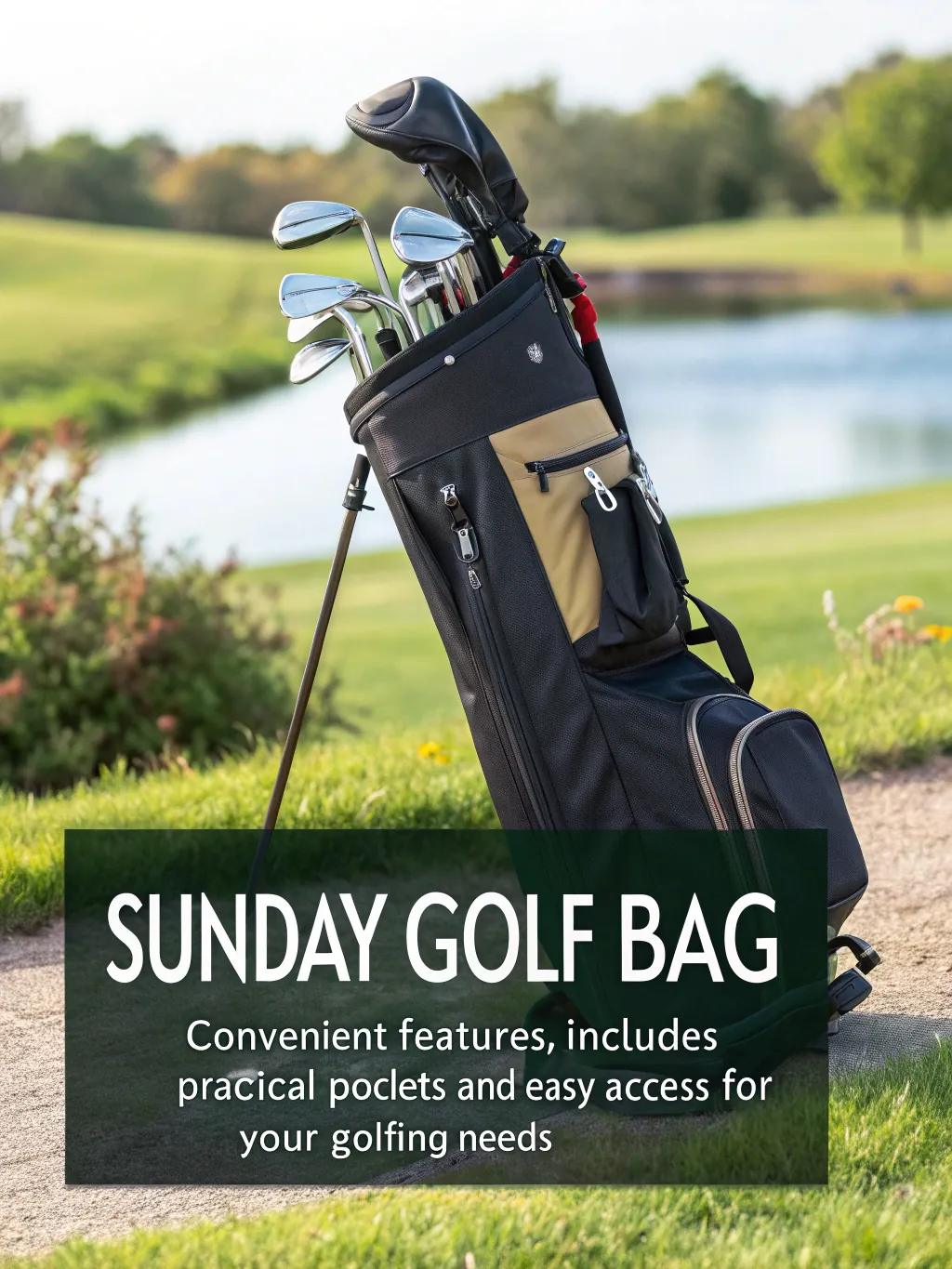
The best compact golf sunday bags for short rounds hold 4-6 clubs, weigh roughly 0.8-1.8 kg (1.8-4 lb) empty, and use a 2-3 way top with a waterproof or water-repellent fabric shell. For a 9-hole or executive loop, a compact sunday bag is the most practical carry: it eliminates the weight of a full stand bag while still protecting a driver, hybrid, mid-iron and putter with organized pockets for balls, tees, gloves and valuables. From a manufacturing standpoint, the compact sunday bag is also one of the most efficient, low-MOQ products a new brand can launch, and this guide — written from the factory floor of QUANZHOU JUNYUAN BAGS, serving 200+ brands across 100+ countries — tells you exactly how to choose, compare and wholesale-source one.
What Defines a True "Compact" Sunday Bag
Manufacturers use three measures to separate a compact sunday bag from an ordinary light bag: club capacity, empty weight, and the volume of the main tub. Most compact sunday bags carry between 4 and 6 clubs. The smallest, sometimes called "Sunday sticks" bags, hold a driver plus two or three irons and a putter; roomier compact models stretch to six with a dedicated (often lined) putter well. What they all share is a height that rarely exceeds 70-75 cm when laid flat, a top opening of 10-14 cm, and a deliberately small girth that fits easily into a dorm room, locker or car trunk.
The second defining trait is weight. A full stand bag with legs, padded shoulder straps and a rigid frame can tip the scale past 2.5 kg. A quality compact sunday bag trims that to under 1.5 kg in most cases by using a single-layer shell, minimal hardware, and thinner (but still strong) 600D-840D polyesters or ripstop nylons. When we engineer these bags at our Quanzhou facility, the goal is not the absolute lightest possible product but the lightest weight that still survives the bar-tack and seam-pull tests we run on every production lot: 7 production lines, 126 sewing machines among 149 total machines, and 137 staff keep tolerances consistent across runs in the tens of thousands of pieces per month (monthly capacity 200,000 pieces).
Who Actually Buys Compact Sunday Bags
Understanding the buyer profile explains why the form factor persists. Compact sunday bags are bought, in descending order of volume, by: casual par-3 and municipal-course golfers who play 9 or fewer holes; executive and business golfers who want a bag small enough to keep mid-week; junior programs issuing a lightweight entry bag; and travel-focused golfers who need a second, small bag for short resort trips. Wholesale demand maps closely to the same groups: pro shops, golf academies, corporate gift programs, and resorts lean on compact bags as an impulse accessory.
Because the audience is broad, the best products are rarely the most stripped-down ones. Bags that keep a useful pocket architecture — a rangefinder pocket, a beverage pocket, and a small valuables pocket — consistently outperform bare "sock" bags in sell-through. In our experience running factory-direct programs on platforms such as Alibaba, buyers also weight deco options heavily: the ability to add a logo panel, an embroidery zone or a custom colorway at low minimums is often the deciding factor between two otherwise identical constructions. That is exactly what OEM/ODM service covers, from custom golf bag manufacturing to decoration.
How Many Clubs Really Belong in a Short-Round Bag
There is no single right answer because the "right" club count depends on the course. On a compact executive course with holes under 150 m, a 4-club set (driver, 5-iron, wedge, putter) covers virtually every shot. On a course where you occasionally need a longer approach, a 5-club set (driver, hybrid, 6-iron, wedge, putter) adds insurance without meaningful weight. Six clubs is the practical ceiling; beyond six you stop saving weight and are better served by a full stand bag.
Manufacturers design the divider top around these real-world loads. A 2-way top is the most common on 4-5 club bags because clubs self-organize into two groups and grab cleanly. A 3-way top adds a central slot and helps protect grips from tangling at six clubs. For golfers who want maximum organization we also build compact bags with a full-length divider arrangement borrowed from cart-bag tooling — you can read more about that layout in our guide to golf bag divider systems. The practical takeaway: choose capacity to match your shortest honest round, not your weekend 18-hole set.
Materials That Balance Weight and Durability
Fabric choice is the single biggest lever a factory pulls to hit a weight target without inviting durability complaints. The three workhorse fabrics for compact sunday bags are 420D nylon (light, packable, slightly less abrasion-resistant), 600D polyester (the durability/weight sweet spot and by far the most common), and 840D-1000D nylon (heavier and tougher, used when a brand positions the bag as near-stand-bag). For premium short-round lines we also use ripstop weaves that stop minor tears from spreading.
Beyond the shell, hardware matters more than most buyers think. Injection-molded plastic buckles and ladder-lock adjustments are lighter than metal and corrosion-free; metal hardware adds premium feel but also grams. Zippers are the highest-failure component on any bag, so in our quality-control workflow we specify #5 or #8 YKK-style zippers on main compartments and pull-open zippers on pockets. If your short-round route is damp — coastal courses, early-morning dew, or rainy seasons — request a PU-coated or laminated waterproof shell and welded/tape-sealed seams. Our golf bag materials guide breaks down these fabric trade-offs in detail, and our waterproof golf bag guide covers coating standards.

Pocket Layout That Works for a 2-3 Hour Round
A compact sunday bag lives or dies on whether its pockets fit the actual kit of a short round. The minimum viable layout is three pockets: one large open pocket for a pullover or rain jacket, one organized pocket for balls and tees, and one small valuables pocket with a smooth, secure lining for keys and phone. That trio covers 95% of short-round needs without making the bag bulky.
For golfers who add a rangefinder or a beverage, the best compact bags grow to four or five pockets with specific homes: a top-mounted rangefinder pocket within easy reach at the club top, and an insulated side pocket sized for a 500-600 ml bottle. A glove-and-scorecard pocket near the top handle is a useful extra. When brands design these layouts with our engineers, the recurring mistake is asking for too many pockets and defeating the purpose of the form factor. The discipline of a good compact bag is knowing what to leave off — cargo space you will never use is wasted weight you carry every hole.
Carrying, Straps and the Comfort Question
Because these bags are light, brands sometimes treat comfort as an afterthought. That is a mistake. A shorts-only round of 9 holes still means carrying the bag on your shoulder for two hours. At minimum specify a single padded shoulder pad; a good pad is 5-8 cm wide, 25-30 cm long, and filled with a closed-cell foam that resists flattening. On slightly larger compact bags we add a second strap (the "dual-strap" arrangement) that balances load across both shoulders and reads as a premium feature.
Ergonomics interact with club protection too: a fixed, non-pivoting single strap can dig into the collarbone and twist the bag against your hip as you walk. A swivel strap mount keeps the bag riding true. For manufacturers, strap attachment is also a durability hotspot; we bar-tack the webbing junction and reinforce it with a welded or doubled-back panel so the strap does not tear free under load. Compact bags also benefit from a grab handle at the top, which sounds trivial but is the point everyone reaches for when lifting a bag out of a car or off a cart.
Compact Sunday Bag vs Stand Bag: When Each Wins
The most common decision a shopper faces is compact sunday bag versus lightweight stand bag. The honest answer, based on how these products are actually used and re-ordered, is that they serve different rounds. A compact sunday bag wins for: 9-hole or par-3 play, executive corporate loops, travel as a second bag, and juniors needing a first bag with a low bar to entry. A stand bag wins for: walkers playing full 18, golfers who carry on hilly courses and want the bag to stand upright between shots, and players who need large storage for layers and more tools.
The decisive practical difference is whether you need the bag to stand on its own. A sunday bag has no legs and must lean against a cart, bench, or tree. If that is not a problem on your course, the sunday bag's weight saving and packability win. If you regularly practice or play without a cart and want to drop the bag any place on the fairway, a light stand bag is the better buy. Our sunday bag vs stand bag comparison and the full golf bag types guide map these scenarios in detail.
Comparison of Leading Compact Sunday Bag Configurations
| Configuration | Club Capacity | Empty Weight | Best For | Typical Shell Fabric |
|---|---|---|---|---|
| Minimal "sticks" bag | 3-4 | 0.8-1.1 kg | Par-3, travel, juniors | 420D-600D |
| Standard compact | 4-5 | 1.1-1.5 kg | 9-hole, executive rounds | 600D polyester |
| Compact with dual strap | 5-6 | 1.4-1.8 kg | Hilly 9-13 hole loops | 600D-840D |
| Waterproof compact | 4-5 | 1.3-1.7 kg | Damp and coastal climates | PU-coated / laminated |
Figures reflect typical production specifications at QUANZHOU JUNYUAN BAGS and are representative of the mainstream market rather than a single SKU.
Sourcing and Wholesale Economics of Compact Bags
For retailers, pro shops and golf academies, compact sunday bags are attractive because they are lower-cost, lower-volume products that fit impulse purchase behavior. The economics start with MOQ. In the Chinese golf bag factory market, the standard MOQ is 200 pieces per design and colorway, with test orders available from 100 pieces — this discipline keeps material purchasing, marker cutting and production-line setup efficient while letting a new brand validate a design with a relatively small first run. Sampling takes 10-20 days, after which bulk production runs 45-60 days depending on fabric and decoration complexity.
Because the compact bag uses less material and trim, per-unit factory-direct pricing is lower than for stand or cart bags, which is why margins hold up even at retail price points that feel accessible. Brands typically amortize three cost buckets — fabric, hardware/trim, and decoration (screen print, embroidery, woven labels) — and we help customers optimize each. Our wholesale pricing guide explains how MOQ tiers, decoration and finishing affect landed cost, and the wholesale section covers order fulfillment. For brands scaling a full line, custom solutions bundle compact, stand and travel bags into one program.
Decor, Branding and Low-Minimum Customization
The compact sunday bag is one of the best canvases for branding because it is small, affordable, and usually carried in hand — visible to playing partners and other groups all round. The most popular decoration options, in order, are full-panel screen printing on a smooth polyester field, embroidery on a front logo panel, woven labels at the top handle, and heat-pressed PU/leather-look logo patches. Because the bag is small, a single dominant logo zone at the front upper panel is usually more effective than several small marks.
Corporate and academy demand leans on this. Business parks, real-estate sponsors, resorts and academies order branded compact bags as gifts, on-course merch, or entry-program kit. Because MOQ is low relative to full bags, a company can order a meaningful custom run without committing to carton-load quantities. Our OEM/ODM services page details the decoration and sampling workflow, and our factory staff will walk a first-time brand through the embroidery and screen-print variables that materially change cost and durability.
Quality Control That Prevents Short-Round Failures
Nothing damages a compact bag's reputation faster than a seam that pops or a zipper that jams halfway up a hill. A reputable factory applies a consistent quality-control ladder. At QUANZHOU JUNYUAN BAGS we run three checkpoints on every compact-sunday-bag lot: incoming material inspection (fabric weight, color fastness, zipper smoothness), in-line checks during sewing with a 100% seam and bar-tack verification, and a final AQL-based random inspection before packing. Key test points for compact bags specifically include shoulder-strap pull strength, top handle reinforcement, and zipper cycle testing on main compartments.
Because compact bags carry fewer clubs, buyers sometimes under-specify the strap and handle — the exact components most likely to fail. We recommend specifying minimum pull-force requirements for the strap junction (commonly 100-150 N of static load) and reinforcing the top handle with a full-width panel rather than a simple strap loop. For brands that want the assurance spelled out, our golf bag quality standards guide and manufacturer selection guide lay out the inspection checklists we and vetted suppliers use. In 2026 our factory was also subject to on-site SGS and Alibaba verification, providing independent confirmation of capability to buyers.
Caring for a Compact Sunday Bag
A compact bag is small enough that many owners neglect it, yet proper care multiplies its life. The most common failure point is a zipper jammed with sand or a muddy main tub left wet and closed. After a damp round, open all pockets and let the bag air-dry for a few hours before storing; never fold a wet bag into a car boot, because trapped moisture accelerates seam and hardware corrosion. When the shell is visibly dirty, clean it with a soft brush and a mild detergent, and rinse thoroughly so no abrasive grit remains to work into zippers.
Strap and handle hardware deserve a quick seasonal check. Tighten any loosening ladder-lock buckles, and inspect the bar-tacked strap junction for signs of fraying. If the bag has been waterproofed with a DWR-style coating, refresh the water repellency once a season so damp climate rounds are handled properly. Storage matters too: store the bag loosely on a shelf or hook rather than fully collapsed and zipped shut, which creases the shell. For deep detail on keeping any golf bag in service, our factory guides on care and longevity and seasonal storage cover cleaning, hardware upkeep and off-season protection. A well-maintained compact sunday bag routinely outlasts expectations because there is simply less surface area and fewer components to fail.
One more practical point: because compact bags are often the "grab bag" in the house, register its care cycle with your routine rather than treating it as disposable. The four-club set, a couple of clean zippers and a reinforced strap will give many seasons of par-3 and twilight golf when looked after.
Seven Practical Buying Tips for Short Rounds
- Match capacity to the course: 4 clubs for par-3/executive, 5-6 for longer 9-hole loops; never over-pack a compact bag.
- Specify the tube top: a 2-way top is enough for 4-5 clubs; choose 3-way only if you carry six.
- Confirm empty weight in grams: ask the factory for the empty weight, not a marketing range; variations of 100-200 g change carry feel.
- Prioritize the strap junction: a swivel, bar-tacked, reinforced strap is the difference between a bag that lasts and one that tears.
- Choose fabric by climate: 600D for dry/all-round use; PU-coated or laminated for damp regions.
- Keep the pocket list honest: rangefinder, beverage, valuables, and a weather pocket cover almost every short round.
- Use the low MOQ to test: start with a 100-piece test order and iterate on colorway before scaling to 200+.
Frequently Asked Questions
- How many clubs fit in a compact golf sunday bag for short rounds?
- Most compact sunday bags hold 4-6 clubs with a 2-way or 3-way top. The most common short-round set is four clubs: driver, hybrid or mid-iron, wedge, and putter.
- How much should a compact sunday bag weigh?
- Quality compact bags weigh roughly 0.8-1.8 kg (1.8-4 lb) empty. Anything above about 2 kg is usually a light stand bag, not a true compact sunday bag.
- Is a compact sunday bag good for beginners?
- Yes, especially for juniors and casual beginners playing fewer than 18 holes. It keeps the kit light and simple. For full-length rounds we recommend a modest stand bag instead.
- Can I get a custom logo on a compact sunday bag?
- Yes. Screen printing, embroidery, woven labels and heat-pressed patches are all common on compact bags. The low MOQ (200 pieces standard, 100-piece test orders) makes small branded runs practical.
- Are compact sunday bags waterproof?
- Standard versions are water-repellent, not waterproof. For heavy rain or coastal damp, specify a PU-coated or laminated shell with sealed seams via our waterproofing options.
- What is the lead time for a custom compact sunday bag?
- Sampling typically takes 10-20 days; bulk production then runs 45-60 days. Lead times depend on fabric, hardware and decoration choices.
- Do compact sunday bags fit on a push cart?
- Yes, most compact bags sit and strap onto a push cart, though they are primarily designed for shoulder carry on short rounds.
The Factory Verdict on Compact Sunday Bags
Seen from the production floor, the best compact golf sunday bags for short rounds are not the thinnest possible bags but the most honestly engineered ones: 4-6 club capacity, sub-1.8 kg weight, a 2-3 way top, and a pocket layout that fits a real short-round kit without bloating the form factor. They are durable enough because the strap and handle are reinforced and zippers are high-grade, and they are branded-friendly because the low MOQ makes custom colorways and logos practical for shops large and small.
Whether you are a buyer selecting a bag for afternoon loops, an academy issuing a junior entry bag, or a brand wholesale-sourcing a compact sunday bag line, the same engineering logic applies: specify capacity and weight honestly, choose fabric for your climate, reinforce the carry points, and use a factory whose quality control and low-minimum programs let you iterate. QUANZHOU JUNYUAN BAGS has produced compact sunday bags for over a decade since the company's founding in 2014 (our founder entered the golf bag industry in 2004), and our commercial team is happy to review your spec sheet at contact or by email at service@junyuanbags.com.
Looking for a Reliable Manufacturing Partner?
Whether you need custom compact sunday bags, stand bags, cart bags or specialized travel covers, our team is ready to bring your vision to life with factory-direct pricing. Test orders from 100 pieces, sampling in 10-20 days, bulk production in 45-60 days.
Request a Bulk Quote →Sources
- [USGA – Equipment Rules](https://www.usga.org/equipment-rules)
- [The R&A – Rules and Equipment Guidance](https://www.randa.org/equipment)
- [National Golf Foundation – Golf Participation & Market Data](https://www.ngf.org/)
- [Golf Datatech – Industry Sales and Market Research](https://www.golfdatatech.com/)
- [PGA of America – Junior Golf and Coaching Resources](https://www.pga.com/)