OEM Golf Staff Bag Production Process From Factory
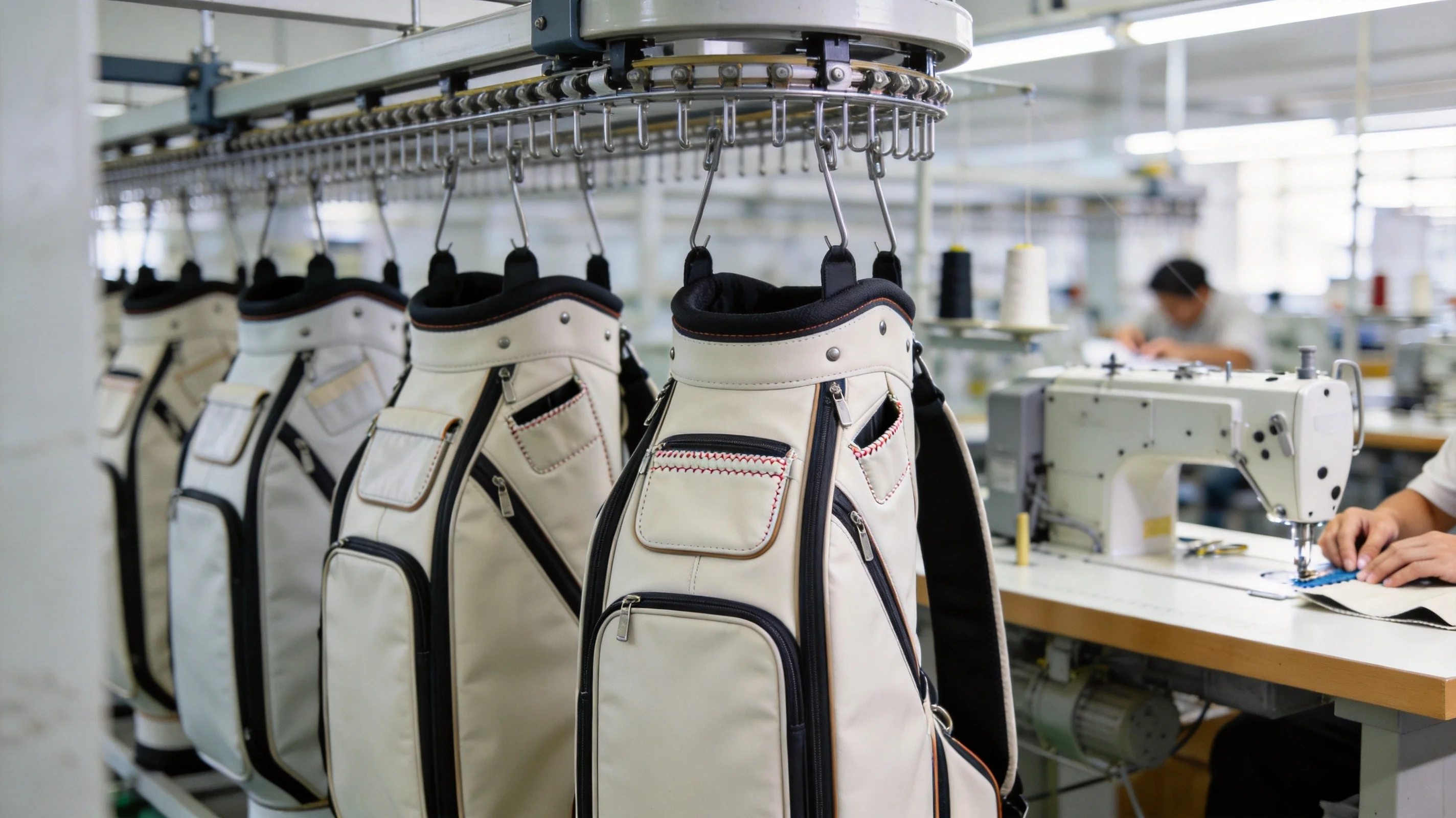
An OEM golf staff bag order moves through a defined factory process — design transfer and specification, sampling in 10-20 days, sample approval, coordinated material selection, cutting, sewing and assembly across the line, finishing and decoration, then an AQL pre-shipment inspection before export — on a standard 200-piece MOQ (100-piece test) with 45-60 days of bulk production after sample approval. This guide follows a staff bag order from your brief to the container.
What Makes a Staff Bag Different
A staff bag is the largest, highest-capacity type of golf bag, carried by a bagman or on a cart and built to hold a full set plus ample storage. Its scale and construction mean more material, more pockets and far more sewing than a standard carry bag, so the production process is correspondingly detailed. Staff bags also carry high-brand-visibility potential — often the most photographed bag at tournaments and courses — which puts a premium on perfect finishing and decoration.
For a buyer, understanding the staff bag production process is essential because the project's scale multiplies any mistake. A design flaw, colour mismatch or functional error on a staff bag is expensive to correct at volume. Following the process stage by stage protects both your investment and the brand presence the bag will carry.
Stage 1: Design Transfer and Specification
Every OEM staff bag starts with a complete design transfer. You provide your design, patterns or detailed specification covering dimensions, construction, materials, hardware, pocket layout and decoration. The factory converts this into a manufacturable specification and confirms the build. Any gaps between your intent and physical production reality are resolved here, on paper, before a single unit is cut.
A complete specification is the strongest factor in a smooth project. Vague or incomplete briefs force interpretation, and interpretation invites drift. Getting construction, material grades and dimensions fully specified at transfer — and confirming them in writing — prevents most of the disputes that arise later in large-scale projects. Our OEM/ODM process guide sets out the specification checklist to prepare.
Stage 2: Sampling (10-20 Days)
From the completed specification, the factory produces a first physical prototype in 10-20 days. This sample is the buyer's first tangible view of how the design translates into a real staff bag, and it is the commercial and technical anchor of the whole order. Everything that follows — materials, colours, construction, decoration — is validated against this sample.
Sample approval is the moment to be exacting. Compare the sample against your specification point by point, verify every dimension, test zippers, straps and base, and confirm decoration placement and colour. Whatever you approve at this stage becomes the standard for every production unit, so a thorough review now protects the entire run. Our sampling guidance provides the checklist to work through.
Stage 3: Material Selection and Procurement
With the sample approved, the factory locks the material bill and procures in volume. Fabric grade and weight, padding thickness, hardware types, zipper grades and trims are selected to match the sample and the specification. Materials are controlled by batch and dye lot, and each incoming lot is inspected to protect colour and construction consistency across the entire run.
Material selection is where cost and quality interact most directly. A staff bag's size makes fabric and hardware a meaningful share of cost, so the right grades matter for both performance and price. Choosing materials that match your performance goals — durability, weight, water resistance — without over-specifying keeps quality high and cost controlled. The materials guide maps the options and trade-offs.
Stage 4: Cutting and Preparation
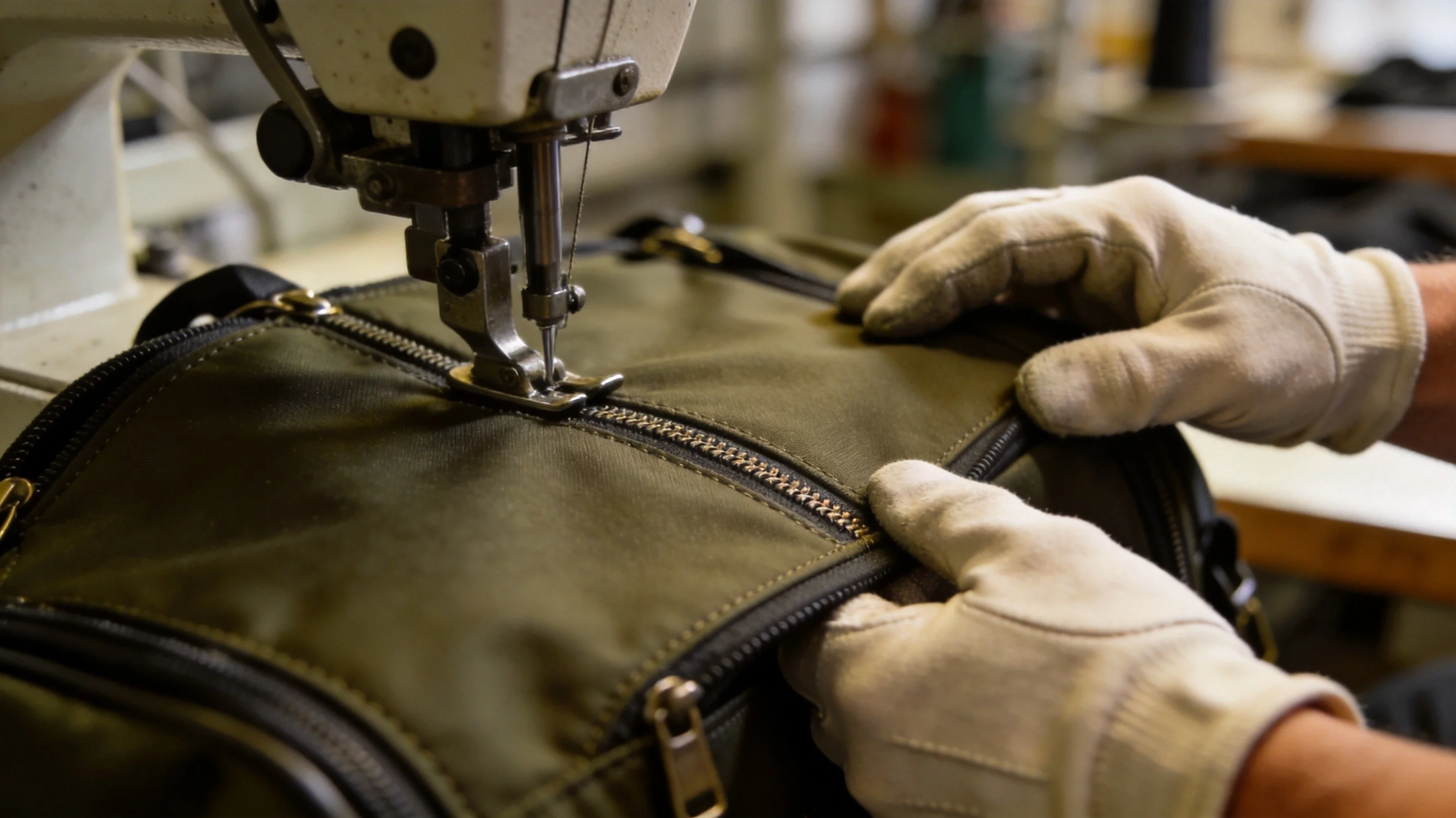
Before sewing, panels are cut from the approved fabric to the pattern. For a staff bag this involves a large number of panels and components, so cutting accuracy is critical. Panels are inspected for dimensional accuracy and material flaws, and colour is reconciled within the same dye lot to keep every bag uniform.
Cutting accuracy on a staff bag directly determines how cleanly the large components fit together. A miscalibrated panel in a small pocket may be invisible; a mis-sized main shell compromises the entire bag. Inspecting panels at cut-off, before the expensive sewing and finishing labour is spent, is the first line of protection in the production chain.
Stage 5: Sewing and Assembly
Sewing is the heart of staff bag production and the most labour-intensive stage. Components are stitched into sub-assemblies, then joined into the complete bag: the shell, dividers, pockets, handle, straps and base. Given the number of pockets and reinforcements on a staff bag, this stage both demands and rewards skill, and it is staffed across our line with experienced sewers.
Quality control follows each sewing step. Seam quality, stitch density and reinforcement at load points are sampled at defined intervals across the line, catching slips while they affect a few units rather than a batch. Because staff bags carry high loads and heavy branding, reinforcing seams at handles, straps, base and pocket connections is essential. The in-process sampling protects that standard through the whole build.
Stage 6: Finishing and Decoration
After assembly, the bag is finished: edges and seams trimmed, hardware fitted, final assembly completed, then decoration applied. Decoration — logos, names or full artwork — is a defining element of a staff bag, and it must match the approved artwork precisely for placement, colour and durability. Methods range from embroidery to printed or branded panels depending on your design.
Decoration on a staff bag is high-stakes because the bag is so visible. A misaligned or fading logo is damaging on any product, but on a staff bag carried in front of crowds it is a direct brand risk. Finished-goods inspection therefore validates decoration against the approved design and confirms placement, colour and finish quality on every unit.
Planning an OEM Staff Bag Programme?
Factory founded 2014 with 20+ years experience, 7 lines and 126 sewing machines, 200,000-unit monthly capacity, ISO 9001 & BSCI certified. Staff-bag specialists.
Start Your Staff Bag Project →The OEM Staff Bag Process at a Glance
Mapping the complete sequence helps buyers schedule a programme realistically and hold each stage accountable.
| Stage | Key Activity | Typical Timing |
|---|---|---|
| Design transfer | Specification & build confirmation | At kickoff |
| Sampling | Prototype & buyer approval | 10-20 days |
| Material & cutting | Procure, cut, panel inspection | Before sewing |
| Sewing & assembly | Sub-assemblies to full bag | Core build |
| Finishing & decoration | Trim, hardware, branding | After sewing |
| Pre-shipment | AQL inspection, pack & ship | 45-60 days total |
MOQ, Cost and Consolidation
The OEM staff bag runs on a 200-piece standard MOQ per design, with 100-piece test orders to validate a new market before committing. Because a staff bag's large size makes per-unit material and labour higher than smaller bags, consolidating designs and colourways is the fastest lever to hold unit cost down while using capacity efficiently.
Planning your basket of sizes, colours and quantities to fit cleanly into the MOQ framework is one of the highest-ROI activities in a custom project. Our wholesale pricing guide models how volume and design count interact with unit pricing, so you can optimise before quoting to customers.
Quality Control Protecting the Whole Process
Every stage of the OEM staff bag process is reinforced by quality control: incoming material checks, cutting inspection, in-process sewing samples, finished-goods validation against the approved sample and an AQL pre-shipment inspection. Because staff bags carry high loads and heavy branding, the structural and decorative standards are applied rigorously.
Our facility runs these controls under ISO 9001 and passed SGS and Alibaba verification in March 2026. The quality standards guide sets out the measurable criteria for a staff bag, so you and the factory share one standard from the first sample to the last unit.
Conclusion
The OEM golf staff bag production process is a disciplined sequence: transfer your design, sample it in 10-20 days, approve it, procure and cut material, sew and assemble across the line, finish and decorate, then verify through AQL inspection before shipping — on a 200-piece MOQ with 100-piece tests and 45-60 days of bulk production. With foundation at an ISO 9001, BSCI certified and independently audited factory, that process delivers a staff bag your customers will carry with confidence and your brand will be proud to show.
Specifying a Staff Bag Correctly
Because a staff bag is large, complex and expensive, correct specification at the start is disproportionately valuable. You must define the exact dimensions, the divider layout for club organisation, the number and type of pockets, the material grades and the hardware specification — down to zipper grades and strap construction. Each specification detail becomes a production instruction, so completeness directly protects the entire project.
Specification also extends to decoration, which on a staff bag is a major element. Confirm the logo placement, size, colours and method (embroidery, print or panel), and approve the artwork strictly. Because staff bags carry high-visibility branding, the decoration specification should be exact to avoid the expensive and embarrassing position of approving a misbranded run.
A complete staff bag brief lets us quote, sample and build accurately. Our OEM/ODM process guide provides a staff bag-specific specification checklist, ensuring nothing is left to interpretation before production begins. Investing in a thorough spec is the single most effective way to keep a staff bag project on budget, on time and exactly as designed.
Staff Bag Materials and Cost Balance
Materials dominate the cost of a staff bag because of its size. The main fabric must be durable enough for heavy use yet appropriately priced for the product's tier; the padding must protect clubs while controlling bulk; the base and stand must be robust; and the hardware must perform without breaking the budget. Balancing these is the core cost management work of a staff bag project.
The balance differs by market. A flagship staff bag supports premium material grades and passes the cost to a higher price point; a value-tier staff bag requires careful selection to hit a lower price without sacrificing structural integrity. The same eight-stage process runs either way, but the material bill is where tier decisions become real money.
Our materials guide maps fabric and component options with their cost and performance trade-offs, so you can specify a staff bag that meets its market. Because we build staff bags across many price tiers, we can advise on the balance that protects performance where it matters and holds cost where your market demands it. Getting the material bill right is the difference between a staff bag that sells and one that only looks good on paper.
Quality Control Specific to Staff Bags
A staff bag's size and heavy branding make quality control especially important, and the standard gates adapt to its needs. Structural testing concentrates on the seams at load points — handles and straps that must hold a heavily loaded bag — and on the base's rigidity. Because a staff bag carries maximum equipment, these structural standards are among the strictest in the product line.
Decoration quality is equally critical. Staff bags are highly visible, so logo placement, colour and finish are validated against the approved artwork on every unit. A misaligned or fading logo is visible to everyone the bag passes, costing more than the bag's value in brand damage. The finished-goods gate therefore pays particular attention to decoration quality on staff bags.
The full six-step QC process applies — incoming materials, cutting, in-process sewing, hardware and function, finished-goods against the sample, and AQL pre-shipment — with the strictest standards at load and brand points. Our quality standards guide details the criteria for a staff bag. Because we specialise in staff bags, we apply these standards with the depth the product's demands justify.
Why a Dedicated Staff Bag Factory Matters
Staff bags reward a factory that builds them routinely, because the accumulated engineering knowledge translates directly into faster sampling, fewer defects and better cost. A factory familiar with staff bag construction has solved the tricky details before — the load-point reinforcements, the large-panel cutting, the complex decoration placement — and applies that experience instead of learning it at your expense.
This is why specialisation matters as much as general capacity. Our facility produces custom staff bags as a core line, backed by the 20+ years of experience of a facility founded in 2014. The result is a smoother project: samer specifications, fewer revisions and a product that builds on proven, refined construction.
When selecting a partner, ask how many staff bags they produce and how deep their experience runs. A factory that makes staff bags its business, rather than a rare add-on, brings the tested knowledge that protects your project from the expensive surprises of first-time engineering. Specialisation is quiet insurance with real, compounding value.
Common Staff Bag Design Elements and Build
A staff bag's design elements shape the entire build and reward advance planning. The divider system is central, typically a top with several full-length dividers that organise clubs and protect their grips and shafts. The pocket layout is extensive — multiple large pockets for balls, shoes, rain gear and valuables — requiring careful pattern construction so the bag opens, closes and balances well.
The carry and standing structure also defines the build. A staff bag rides on a cart or is carried by a caddie, so its handles, strap and base are engineered for heavy, repeated use. Recessed cart-attachment options, a stable wide base and reinforced handles are standard features that the sewing and hardware stages must deliver precisely to perform on course.
Whether you supply the complete design (OEM) or adapt a factory staff bag base (ODM), communicating these elements clearly to the factory is essential. Each element — dividers, pockets, handles, base, attachment — has construction implications and quality requirements. Working through them systematically in the OEM/ODM process guide ensures the design brief is complete before the first panel is cut.
Protecting Your Design and Market
For a brand investing in a custom staff bag, protecting the design and market is a practical concern with measures you can take. Where the design is proprietary, choose OEM and confirm confidentiality and exclusivity in your agreement. Confirm that your branding, artwork and any bespoke elements are yours and restricted from reuse for other clients, and, where relevant, clarify the ownership of any tooling used.
Market protection extends to distribution. Exclusivity for a channel or region, restrictions on resale and clear terms around your branded product all belong in the engagement agreement. Because our facility produces for 200+ brands, maintaining strict client separation and confidentiality is a structural discipline rather than an afterthought, and we document these safeguards.
Done properly, protection through OEM ownership, confidentiality and exclusivity lets you develop a distinctive staff bag without fear of it appearing under another brand. Our OEM/ODM services detail the safeguards in place. Investing in protection is part of realising the long-term value of a well-designed, well-built and properly owned product.
Pricing, Costing and Transparency
For a large, complex product like a staff bag, pricing and cost transparency are central to a healthy programme. Because staff bags are material-intensive and brand-heavy, their cost is the sum of many confirmed decisions — fabric grades, padding, hardware, decoration — and each should be transparently itemised so you understand what you are paying for and where savings are possible without harming quality.
Transparent costing also protects the relationship. When you understand the cost drivers, you can trade features against price with the factory on an informed basis rather than negotiating against a black box. This is how a staff bag reaches not just the quality you want but the price your market calls for, with both sides aligned on what the money buys.
Our quoting is built on itemised transparency, supported by a wholesale pricing framework and the real cost structure of producing in China. That clarity, combined with the factory's capacity and QC discipline, is what makes staff bags a dependable part of a brand's line. Price and quality are only in tension when cost is opaque; transparency resolves that and makes a strong staff bag genuinely affordable.
Getting Started With a Qualified Partner
The most practical way to turn this groundwork into a reliable product is to engage a factory with verifiable credentials, proven output and transparent process. A qualified facility founded in 2014, staffed by a team whose founder entered the industry in 2004, brings more than twenty years of hands-on knowledge to every programme. That experience shows in faster sampling, fewer defects and sound advice at each decision point.
At our facility in China, seven production lines and 126 sewing machines support a 137-person team producing about 200,000 golf bags a month for 200+ brands sold to 100+ countries. Backed by SGS factory audits and BSCI-aligned practices, we combine real capacity with documented quality control, so you can validate us before committing. Whether you begin with a 100-piece test order or move straight to a full production run, the milestones you have read here are the milestones we apply to your order.
To start, bring a detailed specification and an honest sense of your volume and deadline, and we will map the stages, timings and costs for your exact programme. With direct contact to our export team, service@junyuanbags.com or +86 17750020688, you can begin a conversation that moves quickly into a structured plan. The process and standards described above are not theory; they are the operating reality you are welcome to verify before your first container ships.
Our Factory Profile and How It Shapes This Story
The figures and workflows discussed above reflect how QUANZHOU JUNYUAN BAGS actually operates. We build golf bags in a 4,950 sqm affiliated production facility, founded in 2014 by a founder who entered the industry in 2004 — more than twenty years of experience. Seven production lines and 126 sewing machines support a 137-person team, producing about 200,000 golf bags per month for more than 200 brands in over 100 countries.
For custom and OEM/ODM work our standard MOQ is 200 pieces, and a 100-piece test order is available to validate a design before scaling. Prototype sampling takes 10-20 days; bulk production runs 45-60 days. These timings are the real operating window, not a best-case estimate. The facility has completed SGS factory audits and runs its management system to the ISO 9001 standard, giving independent weight to the quality and delivery claims in this article.
If you would like these numbers mapped to your own product, our export team is available at service@junyuanbags.com or +86 17750020688. You can also see the practical expression of this capacity on our OEM/ODM services and OEM/ODM process guide pages. Either way, these are the operating facts behind the story this guide tells.
Sources
Frequently Asked Questions
- What is an OEM golf staff bag?
- A large, high-capacity golf bag you design yourself - construction, materials and layout - that a factory produces to your specification under your branding. You own the design.
- What is the production process for an OEM staff bag?
- Design transfer, sampling (10-20 days) and approval, material selection, cutting, sewing, finishing and decoration, then AQL pre-shipment inspection before export.
- How long does it take to produce an OEM staff bag order?
- Sampling takes 10-20 days and bulk production 45-60 days after approval, before freight. A full programme typically spans 70-90 days with a buffer.
- What is the MOQ for an OEM staff bag?
- A 200-piece standard MOQ per design, with 100-piece test orders available to validate a market before scaling.
- Can I get a sample of my OEM staff bag before bulk production?
- Yes. Sampling delivers a physical prototype in 10-20 days for approval before any bulk commitment, and that approval fixes the benchmark for the run.