Advanced Golf Bag Materials: Carbon Fiber and Innovations

The advanced golf bag materials that matter in today's production are 1680D ballistic shells, TPU seam-welded waterproofing, carbon and glass-fiber composite frames, graphene and nano-silica coatings, and GRS-certified rPET recycled fabrics — and each is deployed in a specific structural role rather than across the whole bag. This guide comes from the production floor of our Quanzhou, China golf bag factory, operating since 2014 with seven production lines, 126 sewing machines and 137 employees, serving more than 200 brands in over 100 countries and audited by SGS in March 2026. Here we identify which advanced materials are genuinely production-ready, how they perform, and how to specify them for a premium OEM or private-label programme.
What Counts as an Advanced Golf Bag Material
The term "advanced material" is overused, so let us define it precisely. In golf bag manufacturing, an advanced material is one that measurably outperforms the standard baseline — usually 600D-840D polyester or nylon with a basic PU coating — on a property your customer cares about, such as weight, water resistance, tear strength or sustainability. By that definition the advanced palette is small and specific rather than a list of buzzwords.
The materials that clear that bar today are: high-denier ballistic nylon (1000D-1680D) for wear surfaces; TPU lamination for waterproofing; carbon fiber and glass-fiber composites for lightweight frames; graphene and nano-silica coatings for surface performance; and rPET recycled polyester for sustainable construction. Each earns its place because it solves a real problem — not because it sounds impressive. The rest of this guide examines each in turn and explains when, and when not, to specify it.
Advanced Material Capability Table
A quick reference for matching advanced materials to the property you value:
| Advanced Material | Primary Role | Key Benefit | Main Limitation | Best Programme | Relative Cost |
|---|---|---|---|---|---|
| 1680D ballistic nylon | Shell fabric | Tear & abrasion resistance | Heavier than mid-denier | Premium cart/staff/travel | High |
| TPU lamination + seam weld | Waterproof shell | Genuinely waterproof seams | Higher cost, welding process | Premium waterproof bags | High |
| Carbon fiber frame | Stand legs / travel rails | 30-40% lighter than steel | Brittle to sharp impact | Lightweight walking bags | Very high |
| Glass-fiber composite frame | Budget composite frames | Light, cheaper than carbon | Stiffness below carbon | Mid lightweight bags | Med-High |
| Graphene / nano-silica coating | Shell surface | Hardness, water & UV benefit | Incremental, needs testing | Premium shells | Med |
| rPET recycled polyester | Shell & lining | Lower carbon footprint | Coating limits recycling | Sustainable ranges | Med-High |
| Mono-material design | Whole kit | Easier end-of-life recycling | Engineering complexity | Progressive brands | Med-High |
Read this table as a specification menu: pick the roles you need to solve and the material that solves them, rather than layering every advanced material into one bag. The premium segment usually combines three or four of these — a 1680D shell, TPU waterproofing, a carbon frame and a nano coating — deliberately, not indiscriminately.
Carbon Fiber Innovations in Detail
Carbon fiber is the most visible advanced material in the current generation because it is the single biggest lever for the attribute everyone talks about: weight. A carbon fiber leg frame can weigh 30-40% less than a steel equivalent while providing the stiffness that keeps a club-packed stand bag stable. The fibre orientation in the composite is engineered so the frame is rigid in the direction it must hold load and accepts the stand-mechanism mountings without stress concentration.
The innovation leading edge in carbon fiber is recycled carbon. Fibre reclaimed from aerospace and industrial offcuts can be re-processed into lower-grade composites suitable for golf bag frames and rails, cutting embodied energy while retaining most of the weight benefit. Recycled carbon is not yet as common as rPET, but it is the direction the industry is heading as brands balance lightweight performance with environmental responsibility.

TPU and Seam-Welded Waterproofing
Waterproofing is the advanced material application that generates the most warranty value. Standard PU coatings make a fabric shower-proof, but water enters at the seams. TPU lamination, combined with seam welding or seam taping, turns the whole enclosure into a genuine waterproof membrane with a hydrostatic head comfortably above 3000mm. Because TPU flexes rather than cracks, it performs better in cold and repeated folding than older coatings.
This is the construction to specify when your target customer plays in persistent rain. It justifies a premium because it delivers a felt, reliable benefit — dry clubs in a downpour — and it is testable to international water-resistance standards. Our waterproof golf bag range uses this TPU seam-sealed system, and for a deeper look at the field engineering see our golf bag weather and waterproofing guide.
Graphene and Nano-Coating Technology
Nanotechnology in golf bag shells takes the form of nanoparticle additives dispersed into a surface coating. Graphene — a single layer of carbon atoms — lends the coating measurable hardness and reduces surface friction, while nano-silica improves water repellency and stain resistance. Applied to a shell, these coatings help the bag shrug off light rain, resist scuffing and stay cleaner between washes.
The honest engineering caveat is that nano gains are incremental, not transformative. A coating cannot fix poor seams or weak fabric; it enhances a shell that is already well constructed. The professional approach is to verify nano benefits with a standard abrasion or water-column test and compare against the uncoated control. When a supplier can show that evidence, the coating is worth its modest price; when the claim is only a label, treat it as marketing.
Recycled and Sustainable Advanced Materials
The advanced materials conversation increasingly includes sustainability. GRS-certified rPET — polyester spun from recycled bottles — is now a mainstream option that matches virgin material for most shell and lining applications while cutting raw-material carbon footprint. Mono-material design, where the shell, lining and laminates are engineered from a single polymer family, makes end-of-life recycling practical and is the direction forward-thinking brands are adopting.
Our facility supports rPET, mono-material and recycled-content reporting because we maintain material traceability. The March 2026 SGS audit independently confirmed the documented quality system behind that traceability. For clients building a credible sustainability story, we can attach recycled-content documentation to each production batch alongside the performance test certificates — the combination a modern retail buyer expects.
Verifying Advanced Materials: Standards and Testing
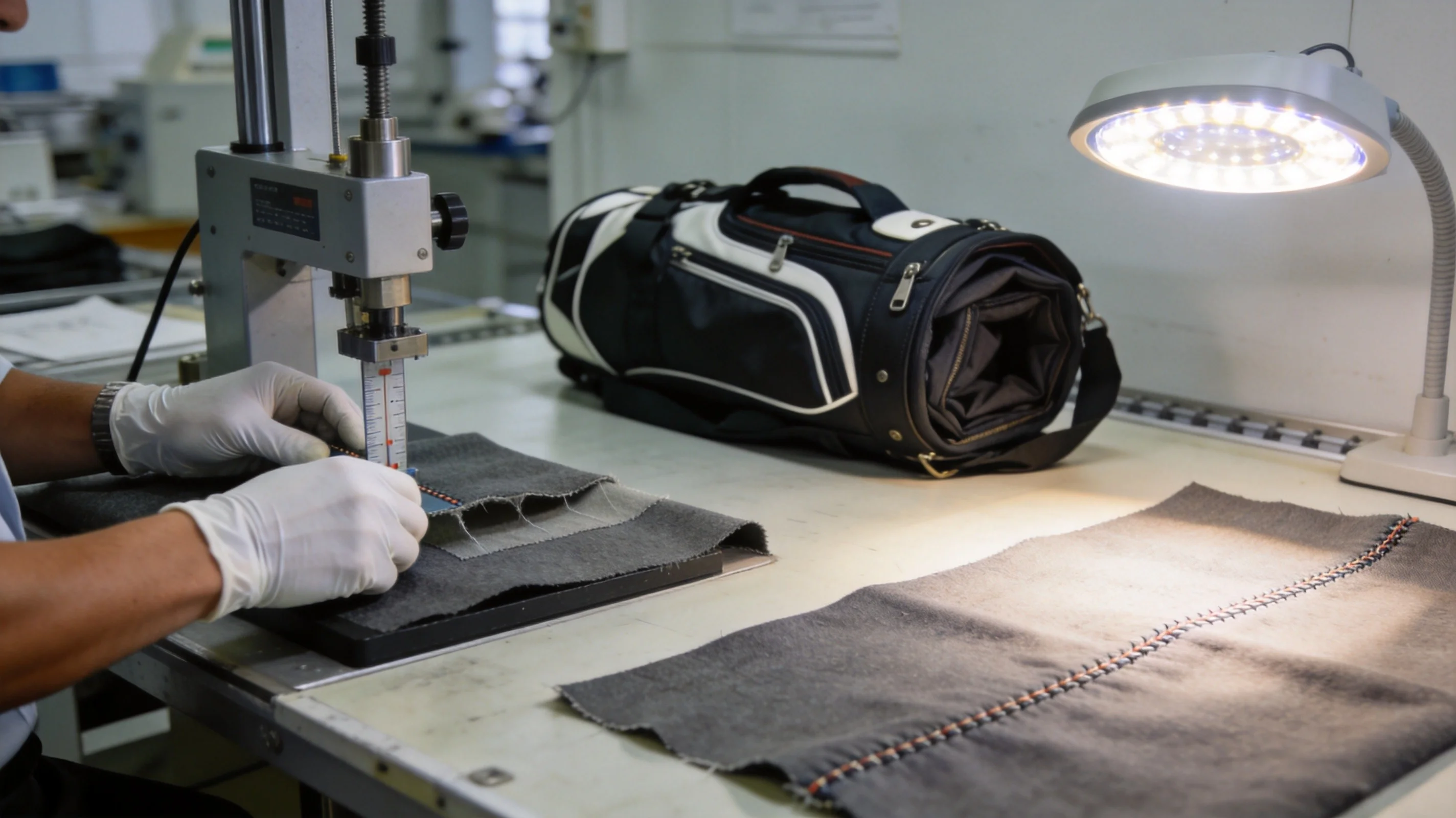
An advanced material claim is only as good as the test that supports it. The industry-standard methods we apply include abrasion resistance (referenced to ISO 12947 Martindale-style methods), tear strength (ASTM textile families such as D2261), water resistance (ISO 811 hydrostatic head and ISO 4920 spray rating), and UV/colour fastness (ISO 105-B02). Composite frame elements are tested for stiffness, deployment cycling and impact behaviour.
Every production line in our seven-line facility feeds samples into this test battery, and results are documented per batch. When you specify an advanced material, ask for the corresponding certificate — an ISO 811 result for TPU waterproofing, an ASTM tear value for 1680D, a GRS certificate for rPET. This is the language that turns a material story into a defensible retail claim, and it is exactly what professional distributors ask for.
Specifying Advanced Materials for Your Programme
The professional route to an advanced-material programme is a top-down specification exercise. Define your target retail price, the golfer you serve (walker vs cart rider), the climate, and your sustainability goals. From that brief, select two to four advanced materials that directly serve the brief, then prototype and validate them together rather than adding them piecemeal.
We recommend the 200-piece test order as the validation gate: a 10-20 day sampling window lets your team physically check hand-feel, wet performance and weight on a scale before the 45-60 day mass production cycle. Because our monthly capacity reaches 200,000 units across seven lines, a validated advanced-material kit can scale from prototype to full retail volume without losing control. Share your brief with service@junyuanbags.com or WhatsApp +86 17750020688 and our engineers will map the right advanced material stack for your target margin and market.
1680D Ballistic Nylon: The Shell Champion
Before newer technologies layer on top, it is worth giving the single most important advanced shell material its due. Historically developed for military flak gear, ballistic nylon is a densely woven twill that combines high denier — typically 1000D to 1680D — with a tight interlaced weave. That construction yields outstanding tear strength and abrasion resistance, which is why it displaced ordinary 600D fabrics on the wear surfaces of premium golf bags.
A 1680D shell resists dragging across cart paths, surviving contact that would abrade a lighter fabric, and holds its shape so the bag does not sag around a full set of clubs. It also gives a refined, dense hand-feel that shoppers read as premium. The trade-off is weight and cost, which is why 1680D is reserved for the high-wear shell and frame-reinforced zones, while lighter 300D-600D fabric appears in pocket linings and non-critical panels. That selective use is the essence of professional material engineering.
In practice we specify 1000D-1680D ballistic for premium cart, staff and travel bags and for the wear panels of high-end stand bags, pairing it with the right needle and thread so the heavy fabric sews cleanly and seam tape adheres reliably. Verifying its tear performance against an ASTM method gives the buyer the evidence behind the "premium fabric" claim.
Lightweight Frame Systems and Their Materials
A golf bag's frame is where advanced material thinking has the biggest measurable impact on comfort. The frame must keep a club-loaded bag upright and stable, yet contribute as little unladen weight as possible. Steel achieves the stiffness at low cost but is heavy and can rust. Aluminium alloy cuts weight by 15-25% and resists corrosion, making it the reliable mainstream. Carbon fiber climbs further, saving 30-40% of frame weight versus steel with the highest specific stiffness, at a premium and with brittleness to sharp impacts.
Glass-fiber composite offers a lighter-than-aluminium alternative to carbon at lower cost and stiffness, finding a home in budget-lightweight programmes. The engineering decision among these is driven by target price and usage: walkers and premium travel bags justify carbon; cart bags and value ranges do not need it. We maintain a deliberate matrix of approved frame materials so the choice follows the brief rather than fashion.
Because the frame interacts with the stand mechanism, base plate and shell tension, integrating it correctly requires a factory comfortable with composite processing. A 200-piece sample order (10-20 day window) is the reliable way to confirm the frame feels right, deploys reliably and carries the bag stiffly before committing to the 45-60 day production cycle.
Advanced Zips and Hardware as Materials
Advanced material logic extends to the smallest parts, because that is where real-world failures concentrate. A golf bag zipper opens and closes tens of thousands of times under load. Moving from a generic #5 nylon zipper to a #8 graded coil or metal zipper with a self-healing coil and water-resistant treatment is a material upgrade that measurably cuts the most common warranty complaint. Buckles and sliders move from commodity plastic to glass-filled nylon for strength, and D-rings to cast alloy where load demands.
Webbing, the 40-50mm strap material, is load-rated in kilonewtons and chosen for UV stability so shoulder straps do not weaken after a season in the sun. The shoulder pad uses closed-cell or memory foam whose density balances comfort against weight. None of these parts gets a marketing paragraph, but together they determine whether a bag earns its warranty reputation. Specifying the right hardware is every bit as "advanced" as the headline shell material.
Regional Fit of Advanced Materials
With clients across more than 100 countries we see plainly that the "best" advanced material varies by region. Rainy markets in the UK, Scandinavia and coastal Canada prioritise TPU waterproofing and high hydrostatic-head figures above all else. Hot markets across the US South, the Gulf and Australia prioritise UV resistance and colour-fastness, valuing lighter UV-optimised shells for walking comfort. Mature markets in Japan and Germany value precise stitching, premium polyester finishes and — increasingly — documented recycled content. Emerging markets lead with honest value in robust 600D-840D constructions.
A single global spec underperforms these regional priorities. Strong programmes use a material matrix: the same silhouette with a waterproof TPU spec for rainy regions, a UV-optimised lighter spec for hot regions, and an economical spec for value markets. Because our seven production lines handle multiple material systems, we deliver that flexibility within one brand programme without inflating minimum order complexity — a practical advantage importers rely on when launching internationally.
Smart Textiles and the Next Wave
Beyond the current palette, a next wave of advanced textiles is arriving. Smart-fabric features — shells engineered to carry low-voltage wiring or integrated sensor pockets, webbing that routes device cables, and fabrics with adaptive or self-cleaning surface chemistry — are appearing in select premium programmes. These are genuine engineering directions, not gimmicks, but they come with integration complexity and cost that limits them to flagship products for now.
For the majority of golf bag production, the practical advance is in making the existing advanced palette cheaper and more sustainable: recycled and mono-material TPU, lower-cost carbon processing, and coatings with better performance per gram. The smart-fabric hype should not distract a professional buyer from nailing the fundamentals of denier, coating and seam quality, which is where real warranty value lives.
That said, brands that want to lead can trial smart and adaptive features in a small premium line while the mainstream catalogue stays on the proven advanced palette. Our engineers help clients scope that balance, prototyping the flagship feature while ramping volume on the foundation materials.
The Economics of Going Advanced
Every advanced material carries a cost that must be recovered at retail, and the economics discipline is what separates successful programmes from over-specced one-offs. The rule of thumb we apply is to spend on the two or three attributes your target customer actually feels — weight for a walker, waterproofing for a rainy-climate golfer, or recycled content for an eco-conscious buyer — and keep the rest of the budget on proven fundamentals like zips and seams.
An over-specced bag that tries to claim every advanced marker at once usually delivers none of them convincingly and prices itself out of its market. A focused bag that nails one hero material and dials in the fundamentals outsells it every season. This is why our material reviews with clients begin with the retail brief and the competitor set, then work backward to the bill of materials, rather than the reverse.
The right validation gate for that economics is a prototype the market can weigh and hold. A 200-piece sample order with a 10-20 day sampling window gives you the cost-per-unit and the hand-feel to price confidently, before mass production commits you to the standard 45-60 day cycle at monthly inventory builds of up to 200,000 units.
The Advanced Material Bottom Line
Advanced golf bag materials are not a single miracle; they are a disciplined toolkit. 1680D ballistic nylon, TPU waterproofing, carbon composites, nano coatings and recycled fabrics each solve a specific problem, and the best bags deploy a few of them where they earn their cost. The value justification always comes back to the end user — is the bag lighter, drier, tougher or greener where it matters to them?
As a manufacturer serving more than 200 brands across 100+ countries since our founding in 2014, we have watched these materials mature from novelty to expectation. Our suggestion is to choose by evidence, not fashion: define the problem, specify the material, and verify with tests. That approach produces a bag that performs, a brand story that is credible, and a programme that ships on schedule.
Frequently Asked Questions
- What are the most advanced golf bag materials in production?
- The most advanced commercially viable materials are 1680D ballistic nylon shells, TPU lamination for seam-welded waterproofing, carbon fiber and glass-fiber composite frames, graphene and nano-silica protective coatings, and GRS-certified rPET recycled fabrics. Each is chosen for a specific role — shell, coating, frame or lining — rather than used everywhere.
- How is carbon fiber used in golf bags?
- Carbon fiber appears as structural elements: stand-bag leg frames, travel-bag rails and base plates, and sometimes handle or badge reinforcement. It is not used for the whole shell. The composite offers 30-40% weight saving versus steel with high specific stiffness, but it is brittle to sharp impact, so it is placed on low-impact structural parts.
- Are carbon fiber golf bag innovations worth the price?
- They are worth it for walkers who value the lightest carry and for premium travel bags guarding clubs in transit. For cart-only or budget golfers, aluminium frames and standard shells deliver most of the benefit at lower cost. The value depends on whether the weight saving is felt by the end user.
- How sustainable are advanced golf bag materials?
- It varies. GRS-certified rPET and mono-material designs are genuinely more sustainable, while virgin carbon fiber carries high embodied energy and is hard to recycle at end of life. Recycled carbon fiber exists and is emerging, though most recycled-content programmes today focus on rPET shells rather than structural carbon.
- Do nano and graphene coatings really improve golf bags?
- At the correct loading and dispersion, graphene and nano-silica additives do improve surface hardness, water repellency and UV resistance. The gains are real but incremental — they lift a good bag, not rescue a poor one — and should be verified with standard abrasion and water-resistance tests rather than marketing claims.
- What should I specify for a premium golf bag in 2026?
- For a premium waterproof programme: 1680D ballistic shell, TPU lamination with seam welding, #8 zips, reinforced base, and optionally a carbon or alloy lightweight frame. For premium lightweight: composite frame plus 300D-600D fabrics in non-wear zones. Always request test certificates and a 200-piece sample order before volume.
Sources & Further Reading
Related Reading
- Carbon Fiber Golf Bags: Performance Analysis — the engineering case in depth.
- Golf Bag Material Science Innovations — the broad 2026 material landscape.
- Eco-Friendly and Sustainable Golf Bag Materials — rPET and mono-material options.
- Golf Bag Quality Control and Testing Standards — how advanced materials are verified.