Golf Bag Material Innovation and Technology Development
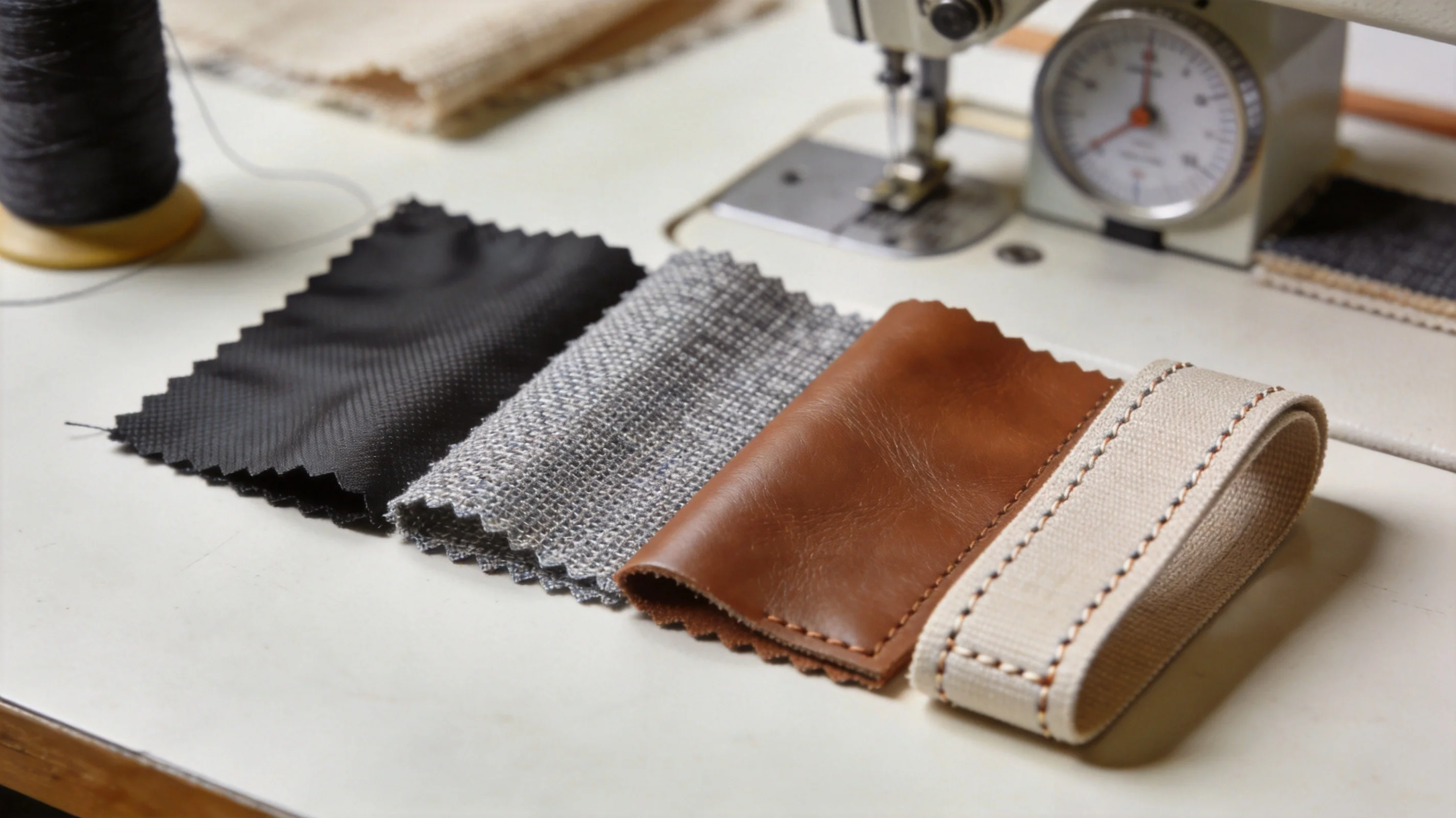
Golf bag material innovation is a structured R&D conversation that flows from a brand's brief through material screening, a 200-piece prototype, standards-based testing, and finally scale production — with the four dominant trends being TPU waterproofing, composite frames, recycled rPET fabrics and smart-surface coatings. This article is written from the development experience of our Quanzhou, China golf bag factory, in operation since 2014 with seven production lines, 126 sewing machines and 137 employees, serving more than 200 brands across over 100 countries and audited by SGS in March 2026. It sets out how material and technology development actually works in practice, so you can commission innovation with confidence rather than guesswork.
The Material R&D Loop in Practice
Innovation is not magic; it is a repeatable process. In our factory the material R&D loop has five stages. First, define the problem — weight, waterproofing, sustainability or durability — clearly enough that it can be measured. Second, screen candidate materials against cost and performance, drawing on a maintained matrix of approved fabrics, coatings and hardware rather than starting from scratch every time. Third, prototype: cut, sew and finish a small run, often the 200-piece sampling order that lets a client hold the result.
Fourth, test the prototype against recognised standards and iterate on seams, coating weight and hardware placement based on results. Fifth, scale: once the prototype passes, move into mass production on the 45-60 day cycle across our seven lines, with the quality-control loop continuing to sample every batch. This loop turns a marketing idea into a shippable, testable product reliably.
What this means for a buyer is that "innovation" should always be anchored to a stage in a process you can see and hold. If a supplier cannot show you a prototype and its test results, the innovation is still a concept, and your purchase should be framed accordingly.
Material Development Trends at a Glance
The development trends that actually shape new golf bags:
| Development Trend | Solution | Maturity | Key Standard | Where It Helps | Adoption |
|---|---|---|---|---|---|
| TPU seam-welded waterproofing | Waterproof shell without weak seams | High | ISO 811 | Rainy climates, premium | Growing fast |
| Composite/carbon frames | Weight cut without stiffness loss | High | Stiffness/impact tests | Walking & travel bags | Premium |
| rPET recycled fabrics | Lower carbon footprint | High | GRS / recycled-cert | Sustainability ranges | Mainstream eco |
| Mono-material design | Easier end-of-life recycling | Emerging | Recyclability trials | Progressive brands | Emerging |
| Nano/smart coatings | Surface hardness, water, stain | Medium | ISO 4920, abrasion | Premium shells | Emerging |
| Smart-fabric integration | Sensors, wiring routes | Early | Custom | Flagship products | Niche |
The trends are not interchangeable; each solves a distinct problem and carries its own maturity and cost. A durable innovation programme invests in two or three of these where they match the brief, rather than chasing every trend at once. The table also shows that some are mainstream while others are still emerging — a useful calibration against over-hyped claims.
Problem-First: Why Good Innovation Starts with the User
The most common failure of material innovation is solving a problem the customer does not actually have. A carbon fiber frame is a genuine engineering achievement, but it is wasted on a cart bag that never leaves the trolley. A nano coating is real science, but it does nothing for a buyer who plays in constant monsoon rain without a waterproof membrane. Strong innovation is relentlessly problem-first: it names the user, the condition and the outcome before selecting a material.
In our development conversations we push clients to define the problem in measurable terms — "reduce carried weight to under 1.8 kg" or "keep clubs dry through 30 minutes of rain." Once the problem is measurable, the material shortlist and the test standard follow logically. This is why our engineers begin with your user and market, not with a catalogue of advanced fabrics.
Technology Development Beyond the Fabric
Material innovation also lives in the hardware and manufacturing technology that turn fabric into a bag. Frame design advances — stand-mechanism geometry, hinge durability, carbon lay-up — are as much technology as material. Coating and lamination lines, the stitching technology for heavyweight shells, and the welding equipment for TPU panels all determine whether an innovation can be produced at scale and quality.
A genuinely capable factory invests in both the material science and the production technology to realise it. Our seven production lines and 126 sewing machines are specified to handle heavyweight shells, TPU lamination and composite components, and our 137-strong team is trained on the methods those materials demand. The 200-piece sampling order is the practical gate at which capability meets material, and we encourage buyers to validate it before committing to the 45-60 day volume run.

The R&D Stage: Prototype, Test, Iterate
The heart of innovation is the prototype-test-iterate cycle. A promising material is worthless until it is sewn, coated and field-tested as part of a real bag. The 200-piece sampling stage is exactly where this happens: we produce enough units for meaningful evaluation, run the test battery, and refine seam placement, coating weight and hardware before scaling. A single sample bag can hide seam or coating issues that only emerge over multiple units.
During iteration we measure against the agreed standard — ISO 811 for water, ISO 12947-style for abrasion, ASTM for tear, ISO 105-B02 for light fastness — and we A/B options such as coated versus uncoated or alloy versus carbon frame. The iteration continues until the prototype meets the brief on both performance and cost. Removing this gate is how over-specced, under-tested products reach the market and generate returns.
For a buyer, the practical translation is that you should budget for and expect a prototype phase, use the 10-20 day sampling window to hold and test the result, and only then commit to volume. This discipline is the difference between a launch that works and one that foots the bill for an unvalidated idea.
Scaling Innovation into Mass Production
Innovation only counts when it can be made at scale without losing quality. A material that sews beautifully in a one-off sample can snag, shift or refuse to accept seam tape across batch production. The scaling step confirms that the material, thread, needles and machine settings all hold up under volume. Our 126 sewing machines and trained operators are configured for this transition, and every batch is sampled by the quality-control team as it ships.
Scalability also determines unit cost. A material that requires slow line settings or a high reject rate becomes expensive at volume, which is why cost-per-unit is validated during the prototype stage, not discovered after the first 100k units. With a monthly capacity of up to 200,000 units, we can ramp a validated innovation smoothly — but only because the process gate caught the issues early.
Clients often ask how quickly they can scale after approval. The honest answer from our floor is: the 200-piece validation decides go/no-go, the 45-60 day cycle delivers the bulk, and the monthly capacity lets you build in phases. This predictability is worth more than a faster-but-risky launch We track that validated programme through to launch so you receive a finished line, not a loose R&D promise.
Because development is deliberately staged, the practical on-ramp for any buyer is short and low-risk. A first conversation with our engineers to define the problem, a material shortlist and costed options, then a 200-piece sample on a 10-20 day window is enough to test whether the innovation holds. If it does, the 45-60 day volume cycle with per-batch sampling completes the programme. If it does not, you have spent only the sample cost to learn that — which is exactly the point of validation.
Smart Textiles and the Next Development Frontier
The frontier of golf bag material development now includes smart textiles. Shells engineered to carry low-voltage wiring, webbing that routes device cables, integrated sensor pockets, and fabrics with adaptive or self-cleaning surface chemistry are in development for flagship programmes. These integrate electronics and materials in a way that demands new thinking about seams, moisture management and repairability.
For the vast majority of golf bag production, however, the near-term advance is making the existing innovative palette cheaper and more sustainable: recycled and mono-material TPU, lower-cost carbon processing, and PFAS-free nano finishes. Smart-fabric features will reach premium products first and remain niche for some time. A professional development plan pursues the pragmatic palette now while prototyping a smart feature for the flagship later.
Choosing a Development Partner
Because innovation lives in the process as much as the material, choosing a development partner matters. Look for a factory with a documented R&D loop, a tested material matrix, the machinery to run advanced constructions, and the habit of attaching certificates to batches — evidence, not just words. Ask for a sample programme and inspect both the product and how the factory talks about test standards.
Our facility has served more than 200 brands across over 100 countries since 2014, and our March 2026 SGS audit independently confirmed the documented quality system behind that work. Whether you are commissioning a first lightweight composite bag or an entire premium waterproof line, the efficient first step is the same: a conversation with our engineers — service@junyuanbags.com or WhatsApp +86 17750020688 — followed by a 200-piece sample on a 10-20 day window.
From Brief to Shelf: The Full Development Workflow
To make the R&D loop concrete, a full material development workflow typically unfolds across clearly defined stages. It begins with a technical intake, where we translate your commercial brief — retail price, target golfer, climate, sustainability goals — into a written material and construction specification. This document, not a conversation alone, becomes the contract for development, making both parties accountable to the same targets.
From the specification we move to sourcing and material confirmation, ordering samples of the shortlisted shell, coating, frame and hardware so the team can assess hand-feel, cost and manufacturability. The confirmed materials then go into pattern and prototyping, where the first physical samples reveal seam behaviour, finish quality and where the design needs adjustment. The 200-piece sampling order is the first meaningful validation volume, large enough to test consistency across units.
After the sample is approved, the workflow moves to production engineering — setting line parameters, confirming thread and needle specifications, and locking the manufacturing process so the batch is repeatable. Pre-production and first-article inspection confirm the first output matches the approved sample, and finally mass production runs on the 45-60 day cycle with ongoing batch sampling. Each gate is a chance to catch an issue early, which is why the disciplined workflow outperforms a "rush to volume" approach every time.
Cost Engineering in Material Development
Innovation and cost must be engineered together, or the programme fails at retail. Cost engineering means building the target price into every material decision from the start: a heavier 1680D shell costs more in material and shipping, a carbon frame carries a premium, and a nano or TPU finish adds a per-unit uplift. We cost each option as we shortlist it so the final specification lands inside the target bill of materials rather than drifting past it.
The value cost-engineering brings is a clear view of trade-offs. If a buyer is 15% over target price, we can show exactly which material step-downs regain that 15% with the least loss of the felt benefit — for example, an aluminium frame instead of carbon when the marginal weight saving is not worth the premium, or a 1000D shell instead of 1680D when the durability floor does not justify the cost.
This is why our development conversations always include a costed comparison table per shortlist. The 200-piece sample then confirms the real per-unit cost at volume, so the retail margin is validated by data before mass production commits inventory. Cost engineering is not the enemy of innovation; it is what makes innovation viable.
Benchmarking Against the Market
Material development should also be informed by the competitive landscape. We routinely benchmark prospective materials against current market norms — the typical denier at a given price point, the waterproofing claim a competitor makes, the empty weight of a bestselling lightweight bag. This calibration grounds the R&D in reality and prevents over- or under-spec relative to what shoppers expect.
Benchmarking also reveals honest gaps to exploit. If most bags at your target price use only shower-proof coatings, offering a genuinely seam-sealed waterproof option at that price is a differentiator. If the market is crowded with "premium" claims, a material backed by attached certificates becomes the trustworthy outlier. Our competitive context, gathered from serving 200+ brands across 100+ countries, helps position a new product to stand out rather than blend in.
Managing Development Risk
Material innovation carries risk, and a professional supplier manages it explicitly. The main risks are performance shortfall, cost overrun, supply failure for a novel material, and appearance or branding mismatch. Each has a mitigation built into the workflow: performance shortfall is caught by the test battery at prototype stage; cost overrun is caught by cost engineering before volume; supply failure is managed by dual-sourcing key materials and keeping stock-grade backups; and branding mismatch is prevented by aligning fabric with decoration during the sample phase.
The buyer's tool for risk management is the iterative sample order. Rather than committing a large production run to an unproven material, stage the risk: confirm hand-feel and cost with a pattern or a 200-piece sample on the 10-20 day window, then scale only the validated design. This staged approach is standard in our OEM work and has protected countless launches from the costs of an unvalidated idea.
We also document the agreed standard and expected results up front, so if a material underperforms in testing there is a clear reference for correction rather than a dispute. Defined expectation, defined gate, defined consequence — that is risk management you can rely on.
Development Lessons from Many Materials
Across our work for more than 200 brands we have drawn consistent lessons. The first is that the shell and coating carry most of the perceived quality, so spending there usually returns the most. The second is that seams are the failure point that decides warranty reputation, so seam integrity should rank beside shell choice even though it is invisible to the shopper. The third is that weight is felt, and genuine lightweighting requires a whole-system approach, not a single material swap.
The fourth lesson is that documentation converts development into credibility: a material backed by test certificates, recycled-content reports and a verified quality system travels further in the market than an identical bag sold on unproven claims. Our March 2026 SGS audit and per-batch certificates exist precisely to give that credibility to every programme we develop.
Whether you are evolving an existing line or building a from-scratch innovation, these lessons keep development on the straight path from brief to good product. The process works because it is repeatable and evidence-driven.
Innovation That Ships: The Bottom Line
Golf bag material innovation is most valuable when it is disciplined, problem-first and test-backed. The four dominant trends — TPU waterproofing, composite frames, recycled rPET and smart coatings — each solve a real problem, and each should be deployed where it earns its cost and verified to a recognised standard. The R&D loop of brief, prototype, test and scale is what turns these trends into products that perform.
Our advice to buyers is to commission innovation with the same discipline we apply: define the problem, choose one or two hero materials, validate with a sample, and demand certificates. That approach has carried more than 200 brands across 100+ countries to successful launches, and it will carry yours.
Frequently Asked Questions
- How do golf bag materials get innovated?
- Material innovation flows from a structured R&D loop: define the problem (weight, waterproofing, sustainability, durability), screen candidate materials in the lab, prototype a 200-piece sampling order, test against recognised standards, and refine before scaling to mass production. Our process applies this loop across seven production lines.
- What material trends are driving golf bag development?
- The four dominant trends are seam-welded TPU waterproofing, composite and carbon lightweight frames, GRS-certified rPET and mono-material recycled fabrics, and increasingly nano or smart-fabric surface technologies. Each is applied where it solves a real problem for the target golfer.
- How long does golf bag material development take?
- A focused material programme from brief to validated prototype typically fits a 10-20 day sampling window for the first test order, followed by a 45-60 day mass production cycle. Complex new constructions or bespoke composites can extend R&D into additional sample rounds.
- What is the R&D role of a golf bag factory?
- A factory's R&D role is to translate a brand's brief into an actual, costed, testable material specification. That includes sourcing stock and bespoke materials, validating seams and coatings, prototyping and A/B testing, aligning branding with fabric, and documenting the test evidence that backs the product claim.
- How important is testing in material development?
- Testing is decisive. Innovations are only worth shipping if they survive recognised methods, including abrasion (ISO 12947-style), tear (ASTM), water resistance (ISO 811), colour fastness (ISO 105-B02) and load cycling. Test certificates convert an R&D claim into a retail promise a distributor can trust.
- What should I ask before commissioning a material innovation?
- Ask which specific problem the innovation solves, where in the bag it is used, what standard verifies it, what it costs per unit, how it is cared for, and whether you can receive a sample or 200-piece test order to validate it before volume. These questions separate engineering from marketing.
Sources & Further Reading
Related Reading
- Golf Bag Material Science Innovations — the current advanced-material landscape.
- Golf Bag Material Technology Innovations — technology beyond the fabric.
- Golf Bag Future Development and Innovation Outlook — where the industry heads next.
- Golf Bag Quality Control and Testing Standards — the testing backbone of innovation.