Golf Bag Material Science and Innovation
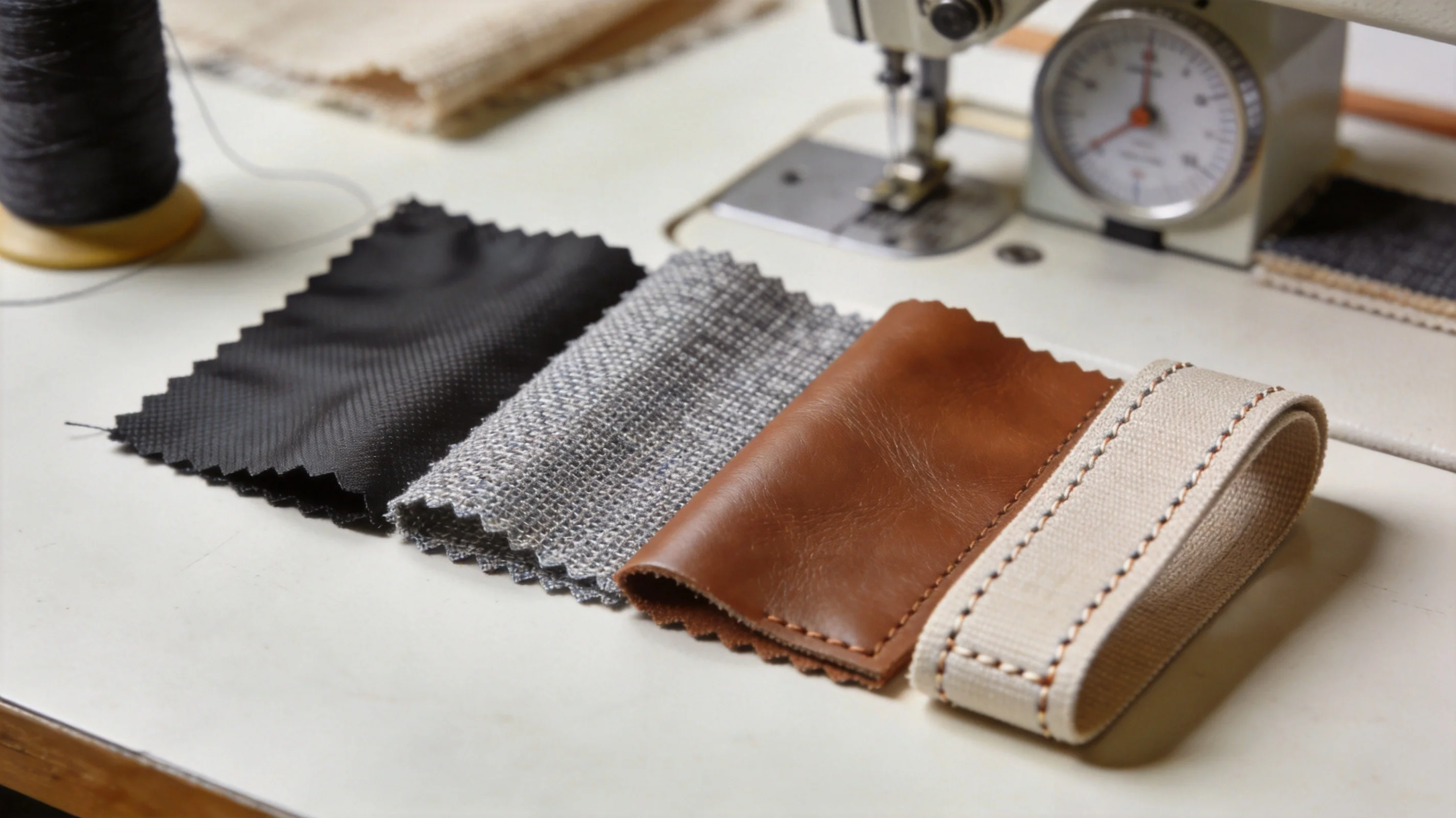
Golf bag material science today is defined by high-tenacity 1680D ballistic nylon, TPU lamination, and composite frames that together deliver 5-8 seasons of service life, roughly 200,000 units of monthly manufacturing capacity, and verified production quality. As a Quanzhou, China-based golf bag manufacturer established in 2014 with seven production lines, 126 sewing machines and 137 employees serving more than 200 brands across over 100 countries, we write this guide from direct factory experience — from yarn specification and coating selection to the ASTM and ISO test methods we apply before each batch ships. This article explains how material science determines the weight, weather resistance, durability and cost of a modern golf bag, and how that science translates into purchasing decisions for importers, brands and retailers.
Why Material Science Matters for Golf Bags
A golf bag is far more than a fabric shell. It is a load-bearing, weather-exposed product that carries as much as 14 clubs, a stand mechanism, zippered pockets, and a range of accessories from range finders to water bottles. The choice of base fabric, coating chemistry, webbing, hardware and frame material dictates whether that assembly survives for five seasons or fails in the first year. Material science is therefore not an abstract laboratory concern; it is the single largest determinant of return on investment for any buyer, whether you produce 500 pieces for a club-branded promotion or 50,000 for a national retail chain.
Our production data across thousands of orders shows a consistent pattern: roughly 55-60% of a finished bag's raw-material cost sits in its outer shell and lining, about 20-25% in hardware and frames, and the remainder in zips, webbing, foam and trims. That ratio explains why material decisions made early in development dominate both the landed cost and the warranty claims you will face later. A 200-piece sampling order at our factory, with a 10-20 day sample lead time, is exactly how our engineering team validates material choices before committing to the 45-60 day mass production window.
The science also matters because the golf bag sits in a uniquely demanding environment. It is dragged across parking lots and cart paths, exposed to UV and rain, compressed in airline holds, and carried on threaded shoulder straps that can exceed 9 kg when fully loaded. Each of those stresses targets a different property — abrasive wear, tensile tear, UV degradation, flexural fatigue, and seam strength. No single material wins on all fronts, which is why modern construction is almost always a layered system rather than a single fabric.
A Brief Evolution of Golf Bag Materials
The earliest golf bags of the late 19th century were leather cylinders stitched by hand. Leather offered strength and a luxury aesthetic but was heavy, expensive, and vulnerable to prolonged moisture. Through the mid-20th century, canvas-topped bags with leather trim dominated because they were cheaper and lighter than full leather, yet they still absorbed water and rotted if stored damp.
The turning point was the post-war introduction of synthetic fibers. Nylon and polyester, first widely used in military and luggage applications, migrated into golf bag production in the 1960s and 1970s. By the 1980s, coated fabrics — nylon and polyester faces with polyurethane (PU) or PVC backings — became the industry default, allowing lighter construction with genuine water resistance. The 1990s added better zipper systems, reinforced bases and early composite handle frames.
The modern era, accelerated after 2005, is defined by engineered performance: 1680D and 1000D ballistic nylons for shells, TPU lamination for seam-free waterproofing, carbon fiber and aluminium alloy frames for support, and increasingly rPET recycled fabrics for sustainability. Our facility, which began operations in 2014 and passed an SGS factory audit in March 2026, has watched these materials climb from novelty to baseline expectations across the wholesale and OEM markets we serve.
Fabric Denier and Weave Explained Without Jargon
When you see a specification like 1680D or 1200D polyester, the number refers to denier — a measure of the linear density of the yarn. One denier equals one gram per 9,000 metres of thread. Higher denier yarn is physically thicker and, all else being equal, contributes to greater tear strength, abrasion resistance and stiffness, at the cost of weight and flexibility.
The weave matters as much as the yarn thickness. A ballistic weave, historically used in body armour, interlocks two or more yarns into a densely packed twill that resists puncture and snagging. A plain or ripstop weave is lighter but offers less abrasion resistance. In practice, premium golf bag shells combine a 1680D ballistic or heavy twill face with a coating layer, and reserve lighter 300D-600D fabrics for pocket linings and divider panels where weight savings matter more than impact resistance.
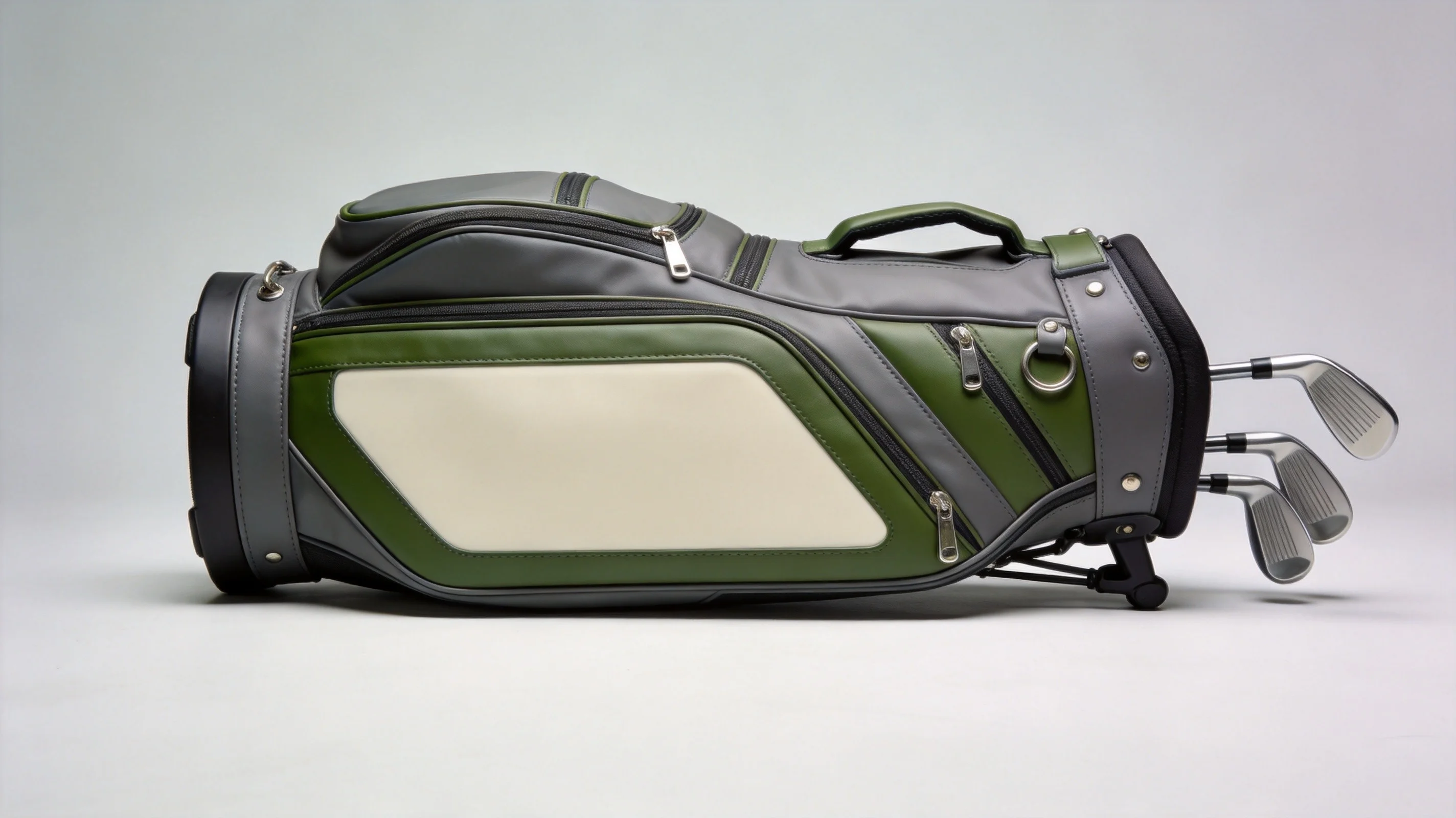
A useful rule we apply when advising buyers: for a stand bag carried on shoulders for 18 holes, aim for a 1000D-1680D face to balance weight and toughness; for a cart or staff bag that rides on a trolley, 1680D with a reinforced base is the practical sweet spot; and for travel bags that face airline handling, 840D-1680D nylon with cushioned padding and a rigid frame provides the best protection-to-weight ratio.
Coating and Lamination Systems: PU, PVC and TPU
The base fabric only provides the face; the coating provides the waterproofing and often the structure. Three systems dominate golf bag construction.
Polyurethane (PU) coating is the most common. It is applied to the reverse of the fabric to a standard measured in millimetres of water column or grams per square metre. A 1000mm-3000mm water column is enough to be shower-proof; a 3000mm+ column is genuinely waterproof for recreational exposure. PU is flexible, lightweight and inexpensive, which is why it features in most standard cart and stand bags.
PVC (polyvinyl chloride) coating is heavier and stiffer but very durable and cheaper. It is typically reserved for economy travel covers and reinforced bases where weight is not the priority. Its main drawback — beyond weight — is that PVC can become brittle and split in cold climates.
Thermoplastic polyurethane (TPU) lamination represents the premium tier. Unlike a coating, TPU is a film that is heat- or adhesive-laminated to the fabric, producing a smooth, seam-weldable layer with superior low-temperature flexibility, abrasion resistance and elasticity. TPU does not contain the chlorine chemistry of PVC and is increasingly favoured in high-performance waterproof bags where reliability matters more than price.
Comparing Golf Bag Materials at a Glance
The table below summarises how the primary golf bag materials stack up across the properties that most affect your product decision.
| Material | Typical Weight | Water Resistance | Durability | Best Use | Relative Cost |
|---|---|---|---|---|---|
| 1680D ballistic nylon | Heavyweight shell | Shower-proof (needs coating) | Excellent tear & abrasion | Cart, staff, travel bags | Highest |
| 1000D nylon | Medium-heavy | Shower-proof (needs coating) | Very good | Stand & cart bags | High |
| 600D polyester | Medium | Minimum w/o coating | Good | Stand bags, linings | Medium |
| 300D polyester | Light | Low | Moderate | Pocket linings, dividers | Low |
| TPU-laminated fabric | Medium-heavy | Waterproof (often seam-welded) | Excellent, flexible | Premium waterproof bags | High |
| PVC-coated fabric | Heavy | Waterproof | Good but stiff/cold-brittle | Economy travel covers | Low-Med |
| rPET recycled polyester | Medium | Varies by coating | Good | Sustainable ranges | Medium-High |
| Carbon fiber frame | Ultra-light (frame) | N/A | Very high stiffness | Frame reinforcement | Very high |
Read the table as a decision tool, not a verdict: a 600D polyester stand bag is the correct choice for a price-sensitive junior range, while a 1680D TPU cart bag suits a premium brand targeting weather reliability. The "best" material depends entirely on your target price point and usage.
Carbon Fiber and Composite Frames
One of the most visible material innovations is the shift from steel to carbon fiber in stand-bag leg frames and high-end travel-bag rails and base plates. Carbon fiber offers a stiffness-to-weight ratio that substantially exceeds aluminium, letting designers reduce frame weight by 30-40% while maintaining the rigidity needed to keep a full set of clubs upright.
Carbon fiber is not a single fabric but a composite: thousands of microscopic carbon filaments are woven or laid up with a resin matrix, then cured under heat and pressure. The result has excellent tensile strength, low thermal expansion, and outstanding fatigue resistance. Its drawbacks are cost and a degree of brittleness under sharp point impact, which is why it is usually reserved for frame components rather than the entire bag shell.
In our OEM work, carbon fiber is typically specified by tour-oriented brands for whom the marginal weight saving down to the last 100 grams justifies a premium price. Volume brands more often choose aluminium-alloy frames, which offer most of the durability benefit at a fraction of the cost. Both approaches are valid; the choice should be driven by the retail positioning you are targeting. For a deeper look, see our analysis of lightweight golf bag weight optimisation through material selection.
Zippers, Hardware and Small Parts Science
Material science extends far beyond the shell. The zippers on a golf bag open and close tens of thousands of times over its life, often while carrying tension from a fully loaded pocket. Entry-level bags use #5 or #6 nylon zippers that can jam or fail; professional bags move to #8 or #10 coil or metal zippers, often with water-resistant (YKK-style) construction and self-healing coils.
Hardware — buckles, D-rings, sliders and stand foot mechanisms — is typically nylon (glass-filled nylon 66 is common for strength) or cast alloys. The stand spring, one of the most failure-prone components, is made from heat-treated steel wire whose spring rate must match the bag weight to deploy reliably. Webbing, usually 40mm-50mm polyester or nylon, is load-rated in kilonewtons, and the shoulder pad relies on closed-cell foam or memory foam for comfort. Every one of these parts is a material decision that our quality-control team tests in line with international standards before release.
Waterproofing Science: Water Columns, Seams and Covers
Waterproofing is arguably the material property golfers test most in the field. The base measurement is the water column or hydrostatic head test, which measures how many millimetres of water pressure a coated fabric can withstand before leaking. Standards commonly reference ISO 811 and ISO 4920 for spray rating in the broader textile industry, and golf-specific brands increasingly publish water-column figures to demonstrate performance.
But the fabric is only half the story. Water enters through seams first, which is why fully waterproof bags use seam-sealed (taped) or welded seams. A seam-taped TPU construction can reach genuinely waterproof performance, while a bag that only uses a coated fabric without seam-proofing is merely shower-resistant. Our waterproof golf bag range uses seam-sealed TPU systems precisely because field testing shows seams are where products fail. You can read more in our dedicated weather and waterproofing guide.
Finally, an external rain cover — typically 3000mm+ PU-coated nylon with an elasticated or drawcord closure — remains the cheapest and most reliable way to protect clubs in persistent downpours. A well-designed cover adds negligible weight but extends bag life dramatically, and it is a high-margin accessory that pairs naturally with any waterproof bag order.
Sustainable Materials and the Recycled Revolution
Sustainability has moved from a niche talking point to a core material requirement, especially for brands selling into the EU, Nordics and North America. The most widely adopted solution is rPET — fabric spun from recycled polyethylene terephthalate bottles. rPET can match virgin polyester performance for most golf bag applications while cutting the carbon footprint of raw material by a significant margin.
Manufacturers are also introducing bio-based polymers, recycled TPU, and mono-material designs that make end-of-life recycling easier by avoiding mixed laminates. Certifications such as GRS (Global Recycled Standard) and OEKO-TEX increasingly appear on packaging and product pages as proof of compliance. For brands sourcing scale production, our factory can specify rPET shells and linings alongside conventional materials, allowing you to progressively green your catalogue without changing silhouettes. Explore our sustainable golf bag manufacturing guide for the full picture.
How We Test Materials: ASTM, ISO and Factory Methods
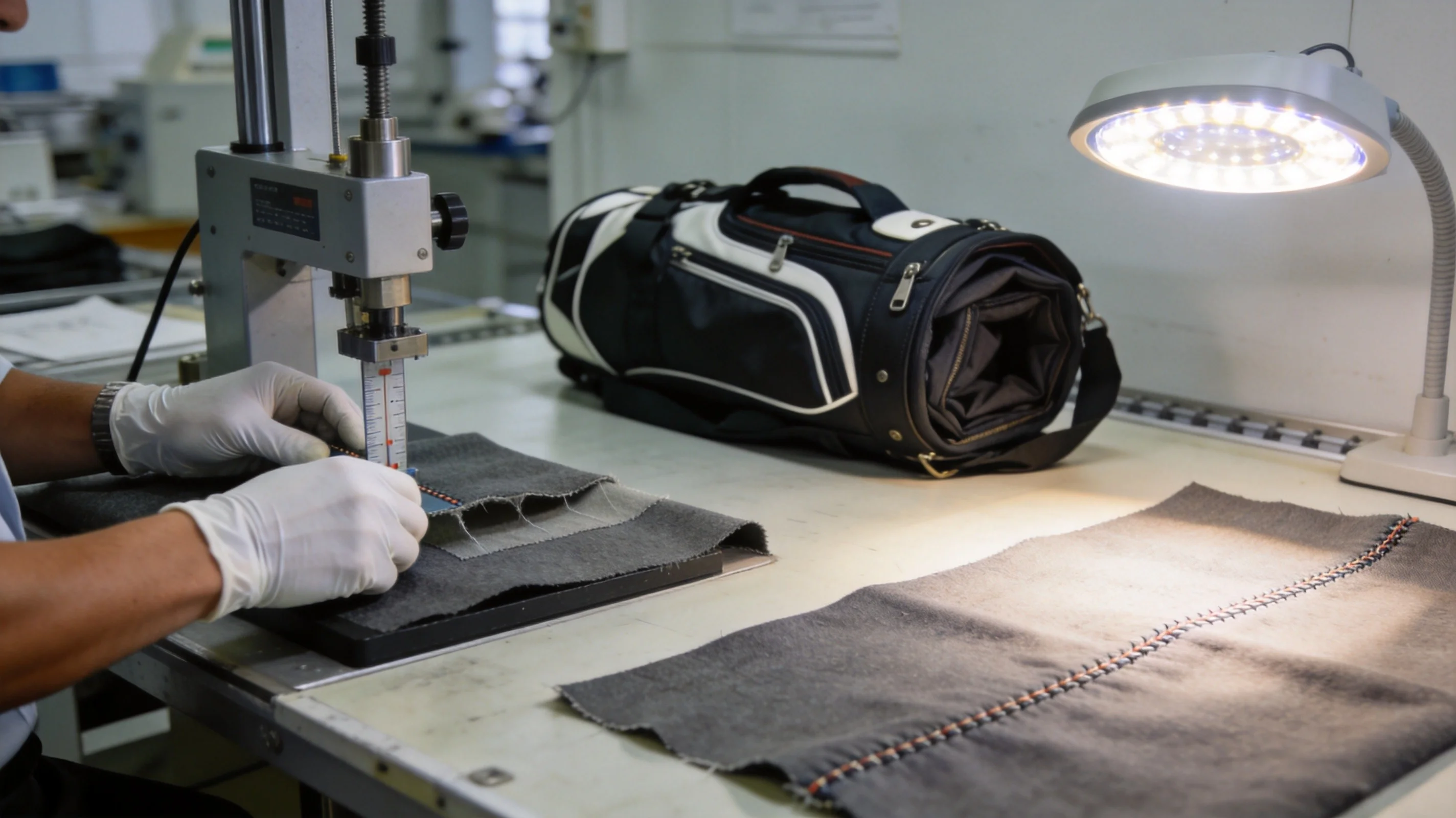
Material claims mean nothing without test data. In our facility we apply a structured battery of methods drawn from ASTM and ISO, adapted to the specific demands of golf luggage. Underlying tests include abrasion resistance (commonly the Martindale method, ISO 12947) to simulate years of rubbing, tear strength to check seam and puncture resistance, and a water-column test for coatings.
We also run colour-fastness to light (to screen UV fading), flexing tests on zips and seams, and static load tests on straps and handles. Every production line in our seven-line facility feeds samples into the same quality-control process, and our March 2026 SGS audit verified the documented controls behind those methods. When a buyer requests a specific standard — for example an ASTM D5034 grab test for tensile strength or an ISO 811 hydrostatic head result — we can provide the test reports that back the material claim.
Manufacturing Considerations That Change Material Choice
The best material is one that can actually be sewn, welded and finished at your chosen scale. Certain fabrics are difficult to seam-tape, some coated materials produce weld lines that crack, and heavyweight shells demand industrial sewing machines with heavier needle systems — which is why the seam count and machine capability of a facility constrain the available material palette.
Our 126 sewing machines and 137-strong team are configured to handle the heavyweight shell fabrics, TPU lamination and complex pocket layups that premium construction requires. A 200-piece test order with a 10-20 day sampling window is the right way to confirm a material runs through production cleanly before you commit to a 45-60 day mass production run and a 20,000-unit monthly throughput at full capacity. Material that cuts and sews without snagging, fraying or shifting is just as important as the marketing-perfect hand-feel.
Buyers often underestimate how material choice interacts with lead time. Odd deniers, special coatings and hard-to-source hardware extend sourcing windows. Specifying stock-grade 1680D, 600D and rPET from a manufacturer's established supply base shortens development and keeps mass production predictable. Our experience across 200+ brands confirms that a disciplined materials spec is the single fastest lever for keeping OEM and ODM programmes on schedule.
How to Choose the Right Materials for Your Golf Bag Line
Begin by defining the retail brief: target price, usage pattern, climate and brand story. From there, translate that brief into a shortlist of materials using the table above. A junior or promotional stand bag can thrive on 600D-840D with plain zips; a premium cart bag should be 1680D with TPU or PU coating and #8 zips; a travel range needs heavyweight nylon, padding, and a rigid frame element.
Next, prototype. A 200-piece sampling order lets you physically test the hand-feel, stitch depth and coating performance before committing. Test the bag loaded, wet, and repeatedly packed — this is where material choices reveal themselves. Finally, agree the test certificate suite up front so both you and your manufacturer are accountable to the same standard.
If you are uncertain, a proven route is to start from a reference bag your team already trusts, then iterate the material spec with factory engineers. Because we produce OEM and ODM daily across golf bag, this is a conversation we can start with a simple inquiry — email service@junyuanbags.com or WhatsApp +86 17750020688.
Future Material Trends to Watch
Looking ahead, we see four material trends reshaping golf bags. First, further lightweighting through advanced composites and honeycomb structures. Second, the spread of seamless, welded waterproof construction to mid-price segments as TPU costs fall. Third, a surge in recycled and bio-based fabrics driven by EU regulation and retailer mandates. Fourth, smart-fabric integration — webbing that can carry cabling, and shells adapted for solar or sensor hardware.
None of these trends replaces the fundamentals of denier, coating and seam quality; they refine them. The manufacturers who win will be those who combine the newest materials with disciplined, verifiable testing. That remains our focus as we continue to serve brands across the world from our Quanzhou facility.
Frequently Asked Questions
- What are the most durable golf bag materials?
- The most durable impact-and-abrasion-resistant options are 1680D or 1680D ballistic nylon, TPU-coated polyester, and luggage-grade PVC/TPU laminates. Upholstery-grade 1680D nylon offers a high tear strength in the range of 100-150 N and excellent UV resistance, which is why professional cart bags rely on it as their primary shell material.
- What does 1680D mean in golf bag construction?
- Denier (D) measures yarn thickness; 1680D means each weft yarn weighs 1680 grams per 9,000 metres. It is roughly double the thickness of 840D, giving the woven face higher tensile strength and puncture resistance. Most premium cart and staff bags pair a 1680D face with a TPU or PU back coating for waterproofing.
- Is TPU better than PVC for golf bag shells?
- TPU is more flexible at low temperatures, more resistant to cracking, lighter, and free of chlorine chemistry that makes PVC heavier and more brittle in cold weather. PVC is cheaper. For premium performance golf bags, TPU lamination is considered superior, while PVC remains cost-effective for economy ranges.
- How waterproof are PU-coated nylon golf bags?
- A 1000mm-3000mm water column PU coating is standard for shower-proof bags; a 3000mm+ column is considered waterproof to most recreational rain. Fully seam-taped and seam-sealed construction pushes bags toward IPX4-equivalent water resistance under typical golf conditions.
- How long do modern golf bag materials last?
- With 1680D nylon shells and good seams, a well-made cart bag typically lasts 5-8 seasons of regular play (roughly 150-250 rounds). Carbon fiber components and TPU hardware can extend frame life. The zips and webbing usually fail before the shell fabric.
- Are synthetic golf bag materials recyclable?
- Yes. rPET (recycled polyethylene terephthalate) is the most common recycled fabric in golf bags. PU/TPU coatings complicate mechanical recycling, so single-polymer designs and detachable hardware are increasingly favoured by sustainable manufacturers.
Sources
Continue Reading
- Golf Bag Material Technology Innovations — a broader look at new fabrics entering production.
- Golf Bag Durability and Lifespan Analysis — how material choice maps to years of service.
- Golf Bag Quality Control and Testing Standards — the test methods behind material claims.
- Eco-Friendly and Sustainable Golf Bag Materials — rPET and recycled options.