Golf Bag Price Analysis 2025
The honest answer for 2025: most functional golf bags sell between $60 and $280 retail, the strongest value-per-dollar sits near $100-$140, and the cheapest defensible wholesale ballpark lands where a dense-nylon, metal-stand build can still be made profitably. The gap between an $80 bag and a $300 bag is only partly about quality; brand markup, component grade and labor-intensive features such as 14-way full-length dividers explain most of it. This guide breaks golf bag pricing into verifiable bands, isolates the real cost drivers at factory level, and gives you a repeatable value-assessment framework you can use to decide what a bag is actually worth before you hand over your money.

The 2025 Golf Bag Price Landscape in Four Bands
Retail pricing for golf bags in 2025 falls into four recognisable bands, each with a distinct specification ceiling and durability profile. Understanding these bands is the first step in any price analysis because it tells you what the money is actually buying at each level and where the famous "value for money" sweet spot really sits.
Entry band (under $50). Basic cart and stand bags in lower-denier polyester with plastic stands, lighter zippers and minimal pocketing. They suit a genuine casual player and a short season, but they compromise durability, water resistance and stand reliability. Anyone playing more than a handful of rounds a year will almost certainly replace one of these.
Budget-value band ($50-$140). This is where dense 600D to 900D nylon shells, metal stand frames, 4-to-14-way tops and reinforced base plates show up. Across the market this band dominates the value-per-dollar conversation because it pairs genuine sustainability with an accessible price. For the majority of amateur players, this is where the smartest purchase is made.
Mid-tier band ($140-$280). Full-length dividers, higher-grade zippers, better stand geometry and at least partial waterproofing appear. Durability improves incrementally over the budget band, which means the premium is only worth it for heavier users who will actually draw down the extra capability.
Premium band ($280 and above). Pro-level components, refined ergonomics and extensive waterproofing. Durability is excellent, but the per-round cost usually undercuts the whole point of budgeting unless you play a very high number of rounds or need true tour-level features.
Why Price and Quality Correlate Only Loosely
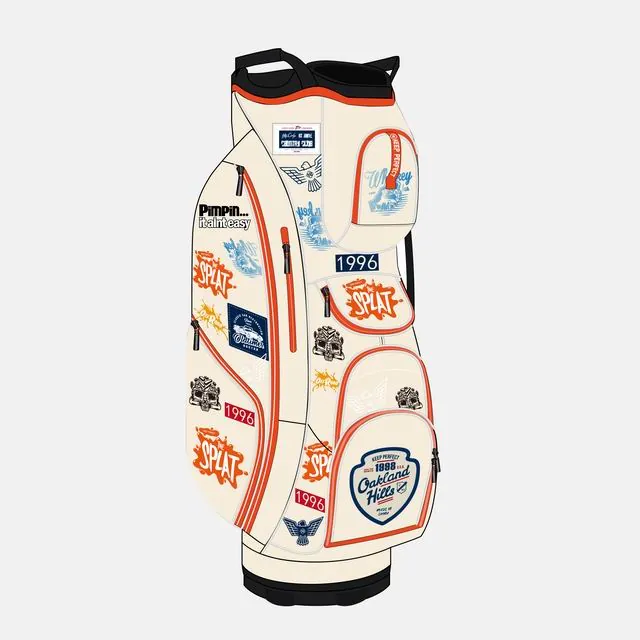
A persistent mistake in golf bag price analysis is assuming a higher price reliably buys more durability. In practice the correlation is weak and frequently misleading. You can buy a $400 bag carrying a premium logo whose shell fabric, stand frame and zipper grade are functionally similar to a $120 bag carrying no logo, simply because brand markup and marketing overhead can exceed the physical cost of the product itself.
That is not to say premium bags are worthless. Many add genuine ergonomics, stronger warranty support, refined materials and better build consistency. But it does mean the premium is often paid for qualities other than raw longevity. A disciplined buyer separates the price into what it buys in components versus what it buys in branding, then decides which part they actually value and whether the extra spend advances their own goal.
At factory level the same discipline applies in reverse. A durable specification, meaning dense nylon, a metal stand, a reinforced base and quality zippers, costs a modest and quantifiable amount no matter which logo gets sewn onto the finished product. Paying directly for that specification is usually smarter than paying for a brand and hoping the specification arrives automatically.
The Real Cost Drivers Inside a Golf Bag
Understanding where cost accumulates turns price analysis from guesswork into arithmetic. Across manufacturing, the cost weight of a golf bag ranks as follows: fabric, hardware and zippers, labor intensity, stand and strap systems, then finishing and branding. Each of these moves price in a predictable way, and knowing the ranking lets you judge whether any given price tag is fair or inflated.
Fabric is the largest lever. Moving from low-denier polyester to dense 600D or 900D nylon changes unit cost by roughly 15 to 25 percent while transforming durability and water resistance. Decisions made at the fabric stage have the single biggest influence on both cost and longevity.
Zippers and hardware follow. A water-resistant bonded zipper costs more than a standard one but attacks the most common early failure point in any bag. D-rings, buckles, sliders and base plate materials vary widely in grade and price, and cheaper knobs here are the usual reason a budget bag dies young.
Labor intensity scales with features. A 14-way full-length divider system takes significantly more sewing time than a simple 4-way top, which is why divider count tracks price so closely across brands. Every added pocket, strap and reinforced seam is a taxable amount of labor.
Stand and strap systems. A metal stand frame with a secure hinge costs more than a plastic one but is the difference between a bag that survives several seasons and one that fails within months. The strap system, particularly for carry bags, affects both comfort and the cost of construction.
The Price-to-Value Assessment Framework
A reliable value assessment needs more than a price tag; it needs a ratio. The most transferable metric in golf is cost-per-round, computed as purchase price divided by the realistic number of rounds the bag survives. To capture premature failure correctly you also add replacement cost. The working formula is: Total Cost of Ownership = (Purchase Price x Number of Purchases) / Total Rounds Played.
Applied to typical 2025 street prices the numbers change the conversation. A $45 bag surviving 35 rounds is roughly $1.29 per round. A $110 bag surviving 150 rounds is about $0.73 per round. A $280 premium bag surviving 220 rounds lands near $1.27 per round. The mid-budget bag wins the value argument on arithmetic rather than opinion, which is exactly why the value zone sits where it does.
Two thresholds help buyers scale this quickly without a spreadsheet. Below $1.00 per round is solid value territory. Above $1.50 per round, the purchase deserves a second look; either the price exceeds the durability on offer, or the buyer plays so often that the premium genuinely pays for itself. Matching the bag to your annual rounds is the whole game.
The framework also exposes why the very cheapest bags are rarely the best value. A shopper who buys a $40 bag four times over five years spends more than a shopper who buys one $130 bag in the same period, yet ends up carrying equipment that has been unreliable for most of that time. Cost-per-round captures this because it penalises the hidden frequency of replacement, not just the visible ticket price. The method is deliberately simple precisely because it is meant to be used at the point of sale rather than reserved for analysts; a mental estimate of lifespan and a quick division will almost always reveal whether a discount is real or merely deferred.
A Comparison Table Built on the Numbers
| Price Band | Key Components | Realistic Life | Cost/Round | Value Verdict |
|---|---|---|---|---|
| Under $50 | Low-D polyester, plastic stand | 30-40 rounds | $1.13-$1.50 | Replacement trap |
| $50-$140 | 600D-900D nylon, metal stand | 150+ rounds | $0.33-$0.93 | Best value zone |
| $140-$280 | Full dividers, better zippers | 180-200 rounds | $0.70-$1.55 | Good for heavy use |
| $280+ | Premium components, waterproofing | 200+ rounds | $1.40+ | Cost per round rises |
Factor in Your Play Style Before Picking a Price Point
Price is only meaningful relative to how the bag will actually be used, and the honest input numbers change from golfer to golfer. The same $140 bag is a sound investment for someone playing 40 rounds a year and a questionable one for a social golfer playing ten. The arithmetic does not change, but the inputs you feed it must.
A casual social player should weight water resistance, storage capacity and price of a lighter build, and can legitimately accept a shorter life because the per-round penalty is diluted across fewer rounds. A frequent walker should pay for a reliable stand frame and a reasonable weight, accepting less styling in exchange for comfort on every round. A traveling competitive player should favour full-length dividers, better waterproofing and a reinforced base, because transit stress and high round counts amplify the return on specification. Let your play profile, not a marketing message, make the price decision.
It also helps to budget for the whole ownership period instead of the initial outlay. Add in the cost of a basic rain cover if you play wet courses, a padded travel cover if you fly, and the occasional replacement part such as a worn strap pad. These small line items are easy to overlook, yet they belong in the same cost-per-round ledger; a bag that needs a $40 accessory immediately is effectively a more expensive bag than its ticket suggests. Building the full picture into the value assessment makes the final purchasing decision far more robust.
Climate and Care: Two Silent Price Multipliers
Two factors routinely distort price analysis if they are ignored: climate and storage habits. In a rainy climate water resistance becomes a defining value factor, and a bag that soaks through in its first wet round is a total loss regardless of what it cost. In a high-UV or high-heat climate, low-end plastic stands and thin webbing degrade faster, rewarding a denser build over several seasons.
Care multiplies whatever you paid. Storing a bag off its base plate so the frame is not crushed under its own weight, keeping zippers clean and lightly lubricated, drying it fully after wet rounds, and protecting it with a padded travel cover on flights all push a bag past its expected service interval. These habits cost nothing and directly lower the effective cost-per-round, which is the number that actually matters.
Buyers can also hedge against climate risk at the specification stage rather than learning about it after the first wet round. Adding a single sealed valuables pocket and a basic rain cover costs very little at wholesale and turns a dry-climate bag into a credible wet-climate option. Similarly, specifying a slightly denser fabric in a high-UV region is a small unit-cost increase that pays back over additional seasons of use. Climate-adjusted value is simply cost-per-round weighted by local wear conditions, and it is one of the easiest refinements a knowledgeable buyer can make.
When a Higher Price Is Genuinely Justified
There are defensible reasons to pay above the value zone, and understanding them keeps your price analysis honest. Championship and pro-level play demands tour-grade ergonomics, full dividers and warranty-backed reliability. Frequent air travel rewards stronger builds and better transit protection. Some golfers simply value the feel, the warranty and the brand experience enough that the premium is worth it to them. None of these preferences is irrational.
The mistake is only paying the premium without recognising that it buys those specific things rather than guaranteed durability. The disciplined question is never just "can I afford it" but "what does the extra money concretely buy, and do I actually use it?" If the answer is mostly a name, the value zone still wins for most budgets.
There is also a practical reason some players buy up even when the numbers say otherwise: reliability under tournament pressure. A bag that must hold up for a full competitive season cannot afford a mid-round stand failure or a jammed zipper, and the assurance of proven components is itself a form of value. Buyers in this group are effectively purchasing insurance and predictability rather than extra durability per se, which is a legitimate but different kind of transaction from a pure value purchase.
Buying Seasonally to Lower the Effective Price
Golf bag pricing moves on a predictable seasonal cycle that smart buyers exploit. New-season stock launches in spring, and prior-season colorways discount through late summer and autumn to clear inventory before the next launch. Buying a discontinued colorway of an identical shell model returns 20 to 40 percent savings with zero specification compromise, because the underlying performance model is unchanged.
Factories exercise the same logic internally. When a production line rotates or a run finishes, good fabric and components occasionally surface as cost-effective lots. A steady OEM relationship surfaces those opportunities early, which is one reason long-term wholesale partners earn better effective pricing than one-off transaction buyers. Timing, like specification, is a genuine price lever.
Wholesale Pricing and Minimum Orders for 2025
For buyers sourcing in volume, price analysis shifts from personal use to unit economics. Two numbers matter most: the minimum order and the unit price at a defensible specification. At QUANZHOU JUNYUAN BAGS, founded in 2014 by a founder who entered the industry in 2004, the standard MOQ is 200 pieces per design, with test orders accepted from as low as 100 pieces, a low-risk way to validate a price and a specification before committing to volume.
Lead times anchor the planning: sampling takes 10 to 20 days and bulk production 45 to 60 days across 7 production lines. The affiliated factory operates 126 sewing machines and 137 employees with roughly 200,000 units of monthly capacity, and has served more than 200 brands across 100-plus countries. Because it is an affiliated production facility rather than a single-owner brand, buyers benefit from an established, SGS-audited base (audited March 2026) with the unit-price discipline of a production-focused operation.
It is worth noting that unit price at wholesale is rarely linear with order size; the curve flattens after a certain volume because fixed setup costs are amortised. This means a buyer chasing an ever-lower unit price by inflating the order may hit diminishing returns, while a buyer who consolidates fewer, larger designs reaps genuine savings. For a value-focused program the sensible move is usually to reduce the number of distinct designs rather than to negotiate each tiny line downward, because factory efficiency rewards repeat volume on a single pattern.
Protecting Margin in a Wholesale Price Strategy
Sellers who resell golf bags face a softer version of the same value math. The number that predicts profitability is margin per unit multiplied by sell-through velocity, minus the cost of returns and warranty claims, not the sticker price. A specification that forces returns because a stand fails in the first season is far more expensive than the small premium that eliminates those returns altogether.
Defining a budget line around a denser shell and a metal stand from the start compresses returns, protects brand reputation and earns repeat orders. Underwrite that bet with a 100-piece test order and real samples before scaling to the standard MOQ. The wholesale pricing guide and the OEM/ODM program set out the exact specification levers that move both cost and perceived value, giving sellers a retail story that is both defensible and truthful.
Avoiding the Three Biggest Price Mistakes
Most disappointing purchases trace back to three recurring errors. First, buying on imagery: vibrant product shots hide fabric weight and stand quality until it is too late to notice. Second, ignoring the stand and the base plate, the two real durability drivers, in favour of pocket count or colour. Third, treating a premium branding as a proxy for value, when brand markup can exceed 100 percent with no proportional gain in longevity.
For wholesale buyers the parallel error is treating unit price as the only variable when fabric weight, hardware grade and lead time all move the true cost number. Reading the specification sheet, demanding the fabric denier, checking the stand material, verifying the zipper grade, and only then comparing prices is the way to avoid all three traps at once. Because fabric is the single largest cost lever, buyers who master the basics often start with our golf bag materials guide, which ranks shell options by both price and durability and helps you translate material choice directly into a value position.
Equally important is matching the specification to the playing format. A clear-eyed value assessment distinguishes the component that protects your longest-lasting club — the divider — from the cosmetic features that inflate price without changing how the bag performs on the course. Our 14-way versus 5-way divider guide explains exactly what the divider upgrade costs in construction time and whether it earns its place in your specification. Read both before you settle a price point, and you will stop paying the "labour-intensive feature" premium blindly and start paying it only where it adds measurable value.
Wholesale value also depends on how the bag performs for the end user, which is why sensible buyers cross-check their price bands against real-world expectations in the weight and portability analysis. A build that is cheap per unit but heavy and awkward in daily use will suppress resale confidence and repeat orders, quietly eroding the margin you protected on paper. When a buyer checks price, material and in-use performance together, the value target they write is one that survives a real season rather than a spreadsheet.
Sourcing a Golf Bag With a Rational Price Specification
If this analysis points you toward sourcing rather than buying off the shelf, approach the factory with your value target written out: a denser nylon shell, a metal stand, a reinforced base, good zippers and a divider count matched to your market. Share the specification rather than a bare number. A capable OEM partner prices the spec honestly and flags MOQ and lead times up front so your unit math is never a surprise.
Review the wholesale pricing framework and the OEM and ODM process guide for the full detail, and contact QUANZHOU JUNYUAN BAGS at service@junyuanbags.com or +86 17750020688 to set the value target in motion. The factory's production focus, established capacity and audited facilities are the quiet reason its pricing stays predictable.
Whichever route you take, record the value target in writing and revisit it after the first season of use. The discipline of checking whether the bag met its cost-per-round promise turns price analysis from a one-time exercise into a useful, repeatable habit.
Frequently Asked Questions
- How much does a quality golf bag cost in 2025?
- Most functional carts and stand bags sit between $60 and $280 retail. Durable value bags cluster near $100-$140, while pro-level builds reach $280 and above.
- Which component drives the most cost?
- Fabric is the largest single lever, moving unit cost 15-25 percent when upgrading to dense nylon. Zippers, stand hardware and labor-intensive dividers follow.
- How do I judge value objectively?
- Divide the price by its lifespan in rounds. Below $1.00 per round is solid value; above $1.50 per round, reconsider unless you play a very high number of rounds.
- What is the wholesale MOQ and lead time?
- QUANZHOU JUNYUAN BAGS runs a 200-piece MOQ with 100-piece test orders, sampling in 10-20 days and bulk in 45-60 days across its 7 lines.
- Why do similar-looking bags cost three times more?
- Brand markup, component grade and labor-intensive features like 14-way full dividers drive much of the gap. Fabric, stand and zipper grade hold the real cost.
- Does higher price guarantee durability?
- No. Price and durability correlate only loosely. A well-specified budget build with dense nylon and a metal stand can outlast a premium bag built on styling.
Sources
- The R&A Equipment and Rules Resources
- GOLF.com Equipment Buying Guides
- MyGolfSpy Durability and Value Testing
Golf bag price analysis for 2025 links FOB cost to fabric grade, hardware, MOQ, sample fees and factory direct sourcing, so buyers can assess true value, not sticker price.
Author note: pricing reflects 2025 retail and factory experience at QUANZHOU JUNYUAN BAGS. Prices fluctuate with materials, labor and freight. For project-specific advice contact service@junyuanbags.com or +86 17750020688.